How about that AAA rating?

As the State of Victoria weighs up the costs of yet another lock down, you could be forgiven for thinking that the local economy has taken a further beating after the horrendous events of the past 15 months. Across Australia, thousands of companies and individuals accessed various government-sponsored financial aid packages to keep afloat, causing the federal government to borrow more money, at something like 8x the equivalent rate pre-COVID. National public debt is now expected to grow to more than 40% of GDP by the 2024-25 fiscal year – effectively double what it was in 2018-19.
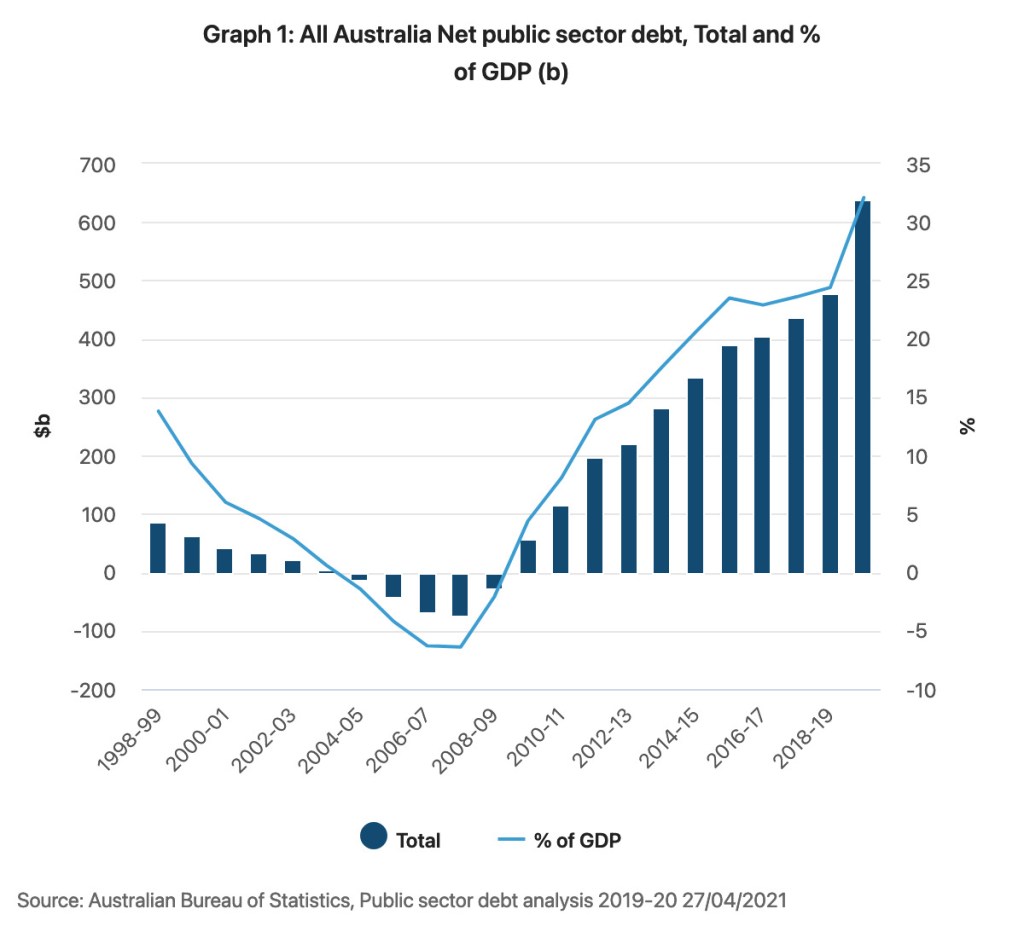
So what has Australia done to retain its coveted AAA sovereign rating from Standard & Poor’s, and have the rating outlook upgraded from negative to stable? According to the ratings agency, and economists such as Westpac’s Bill Evans, there are probably three or four key factors that have warranted this optimistic economic reckoning.

First, while government borrowing (Quantitative Easing) has blown out as a proportion of GDP, the current low interest rates mean that the cost of servicing that debt is manageable.

Second, while the pursuit of QE has destroyed any hope of returning to an overall budget surplus, the deficit will return to similar levels last seen after the GFC, and the current account will continue to return a modest surplus over the coming quarters.

Third, despite the significant economic risks that were identified at the start of the COVID pandemic, the actual impact on the budget has been less than feared, and the economy is recovering faster than expected (as evidenced by latest employment data and consumer sentiment).

Fourth, Australian banks have seen an increase in customer deposits, meaning they are less reliant on more expensive overseas borrowing for their own funding.

Overall, just as with the GFC, Australia has managed to dodge a bullet (the shock to the system was less than anticipated) – in large part thanks to a resurgence in iron ore prices (again).

But weaknesses and disparities remain:

The over-reliance on commodity prices (mainly based on demand from China) hides the true nature of Australia’s balance of payments – we manufacture less than we used to, and our supply chains have been severely tested during the pandemic. And with international borders closed, we won’t see the same levels of GDP growth that resulted from immigration.

Our household savings rate as a percentage of disposable income has come down from its peak of 22% in July 2020, to less than 12% this past quarter, as people held on to their cash for a rainy day (or 3 months lock-down). The savings rate is expected to come down even further as consumers feel more confident and start spending again.

As with the GFC, home owners have chosen to pay down their mortgage debt – but the picture is more complex. Yes, interest rates remain low (and will likely stay so for at least another 18 months), despite commentary from another economist, Stephen Koukoulas suggesting that the RBA will have to raise rates sooner than expected. With property prices expected to increase 5-10% over the next 12 months, home owners will feel wealthier (but asset rich and cash poor?) as mortgage repayments reduce as a percentage of their home’s value. And while analysts at S&P expect banks’ credit loses to remain low while the economy recovers, the fact that two-thirds of banks’ exposures are to highly leveraged residential property could see increased stress when interest rates rise and if wage growth remains sluggish (more on the latter next week).

Australia’s sovereign credit rating is something of a badge of honour, and represents membership of an exclusive club – fewer than a dozen countries are rated AAA; no wonder it’s a big deal, and partly explains why the Prime Minister gets to attend the G7 (albeit as an observer). Comparatively speaking, Australia is doing very well when it comes to managing COVID (although we could be doing a lot better on a number of measures), and has an economy that continues to be the envy of many. Expect more on that AAA rating (“How good was that?”) as we head into the next Federal election…

Next week: Where is wage growth going to come from?

From R&D to P&L

Last week, the leader of the Federal Opposition announced a $15bn reconstruction fund aimed at job creation if Labor wins government, saying Australia must be a country “that makes things”. With a specific focus on cars, trains and ships, this policy pledge sounded like a clarion call to the metal-bashing industries of old (and recalls either an 80s movie or a 60s pop song…). This followed the launch by the Victorian government of the $2bn “Breakthrough Fund”, aimed at enhancing the State’s R&D capabilities.

While this type of government largesse and targeted economic stimulus sounds welcome, I can’t help feeling the money could be better spent on covering some basic building blocks in the search for innovation and economic development – upgrading the primary, secondary and tertiary education for the 21st century (e.g, an integrated STEAM curriculum); funding budding entrepreneurs (e.g., job maker for the newly self-employed, especially those under 25); enhancing the SME loan market (e.g., making it easier to access working capital without first having to own real estate); and overhauling the procurement and “panel” regimes in the public and private sectors (e.g., giving more equitable access to start-ups and scale-ups).

The “reconstruction fund” talks about making equity stakes, and co-investing with the private sector and superannuation funds. This sounds great, but is it the role of government to pick winners? Surely it should be in the business of enabling innovation and facilitating the growth of SMEs (which is where much new employment is created, rather than in legacy industries and/or declining sectors). Also, because of the way their mandates are written (as well as their ROC models and fiduciary duties), traditionally, superannuation funds and other institutional investors find it very difficult to write cheques for less than, say, $200m. Such a figure is generally far beyond what most start-ups or scale-ups are seeking – so these institutional funds are often placed with external managers who can slice them up into smaller allocations, which adds to the overall investment costs.

The role model for the $15bn fund is the Clean Energy Finance Corporation, which returned a cumulative 4.75% as at June 30, 2020. Certainly a higher return than the cash rate, but hardly competitive with other asset classes or investment returns, if that is a key measure of success. The CEFC performance is currently running below its own benchmark, and while the efforts of the CEFC have no doubt led to more jobs in the renewables and sustainability sectors, hard data is not easy to come by. In its favour, the CEFC has made a large number of small scale investments, which may well provide a template for Labor’s manufacturing fund (although it’s not evident what form those investments have taken).

In speaking to a range of people over the past few weeks (civil servants, start-up founders, VCs, CEOs of listed companies, etc.), the following mixed messages emerged:

  1. Well-meaning government officials tell you that they are “here to help” founders, start-ups, entrepreneurs, SMEs etc. Problem is, these bureaucrats can’t effect necessary systemic change in the way innovation is funded – they can only operate at a transactional level. Also, many entrepreneurs would politely suggest that the government could do more by getting out of the way…
  2. One VC took issue with my suggestion that Australia needs a better manufacturing supply chain that produces more local components that are interoperable/interchangeable, and which also encourages more user-serviceable (and therefore more sustainable) devices and appliances – he was advocating in favour of sealed units and thus a continued dependance on the manufacturer/distributor service model; whereas I think self-sufficiency in manufacturing also means more consumer choice in post-sales support.
  3. An innovative Australian fintech chose to list overseas because the local capital markets did not “get” its business model, while another locally-listed fintech faced similar obstacles with its own listing.
  4. A start-up founder looking for a modest amount of money for an R&D project (in the sustainability sector) had already secured an equal amount of funding “in kind” from a government agency – but was finding it somewhat difficult to match it with the equivalent private capital.
  5. Neighbours building a passive house have had to import energy-efficient triple-glazed window units – because they are not easily available locally, and the only supplier they could find would have cost at least 50% more.

Finally, the new Labor policy (especially if it aims to support the EV sector) will need to demonstrate it has learned the lessons of Australia’s subsidised car industry, and that the proposed fund is part and parcel of an integrated approach to public transport infrastructure, encompassing high-speed inter-city trains, smart cities with self-drive vehicles, better orbital routes connecting suburbs, and regional hubs that aren’t reliant on cars.

Next week: Synchronicity

Victorian Tech Startup Week

Last week, I mentioned that Australia’s headline employment numbers appeared to be making a strong post-lockdown recovery – however, the latest ABS data shows that while the unemployment rate has declined, the overall participation rate has remained the same, and the underemployment rate has actually increased. “Underemployed” is defined by the ABS as the number of “employed people who would prefer, and are available for, more hours of work than they currently have”. For many people, the traditional solution to bridging the gap between the amount of work they have, and the amount they want, is to juggle multiple part-time jobs, while others may choose to seek freelance work. Another approach is to create your own role, by becoming a startup founder, or joining a startup.

Of course, as I have written elsewhere, startups might not be for everyone. But until you try (or at least explore the idea), how will you know? This was one theme to have emerged from the recent Victorian Tech Startup Week, hosted by YBF Melbourne, with support from OVHcloud, AirTree Ventures, Silicon Beach Melbourne, the Victorian Government and YBF’s network of mentors, programme partners and community of members.

In part an effort to rekindle the local community of startups, in part a celebration of YBF’s Startup Immersion Programme, the week also showcased the benefits of co-working, and included sessions on startup funding, R&D grants, engaging with corporate clients, and a pitch night (more on that next week).

Of course, as a YBF member, and having worked with startups and founders for more than 10 years, I’m naturally biased. I have been working from their Melbourne co-working facility for the past two years (lock-down permitting), and I have been attending events and workshops there for many years (including participating in my very first hackathon….). I have also worked with some of their earliest startup founders.

Even though I am used to working from home and working remotely, the value of being on-site with other startup teams and founders within a supportive environment cannot be overestimated. And it’s not just about access to great facilities, and the many benefits that YBF offers. For one thing, as a member I get invited to meetings and events not open to the wider public. For another, I can host clients and other visitors without having to maintain my own office. But most of all, it’s the opportunity for chance encounters with potential clients, partners and suppliers, often triggered by casual conversations by the coffee machine or during other networking sessions.

A few years ago, it was reported that there were over 300 co-working spaces in Australia, and more then 80 of them in the Melbourne area alone. I’m not sure what those numbers are now, post-pandemic, especially as offices in Melbourne are still not back to full operating capacity. Nevertheless, co-working spaces are in demand again as (ex-)employees consider their future career options in light of the COVID recession, and as startups and their founders are expected to support the anticipated economic growth in areas like new technology, sustainability, smart manufacturing, healthcare and financial services. Of course, before making a decision on where to locate your new business or where to start co-working, it pays to do your due diligence.

Next week: Victorian Tech Startup Week – Pitch Night

Rebooting the local economy

Continuing the theme from my previous, post-lockdown blog, there are definitely some growing challenges ahead as the local economy tries to gather momentum. Yes, the jobs recovery looks encouraging for the hoped-for recovery (at least, based on headline numbers); and property prices (that staple of banks and economists alike) are getting very frothy again. But the end of JobKeeper later this month will hurt both employees and employers – it will be especially hard to stomach when you consider that a few household brands have chosen to keep their government-funded windfalls, despite making significant profits even during (or as a result of) the pandemic, while these same public companies have also been paying out shareholder dividends.

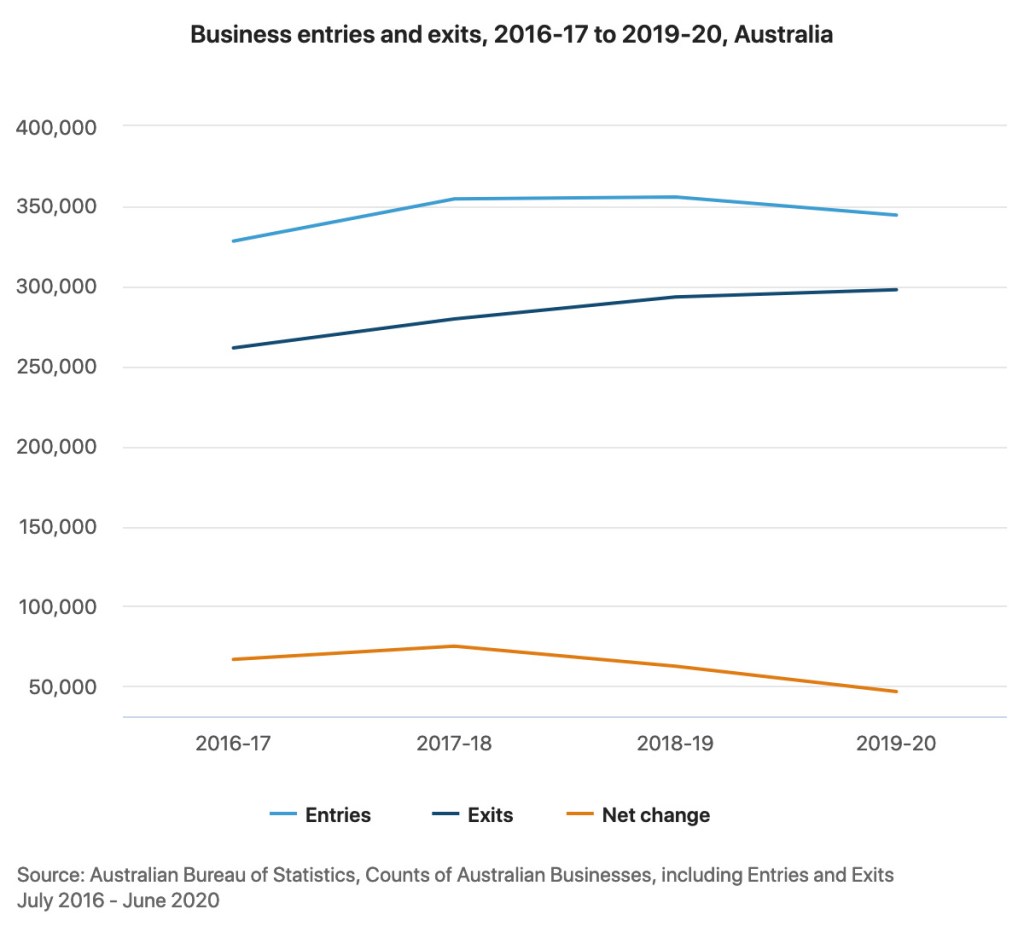
It will be very interesting to monitor ABS data on the number of business entries and exits (CABEE), which is now also being reported quarterly, instead of just annually. The latest annual data released in February (for the period ending June 30, 2020) shows that there were more new businesses registered than the number of businesses that were de-registered – but the net gain was a lot lower than in recent years, as can be seen from this graph:

Even after a few months of the pandemic, the number of new entries looks to have declined significantly, with a corresponding rate of increase in exits – and the net increase was already on a steep downward trajectory from 2017-18.

According to the ABS data, “In 2019-20 three industries accounted for more than half of the net annual increase in businesses, these were:

  • Transport, postal and warehousing
  • Professional, scientific and technical services
  • Health care and social assistance”

None of this data should be too surprising; further, we should expect to see a significant number of exits from the retail, hospitality and tourism sectors. Government support in the form of domestic travel vouchers and discounted air tickets will only go so far to reverse the fortunes of airline, hotel and tour operators. (The folks in Queensland must be happy with the twin benefit of being a desirable destination for both domestic holidays and Hollywood film production.)

While on-line shopping has helped to keep retail afloat, bricks and mortar retail has been dealt a heavy blow, from which it will take a long time to recover – many people have no doubt got used to e-commerce, and can’t be enticed back to the shops.

From what I see in Melbourne, the CBD is still running at 40-60% capacity (depending on location, sector, and day of the week). Mondays are definitely quiet, it gets busier on Wednesdays and Thursdays, and then starts to taper off again on Fridays, with people opting to “work from home” as the weekend draws near. Last week, one business group wants companies to close at 4.00pm on Fridays, to encourage workers to hang out in the city after work – but Fridays has always been known as POETS day, so I hardly think anyone still here at the end of the week needs any encouragement to down tools any earlier…

There are still so many construction sites within the CBD, both new build and renovations. But who is going to be occupying this new and refurbished real estate – especially as offices are still limited to 75% capacity, and employees seem reluctant to come back to the office full time? Many shops (old and new) remain boarded up. Some cafes have not even bothered to re-open at all, let alone just on the busy days. Doubtless some current construction projects have been brought forward to take advantage of JobKeeper payments, quieter streets and low interest rates – but it means that in some areas, whole blocks lie empty and virtually devoid of any business, and it feels that many shops don’t see a customer all day.

Unfortunately, with politicians distracted by non-economic matters (plus the small tasks of managing hotel quarantine and rolling out a vaccination programme), we are only seeing short-term responses and band-aid solutions, rather than strategic and visionary policy-making. Neither our governments nor the opposition parties (of all persuasions) seem willing or capable of serious (and non-partisan) debate on things like Universal Basic Income, structural reform of the economy, and instilling innovation across all areas of industry. Instead, they prefer to tinker at the edges (tax, superannuation, industrial relations), engage in Parliamentary point-scoring, and maintain the status quo within their respective supporter base. Something has to change, and soon.

Next week: Victorian Tech Startup Week