It’s never too late to change….

Few things annoy me more than when someone in their late 20’s or early 30’s says: “I’m stuck in my job, and I can’t do anything about it.” My immediate reaction is to shout, “No you’re not, and yes you can!” But I stop myself, and ask instead, “What’s stopping you from making a change?” Usually, there is a mental blockage, and an inability to think outside or beyond the immediate situation. In turn, this is often linked to a distorted perspective about how they got to where they are, coupled with unreasonable (and therefore, unrealised) expectations.

Sculpture, Ueno Park, Tokyo (Photo © Rory Manchee, all rights reserved)

” A new perspective?” (Ueno Park, Tokyo – Photo © Rory Manchee, all rights reserved)

Helping my clients to identify the barriers in their way (in particular any deeply entrenched obstacles), and to explore ways to dismantle or overcome them usually leads to alternatives: a new job opportunity, a potential career transition or a new business direction. It may not be an easy or comfortable process, but it’s not impossible. At its heart is the need for self-awareness, the willingness to embrace change, and the commitment to making it happen.

“See You At The Barricades”

Here are some of the initial objections I hear when people say they can’t make a career change or transition:

  • Financial security
  • Lack of time
  • No access to resources
  • No idea what to do next, where to look, how to plan
  • Enjoy the job, but not the organisation (or vice versa)
  • This is the only work they know, or studied/trained for
  • Non-transferable skills or inadequate training

My usual response is to get them to re-contextualize. It’s rather like using cognitive behaviour therapy, to reframe the situation. “How could you look at this differently?”, “What if you did this?”, “Who could help you overcome that?”, “What would be the ideal situation?”.

“Money’s Too Tight To Mention”

I understand that financial insecurity can be a major cause for concern. The certainty of a regular salary (even if you hate the job) can be preferable to taking a pay cut for a more rewarding role, or having to forego immediate financial return during a period of retraining or re-skilling. But if you are only doing a job because of the money, the likelihood is that you may never be entirely happy in your role, you may come to resent the work you do, and eventually you may lose sight of what is important to you. Plus, the knock-on effect on your personal well-being and that of your family can be significant. After all, no job has a lifetime warranty or even a 2-year guarantee, so the paycheck will probably run out anyway.

“Time Is On My Side”

Even if your financial circumstances or apparent lack of time mean that you can’t leave your current job or explore other options without securing a comparable income in another role, there are several ways to prepare for a career transition:

  • Re-train in your own-time – use on-line courses, evening classes and weekend workshops to access new skills and education
  • Ask your current organisation about options for study leave or flexible work hours
  • Suggest a personal development plan that draws on existing resources – e.g., shadow another colleague, or do a rotation or secondment to another team or department
  • Workers in some industries or older employees may be able to access public funding to support retraining and re-skilling
  • Use your annual leave to intern or volunteer at an organisation where you might like to work in the future

“Possibly Maybe”

There are many new opportunities for personal development through short courses, skill sharing or peer-to-peer platforms, and alternative learning paths to re-connect with your purpose. It might even be possible to reconfigure or restructure your current role to better suit your needs. Besides, the job you were originally hired for (or the industry and/or the career you trained for) has probably changed significantly; if you are not doing some regular re-engineering, you risk being confined to outdated thinking or processes, or worse, becoming obsolete.

“This Is Your Big Opportunity”

In fact, you have an obligation to yourself to invest in your own career, by re-training, updating your skills, or embarking on new challenges. Increasingly, organisations expect employees to take personal responsibility for self-managing their career, their professional development and to maintain the technical currency of their skills. Even better if you can demonstrate that learning a new skill can support innovation, generate efficiency gains, or deliver customer benefits. There are increasing examples where collaboration, co-creation and cross-pollination of ideas, skills and people between organisations and their suppliers/vendors/clients/distributors can have mutual outcomes, and employers are looking for people who can identify these opportunities.

“This Is The Way”

From personal experience, curiosity, pro-active networking, asking questions and generally taking an interest in what is going on in and around the organisation and wider world can reap huge rewards. In my own case, having a sense of enquiry prompted a transfer from London to Hong Kong to open a new Asian office for the company I worked for. Earlier in my career, I took evening classes so I could transition from a role in the public sector to a new career in publishing. And I continue to find new learning opportunities through meetups, hackathons and startup pitch nights, and attending workshops on innovation, collaboration, design thinking and technology.

I’ve written previously about the changing economic relationship of employment, because it’s incumbent on all of us to learn resilience and adaptability. We have a duty to equip ourselves in order to cope with and prepare for the continuous change and volatility we are all experiencing in the nature of the work we do.

Finally, for anyone who says they are “too old to change”, consider this: I recently met a man in his 60s, who had retired from a lifelong career in teaching, quickly got bored, and so he went back to college and is now a licensed horse trainer. He gets up earlier than he used to as a teacher, but he has connected with a passion and made it his career choice.

Declaration of Interest: I am a member of the Slow School of Business Advisory Council, which delivers Slow Coaching and Talk on Purpose

Next week: ANZ’s new CEO on #FinTech, CX and #digital disruption

Is this The Conversation we should be having?

Here’s a barbecue topic for Australia Day: What is happening to the quality of public discourse? Over the holidays, I read The Conversation’s 2015 yearbook, “Politics, policy & the chance of change”. It’s a collection of individual articles from the past 12 months, grouped into broad themes, covering key issues of the day, at least among the academic and chattering classes. As a summary of the year in Australian political, economic, cultural and social reportage, it’s not a bad effort. With “news” increasingly bifurcated between a dominant commercial duopoly and a disintermediated social media maelstrom, The Conversation can offer a calm rational voice and an objective alternative.

Screen Shot 2016-01-24 at 6.43.50 PMThe title promises a new direction in political debate, and I went to the book’s Melbourne launch at the start of the summer, where Michelle Grattan, The Conversation’s Chief Political Correspondent held court in an audience Q&A. I was looking forward to the event, because part of The Conversation’s remit is to foster informed debate that is more than tabloid headlines, news soundbites and party room gossip. It has also positioned itself as a non-partisan, independent and authoritative source of news analysis.

I was hoping the Q&A would provide a considered discussion on some of the key policy issues facing the country – long-term tax reform, addressing climate change, updating Federation, dealing with the post-mining boom economy, improving the quality and efficiency of our education, health and infrastructure systems, etc.

Instead, the first three questions from the audience concerned Mal Brough, Ian Macfarlane and Tony Abbot. How demoralising. Haven’t we moved on from this cult of personality? Haven’t we learnt anything from the past 10 years or so? If the same event had been held during Julia Gillard’s term as PM, the names would have been different (Craig Thomson, Peter Slipper, Kevin Rudd?) – and for quite separate reasons, I hasten to add – but the context and implication would have been very similar: “Never mind policies, what’s the chance of (another) leadership spill? How are the numbers stacking up in Parliament? When’s the court case?”

Although I admire the aims of The Conversation, and I understand why it exists, I have some concerns about the type of discourse that The Conversation is actually fostering among its audience. As with many public institutions, I appreciate that it’s there (even though I am not a frequent reader), but like other news media, it risks confirming the bias and prejudices of its audience. It can also feel as if it is serving only the vested interests of its contributors, partners and sponsors.

So much of Australia’s recent political history has been dominated by self-delusional egos, nefarious party factions, insidious vested interests and character assassination (which I blame for giving us five prime ministers in as many years).

When it was my turn to ask a question, it concerned the recent bipartisan compromise between the Coalition and The Greens to publish the tax records of companies generating more than $200m in revenue (as a step towards tackling corporate tax avoidance). I asked, “Should we expect to see more of this seemingly new approach to politics?” Although Ms Grattan gave a detailed (and somewhat technical) explanation for this particular Parliamentary outcome and its likely implications, I felt that most of the audience were not interested. They would probably have preferred to be talking about the ins and outs of the party rooms. For me, this does not bode well for the level and quality of public debate we are having on (non-party) political issues that really matter.

I also have a few other niggles about The Conversation and the 2015 Yearbook:

  1. By only sourcing content from “recognised” academic experts and policy wonks, I think this overlooks contributions from commercial and industry experts which are just as valid. As long as such authors also declare any interests, it should ensure balanced commentary – but to exclude them from the debate just because they don’t have academic, public or research tenure is self-limiting.
  2. The site as a whole (and the book in particular) is rather thin on actual data references, and when research data is included in articles, there are rarely any charts, tables or infographics. I think this is a shame and a missed opportunity.
  3. The book hardly mentions the critical issue of tax reform (which barely merits half a dozen pages). Whereas, reform of the education system (including academic research funding) gets around 40 pages – which rather smacks of self-interest (and bias?) on the part of the academic authors

Finally, The Conversation provides a valuable (and from what I have seen, an impartial) service via its factcheck section, which in tandem with the ABC’s Fact Check is doing a sterling job of trying to keep our pollies honest (at least in Parliament…). More power to it.

Next week: David Bowie Was – “It’s a god-awful small affair”


#AngelCube favours B2B #startups…

The latest intake to AngelCube‘s accelerator program presented at the recent Startup Victoria meetup event. It was interesting to see that all 6 pitches were aimed at B2B audiences, since I have heard several angel investors and startup advisers express a strong preference for end-consumer products (or those with 2-sided markets). Perhaps there is more appetite for enterprise solutions, despite the longer lead times for sales, and the challenge of strategies required to displace incumbant products.

Screen Shot 2015-08-31 at 5.18.46 pmWhether there is a new interest in B2B startups, or whether more founders are identifying B2B opportunities, there’s probably some further analysis to be done. Meanwhile, here are the 6 fledgling startups in the order they pitched on the night:

Screen Shot 2015-08-31 at 5.45.53 pm1. Peer Academy

Peer Academy aims to “change the way professionals learn”. It does this by offering students access to open enrollment classes via an online market place. The classes are conducted by facilitators and experts (“hosts”) who have been “screened” for quality by Peer Academy, with a focus on “soft” management and leadership skills.

Peer Academy hopes that students will act as “warm leads” for corporate sales, by taking their classroom experience back into their organisations, and acting as champions or brand advocates. With follow-up introductions to training and HR managers, Peer Academy then curates programs for corporate clients, by matching training needs to individual users.

I like the notion of “peer-to-peer” learning (although I presume that the hosts are expected to have more advanced and developed skills than their students), and there is certainly a trend for alternative learning platforms. At least one major bank has expressed interest in sourcing corporate training via Peer Academy, who take a 30% commission on course sales.

A huge challenge will be to engage corporate clients who already have established relationships with trusted training providers, or who have existing panels of approved organisations, or who outsource training procurement to third parties.

Screen Shot 2015-08-31 at 6.04.05 pm2. Jack

Workplace wellbeing is becoming big business ($5bn and counting?), and in the process, sedentary workers are in the firing line. According to Apple CEO TIM Cook, “Sitting is the new cancer”, and hence the recent fad/trend/fashion for sit-stand desks which is driving market interest in ergonomic solutions. The team at Jack have built a device that can monitor how much time people are sitting or standing, and even provide some feedback on user posture.

As you would expect, Jack uses cloud connectivity to monitor user activity, and to relay data via cross-platform apps and dashboards. It also uses elements of social media engagement and gamification, and has already launched a pilot scheme with several desk suppliers, as well as a paid beta at a well-known payments provider.

Customers will buy the device plus pay for a monthly subscription service. There is a direct competitor, but Jack claim their device can be retrofitted to any sit-stand desk. The unit price is much higher than, say a Fitbit, but since this is not a consumer product, Jack is confident it can sustain current pricing.

Finally, with the data it aims to collect, Jack reckons it may even be able to help reduce insurance premiums, although this will no doubt be subject to actuarial scrutiny, Work Cover and OH&S requirements, as well as data privacy issues.

Screen Shot 2015-08-31 at 6.24.11 pm3. Coin-Craft

In the professional services and consulting sectors, tracking project costs and resourcing have become highly demanding activities – witness the plethora of project management, costing, billing, ERP and time-tracking solutions on the market. Based on personal experience, the founders of Coin-Craft have identified a specific need among architects, and have built an all-in-one tool for Project Management, Cashflow Analysis and Resource Planning. Built “for architects by architects”, Coin-Craft is designed to help clients stay optimal, by managing staff over/under utilisation, and tracking cashflow projections.

The system also claims to integrate with third-party accounting software, and has around a dozen firms using the service, with another 30 in the pipeline. Although Coin-Craft have chosen a niche client base to protect their market entry, they claim the solution can also be adopted by engineering practices, graphic art studios and project management firms.

However, feedback from the audience suggested there are already similar, mature products that are tracking individual billable hours against specific projects, so Coin-Craft may need to work on their value proposition and differentiation.

Screen Shot 2015-08-31 at 6.38.22 pm4. CurveUp!

As social media and content marketing become more ubiquitous (if not more sophisticated), companies need to understand the value of their direct marketing spend. Mostly, they can do this via web analytics, e-commerce tracking, campaign conversions, and cost of customer acquisition. According to CurveUp! however, measuring the ROI of your PR activity is not so easy using “conventional” social media monitoring tools. For example, CurveUp! claim they can deliver tailored reports to show which blog post or article converted to a ticket sale for a concert or event.

Currently using web and online sources only, CurveUp! track mentions and link this to customer data. Some platforms, such as Instagram, are harder to track, and even via a possible API solution, it will only be possible to monitor the number of views and shares, but otherwise little or no data will be available.

However, at least one online market place has expressed interest, and CurveUp! has the potential to integrate with Facebook and Google, so that clients could possibly use campaign codes to track referral activity from mention to firm sale. Overall, the service will need to align itself with the ROI outcomes linked to PR campaign goals – which will vary between clients and markets, depending on organisational KPIs around brand advocacy, share of wallet, products per customer and customer satisfaction.

Screen Shot 2015-08-31 at 6.56.07 pm5. TribeGrowth

In a similar vein, the team at TribeGrowth claim to have built “artificial intelligence for social media marketing“. Their goal is to help clients build an audience and get customers, via the use of “intelligent engagement” to generate conversions.

Initially targeting startups, professional service providers and the hospitality sector, TribeGrowth offers a tiered monthly subscription service, and claims to be a (cheaper) alternative to agencies or even Twitter ads.

Currently in private beta (and so far, only designed for Twitter and Instagram), TribeGrowth focuses on audience growth by careful selection of connections and influencers. According to the founders, this is not “pay & spray”, but uses machine learning to refine audience outreach and engagement.

Screen Shot 2015-08-31 at 6.59.11 pm6. SweetHawk

Finally, and in what was probably the most technical presentation of the evening, came SweetHawk, which is building “voice for e-commerce”. I have to confess that, although I had previously heard about this product, I’m still not totally clear how it works.

In essence, it’s an outbound platform that enables companies to have more focused/targeted real-time conversations with warm sales prospects, namely people who are visiting their websites. Personally, I would find that a bit spooky, if I was browsing a site and suddenly a widget popped up asking me if I wanted to receive a call right there and then. Isn’t it a bit like stalking?

The business model is designed to offer tiered services in return for monthly subscription fees – depending on call volumes and functionality, such as workflow tools. I would see it as sitting somewhere between an outbound sales call centre and a SaaS-style inbound helpdesk solution.

On the plus side, I do see the opportunity to deliver superior and more responsive customer service, except that SweetHawk appears to be a sales and prospecting platform, not an after-sales or support solution. I’m also used to live chat tools that pop up on various software and other service sites I use, so I would probably engage with a similar offering if I was browsing to purchase.

Final Thoughts

While none of these pitches has so far demonstrated anything truly disruptive (but let’s not criticise them for that), they all seem reasonably sensible and logical solutions using a mix of digitally-driven technologies (cloud, mobile, social, peer-to-peer, data analytics) that we are all increasingly familiar with. So, rather than major game changers, I see each of them building on established platforms. By refining the potential that new technologies and business models are creating, they are tapping into better-defined client needs rather than taking a “build it and they will come” approach.

In conclusion, I was generally impressed by the 6 pitches on offer, although some of the presentations will no doubt be reworked in light of the audience feedback and Q&A, and before the plucky founders hit the investor road show organised by AngelCube.

The event was hosted by inspire9, and sponsored by BlueChilli and PwC.

Next week: More on FinTech – another look at data and disintermediation


Update: Health, AusPost, eTaskr and Slow School

Over recent months, I have blogged about health and the digital economy, the challenges facing AusPost, the progress of eTaskr and the birth of Slow School of Business. Here are some updates on each of these topics:

IMG_0211Apple launches developer platform for health apps

On top of launching “Health” with iOS8, Apple has released a software tool called ResearchKit designed to help researchers and developers build and test new health apps.

I think that while we hear a lot about the Internet of Things (#IoT), health is one area where the connection of the physical and the digital will really deliver tangible benefits (not just a fridge with a screen…).

Australia Post plans to raise the cost of sending letters

In the wake of declining letter volumes (and poorer financial performance), AusPost is considering jacking up the price of letter postage, and introducing a 2-speed letter service.

While this is not a surprising move, it does seem shortsighted. Given the increase in parcel volumes, especially from e-commerce and small online purchases, I reckon AusPost would be better off with more refined domestic parcel rates. For example, using exactly the same dimensions and weight, I can either send an item as a “large letter” for $2.10 (which is perhaps too cheap?), or as a “small parcel” for $7.45 (which is incredibly expensive for an item that might cost no more than $25). Maybe different band rates of 50g, from 100g up to 500g (the current weight limit for a small parcel/large letter) or even 1kg  might be a better option, coupled with improved payment and lodgment automation? Just saying…

etaskr secures seed funding

Described as a “private label elance”, etaskr is a graduate of the AngelCube accelerator program, and was a finalist at last year’s Big Pitch organised by Oxygen Ventures.

Following their appearance at the Big Pitch, etaskr have recently closed $1.3m in seed funding from Oxygen Ventures. As mentioned in an earlier blog, etaskr is starting to see traction among corporate clients, including overseas markets, but the nature of the B2B sales cycle has meant that investors, incubators and accelerators are traditionally wary of such startups. Hopefully, this latest development will start to change market perception.

Slow School founder in the news

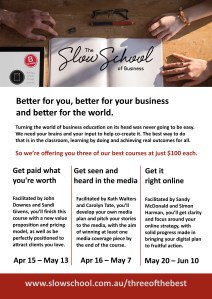
Finally, Carolyn Tate, the founder of Slow School of Business has been busy launching a new program of short courses (including Three of the Best) a new website and a new book. Oh, and she’s also become a B Corp. (Declaration of interest: I am a participant in, and adviser to, Slow School.)

Previously featured in Slow Living (required reading for the Slow Movement), Carolyn has taken a simple idea based on collaborative and peer-to-peer learning, and created a potentially disruptive platform for professional development and corporate training. Slow School is also tapping into the growing trend for people to work as independent contractors, freelancers and consultants (rather than permanent employees), and the dynamics of the digital economy where participants are also looking to make deep, personal connections rather than just online “friends”.

The new normal?

Post GFC, we’ve been told to expect a low/slow/no growth environment – that this is the “new normal”. I would add to that digital disruption, non-traditional commercial models and emergent ecosystems as being the other key influences on how we do business in this new environment. From what I have skim-read of the latest Intergenerational Report, the language is still couched in traditional terms of “jobs”, “productivity” and “industries”. Yes, there is mention of innovation, demographics, technology and flexible workplaces (i.e., deferring retirement?), but nothing that inspires me to think our political leaders understand what is really going on within the startup economy and the broader digital movement.

Next week: How to survive a Startup Weekend