Rebooting the local economy

Continuing the theme from my previous, post-lockdown blog, there are definitely some growing challenges ahead as the local economy tries to gather momentum. Yes, the jobs recovery looks encouraging for the hoped-for recovery (at least, based on headline numbers); and property prices (that staple of banks and economists alike) are getting very frothy again. But the end of JobKeeper later this month will hurt both employees and employers – it will be especially hard to stomach when you consider that a few household brands have chosen to keep their government-funded windfalls, despite making significant profits even during (or as a result of) the pandemic, while these same public companies have also been paying out shareholder dividends.

It will be very interesting to monitor ABS data on the number of business entries and exits (CABEE), which is now also being reported quarterly, instead of just annually. The latest annual data released in February (for the period ending June 30, 2020) shows that there were more new businesses registered than the number of businesses that were de-registered – but the net gain was a lot lower than in recent years, as can be seen from this graph:
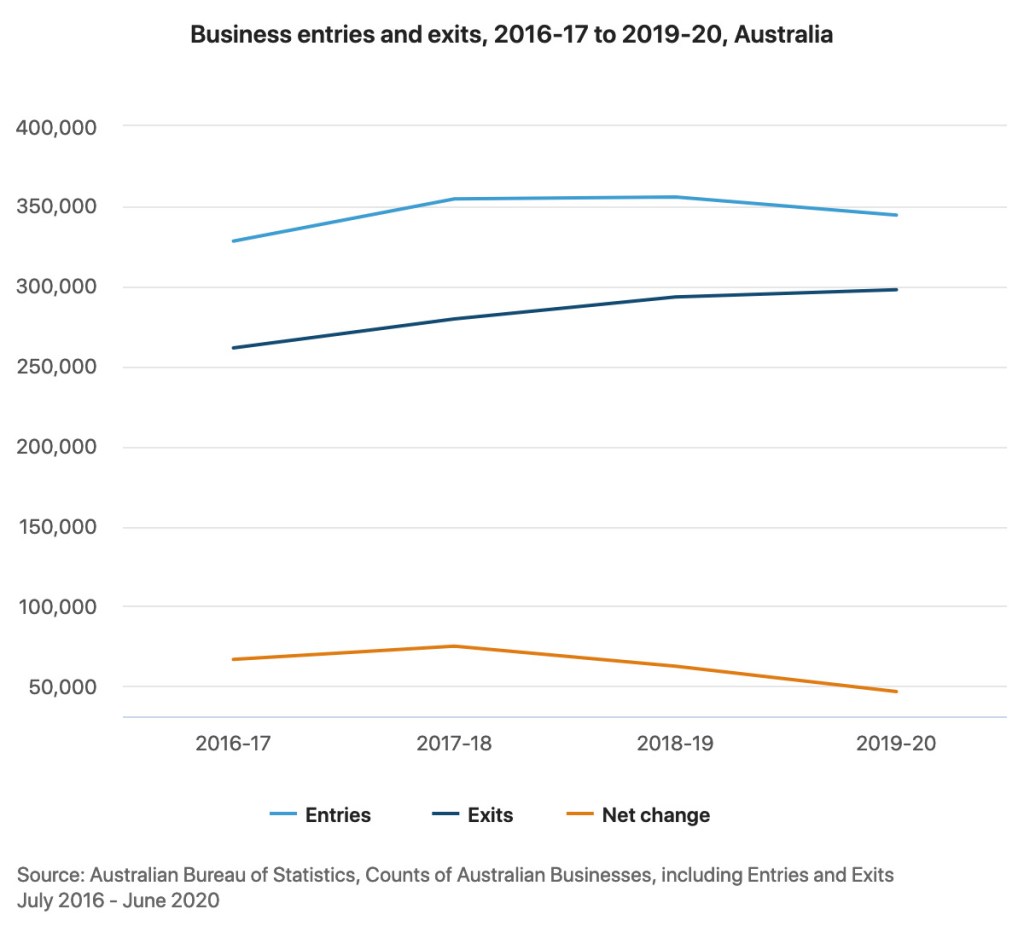
Even after a few months of the pandemic, the number of new entries looks to have declined significantly, with a corresponding rate of increase in exits – and the net increase was already on a steep downward trajectory from 2017-18.

According to the ABS data, “In 2019-20 three industries accounted for more than half of the net annual increase in businesses, these were:

  • Transport, postal and warehousing
  • Professional, scientific and technical services
  • Health care and social assistance”

None of this data should be too surprising; further, we should expect to see a significant number of exits from the retail, hospitality and tourism sectors. Government support in the form of domestic travel vouchers and discounted air tickets will only go so far to reverse the fortunes of airline, hotel and tour operators. (The folks in Queensland must be happy with the twin benefit of being a desirable destination for both domestic holidays and Hollywood film production.)

While on-line shopping has helped to keep retail afloat, bricks and mortar retail has been dealt a heavy blow, from which it will take a long time to recover – many people have no doubt got used to e-commerce, and can’t be enticed back to the shops.

From what I see in Melbourne, the CBD is still running at 40-60% capacity (depending on location, sector, and day of the week). Mondays are definitely quiet, it gets busier on Wednesdays and Thursdays, and then starts to taper off again on Fridays, with people opting to “work from home” as the weekend draws near. Last week, one business group wants companies to close at 4.00pm on Fridays, to encourage workers to hang out in the city after work – but Fridays has always been known as POETS day, so I hardly think anyone still here at the end of the week needs any encouragement to down tools any earlier…

There are still so many construction sites within the CBD, both new build and renovations. But who is going to be occupying this new and refurbished real estate – especially as offices are still limited to 75% capacity, and employees seem reluctant to come back to the office full time? Many shops (old and new) remain boarded up. Some cafes have not even bothered to re-open at all, let alone just on the busy days. Doubtless some current construction projects have been brought forward to take advantage of JobKeeper payments, quieter streets and low interest rates – but it means that in some areas, whole blocks lie empty and virtually devoid of any business, and it feels that many shops don’t see a customer all day.

Unfortunately, with politicians distracted by non-economic matters (plus the small tasks of managing hotel quarantine and rolling out a vaccination programme), we are only seeing short-term responses and band-aid solutions, rather than strategic and visionary policy-making. Neither our governments nor the opposition parties (of all persuasions) seem willing or capable of serious (and non-partisan) debate on things like Universal Basic Income, structural reform of the economy, and instilling innovation across all areas of industry. Instead, they prefer to tinker at the edges (tax, superannuation, industrial relations), engage in Parliamentary point-scoring, and maintain the status quo within their respective supporter base. Something has to change, and soon.

Next week: Victorian Tech Startup Week
Transition – post-pandemic career moves

Even before the latest lock-down v3.0 in Melbourne, one of the other members of my co-working space in the CBD decided they’d already had enough of being confined to a 5km radius, working from home, and other lock-down related restrictions. Having had their interstate travel curtailed over the past 12 months, and suffering from cabin fever, they have opted to spend the next few months living in and working from various Airbnb locations around regional Victoria. Even though they are used to WFH, recent experience has shown that they don’t need to be confined to one place. And this post-COVID shift in our work/life patterns (already being disrupted and enabled by remote working) is only increasing.

Likewise, a client I spoke to in the USA last week informed me that they had just settled into a new location on the west coast, and was “living the dream” of a nomadic existence.

More extreme is the recent example of a Guardian employee who, having had to travel from Sydney to the UK for a family funeral last year, then took several months to get back home (due to flight cancellations), but managed to keep working remotely from various European locations as he moved around to stay ahead of border closures.

Prior to this past weekend, and despite the city being out of Stage 4 lock-down for 3 months, private offices in Melbourne’s CBD have only been allowed to operate at 50% of capacity – the proposed move to 75% capacity has been put back. It means, for example, that even on a really good day, my local coffee shop is still only doing 60% of its pre-COVID business.

It’s my guess that the combination of office restrictions and many retail and hospitality businesses simply not bothering to re-open at all means the CBD is barely operating at 40-50%. It’s deceptive – some activities (e.g., construction) have continued pretty much unabated (even expanding while there is less traffic on the roads); while others have been shut down altogether (e.g., entertainment). Certainly food delivery services are still in demand, while some retail has been doing a bit better as customers appreciate the novelty of shopping in-person.

Monday to Friday in the CBD is like a bell-curve distribution – Mondays and Fridays are much quieter, as people choose to WFH part of the week. Which is challenging for employers, as they try to revert to “normal”. But assuming a mix of remote and on-site working continues, it probably means less overall demand for office space. (It’s also difficult to assess the impact of the CBD exodus on suburban hubs.)

So all that construction work suggests we will have an over-supply of commercial premises (offices, shops, restaurants and hotels).

Residential property is a similar story – student accommodation is far from full, as overseas students aren’t returning; and more inner-city apartment buildings are still going up, but there is something of an exodus from the city to regional and rural locations.

The latter tree- and sea-changes are being fueled by a number of factors: a desire to leave the city (which is more prone to lock-downs); low interest rates (so, cash out the equity in your suburban home and move to the country where your money buys you more); increased opportunity to WFH (see, 5G and the NBN have their benefits!); and a broader wish for a different work/life balance.

Unfortunately, this shift is also putting pressure on local housing supply – average property prices are going up faster in some regional centres than in the capital cities; and more nomadic lifestyles are driving up demand for short-stay accommodation. The combined effect is higher rental costs and reduced supply, tending to squeeze out the locals.

Ironically, we’ve heard farmers and primary producers in rural and regional Australia complain that they can’t get seasonal workers due to COVID restrictions on international visitors (especially students, back-packers and experienced fruit pickers). Conversely, we’re told that 90% of jobs lost after March last year have now been recovered – although this apparent rebound is mainly in part-time roles, not full-time positions. It would be interesting to see a detailed breakdown by industry, as some sectors (tourism, aviation, universities) are still struggling.

The hiatus (and disruption) brought about by COVID and subsequent lock-downs has no doubt prompted many people to reassess their careers: where do I want to live/work? what type of work do I want to do? which industries or companies are hiring? and for what roles? As part of a wider re- and up-skilling initiative, the Federal and State governments are offering a range of free vocational courses (mostly Cert I to IV programmes), as well as some enhanced “pathways” to trade apprenticeships.

While this is to be applauded, I can’t help feeling the effort is at least 5-10 years too late to address the technological, demographic and societal changes that began at the end of the last century, with the advent of the internet, cheaper technology, an ageing population, increased globalisation, inefficient taxation and tariff systems, and general economic restructuring. If nothing else, COVID has demonstrated the need for more resilience in the domestic economy, (and a reduced reliance on overseas imports and supply chains) such as smart manufacturing and food security.

Meanwhile, a friend of mine recently related that a nephew of his had dropped out of college (like many of his peers in the USA and elsewhere) and decided to become a self-taught expert in DeFi, as there is more chance of financial success (and career satisfaction) than obtaining an “off the shelf” bachelor degree….

Next week: Corporate Art

Life During Lock-down

As I write, Victoria is witnessing record numbers of new COVID-19 cases in the so-called second wave of the pandemic. Even as the State Government maintains the Stage 3 lock-down in Greater Melbourne (and most recently mandated the wearing of masks), some members of the public are trying to challenge these restrictions, while others have to keep being reminded to comply with the pandemic measures. Frankly, the way I have been feeling about the latest events, I don’t know whether to laugh, scream or cry.

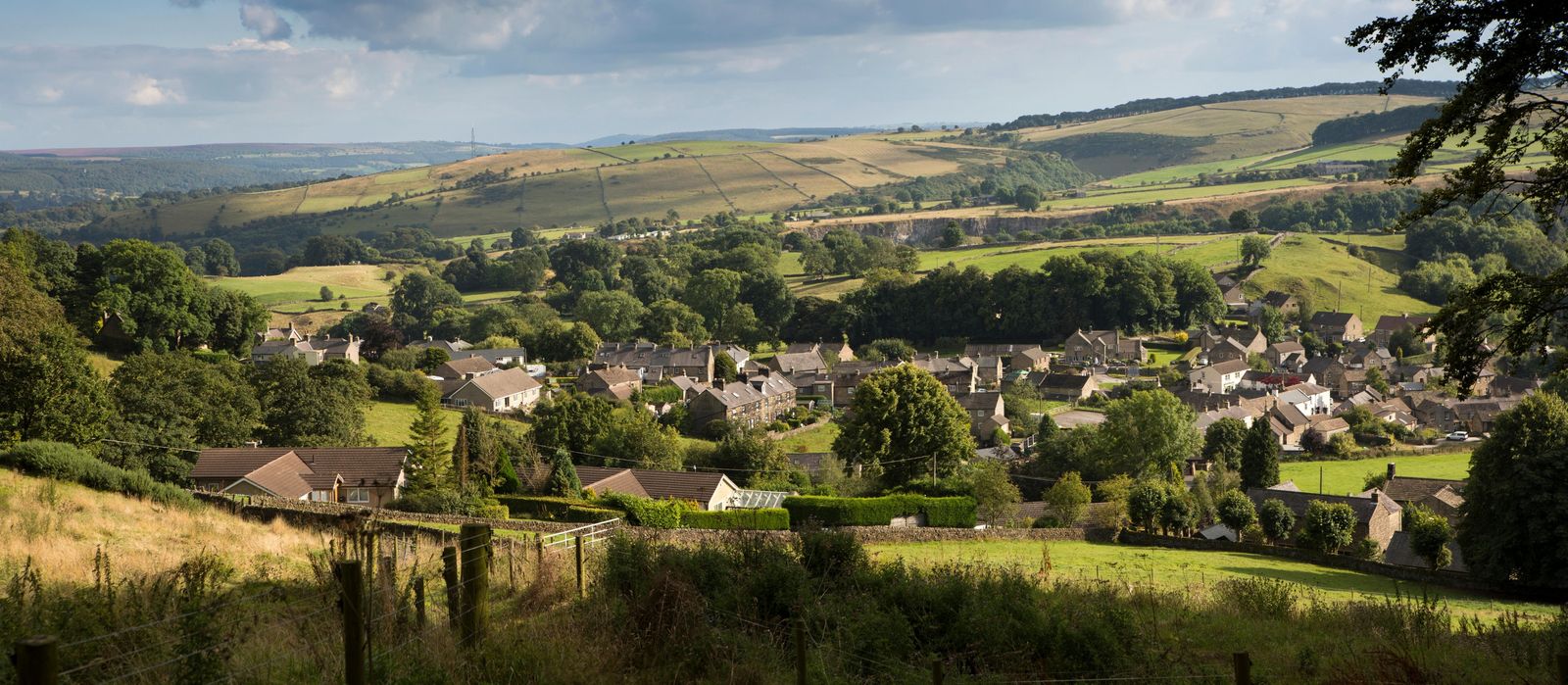
The Village of Eyam – Image sourced from National Geographic

Laugh, because I can’t believe how crass or stupid some of these refuseniks are. Scream, because I am so angry at the State Government’s failure to properly manage the hotel quarantine programme (which has led to the widespread community transmission), and the delayed decision to require masks in public. Cry, because the whole situation is incredibly sad, given all the people who have lost loved ones to the virus, and the many more who are experiencing financial hardship.

The Premier keeps saying that now is not the time to debate the whys and wherefores of who is responsible for the failure in hotel security arrangements, what caused the community transmission, or why so many people continued with their normal routines despite being symptomatic or while waiting for coronavirus test results. OK, fair enough – the Government’s main focus is on protecting public health (and shoring up the local economy), but hopefully there will be plenty of time for analysis and debate once the virus is under control (and hopefully well before the next State election, due in 2022…).

Meanwhile, I don’t know why politicians and health administrators are so surprised when members of the public fail to “exercise common sense”. Maybe the public kept hearing the Government was doing a such a great job (hey, remember Lock-down Pt. I?). Perhaps they over-compensated after a few weeks’ social distancing, became complacent and let down their guard. Or maybe they took their lead from public messages about “returning to normal” – and going to the footy and getting on the beers again….. Perhaps there is a sizeable portion of the community who can’t be trusted “to do the right thing” (or maybe they just don’t trust politicians, public servants, health experts or mainstream media).

As for why those people carried on as usual (despite being symptomatic or awaiting test results): there may be economic factors at play (to be discussed another day, but if that doesn’t include a debate on a Universal Basic Income, it will be a lost opportunity). It could be a lack of information and awareness. It could simply be human nature. But for a culture that celebrates “chucking a sickie” (indeed, one former Prime Minister even suggested it would be a point of national pride to do so following Australia’s success in the Americas Cup), something has gone wrong somewhere if people don’t feel any responsibility or obligation towards the health of their fellow citizens.

In my more existentialist moments (and I seem to have so much more time for that these days…), I can’t help thinking the pandemic is a three-fold challenge to the future of the human race: 1) the virus is nature’s way of inoculating itself against homo sapiens; 2) it will prove Darwin’s theory of evolution (survival of the fittest) by exploiting our weakness as social creatures – it’s figured out how to get us to spread the virus on its behalf; 3) the reduced levels of human activity and pollution will give the earth some time to heal (at least for a while).

At other times, I think about Talking Heads’ song “Life During Wartime”* – especially the line “I got some groceries, some peanut butter to last a couple of days”. With the need to limit shopping trips, the various shortages, and the focus on being prepared for a total lock-down, is it any wonder we may feel some anxiety? Of course, we could be in a far worse situation than what we are currently experiencing in Melbourne, both in terms of the number of cases and the breakdown in social order we see elsewhere. Yet that just underscores how inconsiderate and selfish those people are who can’t bring themselves to wear masks, or observe Stage 3 restrictions. Yes, the restrictions are inconvenient, and at times tedious, but they are hardly onerous compared to a full scale health crisis. And if anyone wants to discuss public sacrifice in the face of a virulent disease, I suggest they do some research on the village of Eyam in Derbyshire, England.

For myself, I know I have been very fortunate so far (probably thanks to some “compound privilege”). I have been able to work from home since March (although as an independent contractor, my monthly income has been reduced), but I have not seen any friends or family face-to-face either, and I won’t be traveling overseas next month for a family wedding, or to visit elderly parents. I am able to walk each day in the nearby park, but apart from food shops and the post office, I’ve not been inside any other retail premises. I haven’t been to pubs or restaurants, but I try to support the local hospitality sector by ordering prepare-at-home meals about once a week. I can’t get to see live music, but this has forced me to revisit my own music-making. And I don’t have to do any home-schooling, but I have friends and relatives who work in the health and education sectors.

My biggest concern, apart from the pandemic itself, is that we miss the opportunity to re-think the large areas of the economy that need restructuring. Politicians keep talking about “jobs, jobs, jobs”, as if the archaic labour structures inherent in the traditional master and servant relationship is the be-all and end-all of social economics. But where are these jobs coming from? COVID19 shows we can consume less, make do with less stuff, and so it can’t just be a demand-led stimulus. Nor should it just be a construction-led recovery (more “Big Build”), unless it is combined with innovation, sustainability, hi-tech, smart cities, etc. There is definitely a need to think about national self-sufficiency, and figure out what to do about supply chains, manufacturing and renewable energy.

Somehow, we have to turn this uncertainty and these challenges into positive outcomes.

Next week: The Limits of Technology

* The whole album, “Fear of Music” is the perfect soundtrack for the nervous paranoia and unease of the pandemic…..

Business as Unusual

At the time of writing, the Victorian Government has decided to defer the easing of Covid-19 restrictions, in the wake of a sudden spike in community transmissions. There was always a risk that opening up too much, too soon, would result in a second wave of coronavirus infections, as people returned to work, as shops, restaurants and bars started to re-open, and as people began socializing on a larger scale. There is even talk of more drastic local restrictions in so-called hot-spot areas.

Meanwhile, the deferment (and the extended State of Emergency) is creating further uncertainty for businesses in an already fragile economy. In recent weeks, I have been attending a number of on-line seminars on the broad theme of business in the post-pandemic era. Variously described as the “new normal”, the “new new normal”, and even the “next normal”, things are unlikely ever to be the same, and not many punters are willing to bet on the resumption of business as usual.

Here are some of the challenges and opportunities that lay ahead:

Future of Work

As employees head back to the workplace, employers will need to balance the need for productivity and business continuity with the obligation to provide a safe working environment. Some staff can’t wait to get back to the office, some will prefer to continue working from home (if they can), while a large number would probably welcome a mix between the two. This has prompted debate on introducing a 4-day working week, the introduction of team rostering (e.g., alternating one week in, one week out), and possibly the end of hot-desking.

Overall, new work practices will necessitate a re-think on office space, workplace location and employee facilities. Some commentators have predicted that companies will need to extend their current premises (to allow for adequate space per employee); while others suggest CBD workplaces may need to decentralize towards more suburban or regional hubs (to reduce commuting times, to relieve congestion on public transport and to allow people to work closer to home). The latter may also stimulate local economies as people reallocate their commuting costs and daily expenses into local shops, cafes and services.

Innovation

Change and uncertainty should drive companies to innovate – in fact, former Prime Minister Malcolm Turnbull recently spoke about innovation in light of the pandemic. His view is that current technological trends will only accelerate, and industries facing disruption will be displaced even faster. So no time for complacency, and no point waiting for normal service to resume.

Necessity has driven many retail and restaurant businesses towards more online engagement with their customers, and those that have been shown to be creative, resilient and agile appear to have found a way through the lock-down. Equally, many businesses used to delivering their services in person have had to find ways to embrace digital solutions – no doubt enhancing their digital transformation in the process.

Self-sufficiency

We’ve heard about the need for food and fuel security – especially when supply chains are disrupted, and when countries pursue “domestic first” policies in relation to essential goods and commodities.

While Australia is a net food exporter, we still have to import many daily staples. Primary producers have come to rely on lucrative export markets, so in the light of trade wars and import bans, local farmers and consumers alike will need to adjust their expectations – on choice, price, seasonal availability and market volumes.

Australia is also in the enviable position of being potentially self-sufficient in energy – but although we are rich in renewables, we are still reliant on fossil fuels, and recent events revealed our vulnerability to volatility in the oil markets. It suggests the current environmental and economic debates around weaning ourselves off coal, oil and gas are only going to become more critical.

There has also been a call for a larger domestic manufacturing base – not only to enhance workforce skills and productivity, but also to ward off supply chain disruption. Some have called for a return to domestic car production. Even if that were desirable, let alone a realistic option, I don’t imagine that anyone would welcome the bad old days of churning out Australian-made gas guzzlers that nobody wants to buy. We would need to advocate for smarter cars, energy efficient and non-fossil fuel vehicles, environmentally sustainable materials and manufacturing process, and possibly different car ownership models (in line with the trend for ride share businesses and smart city solutions) and more creative financial incentives to the industry than wholesale subsidies.

Other manufacturing sectors that are getting attention include medicines and medical supplies (surely there must be a market for domestically-produced PPE made from bio-degradable materials?), clothing (again, an opportunity for environmentally sustainable materials and manufacturing processes), processed goods (after all, we already have much of the raw material), domestic appliances and technology.

One area where Australia has also proven vulnerable is in recycling. China and the Indian Sub-continent are pushing back at taking and processing our exported waste. So we have to get smarter at recycling household waste (paper, plastic, glass and metal) especially if in a post-pandemic world we see a return to single-use items and additional sterile and protective packaging for foodstuffs and personal products. We also need to look at e-waste, and find ways to extract more recycling value from obsolete devices.

The lock-down during the pandemic has also highlighted an opportunity to re-connect with the “make do and mend” mentality of our parents and grandparents. Again, if supply chains are disrupted, buying a replacement item might not be an option. But often, nor is it possible to buy replacement parts – either they rely on the same supply chains, or there are no user-serviceable parts available. What if manufacturers and distributors had more of an obligation to take back and recycle their products, or to include more interchangeable parts in their designs, and enable consumers to become more self-sufficient in repairing and maintaining their electronic and electrical goods?

Federal, state and local governments have a huge role to play here – from mandating the use of more recycled and recyclable materials, to incentivizing recycling schemes, from supporting local repair workshops and “maker” projects, to creating more common and open standards around components and replaceable parts.

Finance and Digital Money

At a time when many people are on reduced income and/or or relying on government welfare, the pandemic has also demonstrated a need to rethink our relationship with money in general, and cash in particular.

The latest round of QE by governments and central banks to offset the financial impact of the pandemic has highlighted once again the fragility of current monetary policies, including fractional reserves and treasury buy-backs. The decision to print money on demand will only increase public appetite for crypto currencies as a legitimate store of value – including stable coins and (ironically) central bank digital currencies – and paradoxically, accelerate the removal of physical cash from the economy.

In times of crisis, digital currencies can also transfer money to remote recipients faster and cheaper than traditional means (i.e., incumbent remittance businesses, bank transfers, payment gateways), and actually increase transparency and traceability.

The lock-down also revealed that many people did not have a sufficient financial buffer to withstand job losses, especially in the casual workforce and the so-called gig economy. This suggests a new approach is required for how people are remunerated for their labour and services, taxed on their income, and incentivized to save for the future. Current systems cannot address these issues because they are over complex, far too rigid, and totally dis-empowering of the people they are designed to serve and support.

Digital currencies (along with the benefits of Blockchain technology, and the new economic models represented by digital assets and tokenization) will enhance trends such as decentralization, peer-to-peer networks, trust-less systems, fractional ownership and more sophisticated barter structures.

Bitcoin was created in response to the GFC, it has now come of age in the post-COVID-19 era.

Next week: Antler Demo Day – Rewired