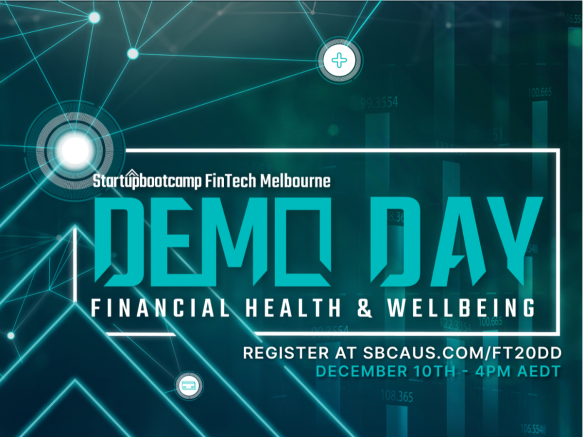
Startupbootcamp – Melbourne FinTech Demo Day

Taking its cue from some of the economic effects of the current pandemic, the latest Startupbootcamp Melbourne FinTech virtual demo day adopted the theme of  financial health and well-being. When reduced working hours and layoffs revealed that many that people did not have enough savings to last 6 weeks, let alone 6 months, lock-down and furlough have not only put a strain on public finances, they have also revealed the need for better education on personal finance and wealth management. Meanwhile, increased regulation and compliance obligations (especially in the areas of data privacy, cyber security and KYC) are adding huge operational costs for companies and financial institutions. And despite the restrictions and disruptions of lock-down, the latest cohort of startups in the Melbourne FinTech bootcamp managed to deliver some engaging presentations.
Links to each startup are in the names:

Datacy

Datacy allows people to collect, manage and sell their online data easily and transparently, and gives businesses instant access to high quality and bespoke consumer datasets. They stress that the data used in their application is legally and ethically sourced. Their process is also designed to eliminate gaps and risks inherent in many current solutions, which are often manual, fragmented and unethical. At its heart is a Chrome or Firefox browser extension. Individual consumers can generate passive income from data sales, based on user-defined permissions. Businesses can create target data sets using various parameters. Datacy charges companies to access the end-user data, and also takes a 15% commission on every transaction via the plugin – some of which is distributed to end-users, but it wasn’t clear how that works. For example, is it distributed in equal proportions to everyone, or is it weighted by the “value” (however defined or calculated) of an individual’s data?

Harpocrates Solutions

Harpocrates Solutions provides a simplified data privacy via a “compliance compliance as a service” model. Seeing itself as part of the “Trust Economy”, Harpocrates is making privacy implementations easier. It achieves this by monitoring and observing daily regulatory updates, and capturing the relevant changes. It then uses AI to manage a central repository, and to create and maintain tailored rules sets.

Mark Labs

Mark Labs helps asset managers and institutional investors integrate environmental and social considerations into their portfolios. With increased investor interest in sustainability, portfolio managers are adopting ESG criteria in to their decision-making, and Mark Labs helps them in “optimising the impact” of their investments. There are currently an estimated $40 trillion of sustainable assets under management, but ESG portfolio management is data intensive, complex and still emerging both as an analytical skill and as a practical portfolio methodology. Mark Labs helps investors to curate, analyze and communicate data on their portfolio companies, drawing on multiple database sources, and aligning to UN Sustainable Development Goals. The founders estimate that there are $114 trillion of assets under management “at risk” if generational transfer and investor mandates shift towards more ESG criteria.

MassUp

MassUp is a digital white label solution for the property and casualty insurance industry (P&C), designed to sell small item insurance at the consumer point-of-sale (POS).
Describing their platform as a “plug and sell” solution, the founders noted that 70% of portable items are not covered by insurance policies, and many homes and/or contents are either uninsured or under-insured. MassUp is intended to simplify the process (“easy, accessible, online”), and will be launching in Australia under the Sorgenfrey brand in Q2 2021. For example, a product known as “The Flat Insurance” will cover items in and out of your home for a single monthly premium. As MassUp appears to be a tech solution, rather than a policy issuer, underwriter or re-insurer, I couldn’t see how they can achieve competitive policy rates both at scale and with simplicity (especially the claims process). Also, as we know, vendors love to “upsell” insurance on tech appliances, but many such policies have been seen to be redundant when considering existing statutory consumer rights and product warranties. On the other hand, short-term insurance policies (e.g., when I’m traveling, or on holiday, or renting out my home on AirBnB) are increasingly of interest to some consumers.

OnTrack Retirement

Ontrack provides B2B white label digital retirement planning solutions for financial institutions to help their customers in a more personalised way. There is a general consumer reluctance to pay for financial advice, but retirement planning is deemed too complicated. Taking an “holistic” approach, the founders claim to have developed a “best in class simulation engine” – founded on expected retirement spending priorities (rather than trying to predict the cost of living in 20 years’ time). Drawing on their industry experience, the founders stated that a key challenge for many financial planning providers is getting members comfortable with your service. I would also add that reducing complexity with cost-effective products is also key – and financial education forms a big part of the solution.

In Australia, the past 10 years has seen a major exit from the financial planning and wealth management industry – both at the individual adviser level (higher professional qualification requirements, increased compliance costs, and the end of trailing sales commissions in favour of “fee for advice”); and at the institutional level (3 of the big 4 banks have essentially withdrawn from offering financial planning and wealth management services). At the same time, there have been a number of new players – including many non-bank or non-financial institution providers – offering so-called robo-advice and “advice at scale”, mainly designed to reduce costs. In addition, the statutory superannuation regime keeps being tweaked so it is increasingly difficult to plan for the future, with the constant tax and other changes. Superannuation (a key success story of the Keating government) is just one of the “pillars” of personal finance in retirement: the others are the Commonwealth government aged pension (means-tested), personal wealth management (e.g., investments outside of superannuation); and retirement housing (with the expectation of more people opting to remain in their own homes). I would also include earnings from part-time employment while in “retirement”, as people work longer into older age (either from choice or necessity) – how that aligns with the aged pension and/or self-funded retirement is another part of the constantly-shifting tax and social security regime.

Plastiq.it

This product describes itself as a customer data platform that powers stored value, and was described as a “Safe harbour” solution (I’m not quite sure that’s what the founders meant in this context?). According to the pitch, consumers gain a fair and equitable outcome (consumer discounts), while retailers get targeted audiences. The team have created a vertically integrated gift card platform (working with MasterCard, Apple Pay and GooglePay), and launched JamJar, a cashback solution.

RegRadar

Similar to Harpocrates (above), RegRadar is a regulatory screening platform that helps companies “to set routes and avoid crashes”. The tool monitors regulatory changes (initially in the financial, food and healthcare sectors) and uses a pro-active process to developing a regulatory screening strategy, backed by analysis and a decision-support tool.

Having worked in legal, regulatory and compliance publishing for many years myself, I appreciate the challenge companies face when trying to keep up with the latest regulations, especially where they may be subject to multiple regulatory bodies within and across multiple jurisdictions. However, improved technology such as smart decision-support tools for building and maintaining rules-based business systems has helped enormously. In addition, most legislation is now online, so it can be searched more easily and monitored via automated alerts. Plus services such as Westlaw and Lexis-Nexis can also help companies track what is currently “good” or “bad” law by tracking court decisions, law reports and legislative updates. 

Next week: Goodbye 2020

Blockchain and the Limits of Trust

Last week I was privileged to be a guest on This Is Imminent, a new form of Web TV hosted by Simon Waller. The given topic was Blockchain and the Limitations of Trust.

For a replay of the Web TV event go here

As regular readers will know, I have been immersed in the world of Blockchain, cryptocurrency and digital assets for over four years – and while I am not a technologist, I think know enough to understand some of the potential impact and implications of Blockchain on distributed networks, decentralization, governance, disintermediation, digital disruption, programmable money, tokenization, and for the purposes of last week’s discussion, human trust.

The point of the discussion was to explore how Blockchain might provide a solution to the absence of trust we currently experience in many areas of our daily lives. Even better, how Blockchain could enhance or expand our existing trusted relationships, especially across remote networks. The complete event can be viewed here, but be warned that it’s not a technical discussion (and wasn’t intended to be), although Simon did find a very amusing video that tries to explain Blockchain with the aid of Spam (the luncheon meat, not the unwanted e-mail).

At a time when our trust in public institutions is being tested all the time, it’s more important than ever to understand the nature of trust (especially trust placed in any new technology), and to navigate how we establish, build and maintain trust in increasingly peer-to-peer, fractured, fragmented, open and remote networks.

To frame the conversation, I think it’s important to lay down a few guiding principles.

First, a network is only as strong as its weakest point of connection.

Second, there are three main components to maintaining the integrity of a “trusted” network:

  • how are network participants verified?
  • how secure is the network against malicious actors?
  • what are the penalties or sanctions for breaking that trust?

Third, “trust” in the context of networks is a proxy for “risk” – how much or how far are we willing to trust a network, and everyone connected to it?

For example, if you and I know each other personally and I trust you as a friend, colleague or acquaintance, does that mean I should automatically trust everyone else you know? (Probably not.) Equally, should I trust you just because you know all the same people as me? (Again, probably not.) Each relationship (or connection) in that type of network has to be evaluated on its own merits. Although we can do a certain amount of due diligence and triangulation, as each network becomes larger, it’s increasingly difficult for us to “know” each and every connection.

Let’s suppose that the verification process is set appropriately high, that the network is maintained securely, and that there are adequate sanctions for abusing the network trust –  then it is possible for each connection to “know” each other, because the network has created the minimum degree of trust for the network to be viable. Consequently, we might conclude that only trustworthy people would want to join a network based on trust where each transaction is observable and traceable (albeit in the case of Blockchain, pseudonymously).

When it comes to trust and risk assessment, it still amazes me the amount of personal (and private) information people are willing to share on social media platforms, just to get a “free” account. We seem to be very comfortable placing an inordinate amount of trust in these highly centralized services both to protect our data and to manage our relationships – which to me is something of an unfair bargain.

Statistically we know we are more likely to be killed in a car accident than in a plane crash – but we attach far more risk to flying than to driving. Whenever we take our vehicle out on to the road, we automatically assume that every other driver is licensed, insured, and competent to drive, and that their car is taxed and roadworthy. We cannot verify this information ourselves, so we have to trust in both the centralized systems (that regulate drivers, cars and roads), and in each and every individual driver – but we know there are so many weak points in that structure.

Blockchain has the ability to verify each and every participant and transaction on the network, enabling all users to trust in the security and reliability of network transactions. In addition, once verified, participants do not have to keep providing verification each time they want to access the network, because the network “knows” enough about each participant that it can create a mutual level of trust without everyone having to have direct knowledge of each other.

In the asymmetric relationships we have created with centralized platforms such as social media, we find ourselves in a very binary situation – once we have provided our e-mail address, date of birth, gender and whatever else is required, we cannot be confident that the platform “forgets” that information when it no longer needs it. It’s a case of “all or nothing” as the price of network entry. Whereas, if we operated under a system of self-sovereign digital identity (which technology like Blockchain can facilitate), then I can be sure that such platforms only have access to the specific personal data points that I am willing to share with them, for the specific purpose I determine, and only for as long as I decide.

Finally, taking control of, and being responsible for managing our own personal information (such as a private key for a digital wallet) is perhaps a step too far for some people. They might not feel they have enough confidence in their own ability to be trusted with this data, so they would rather delegate this responsibility to centralized systems.

Next week: Always Look On The Bright Side…


Antler Demo Day – Rewired

As with the recent Startupbootcamp Virtual Demo Day, the Antler incubator program also ran its Demo Day Rewired as a live webcast. Both online events were an opportunity to see what their respective startup teams could achieve in less than 3 months, and a chance to interact in real-time with the founders themselves. The main difference was that Antler decided to stream the event live (rather than broadcast pre-recorded presentations) which worked surprisingly well in the circumstances – and not just the technology; it must have been really challenging to pitch to an empty room, with no ability to “read” the audience.

Like Startupbootcamp, the majority of teams were only formed at the start of this cohort, and to do this during the current pandemic lock-down must have been especially challenging.

Of the 12 teams to present, half were SaaS solutions, two were curated marketplaces, two were related to carbon offsets, while the remaining pitches offered a support platform for people suffering addiction, and an investment solution aimed at Millennials.

All of the SaaS teams, deal in some way with managing other SaaS applications, as follows:

Intalayer – streamlining software development and product management tools

motiveOS – streamlining CRM, accounting and billing systems to track sales commissions

meetric – streamlining productivity and collaboration tools

Elenta – streamlining workplace L&D services

CloudOlive and Hudled – streamlining the procurement, provisioning and management of SaaS stacks themselves

Given the similar nature of these concepts, there was some commonality in their approach to problem identification, solution design, and market sizing. A number of the audience questions also asked why existing incumbents in each of the specific verticals wouldn’t simply come up with their own solution (even if it was simply to offer 3rd party plug-ins, which leading SaaS platforms such as Xero and Salesforce already do)?

Both Pathzero and Trace aim to make it easier/cheaper to go carbon neutral (via carbon credits and offsets) for SMEs and consumers respectively. Both solutions are essentially curated services, to help customers access, evaluate and verify carbon offsets and make informed decisions about going carbon neutral. Other traditional solutions involve repackaging wholesale schemes (often expensive to administer, since they are not designed for small businesses and retail consumers), or they lack transparent reporting and certification. Blockchain (as a form of immutable distributed ledger) and tokenisation (to streamline the origination, structuring and distribution of carbon offset assets) are also concepts that are being explored.

In the curated marketplaces, Mys Tyler is a platform for women’s fashion, and RightPaw is designed to help dog breeders connect with prospective dog owners. The former may find an opening now that Amazon has decided to decommission the Echo Look (an AI-supported camera offering fashion advice) although Amazon claims most of the features have been incorporated into the main Amazon Shopping app. While the latter made the point that during Covid19 lock-down in April, online pet scams increased 5-fold.

Combining clinical research, community networking and self-help solutions, Aurelius is designing an online support system for people who suffer from addiction, or living with family and friend who do. It’s quite an ambitious goal, given the value will be in providing highly personalized, proven and achievable outcomes for their users, but the team are not, and do not claim to be, medically qualified professionals. It was not clear from the pitch how the service will be funded.

Finally, Yolo ex is designed to be an investment platform aimed at Millennials. On the one hand, it was suggested that younger people don’t have access to investment products and services suited to their needs, since current solutions are geared towards older investors. On the other, Millennials are said to be more likely to research and do their own analysis on investment choices and opportunities. Part of me thinks that if it was that easy, superannuation brands and financial planners would find it easy to engage with this demographic (remember those colourful ads for Kinetic Super, before it ended up merging with Sun Super?). Another part of me is encouraged by what I have seen after more than four years working in the Blockchain and crypto space – the adoption of Bitcoin and other  digital assets by younger people demonstrates that they looking for alternatives to what the major banks and traditional wealth management providers offer them. And not all of them are looking to make a quick buck via RobinHood and Hertz….

Next week: Music during lock-down


#Rona19 – beyond the memes

More commentary on Covid-19 – at the time of writing, Victoria is at Stage 3 restrictions, with Stage 4 possible very soon. Generally, people seem to adapting to if not actually coping with this daily reality (although people are still flouting their quarantine obligations). But there is still some confusion on how to interpret, observe and enforce the social distancing measures, and of course, huge economic uncertainty remains for many people who have seen their working hours evaporate, especially if they are in vulnerable industries, and/or they can’t work from home.

Sign of hope? (Seen on my daily walk)

Meanwhile, the shutdown has prompted a fair number of less serious responses, from toilet paper memes, to “viral” GIFS, from parodies of “My Sharona” and “Bohemian Rhapsody”, to unfortunate examples of the downside of company video conferences while working from home.

But beyond the hashtags, what might we expect once we get through the current pandemic? Here is a somewhat random list of possible outcomes:

  • A renewed appreciation of personal space in public places – will we continue to observe such protocols where and whenever practical, as it becomes a community norm?
  • Greater respect for introverts – possibly better able to handle self-isolation, they are comfortable with their own company and don’t feel the need to seek out crowds  – social distancing does not represent an existential crisis, and they don’t rely on social situations for their personal validation.
  • Passenger airlines and cruise companies are toast – the tourism and travel industries will be hard hit, and may struggle to rebuild in their current form.
  • The online economy will get a boost  – restaurants and providores are already retooling to offer D2C food and meal deliveries (even cutting out the likes of Uber Eats, Deliveroo and Menu Log). Some brick and mortar retail is adapting fast, but will face a reduced share of available discretionary spending.
  • Naturally, digital services will thrive – from communication solutions to virtual classes, from remote working support services to telehealth. But bandwidth capacity and internet down/upload speeds remain a challenge in Australia.
  • The end of physical cash – if retailers prefer contactless payments (less contamination), what use are those notes and coins in your wallet?
  • A higher community standard for the individual duty of care we owe to each other – Covid-19 will certainly test the “duty of care” we owe to neighbours, colleagues, members of the public… if I knowingly infect someone, or act recklessly or negligently, can the victim sue me?
  • Likewise, the corporate social license to operate will be tested and re-cast – in light of monopolistic practices, price gouging, market abuse and disregard for the “new normal”, companies will need to re-assess many of their standard policies.
  • Increased use of facial recognition and other technology for surveillance purposes – if people cannot be trusted to observe their quarantine, self-isolation and social distancing obligations, the authorities will not shy away from further incursions into civil liberties that we currently take for granted.
  • A hybrid of on-site and working from home employment structures – not everyone will want to continue working remotely, nor will everyone be in a rush to head back to the office (or the daily commute), which will likely cause headaches for employers….

More on these themes next week….

Next week: The “new, new normal”