Personal data and digital identity – whose ID is it anyway?

In an earlier blog on privacy in the era of Big Data and Social Media, I explored how our “analog identities” are increasingly embedded in our digital profiles. In particular, the boundaries between personal/private information and public/open data are becoming so blurred that we risk losing sight of what individual, legal and commercial rights we have to protect or exploit our own identity. No wonder that there is so much interest in what blockchain solutions, cyber-security tools and distributed ledger technology can do to establish, manage and protect our digital ID – and to re-balance the near-Faustian pact that the illusion of “free” social media has created.

Exchanging Keys in “Ghostbusters” (“I am Vinz Clortho the Keymaster of Gozer”)

It’s over 20 years since “The Net” was released, and more than 30 since the original “Ghostbusters” film came out. Why do I mention these movies? First, they both pre-date the ubiquity of the internet, so it’s interesting to look back on earlier, pre-social media times. Second, they both reference a “Gatekeeper” – the former in relation to some cyber-security software being hijacked by the mysterious Praetorian organisation; the latter in relation to the “Keymaster”, the physical embodiment or host of the key to unleash the wrath of Gozer upon the Earth. Finally, they both provide a glimpse of what a totally connected world might look like – welcome to the Internet of Things!

Cultural references aside, the use of private and public keys, digital wallets and payment gateways to transact with digital currencies underpins the use of Bitcoin and other alt coins. In addition, blockchain solutions and cyber-security technologies are being deployed to streamline and to secure the transfer of data across both peer-to-peer/decentralised networks, and public/private, permissioned/permissionless blockchain and distributed ledger platforms. Sectors such as banking and finance, government services, the health industry, insurance and supply chain management are all developing proofs of concept to remove friction but increase security throughout their operations.

One of the (false) expectations that social media has created is that by giving away our own personal data and by sharing our own content, we will get something in return – namely, a “free” Facebook account or “free” access to Google’s search engine etc. What happens, of course, is that these tech companies sell advertising and other services by leveraging our use of and engagement with their platforms. As mere users we have few if any rights to decide how our data is being used, or what third-party content we will be subjected to. That might seem OK, in return for “free” social media, but none of the huge advertising revenues are directly shared with us as ordinary end consumers.

But just as Google and Facebook are facing demands to pay for news content, some tech companies are now trying to democratise our relationships with social media, mobile content and financial services, by giving end users financial and other benefits in return for sharing their data and/or being willing to give selected advertisers and content owners access to their personal screens.

Before looking at some interesting examples of these new businesses, here’s an anecdote based on my recent experience:

I had to contact Facebook to ask them to take down my late father’s account. Despite sending Facebook a scanned copy of the order of service from my father’s funeral, and references to two newspaper articles, Facebook insisted on seeing a copy of my father’s death certificate.

Facebook assumes that only close relatives or authorised representatives would have access to the certificate, but in theory anyone can order a copy of a death certificate from the UK’s General Register Office. Further, the copy of the certificate clearly states that “WARNING: A CERTIFICATE IS NOT EVIDENCE OF IDENTITY”. Yet, it appears that Facebook was asking to see the certificate as a way of establishing my own identity.

(Side note: A few years ago, I was doing some work for the publishers of Who’s Who Australia, which is a leading source of biographical data on people prominent in public life – politics, business, the arts, academia, etc. In talking to prospective clients, especially those who have to maintain their own directories of members and alumni, it was clear that “deceased persons” data can be very valuable to keep their records up to date. It can also be helpful in preventing fraud and other deception. Perhaps Facebook needs to think about its role as a “document of record”?)

So, what are some of the new tech businesses that are helping consumers to take control of their own personal data, and to derive some direct benefit from sharing their personal profile and/or their screen time:

  1. Unlockd: this Australian software company enables customers to earn rewards by allowing advertisers and content owners “access” to their mobile device (such as streaming videos from MTV).
  2. SPHRE: this international blockchain company is building digital platforms (such as Air) that will empower consumers to create and manage their own digital ID, then be rewarded for using this ID for online and mobile transactions.
  3. Secco: this UK-based challenger bank is part of a trend for reputation-based solutions (e.g., personal credit scores based on your social media standing), that uses Aura tokens as a form of peer-to-peer or barter currency, within a “social-economic community”.

Linked to these initiatives are increased concerns about identity theft, cyber-security and safety, online trust, digital certification and verification, and user confidence. Anything that places more power and control in the hands of end users as to how, when and by whom their personal data can be used has to be welcome.

Declaration of interest: through my work at Brave New Coin, a FinTech startup active in blockchain and digital assets, I am part of the team working with SPHRE and the Air project. However, all comments here are my own.

Next week: Investor pitch night at the London Startup Leadership Program
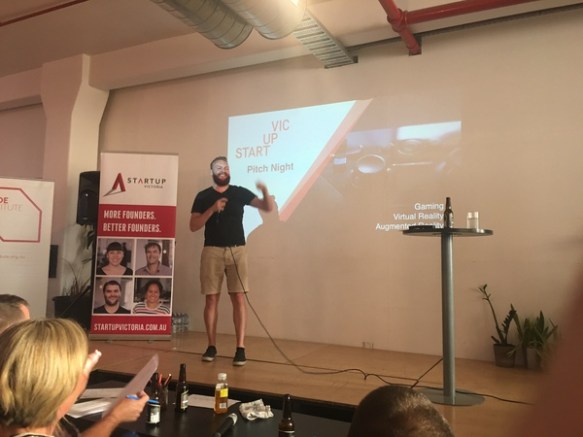
Gaming/VR/AR pitch night at Startup Victoria

Building on the successful format that has been the mainstay of Startup Vic‘s regular meetups for the past few years, February’s pitch night kicked off a scheduled programme of thematic events for 2017. First up was Gaming, VR and AR.

Photo by Daniel C, sourced from the Startup Victoria Meetup page

Hosted as usual by inspire9, the event drew a packed crowd, no doubt helped by the impressive panel of judges assembled by the organisers:

Dr Anna Newberry, responsible for driver-assistance technologies at Ford Australia; Stefani Adams, Innovation Partner at the Australia Post Accelerator; Tim Ruse, CEO of Zero Latency; Rupert Deans, Founder and CEO of Plattar; Samantha Hurley, Co-Founder and Director of Marketing Entourage; Gerry Sakkas, CEO of PlaySide Studios; and Joe Barber, a Commercialisation Advisor to the Department of Industry and Science, a Mentor at the Melbourne Accelerator Program (MAP), and angel investor.

Maintaining the tradition of this blog, I will comment on each startup pitch in the order in which they presented.

Metavents

This niche business offers an event planning app for festivals. At its heart is a tool that allows users to build a 3-D simulation of proposed events, combined with an AI capability to simulate risk management, logistics and team communications, plus a digital time capsule where event attendees can upload photos and other content.

Once licensed to event planners and organisers, the platform charges clients $1 per ticket sale, plus a 2.5% fee on donations and fees for other content and services such as the digital time capsule. In addition, Metavents is building strategic partnerships, and announced a relationship with the Vihara Foundation and its Rock Against Poverty programme from 2018.

All good so far. Then, things got a bit confusing. For example, in addition to festival and event logistics, Metavents claims to offer humanitarian support services in response to natural disasters, and emergency management capabilities for smart cities. There was also talk of a global network (linked to the UN?), and an impact investment fund.

I’m sure I wasn’t alone in thinking that the pitch was a bit disjointed and suffered from a lack of focus. But the pitch did reveal something of the founders’ core passion, and incorporated some impressive graphics – it just felt like a case of form over substance.

Second Sight

Second Sight is a game analytics service that “unlocks the secrets in player data”, by enriching existing big data sources with social media interactions. It does this by profiling players based on their behaviours, and providing this feedback and insights to game developers and product managers. Focusing on the mobile game market, Second Sight is initially targeting independent developers, and will then move on to corporate game businesses.

Second Sight’s own development path is to build automation tools first, then create a library of tasks and insights. With an estimated 1 million users (based on game statistics), 3 paying clients and another 27 beta clients, this startup is showing some promising market traction. However, there are a number of established competitors, including Omniata (which is more of a general user analytics engine, like Mixpanel or Flurry), GameAnalytics, deltaDNA and Xsolla, some of which offer free user services.

In response to the “ask”, ($500k in seed funding in return for 20% equity), the judges suggested that Second Sight might want to address the needs of a specific game sector.

Dark Shadow Studio

This presentation featured an application called Drone Legion, that merges drone experience with VR. Part simulation game, part training software, it was nice to see a demo of the app running in the background, without detracting from the pitch itself.

A key point made by the presentation is that the Civil Aviation Safety Authority (CASA), which is responsible for regulating drones in Australia, is in danger of falling behind other countries. For example, Drone Legion could be adapted to provide user training, testing and licensing before a customer buys a physical drone.

Although there are drone simulators available via Steam, they are not aimed at the general public. Drone Legion is also compatible with a range of gaming consoles.

The judges suggested that this pitch was more an individual game, rather than a business, so it was suggested that the founders should try to get funding from HTC or Oculus to build their first game. And given that one of the judges works for Australia Post (ostensibly a logistics company with a growing interest in drone technology….), there was the offer of a personal introduction.

Phoria

Phoria describes itself as an “immersive media business”, offering rapid 3-D visualisation (especially for the property development sector and the built environment),  and other services such as digital preservation.

But tonight, the pitch was about a plan to use “VR for social good”. Under the moniker “Dreamed”, Phoria is developing a niche health care solution, designing “patient experiences” to help them get out of their current care or treatment environment.

Predicated on an immersive therapy platform, Dreamed will offer a distribution service for cloud-based content, designed to be used alongside other, related assisted therapies that feature Animals, Nature and Music as stimulants for patient engagement and therapeutic outcomes. While not exactly a MedTech solution, Phoria’s “IP special sauce” is the use of VR as a constant dynamic feedback loop, which presumably learns from and adapts to user interaction and monitoring of appropriate patient diagnostics.

So, who pays for the service? Hopefully, hospitals will, especially if they can demonstrate reduced therapy costs and patient treatment times. (Maybe there will also be a consumer market alongside existing meditation apps?) But with some early-stage and potentially high-profile research underway via the Murdoch Childrens Research Institute, Phoria and Dreamed look to be making steady progress, notwithstanding the normally slow pace of medical research. Key to the research outcomes will be user acceptance and ease of service and content delivery, although a large number of unknowns remain in the context of the medical benefits. Meanwhile, Phoria continues to serve its core property market.

Finally, something which I found somewhat surprising, according to the presentation, there is no VR content licensing model currently available. Sounds like a job for a decentralized digital asset management and licensing registry (such as MyBit?).

On the night, and based on the judges’ votes, Phoria took out first place honours.

Next week: The Future of Work = Creativity + Autonomy


Spaceship launches the future of superannuation

Backed by some stellar names in the tech and startup worlds, Spaceship describes itself as a superannuation fund designed to “invest where the world is going, not where it’s been”. Squarely aimed at 18-35 year-olds (and savvy people in their 40s and 50s….), it is the brainchild of Paul Bennetts (a Partner at AirTree Ventures), Andrew Sellen (ex-Marketing Manager at Australian Ethical Investments) and two tech co-founders, Dave Kuhn and Kaushik Sen. Their central thesis is that global tech stocks are the future, and that these assets should form a greater part of a fully diversified portfolio, with a 10-year plus investment horizon.

spaceship-logo-03I first connected with Paul a couple of years ago, when I was working with a legal technology startup that was an early graduate of the Melbourne Accelerator Program. He was interested in what we were doing at Ebla, but the company was at too early a stage for him to invest in. But I’ve kept an eye on what Paul has been doing since, and have followed the Spaceship story quite closely. We last caught up very briefly during a recent roadshow event in Melbourne, as part of the Spaceship beta launch.

Any new superannuation brand, especially if it is neither an industry fund nor a retail fund backed by a major financial institution, is going to struggle to attract members: the industry and public sector funds have the benefit of workplace incumbency (sometimes backed by industrial awards), and the big retail funds have extensive distribution channels via advisor platforms, dealer groups and financial planners. As for corporate superannuation funds, in my experience, many of these employer-run funds are often a re-badged or customised version of an existing retail fund, or a highly outsourced business that retains the company name for brand recognition among employees.

Spaceship is challenging the market by using technology (and very targeted marketing) to streamline the recruitment and on-boarding process. As evidence of its marketing success, Spaceship claims to have built a waiting list of 12,000 prospective members in just 30 days, mostly through social media and word-of-mouth. And as evidence of its success in attracting “smart” money, witness some of the big names who have backed the venture as investors, or joined as members themselves.*

Not surprisingly, Spaceship is also developing some interesting content marketing and social media tactics to drive member engagement. This includes thought leadership on portfolio diversification, understanding investment horizons, accessing investments in early-stage tech companies, and investing in tech brands that its members love and use.

But while much of the media coverage for Spaceship has been positive, it has already drawn detractors (almost in the same breath…). Some of the latter reckon that it won’t achieve necessary scale to be sustainable (in light of APRA moves to drive consolidation among smaller funds), it will be highly concentrated in its exposure to tech stocks (which have a tendency to be more volatile), and without face-to-face contact with members, it will be harder to drive customer engagement.

Given that, following some delays, Spaceship does not launch to the general public until the end of this month (it is still running a waitlist), it’s probably a bit churlish to say it is doomed to failure before it has even really begun. Equally, having worked in financial market research myself, I have met with a number of industry, public sector, retail and corporate superannuation funds who cite member engagement and retention as one of their biggest challenges. The main issue is this: how do you interest an 18-year old in something from which they won’t derive any benefit for at least 40 years?  And once you have got their attention, how do you sustain that interest over the lifetime of their membership and into retirement?

Now technology is having a larger part to play in disrupting the superannuation industry, and changing the way members interact with their fund. As the COO of a major industry fund said recently at a FinTech Victoria event, “consolidating your super balances is only three clicks away” (to which Spaceship, replied “it’s now only one click!”). But it’s not enough to have a smart phone app to check your balances, switch investment options or make voluntary contributions. Members are looking for other services, such as financial education, estate planning, insurance, loans and mortgages, and tailored advice. Plus, they expect much more streamlined processes and pro-active member support.

I suspect that a key factor that will likely contribute to Spaceship’s potential success is the growth of the gig economy:

First, with more people working as freelancers, contractors or becoming self-employed, they will have no ties to a fixed workplace or a single employer – so they will be drawn to a fund product that appeals to their independence and flexibility.

Second, much of the gig economy lies in the tech and startup sectors, so again, prospective members might well be looking for a fund that invests in what they are interested and involved in themselves.

Third, if we are all expected to live and work longer, and if we are going to have to rely more on our own accumulated retirement assets, a fund that fully aligns with this long-term investment philosophy is hopefully going to be better placed to help us meet our financial goals.

Of course, it’s worth remembering that the Australian superannuation industry is both large ($2.1tn in assets as at September 2016, and the 3rd largest pool of pension funds in the world), and highly regulated (for very good reason). Equally, it has been slow to adapt to a changing economy and to different market factors, and is increasingly dominated by just a few big funds. Among some large industry funds, there is almost a cosy, symbiotic relationship between their members (who work in say, construction, energy, mining) and some of the assets the funds invest in (infrastructure, buildings, utilities). (But that may prove to be Spaceship’s USP – representing members who work in the tech sector?)

Although the Australian superannuation and managed funds sectors have established strong capabilities in administration, trustee, custody and asset management services, many of these back-office operations run on legacy IT systems which are potentially ripe for disruption. Plus, while government initiatives look for ways to attract more offshore institutions to place their assets with Australian fund managers, under various financial passport arrangements Australian institutions can invest in offshore funds domiciled and managed in key investment centres such as Luxembourg and Singapore.

Finally, new entrants to the superannuation industry are less likely to be reliant on incumbent and legacy service providers, and more able to take advantage of emerging technologies such as blockchain solutions (distributed ledger platforms), and fully integrated end-to-end CX (mobile apps and tools).

* Declaration of interest and disclaimer: I was successful in signing up to Spaceship in beta/waitlist, and have allocated a small portion of my own super to the fund. I do not have any other commercial connection with Spaceship or its founders. I have not been paid to write this article, nor should it be construed or interpreted as financial advice – it has been provided for general information only. BE SURE TO SEEK YOUR OWN INDEPENDENT FINANCIAL ADVICE BEFORE MAKING ANY FINANCIAL INVESTMENT.

Next week: Gaming/VR/AR pitch night at Startup Victoria

Building a Global/Local Platform with Etsy

In a recent and very informative fireside chat, Linda Kozlowski, COO of Etsy was in conversation with Sarah Moran, CEO of Girl Geek Academy. Key themes of the discussion included the challenges in building a “global/local” platform, making sure you are addressing the right audience needs, and in a two-sided market place, knowing how to balance the interests of sellers and buyers.

etsyOrganised by StartupVic and hosted by inspire9, it was yet another example of how fortunate Melbourne is to attract and host so many leading global figures in the startup world, willing to share their insights (as well as learn more about the local startup scene – which probably does not get as big a rap as it should, especially in mainstream media).

With previous operational roles at both Alibaba and Evernote, Linda brings a strong combination of experience in tech and market places, and describes her current position as covering “CX and revenue from end-to-end”. Her primary focus is on product development, global expansion and addressing sellers’ problems.

At Etsy, the aim is to develop a global product platform that is culturally diverse. There is a natural tension between fully localised customisation (which can be costly to maintain – translation, version control, managing updates), and a “best of breed” model that can serve most users (which can lead to too many compromises). So instead, Etsy pursues a strategy of locally originated products and features, combined with open APIs.

Etsy has also identified sellers as their core audience. This means that so much of the CX is actually determined by sellers’ needs, to whom Etsy then serves up customers to the platform via social media, content marketing and SOE. Etsy sees this as a point of differentiation when considering traditional retailers who often end up squeezing their suppliers on pricing and margins.

In balancing the needs of two-sided markets, again Etsy focuses on the seller first – because buyers want to see depth of inventory and a range of quality products, so get sellers on-board and the buyers will come.

Asked how Etsy avoids buyers going direct to suppliers, Ms Kozlowski commented that it all really depends on where transactions happen: make the CX is so sticky that sellers want to stay on the platform, offer great seller features, and bring in quality buyers. On the other hand, it’s a healthy market place, so there is no mandating or exclusivity – because of course, successful sellers will sell in multiple places.

Etsy believes in investing in the right technology and the right marketing at the same time. For example, although the business was started in 2004, Etsy only began brand marketing in 2016. The types of marketing deployed include storytelling, identifying key differentiators, understanding customer influences, extensive content strategy, plus performance marketing (site traffic, SEO) to see what else customers may be looking for. According to Ms Kozlowski, a retail site should spend about 20-30% of revenue on marketing, otherwise you are buying traffic and customers (red flag to investors!) Alternatively, establish some ROI goals for marketing costs, especially performance marketing, and during the startup phase (up to 1 year) begin with 15-20% of revenue.

At the heart of Etsy’s business model is an evolving technology and e-commerce platform that allows micro-businesses to run at scale. The USP is a community of network effects: 1.7m sellers, 27m buyers, 40m products, 12,000 “teams”, whose “captains” recruit other sellers. (Australia is actually in Etsy’s Top 5 markets.) In addition, Etsy aims to act with integrity in respect to dispute resolution and addressing fraud – they use machine learning to detect rogue sellers (although often, buyer disputes are a reflection of seller inexperience, rather than fraudulent behaviour). Etsy also offers training and support to resolve disputes, and the community is very good at policing itself.

What are some of the unexpected challenges of market places? When it comes to distinguishing between commodity items and unique creative products, technology will under-price and displace commodity goods that are easily made. It’s also important to build human-to-human connections, and to have a global perspective – for reasons of quality and diversity, and not self-limiting your business, especially when it comes to managing different market and economic cycles. Remember to “follow the data”, and anticipate demand and trends. Among some of the technology challenges, dealing with different devices in different countries can be an issue.

In conclusion, Ms Kozlowski offered some advice for anyone thinking of launching a market place:

First, consider why there are very few local e-commerce markets in Australia (from my personal perspective it’s a complex mix of retailers getting burned in the dotcom boom/bust, cosy market duopolies, and perpetual geo-blocking…). But let’s not forget that Alibaba has just opened its Australian & New Zealand HQ in Melbourne, likely to ruffle a few feathers in the retail sector.

Second, embrace a local/global mix (for the reasons mentioned above)

Third, don’t price too low (although Australia is notorious for being a “price-sensitive” market…).

Finally, the conversation ended with a tantalising glimpse of “the future consumer” (Gen Z) where makers connect directly with buyers.

Next week: Spaceship launches the future of superannuation