Bitcoin – to fork or not to fork?

Anyone following the crypto-currency markets this past two weeks will be fully aware that this has been a turbulent time for Bitcoin and other blockchain assets. First, the SEC published its Report on the DAO.  Second, there was a significant arrest in connection with the Mt Gox failure. And third, Bitcoin underwent a fork which has resulted in a new version, known as Bitcoin Cash. Meanwhile, at the time of writing, the price of Bitcoin itself is testing renewed highs, and continues to enjoy a 3-month long rally.

What implications do each of these developments have for the digital asset industry?

Photo by Andre Chinn – Image sourced from Flickr under Creative Commons

The Mt Gox-related arrest came as Japanese authorities began separate criminal proceedings against the former head of the failed exchange. These developments underscore two things: 1) as with any complex financial fraud investigation, bringing the culprits to justice takes time. 2) exploiting the financial system for ill-gotten gain is not exclusive to crypto-currencies – just ask investors in Australia’s CBA bank how they feel about losing nearly 4 per cent of the value of their shares in one day on the back of a money laundering scandal.

It also means that as regulators play catch-up, exchanges, brokers and other participants in the crypto-currency markets will need to ensure that they are updating their security and privacy systems (to prevent future hacks) while ensuring they comply with AML/KYC/CTF provisions. No bad thing, to instil confidence and trust in this emerging asset class, which is entering a new phase of maturity.

The SEC Report on the DAO, meanwhile, has put ICO’s (Initial Coin Offering) and TGE’s (Token Generation Event) on notice that in some cases, these products will be treated as securities, and will be subject to the same regulation as public offers of shares etc. As a result, token issuance programs will need to structure their sale processes to be either fully compliant with, or exempt from, the regulations; at the very least, they must remove any suggestion that these tokens are capable of creating security interests in financial or dividend-bearing assets, unless that is the express intention. (In some cases, these tokens are sold as membership services, software and IP licenses, or as network access permits. Any “return” to the buyer comes from the network value effects, service discounts or user rewards, similar to frequent flyer schemes and customer loyalty programs.)

Again, this suggests a coming of age for digital assets, and a growing maturity in the way token sales can be used as an alternative to VC funding and other traditional sources of raising operating capital and project financing.

The Bitcoin fork was hugely anticipated, with a mix of fear and excitement – fear because of the unknown consequences, excitement at the prospect of Bitcoin holders getting “free money” in the form of “Bitcoin cash“, via a 1:1 issue. Without getting into the technical details, the fork was prompted by the need to increase Bitcoin’s blockchain processing speed and transaction capacity; and while nearly everyone connected to Bitcoin’s infrastructure agreed on the need to accelerate block performance, there was a schism as to how this should be achieved. Some exchanges said they would not recognise the new currency, and only some Bitcoin miners said they would engage with it (especially as the cost of mining the new asset was more expensive than Bitcoin core). In addition, most exchanges were advising their customers not to attempt performing any Bitcoin transactions for several days, before and after the fork, until the system settles down again.

In the aftermath of the fork, at least one more exchanges has said it will probably offer some support Bitcoin cash; while due to the nature of the fork, Bitcoin cash’s own block processing time was something like 6 hours – meaning transactions could not be confirmed, and holders of the new asset could not easily transfer or sell it, even if they wanted to. It feels like a combination of a liquidity squeeze, a trading halt, and a stock split resulting from a very complex corporate action.

So far, the value of Bitcoin has held up, while the value of Bitcoin cash has steadily declined (despite an early spike), almost flat-lining to less than one-tenth of the value of Bitcoin:
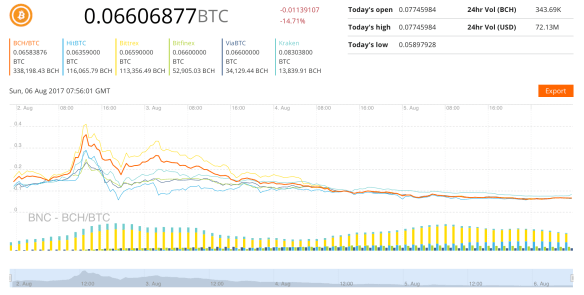
Relative value of Bitcoin cash (BCH) to Bitcoin (BTC) – Market Data Chart sourced from Brave New Coin

I’m not a “Bitcoin absolutist“, as I think different currency designs and technical solutions will continue to emerge based on specific use cases. These products will continue to co-exist as markets come to understand and appreciate the different attributes and functionality of these digital assets.

As a consequence of recent events, some new token projects are refining the design of their issuance programs, more legal opinions are being commissioned, and raise targets are being adjusted in light of the current climate. But the number of new projects coming to market shows no sign of abating, and the better projects will have successful and sustainable sales. The total market cap of all digital assets is now well over $100bn (although the data reveals something of an 80:20 scenario – the top few assets account for the bulk of that value); and more institutional investors and asset managers are taking a greater interest in this new asset class.

NOTE: The comments above are made in a purely personal capacity, and do not purport to represent the views of Brave New Coin or any other organisations I work with. These comments are intended as opinion only and should not construed be as financial advice.

Next week: Bringing Back Banter   


Token Issuance Programs – the new structured finance?

We’ve known for some time now that Blockchain and Bitcoin were designed to disrupt the financial services sector. But I suspect that not even the earliest proponents of distributed ledger technology nor the most avid supporters of crypto-currencies anticipated how far and how quickly that disruption would spread. In addition to P2P payments and lending, alternative stock exchanges, and self-executing smart contracts, recent events suggest that digital assets issued on Blockchain infrastructure are themselves the new source of venture capital, that they may even come to be seen as the new form of structured finance (albeit with less complexity and more transparency).

Image: Maria’s Cakes founder issues her own record…. (Source: Maria Lee website)

In the past few weeks, we have seen Token Issuance Programs (sometimes referred to as ICOs – “initial coin offerings” – or token sales) raise extraordinary amounts of capital – $53m for MobileGo, $150m for Bancor. Even allowing for the fact that VC funding rounds have been increasing in recent years, these results are quite staggering – given that the sellers of these tokens have not had to relinquish any equity, or incur any debt either. Because tokens do not represent shares in a company or units in a corporate bond. Nor are they securities in the usual sense, as they do not create any interest or obligation other than an entitlement to be granted a given number of tokens at a predetermined price.

Of course, these tokens may carry the right to use proprietary software or access marketplace platforms, and even acquire future products. In this way, they also resemble crowdfunding projects. But because of the potential returns generated by the increased value tokens may accrue (a combination of network effects, scarcity and market appreciation), there is buyer demand for new tokens backed by the right project.

These token sale results have also benefited from the increased price of Bitcoin, Ethereum and other leading digital currencies – or perhaps the other way round? – as investors get more comfortable with this new asset class. That’s not to say there isn’t talk of a market correction, or even a bubble. But despite the apparent risks, and the occasional exchange outage, new token issuance and crypto-currency trading are generating growing interest – not just from currency speculators, but also asset managers and traditional investors. No doubt helped by developments in markets like Japan, where crypto-currencies are now a legally recognized form of payment.

As for structured finance, some projects are looking to issue tokens that are linked to or represent an underlying asset, such as a pool of loans. In the case of securitization, for example, Blockchain technology can not only help to structure the token issuance (via smart contracts, for example), it can also provide better transparency on the underlying loan performance (using real-time repayment data from bank feeds, for example).

Of course, there have been some speed bumps along the way for Blockchain-derived assets, most notably the infamous DAO “hack” of last year.  Plus, the price of Bitcoin continues to display considerable volatility, which makes it harder for some investors to embrace. And if anyone is wondering why this week’s blog features an image of a Hong Kong cake shop owner, it relates to the Asian Currency Crisis of 1997-98. Maria’s Bakery was a famous chain of shops that sold coupons at a discount, that could be redeemed for cakes at any time in the future. It was a practice that spread to other retail sectors. But during the market jitters caused by failing currencies and a tightening of credit, there was a run on Maria’s coupons, which coincided with a 2% fall on the Hong Kong stock exchange. This may have been coincidental, but it also demonstrates that financial markets can be sidelined by the most unexpected events. Like, who would have made the connection between over-extended home owners in parts of the USA with the worst global financial crisis for 80 years…?

NOTE: The comments above are made in a purely personal capacity, and do not purport to represent the views of Brave New Coin or any other organisations I work with. These comments are intended as opinion only and should not construed be as financial advice.

Next week: Expert vs Generalist

SportsTech and Wearables Pitch Night at Startup Victoria

Appropriately hosted within Melbourne’s Olympic Park, last week’s Startup Victoria pitch night featured four companies working in SportsTech. It was further evidence of the breadth and variety within the local startup sector even if, on this showing at least, there was a little less innovation than we have seen at other monthly pitch nights.

First, there were a couple of presentations from Catapult and Genius Tech Group, to help provide some context to the topic, especially helpful for people who may not be familiar with this sector. However, I’m not convinced that referencing Australia’s Olympic medal tally as a key rationale for building a sports technology industry necessarily set the right tone. For a start, despite some gold medal success in the 2000, 2004 and 2008 summer games, Australia has seen a rapid decline in medal performance at the past two Olympiads. Then there are the cultural and governance issues at the AOC itself.

Then came the pitches, in order of appearance (website links in the titles):

TidyHQ

With the slogan “tribes are everywhere”, this business is all about getting the off-field performance right. TidyHQ is supporting smarter sporting clubs and organisations by helping them with things like governance and succession planning, and by having all their back office operations in one place. Essentially a white label portal solution that offers branded websites (“SaaS doesn’t work in this market”), the service is designed to support grassroots clubs and associations, across all sports.

Using a freemium subscription model, the main sales channels are local and regional AFL leagues. Sales are helped by a viral effect – given that in small towns and regional areas, there is quite an overlap of club officers.

TidyHQ also takes a clip from sales of multi-stream products and services sold through their customer sites, which includes a diverse range of clients such as yoga studios, play groups, plus a number of US sororities, fraternities and law schools.

Competition comes from different quarters: vendors like TeamSnap and SportsTG; incumbent club officials and their spreadsheets; even social media. One challenge, however is managing and harnessing the “volunteer mindset” associated with community sports clubs, especially when it comes to budgets and adapting to change.

RefLIVE

This company has built an app for soccer referees that works on smart watches. Referees typically use stopwatches to record match time and stoppages which, with constant match use have an average life of 2-3 years. Yet referees also have to keep track of player substitutions, match scores as well as the yellow and red cards they hand out.

At a price point of $60 per annum for referees, and annual fees of between $5k and $50k for soccer leagues and associations, an ideal entry point for RefLIVE would seem to be local, short-form knock-out tournaments, where the full range of features can be deployed in one place.

Currently scaling to take advantage of international market opportunities, RefLIVE is currently receiving enquiries from youth soccer leagues in Japan, as well as Germany and China.

Considered to be (literally) a game changing app for the Apple smart watch, RefLIVE is
also seeing interest from AFL, Rugby Union, Rugby League and field hockey.

At the moment, the platform does not support a live back-end, and there are no real plans to distribute or commercialize the data. While live data could be pushed to a server via WiFi, a bigger obstacle is getting the refs themselves on board – even though it has the potential to enhance their on-field performance and help them with off-field administration.

Spalk

Spalk (“crowd-sourced sports commentary”) enables custom audio streaming for TV sports, via some proprietary technology to synchronise secondary content with traditional broadcasts. Due to the high costs and copyright issues associated with TV broadcast rights for professional sports (only made more complex by “over the top” platforms), Spalk is mainly licensed by broadcasters for coverage of amateur competitions.

The international basketball body, FIBA, sees an opportunity for Spalk to help drive international engagement, through the use of localised and translated commentary. However, in many cases, Spalk will need sports that retain their own D2C content rights. (Anyone familiar with the challenges of listening to overseas test matches will be aware of Guerilla Cricket, and its predecessor, Test Match Sofa.)

Part of Spalk’s “special sauce” is in integrating and synchronizing multiple audio tracks, which can provide better UX compared to social media streams and viewer posts, commentary and Tweets. Another key to success is the ability to integrate with existing broadcasting commentary technology and vendors.

SPT

Finally, SPT (sports performance tracking) is a GPS monitoring system aimed at amateur and grass-roots clubs and leagues. Offering analytics for all teams, SPT is cloud-based, multilingual and claims to be “efficient, simple, affordable”. So simple, that unlike the aforementioned Catapult, clubs don’t even need to hire sports scientists….

Currently supporting 800 clubs, and 65% of revenue coming from overseas (despite claiming to have spent only $300 on marketing), the main appeal is probably the $299 price point per device, and the core user base is amateur leagues.

SPT has so far relied on viral effects and referrals, plus an element of FOMO. While SPT may not be as sophisticated or as detailed as similar platforms used in professional sports, it has managed to demonstrate the data validation when compared to some camera-based apps. In any event, according to the founders, a 2-3% margin for error is OK for this audience. And if users can compare their own performances against those of professionals, that is an added bonus.

However, one issue facing the collection, use and sharing of sports analytics has recently surfaced in a spat between the England team manager, Gareth Southgate, and Manchester United boss, Jose Mourinho. Which may make some clubs reluctant to upload their data.

Following a tally of the judges’ votes, Spalk was declared the winner, but only by a margin of 0.25 points….

POSTCRIPT: While I think the decision to present thematic pitch nights was a good call, there are a few logistical aspects to the current series of events that the organisers need to address:

  1. Choice of venues: the room used for the sports tech pitch night had an unfortunate layout – there was a pillar right in front of the stage, which must have been off-putting for the presenters. (Also, there was only a very small screen to display the pitch deck slides, so most people in the audience wouldn’t have been able to see them.)
  2. AV tech: I’ve said this before, but organisers need to arrange for a second monitor in front of the presenters, so they don’t need to keep looking over their shoulders at their slides. And please, please check that clickers are working (or that presenters know how to use them!)
  3. Audience participation: At previous pitch nights, the MC would field questions from the audience. Now, no more. And the audience voting system (people’s choice) has gone awry. Makes it feel less engaging.

Next week: The network(ing) effect

#Blockchain heralds a new railway age?

Last week, I suggested that digital currencies might be the new portals. Reflecting further on my work with Brave New Coin*, it also occurs to me that the growth of Blockchain resembles the railway mania of 19th century Britain. Hopefully it won’t end in the same over-investment and asset bubble – but there are some interesting similarities.

“Railway Mania” – Image sourced from Business Pundit

First, the railways displaced the canal system, just as canals overtook roads as the key means of transportation. For these purposes, if we compare roads to the Internet, and canals to the World Wide Web, then Blockchain is the next generation of the “information superhighway”. Blockchain and distributed ledger technology, along with crypto-currencies, digital assets and smart contracts are powering the “new” internet – the Internet of Things, the Internet of Money, the Internet of Value Exchange.

Second, and in a similar vein, the Internet was designed primarily as a means of communication. Then, the web enabled e-commerce, content distribution and on-line interaction. Now, Blockchain technology is supporting a range of new activities – such as tokenizing tangible and intangible assets; securing personal data and financial accounts; decentralizing networks, exchanges and registries; and validating immutable transaction data.

Third, the proliferation of public, private and permissioned Blockchains is prompting the development of technical standards for the design, architecture, security and taxonomy associated with this technology – as railway systems have implemented common safety and operating standards. There is also the need for interoperability between Blockchains, just as railway networks have had to address different track gauges among competing operators.

Of course, on the downside, railway mania led to heightened speculation, failed or over-optimistic prospectuses, and duplication of competing networks as developers sought to secure the most lucrative routes.

And let’s not overlook the issue of forking, which Blockchains are having to address in order to meet the demand for increased processing capacity and/or to iron out potential design weaknesses. In some ways this resembles the creation of railway branch lines – in some cases, these subsidiary routes would become more important than their parent main lines; and may even have outlived them, following the Beeching restructures in the 1960s.

Finally, for all the benefits that Blockchain undoubtedly holds, challenges remain with “on-ramp / off-ramp” access – a bit like disconnected transport interchanges or uncoordinated train timetables.

*Note: the opinions expressed here are my own, and do not represent the views of Brave New Coin or their clients.

Next week: Long live experts….