Spaceship launches the future of superannuation

Backed by some stellar names in the tech and startup worlds, Spaceship describes itself as a superannuation fund designed to “invest where the world is going, not where it’s been”. Squarely aimed at 18-35 year-olds (and savvy people in their 40s and 50s….), it is the brainchild of Paul Bennetts (a Partner at AirTree Ventures), Andrew Sellen (ex-Marketing Manager at Australian Ethical Investments) and two tech co-founders, Dave Kuhn and Kaushik Sen. Their central thesis is that global tech stocks are the future, and that these assets should form a greater part of a fully diversified portfolio, with a 10-year plus investment horizon.

spaceship-logo-03I first connected with Paul a couple of years ago, when I was working with a legal technology startup that was an early graduate of the Melbourne Accelerator Program. He was interested in what we were doing at Ebla, but the company was at too early a stage for him to invest in. But I’ve kept an eye on what Paul has been doing since, and have followed the Spaceship story quite closely. We last caught up very briefly during a recent roadshow event in Melbourne, as part of the Spaceship beta launch.

Any new superannuation brand, especially if it is neither an industry fund nor a retail fund backed by a major financial institution, is going to struggle to attract members: the industry and public sector funds have the benefit of workplace incumbency (sometimes backed by industrial awards), and the big retail funds have extensive distribution channels via advisor platforms, dealer groups and financial planners. As for corporate superannuation funds, in my experience, many of these employer-run funds are often a re-badged or customised version of an existing retail fund, or a highly outsourced business that retains the company name for brand recognition among employees.

Spaceship is challenging the market by using technology (and very targeted marketing) to streamline the recruitment and on-boarding process. As evidence of its marketing success, Spaceship claims to have built a waiting list of 12,000 prospective members in just 30 days, mostly through social media and word-of-mouth. And as evidence of its success in attracting “smart” money, witness some of the big names who have backed the venture as investors, or joined as members themselves.*

Not surprisingly, Spaceship is also developing some interesting content marketing and social media tactics to drive member engagement. This includes thought leadership on portfolio diversification, understanding investment horizons, accessing investments in early-stage tech companies, and investing in tech brands that its members love and use.

But while much of the media coverage for Spaceship has been positive, it has already drawn detractors (almost in the same breath…). Some of the latter reckon that it won’t achieve necessary scale to be sustainable (in light of APRA moves to drive consolidation among smaller funds), it will be highly concentrated in its exposure to tech stocks (which have a tendency to be more volatile), and without face-to-face contact with members, it will be harder to drive customer engagement.

Given that, following some delays, Spaceship does not launch to the general public until the end of this month (it is still running a waitlist), it’s probably a bit churlish to say it is doomed to failure before it has even really begun. Equally, having worked in financial market research myself, I have met with a number of industry, public sector, retail and corporate superannuation funds who cite member engagement and retention as one of their biggest challenges. The main issue is this: how do you interest an 18-year old in something from which they won’t derive any benefit for at least 40 years?  And once you have got their attention, how do you sustain that interest over the lifetime of their membership and into retirement?

Now technology is having a larger part to play in disrupting the superannuation industry, and changing the way members interact with their fund. As the COO of a major industry fund said recently at a FinTech Victoria event, “consolidating your super balances is only three clicks away” (to which Spaceship, replied “it’s now only one click!”). But it’s not enough to have a smart phone app to check your balances, switch investment options or make voluntary contributions. Members are looking for other services, such as financial education, estate planning, insurance, loans and mortgages, and tailored advice. Plus, they expect much more streamlined processes and pro-active member support.

I suspect that a key factor that will likely contribute to Spaceship’s potential success is the growth of the gig economy:

First, with more people working as freelancers, contractors or becoming self-employed, they will have no ties to a fixed workplace or a single employer – so they will be drawn to a fund product that appeals to their independence and flexibility.

Second, much of the gig economy lies in the tech and startup sectors, so again, prospective members might well be looking for a fund that invests in what they are interested and involved in themselves.

Third, if we are all expected to live and work longer, and if we are going to have to rely more on our own accumulated retirement assets, a fund that fully aligns with this long-term investment philosophy is hopefully going to be better placed to help us meet our financial goals.

Of course, it’s worth remembering that the Australian superannuation industry is both large ($2.1tn in assets as at September 2016, and the 3rd largest pool of pension funds in the world), and highly regulated (for very good reason). Equally, it has been slow to adapt to a changing economy and to different market factors, and is increasingly dominated by just a few big funds. Among some large industry funds, there is almost a cosy, symbiotic relationship between their members (who work in say, construction, energy, mining) and some of the assets the funds invest in (infrastructure, buildings, utilities). (But that may prove to be Spaceship’s USP – representing members who work in the tech sector?)

Although the Australian superannuation and managed funds sectors have established strong capabilities in administration, trustee, custody and asset management services, many of these back-office operations run on legacy IT systems which are potentially ripe for disruption. Plus, while government initiatives look for ways to attract more offshore institutions to place their assets with Australian fund managers, under various financial passport arrangements Australian institutions can invest in offshore funds domiciled and managed in key investment centres such as Luxembourg and Singapore.

Finally, new entrants to the superannuation industry are less likely to be reliant on incumbent and legacy service providers, and more able to take advantage of emerging technologies such as blockchain solutions (distributed ledger platforms), and fully integrated end-to-end CX (mobile apps and tools).

* Declaration of interest and disclaimer: I was successful in signing up to Spaceship in beta/waitlist, and have allocated a small portion of my own super to the fund. I do not have any other commercial connection with Spaceship or its founders. I have not been paid to write this article, nor should it be construed or interpreted as financial advice – it has been provided for general information only. BE SURE TO SEEK YOUR OWN INDEPENDENT FINANCIAL ADVICE BEFORE MAKING ANY FINANCIAL INVESTMENT.

Next week: Gaming/VR/AR pitch night at Startup Victoria
The Maker Culture

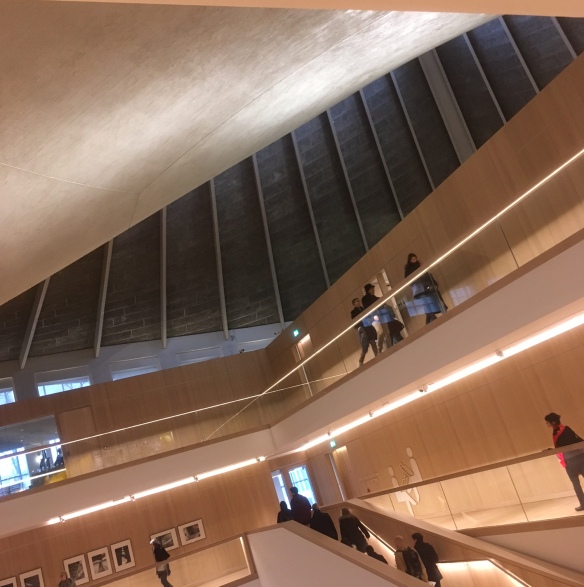
London’s newly re-opened Design Museum welcomes visitors with a bold defining statement of intent. According to the curators, there are only designers, makers and users. To me, this speaks volumes about how the “makers” are now at the forefront of economic activity, and how they are challenging key post-industrial notions of mass-production, mass-consumption and even mass-employment. Above all, as users, we are becoming far more engaged with why, how and where something is designed, made and distributed. And as consumers we are being encouraged to think about and take some responsibility for our choices in terms of environmental impact and sustainability.

Design Museum, London (Photo: Rory Manchee)

Design Museum, London (Photo: Rory Manchee)

There are several social, economic, technological and environmental movements that have helped to define “maker culture”, so there isn’t really a single, neat theory sitting behind it all. Here is a (highly selective) list of the key elements that have directly or indirectly contributed to this trend:

Hacking – this is not about cracking network security systems, but about learning how to make fixes when things that don’t work the way that we want them to, or for creating new solutions to existing problems – see also “life hacks”, hackathons or something like BBC’s Big Life Fix. Sort of “necessity is the mother of invention”.

Open source – providing easier access to coding tools, software programs, computing components and data sources has helped to reduce setup costs for new businesses and tech startups, and deconstructed/demystified traditional development processes. Encompasses everything from Linux to Arduino; from Github to public APIs; from AI bots to widget libraries; from Touch Board to F.A.T. Lab; from SaaS to small-scale 3-D printers.

Getting Sh*t Done – from the Fitzroy Academy, to Andrea de Chirico’s SUPERLOCAL projects, maker culture can be characterised by those who want: to make things happen; to make a difference; to create (social) impact; to get their hands dirty; to connect with the materials, people, communities and cultures they work with; to disrupt the status quo; to embrace DIY solutions; to learn by doing.

The Etsy Effect – just part of the response to a widespread consumer demand for personalised, customised, hand-made, individual, artisan, crafted, unique and bespoke products. In turn, platforms like the Etsy and Craftsy market places have sparked a whole raft of self-help video guides and online tutorials, where people can not only learn new skills to make things, they can also learn how to patch, repair, re-use, recycle and re-purpose. Also loosely linked to the recent publishing phenomena for new magazines that combine lifestyle, new age culture, philosophy, sustainability, mindfulness, and entrepreneurism with a social conscience.

Startups, Meetups and Co-working Spaces – if the data is to be believed, more and more people want to start their own ventures rather than find employment with an existing organisation. (Under the gig economy, around 40% of the workforce will be self-employed, freelance or contractors within 5 years, so naturally people are having to consider their employment options more carefully.) While starting your own business is not for everyone, the expanding ecosystem of meetups and co-working spaces is enabling would-be entrepreneurs to experiment and explore what’s possible, and to network with like-minded people.

Maker Spaces – also known as fabrication labs (“FabLabs”), they offer direct access to tools and equipment, mostly for things like 3-D printing, laser-cutting and circuit-board assembly, but some commercial facilities have the capacity to support new product prototyping, test manufacturing processes or short-run production lines. (I see this  interface between “cottage industry” digital studios and full-blown production plants as being critical to the development of high-end, niche and specialist engineering and manufacturing services to replace the declining, traditional manufacturing sectors.) Some of the activity is formed around local communities of independent makers, some offer shared workshop spaces and resources. Elsewhere, they are also run as innovation hubs and learning labs.

Analogue Warmth – I’ve written before about my appreciation for all things analogue, and the increased sales of vinyl records and even music cassettes demonstrate that among audiophiles, digital is not always better, that there is something to be said for the tangible format. This preference for analogue, combined with a love of tactile objects and a spirit of DIY has probably reached its apotheosis (in photography at least) through Kelli Anderson’s “This Book Is A Camera”.

Finally, a positive knock-on effect of maker culture is the growing number of educational resources for learning coding, computing, maths and robotics: Raspberry PI, Kano and Tech Will Save Us; KidsLogic, Creative Coding HK and Machinam; Robogals, Techcamp and robokids. We can all understand the importance of learning these skills as part of a well-rounded education, because as Mark Pascall, founder of 3months.com, recently commented:

“I’m not going to advise my kids to embark on careers that have long expensive training programs (e.g. doctors/lawyer etc). AI is already starting to give better results.”

Better to learn how things work, how to design and make them, how to repair them etc., so that we have core skills that can adapt as technology changes.

Next week: Life Lessons from the Techstars founders


“Language is a virus” – a look at coding skills

We are fast-approaching the point when a lack of some basic coding skills will be likened to being illiterate. If you are unable to modify a web page or use an HTML text editor, it will be like not knowing how to create a Word document or edit a PDF file. Coding does appear on some school curricula, but it is primarily taught in the context of maths, computer programming or IT skills. Whereas, if we look at coding as a language capability (part of a new literacy), it should be seen as an essential communication tool in itself.

quote-William-S.-Burroughs-language-is-a-virus-from-outer-space-92713First, I am aware that a number of programs for children are trying to teach coding and maths in more relevant ways, and having talked to some of their creators, I admire their ambition to place these skills in a broader context. Coding might be described as the “4th R”: alongside reading, writing, arithmetic we have reasoning”. So a program like Creative Coding HK (as it name implies) focuses on students making things; in the USA, KidsLogic is placing as much emphasis on contextual learning as on robotics; while Australia’s Machinam is re-writing the maths curriculum to teach practical, everyday problem-solving skills.

Second, as we know, learning the foundations of coding is like learning the syntax of a foreign language. However, while Latin and Greek can provide the basis for learning the structure (and many words) of many European languages, it’s not much use when learning character-based languages (Chinese, Japanese) – although there are common grammatical elements. But if we understand that a line of any code has to be structured a certain way, contain essential elements, define key attributes and run in a particular sequence or order, we may come to “read” and interpret what the code is saying or doing.

As an aside, I’m struck by the comments made by the founder of AssignmentHero during a recent pitch night. Although he had studied computer sciences at Uni, he did not use any of the formal computing languages he had learned when building his product. This highlights the downside of learning specific languages, which can become obsolete, unless we have a better grasp of “which languages for which purposes”, or find ways to easily “interpolate” components of one language into another (just as languages themselves borrow from each other). Or do we need an Esperanto for coding?

Third, even if I don’t want or need to learn how to program a computer or configure an operating system, knowing how to define and sequence a set of instructions for running some software or a dedicated program will be essential as more devices become connected in the Internet of Things. For myself, I have dabbled with a simple bluetooth enabled robot (with the original Sphero), acquired a WiFi-enabled light bulb (the programmable LIFX) and experimented with an iOS music app that incorporates wearables (the MIDI-powered Auug motion synth).

Finally, just like a virus, coding is contagious – but in a good way. At a recent event on Code in the Cinema (hosted by General Assembly as part of the Melbourne International Film Festival), there were three demos which captured my attention, and which I will be investigating over the coming months:

I think they show why, where and how many of us “non-computing” types will want to learn the benefits of coding as a new language skill. If nothing else, getting comfortable with coding will help mitigate some of the risks of the “digital divide”.

Next week: The arts for art’s sake….

Re-Imagining Human-led #Innovation

Following my previous blog on Innovation, I recently participated in an on-line forum on the Future of Innovation, hosted by Re-Imagi, and facilitated by Jesper Christiansen from NESTA, a UK-based think-tank. You can read about it here, including the infographic output of the discussion. As a result of working with my fellow Re-Imagineers, I developed some ideas on what I call the “Innovation Dichotomy”, which I shared last week at an Re-Imagi event on the Future of Financial Services, hosted at NAB Village in Melbourne.

Screen Shot 2016-08-07 at 3.03.52 PMThe Innovation Dichotomy revolves around an over-emphasis on technology, as illustrated by the following:

  1. Innovation is heavily tech-led, but design thinking is very much human centred and is all about mapping people’s’ needs;
  2. Innovation is often based on digital disruption, and is mostly about devaluing existing processes, de-layering management levels, and increased automation; and yet human skills (cognition, empathy, client-facing, service delivery) are going to be in increasing demand;
  3. Innovation usually happens in tech-labs and silos (external and internal), but it will be people (employees, customers, stakeholders) who actually implement the changes – so there has to engagement through alignment of values and purpose.

And as one of our participants at NAB Village commented, if the organisational culture and communications are not right, any innovation-led change will be destined to fail.

Finally, Re-Imagi will be in Sydney this week, so get in touch if you’d like to find out more: rory@re-imagi.co

Next week: The Day of the Mavericks – the importance of intrapreneurship