Finding purpose through self-reflection

We hear a lot about “finding your purpose” these days, whether it’s to develop a personal career plan, or to validate a business idea. My colleague Carolyn Tate, founder of the Slow School of Business, spoke on “purpose” at the recent Huddle Design Fest drawing on her TEDx talk for Telstra entitled “Profit on Purpose”. During her presentation, Carolyn referenced the Japanese concept of 生き甲斐 (“ikigai” = “a reason for being”) which is sometimes represented in the following diagram:

Ikigai-EN-optimized-PNG

“Finding the purpose of your life”. Graphic representation by @emmyzen (Emmy van Deurzen). Image sourced from Wikimedia Commons

Variations on this theme include, for example, the work of Lianne Bridges and Susan Biali. Earlier, more prosaic, interpretations might be found in the work of Richard N. Bolles (“What Colour is Your Parachute?”) or Spencer Johnson (“Who Moved My Cheese?”).

What it all boils down to is connecting with your values and interests, and finding a balance between what motivates you, what rewards you, what you can contribute, and what people want from you.

For me, a the starting point is developing a personal narrative, to understand how you have arrived at this particular point in your life and/or career, in particular your influences, achievements, challenges, experiences and insights. Through this self-reflection, some common themes should emerge that can form of the basis of defining your own purpose. This should include your core values, the things that are important to you, and your own particular passion.

Where I may differ in my interpretation of “purpose” is that I believe that our purpose can change over time. I don’t see purpose as singular or even linear – it’s multi-dimensional, dynamic, situational and contextual. Our needs and our circumstances don’t stay the same. Likewise, our relationships and the the external environment are constantly changing. So our purpose will likewise be different at different points in our life. For example:

  • Early in our career we may be technically qualified, but without relevant experience we may not be able to command the most senior roles or the highest pay – so our purpose may be to hone our skills and knowledge
  • Later, we may find that our focus on things like marriage, children and a mortgage means we may be willing to get well-paid for work that we don’t actually enjoy – someone I was coaching recently stated that “I’m caught in a job” which was preventing him from pursuing his passion (thankfully, he has since decided to pursue a portfolio of interests, rather than stick with a single job he no longer enjoys)
  • During the “third act” of our career, financial or material rewards may not be so important, but we still need to be engaged in work that we enjoy, that motivates us and which can still sustain us at more than just a basic level of food and shelter
  • Throughout, I think it is essential to keep connected to our true passions (especially creative outlets), in part to provide a counterbalance to work/financial/external imperatives, in part to explore alternative ideas, find linkages between our other interests, and even to connect with new technology – for example, in my own case, my interest in electronic music has led me to recording an album using iOS devices, releasing it via social media sites Soundcloud and Bandcamp, getting it broadcast on the ABC, and beta-testing new music apps

When working with clients to help them re-connect with their business or their career purpose, I like to do an audit of where they are now, and where they could be in 3-5 years time. Through a process of exploring what might be possible, and reframing the present to re-position it for future growth and development, we can discover ways to regain balance by prioritising what’s important, reconfigure or even abandon what isn’t working, and re-establish goals and objectives.

While it is important to strike a balance between the “four pillars” of the ikigai model, my experience is that rarely will all four be in equilibrium – at times they may even be in conflict with one another, or at least in a state of flux. But it’s the resulting points of friction, when we look at them objectively, that can be the source of ideas, context, clarity and resolution. Making time for regular self-reflection enhances our pursuit of purpose, and allows us to take stock of our current situation, without undermining our core values or abandoning our particular interests.

Next week: Challenging Monocultures via Crop Rotation

Making the most of the moment…

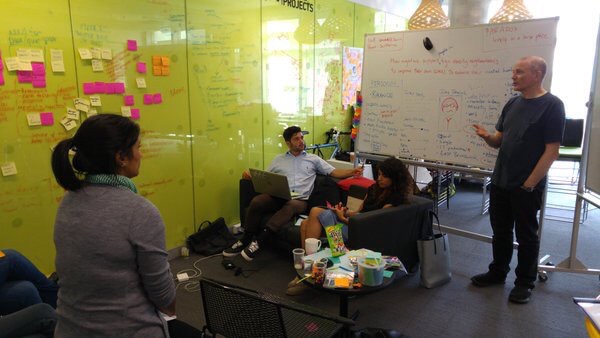
I’m the first to admit that I am not very good at practising meditation. It’s not that I don’t aspire to a state of mindfulness, but I sometimes find it hard to “be in the moment”. It does not come easily or naturally to me, because I’m often too busy thinking about the objective context, rather than the subjective conscious experience. So it was really interesting to see this photo of myself at last weekend’s Global Service Jam, organised by the Melbourne Jam Team at Swinburne Design Factory, and supported by Deloitte Digital, the School of Design Thinking and Huddle.

“This is where the magic happens…” (Photo by Johan Pang – image sourced from Twitter)

This photo was probably taken about halfway through the 48-hour event. Our team had got to the stage where we had articulated our problem statement (after much ideation…), scoped a solution model, done some validation through research and field interviews, and refined our key persona, all supported by some feedback from role-play and scenario testing. We had also just completed a lightning prototyping workshop, so the team needed to decide the overall form of our proposed service design solution, and reach agreement on the presentation format. Although there was so much still to do, we were at risk of revisiting things that had already been decided, because it felt like there was some remaining uncertainty about our prototype and some of the choices we had made along the way.

I don’t recall the exact “moment” (how imprecise a measure of time is that word?) but without realising it I found myself almost urging the team to stick with our existing decisions, and work through the remaining tasks based on the information we had to hand. It was a subconscious reaction to the message we had been given in the prototyping workshop about making decisions based on “the authority of the moment”. (Thank you, Rez Ntoumos!)

Sure, we weren’t having to make split-second, life-or-death decisions under enormous pressure, but if there was any “magic” here, it was probably about being able to be in the zone – the willingness to submit to the situation, to go with the flow. Throughout the weekend, we were advised not to fall in love with a particular idea or solution, but at the same time we were encouraged to get behind the team decisions and the options we chose – partly to sustain momentum, and partly to make sure we met the project deadlines!

There is a huge lesson here, because it goes some way to addressing the dilemma that many organisations face in making and implementing decisions (be they boards, policy makers, executive teams, startups, project managers, entrepreneurs, product developers or designers….). While it’s important to have robust decision-making processes, and it’s vital to consider all available data, the quality of any decision may not rest on whether it was the “best” choice to make, because usually only the benefit of hindsight can tell you that. If, however, at the time, it seemed like the right or appropriate choice, then in that moment it has to be the best-available decision.

Of course, there needs to be governance, transparency, authority and information to support, justify and legitimise the decision. Good decisions are usually those which can be fully articulated, the reasons easily communicated, and the implications clearly understood. Then once a choice has been made, the organisation or team that gets right behind the decision is more likely to succeed in the execution. All organisations at some point make “bad” decisions or inappropriate choices, but I think more often, even good decisions can suffer through poor implementation.

I acknowledge the need to get better at meditating, to enhance mindfulness for both personal reflection and clarity of thinking. Above all I recognise the enormous value of making the most of the moment when it comes to decision-making.

Next week: Startup Victoria’s latest pitch night

It’s never too late to change….

Few things annoy me more than when someone in their late 20’s or early 30’s says: “I’m stuck in my job, and I can’t do anything about it.” My immediate reaction is to shout, “No you’re not, and yes you can!” But I stop myself, and ask instead, “What’s stopping you from making a change?” Usually, there is a mental blockage, and an inability to think outside or beyond the immediate situation. In turn, this is often linked to a distorted perspective about how they got to where they are, coupled with unreasonable (and therefore, unrealised) expectations.

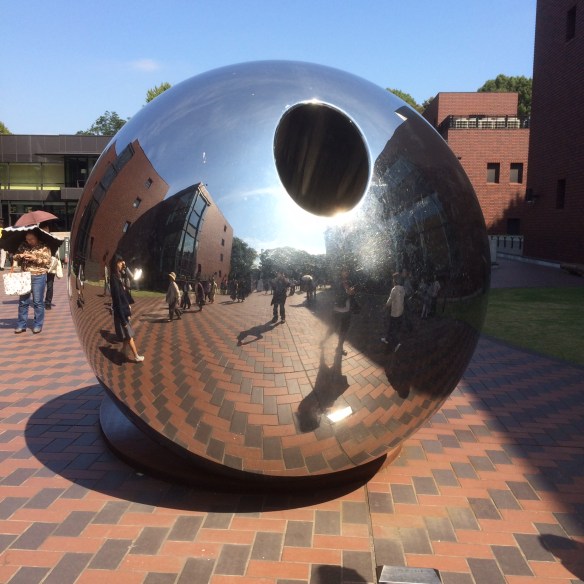
Sculpture, Ueno Park, Tokyo (Photo © Rory Manchee, all rights reserved)

” A new perspective?” (Ueno Park, Tokyo – Photo © Rory Manchee, all rights reserved)

Helping my clients to identify the barriers in their way (in particular any deeply entrenched obstacles), and to explore ways to dismantle or overcome them usually leads to alternatives: a new job opportunity, a potential career transition or a new business direction. It may not be an easy or comfortable process, but it’s not impossible. At its heart is the need for self-awareness, the willingness to embrace change, and the commitment to making it happen.

“See You At The Barricades”

Here are some of the initial objections I hear when people say they can’t make a career change or transition:

  • Financial security
  • Lack of time
  • No access to resources
  • No idea what to do next, where to look, how to plan
  • Enjoy the job, but not the organisation (or vice versa)
  • This is the only work they know, or studied/trained for
  • Non-transferable skills or inadequate training

My usual response is to get them to re-contextualize. It’s rather like using cognitive behaviour therapy, to reframe the situation. “How could you look at this differently?”, “What if you did this?”, “Who could help you overcome that?”, “What would be the ideal situation?”.

“Money’s Too Tight To Mention”

I understand that financial insecurity can be a major cause for concern. The certainty of a regular salary (even if you hate the job) can be preferable to taking a pay cut for a more rewarding role, or having to forego immediate financial return during a period of retraining or re-skilling. But if you are only doing a job because of the money, the likelihood is that you may never be entirely happy in your role, you may come to resent the work you do, and eventually you may lose sight of what is important to you. Plus, the knock-on effect on your personal well-being and that of your family can be significant. After all, no job has a lifetime warranty or even a 2-year guarantee, so the paycheck will probably run out anyway.

“Time Is On My Side”

Even if your financial circumstances or apparent lack of time mean that you can’t leave your current job or explore other options without securing a comparable income in another role, there are several ways to prepare for a career transition:

  • Re-train in your own-time – use on-line courses, evening classes and weekend workshops to access new skills and education
  • Ask your current organisation about options for study leave or flexible work hours
  • Suggest a personal development plan that draws on existing resources – e.g., shadow another colleague, or do a rotation or secondment to another team or department
  • Workers in some industries or older employees may be able to access public funding to support retraining and re-skilling
  • Use your annual leave to intern or volunteer at an organisation where you might like to work in the future

“Possibly Maybe”

There are many new opportunities for personal development through short courses, skill sharing or peer-to-peer platforms, and alternative learning paths to re-connect with your purpose. It might even be possible to reconfigure or restructure your current role to better suit your needs. Besides, the job you were originally hired for (or the industry and/or the career you trained for) has probably changed significantly; if you are not doing some regular re-engineering, you risk being confined to outdated thinking or processes, or worse, becoming obsolete.

“This Is Your Big Opportunity”

In fact, you have an obligation to yourself to invest in your own career, by re-training, updating your skills, or embarking on new challenges. Increasingly, organisations expect employees to take personal responsibility for self-managing their career, their professional development and to maintain the technical currency of their skills. Even better if you can demonstrate that learning a new skill can support innovation, generate efficiency gains, or deliver customer benefits. There are increasing examples where collaboration, co-creation and cross-pollination of ideas, skills and people between organisations and their suppliers/vendors/clients/distributors can have mutual outcomes, and employers are looking for people who can identify these opportunities.

“This Is The Way”

From personal experience, curiosity, pro-active networking, asking questions and generally taking an interest in what is going on in and around the organisation and wider world can reap huge rewards. In my own case, having a sense of enquiry prompted a transfer from London to Hong Kong to open a new Asian office for the company I worked for. Earlier in my career, I took evening classes so I could transition from a role in the public sector to a new career in publishing. And I continue to find new learning opportunities through meetups, hackathons and startup pitch nights, and attending workshops on innovation, collaboration, design thinking and technology.

I’ve written previously about the changing economic relationship of employment, because it’s incumbent on all of us to learn resilience and adaptability. We have a duty to equip ourselves in order to cope with and prepare for the continuous change and volatility we are all experiencing in the nature of the work we do.

Finally, for anyone who says they are “too old to change”, consider this: I recently met a man in his 60s, who had retired from a lifelong career in teaching, quickly got bored, and so he went back to college and is now a licensed horse trainer. He gets up earlier than he used to as a teacher, but he has connected with a passion and made it his career choice.

Declaration of Interest: I am a member of the Slow School of Business Advisory Council, which delivers Slow Coaching and Talk on Purpose

Next week: ANZ’s new CEO on #FinTech, CX and #digital disruption

Technology vs The Human Factor

Several times over the past month I have been reminded that the pursuit of technology for its own sake can give rise to misguided innovation; so-called solutions that are divorced from real world problems cannot justify the effort or resources. It feels like we are entering a new phase of the post-industrial revolution era, where a lack of “the human touch” will render many new inventions as worthless, irrelevant or redundant.

Street scultpure, Nagoya. Photo © Rory Manchee (all rights reserved)

Street sculpture, Nagoya. Photo © Rory Manchee (all rights reserved)

In no particular order:

  • At the second Above All Human conference in Melbourne, there was a consistent theme: how do we make sure there is a real connection between human needs and bleeding edge technology?
  • A Slow School of Business excursion to an eco-friendly homestead in rural Victoria offered a practical lesson on how to create harmony between technology and nature, and still achieve a modern (but modest), highly personal and comfortable home.
  • The economic debate about whether technology is improving our standard of living (as reported in the latest CPA magazine), which also echoes a recent CEDA report on automation and the implications for job losses.
  • A Q&A with Shayne Elliott, the new CEO of ANZ Bank, which prompted the observation that big data analytics, process automation and digital disruption are all very well, but will prove meaningless unless they can improve the customer experience. (But Elliott also conceded that the likes of Uber and Airbnb have succeeded because of complacency among industry incumbents.)

Advances in technology don’t have to lead us to the dystopian worlds of “Modern Times” or “Metropolis” (or any of the other post-apocalyptic visions that cinema and literature like to give us). However, the understandable focus on innovation must take the “human factor” into greater account when making design decisions, undertaking cost-benefit analysis and opting for one technology format over another.

Conclusion? It’s not totally clear whether we are entering another dot.com market correction, but there is a case to be made for whether or not we are seeing enough of a “technology dividend” from the current digital disruption and economic displacement centred on the use of cloud, social and mobile platforms; and whether we need a new methodology to measure the impact of the Internet of Things, robotics, AI, nano-technology, AR/VR, cognitive apps, wearables, 3-D printing, etc.

Next week: It’s never too late to change….