The Future of Fintech

Predicting (or at least hypothesising upon) the Future of FinTech in 2019 at NextMoney last week were three brave souls from the Melbourne FinTech community: Alan Tsen, GM of Stone & Chalk and Chair of FinTech Australia; Christina Hobbs, CEO of Verve Super; and Paul Naphtali, Managing Partner at Rampersand. Referencing the latest CB Insights report on VC funding for Fintech, various regulatory developments in Australia (especially Open Banking), as well as the outcomes of the recent Royal Commission on Financial Services, the panel offered some useful insights on the local state of FinTech.For all the positive developments in the past 2-3 years (Open Banking, New Payments Platform, Comprehensive Credit Reporting, Equity Crowdfunding, ASIC’s Regulatory Sandbox, Restricted ADIs etc.) the fact is that innovation by Australian FinTechs is hampered by:
1) fallout from the Royal Commission (although this should actually present an opportunity for FinTech);

2) the proposed extensions to the Sandbox provisions (which are stuck at the Federal level); and

3) lack of regularity clarity on the new class of digital assets made possible by Blockchain and cryptocurrencies (cf Treasury Consultation on ICOs).

Overall, the panel agreed that the channels of distribution have been locked up in an oligopolistic market and economic structure, especially among B2B services. But things are changing in B2C, with the rise of P2P payment platforms, market places, mobile and digital solutions, and challenger brands (e.g., neo-banks).

However, there are under-serviced segments especially among the SME sector, and products and services for part-time employees, contractors and freelancers. For example, meeting the superannuation and insurance needs of the “gig economy”? (Maybe something will come out of the recent Productivity Commission review on Superannuation.)

A number of areas have already benefited from FinTech innovation and disruption – lending (origination, funding, distribution), robo-advice (at scale but not yet offering truly tailored solutions), and P2P payments (and which largely happened outside of the NPP).

When it comes to disrupting and innovating wealth management and financial advice, there is still a distribution challenge. Whatever your views are on the Royal Commission findings and recommendations, there is clearly a problem with the status quo. But is the appropriate response to “smash the banks” or to enable them?

One view is that we are going through a period of un-bundling of financial services. Personally, I think customers want ease of use and interoperability, not only standalone products that are best in breed. For example, if I have established sufficient identification to open and maintain a bank account with one ADI, shouldn’t I be able to use that same status to open a deposit, savings or transaction account with another ADI, without having to resubmit 100 points of ID? And even use that same ID status with an equivalent ADI overseas?

There is often a tension between incumbents and startups. Whether it’s procurement processes, long-term sales cycles, stringent payment policies (notwithstanding the BCA’s Supplier Payment Code) or simple risk aversion, it is very difficult for new FinTech companies to secure commercial supply contracts with enterprise clients. Even though a Blockchain platform like Ripples is working with major financial institutions, most times the latter don’t readily engage with FinTech startups.

Then there is the problem with “tech for tech’s sake”. For example, don’t offer “smart” solutions that actually make it harder or more complex. And don’t build great tech products that offer lousy UX/UI.

A key issue is defining “trust” – whether at the sector level (on the back of the Royal Commission); or at the individual level (the current environment of personal privacy, data protection, identity theft): or at the product level (e.g., decentralised and “trustless” platforms). As one panelist commented, despite the news, “headlines don’t change behaviours”. We love to bash our banks, but we rarely switch providers (mainly because it is far more difficult than it actually needs to be…) And the backlash against social media companies has not resulted in any major movement to unfriend them (witness the response to campaigns like QuitFacebookDay…).

So what are some of the predictions for the next few years (if not the next few months)?

  1. Within 5 years, the 5th pillar will be a challenger bank.
  2. A period of un-bundling followed by re-bundling
  3. A trend for “Financial Wellness” (especially financial education and literacy, not just wealth management and accumulation)
  4. A switch in personal asset allocation/accumulation from mortgages to superannuation – (i.e., new brands like Verve want to be your lifetime financial partner, so that “we invest together”)
  5. Superannuation funds will obtain banking licenses (or maybe one of the FAANGs will?)
  6. Personal Statements of Advice vs ASIC’s MoneySmart – who’s going to be paying for financial planning, advice, products and distributions?
  7. Capitalizing on the lack of trust among incumbents and centralised platforms
  8. More diversity and inclusivity in access to products and services
  9. Payments FinTechs that will disrupt lending (if they can solve the problem of
    going international)
  10. The growth of RegTech – a model of agile governance supported by great UX
  11. The equivalent of open banking for Personal Financial Management services
  12. Banks as data fiduciaries

Next week: An open letter to American Express
The Future of Super

As I mentioned in last week’s blog on the recent Intersekt conference, there was an interesting panel discussion on Superannuation – interesting not just because of the topic, but also because it was about the only session I attended at the conference where there was some real disagreement among the speakers. Just goes to show how sensitive and contentious Super has become – and this was not even a discussion about the Royal Commission!

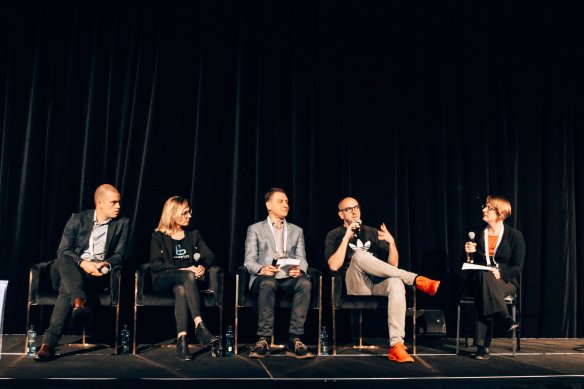
L to R: Peter Stanhope, Carla Harris, Greg Einfeld, Jon Holloway. Moderator Erin Taylor. (Photo sourced from Facebook)

The protagonists were Jon Holloway (Zuper), Carla Harris (Longevity App), Peter Stanhope (GIG Super) and Greg Einfeld (Plenty Wealth).

With around $2.7tn in assets under management, we were told that the Australian model for state-sponsored, privately funded retirement planning is the envy of the world. Yet we also heard that it has been so badly executed at home that we are in the midst of a huge shift in our attitudes towards this defined contribution scheme. And this is not just about disruption or technology – there are serious concerns that many Australians are not willing and/or able to set aside enough assets to provide for their retirement living; that the system is being rorted via skewed tax rules, gender-based wage disparity and expensive management fees; and that there is an overall lack of investor education, interest and engagement.

But for context, and in Super’s defence, the system has helped to make Australians a lot wealthier (along with property), and rank higher than Switzerland for median wealth. And as The Economist recently reported, for good or for bad, Super means that Australia does not have as heavy a state pension cost as most of the OECD.

Some of the issues facing the industry, as outlined by the panel include:

  • the changing definition of “ordinary Australians” (who are they? how is this even defined?)
  • the changing nature of work (the gig economy etc.)
  • the need for Open Super Data (to make choice and switching easier)
  • redefining “retirement” (given we are living longer beyond the traditional working age)
  • addressing gender imbalance in wages and contributions
  • redundant marketing imagery used by much of the Super industry
  • why the audience is under-educated and under-engaged on this topic
  • too little industry competition (although the regulator APRA is known to favour consolidation of smaller funds which are not sustainable)
  • the advice delivery channel needs to change, as does access to, and choice of, products and providers
  • the technical infrastructure is not fit for purpose for things like custody and administration (still living in the 80s?)
  • tax planning (a key rationale for how super is managed is determined by tax minimization)
  • generational change (linked to changing work patterns)

The panel discussion was followed by a fireside chat between Kerr Neilson of Platinum Asset Management, and Simon Cant of Reinventure. According to Mr Neilson, the key structural changes facing the industry are a direct result of financial planning advice becoming less profitable: no more trailing commissions (probably a good thing?); fewer advisors in the market (due to increased professional education requirements) with a resulting shift to accountants; and even robo-advice is not truly scalable. Meanwhile, for anyone watching their Super balance and returns, beware the Trump knock-on effects of trade tariffs and interest rates – this will require greater asset diversification, and robust currency risk management, to take advantage of new investment opportunities.

Next week: What they should teach at school

Wholesale Investor’s Crypto Convention

Another day, another blockchain and crypto event. This time, the latest Wholesale Investor pitch fest in Sydney featuring companies that are looking to raise funding from accredited investors – either to invest in other crypto businesses, or as equity in their blockchain projects, or via a token sale.

Fran Strajnar, CEO and Co-Founder of Techemy delivering the opening Keynote Presentation

The pitches were punctuated by a number of keynote presentations, and panel discussions, to provide some context on what is going on in crypto, from a market, technology and regulatory perspective.

The presenting companies ranged from Xplora Capital, a specialist fund investing in blockchain technology, to Enosi, a platform for retail energy distribution. There were a few projects linked to the entertainment and event industry (Zimrii, FairAccess and Hunter Corp Records), and a couple operating in precious metals (MetaliCoin and Kinesis Monetary System). Ethereal Capital is focused on crypto mining, while Horizon State is bringing blockchain technology to voting systems. Systema is using AI on the blockchain to personalise e-commerce, Amber is like Acorns for crypto, Sendy* is an e-mail engagement platform, and Tatau* is building a distributed computation platform for GPU-based machines.

There was no doubting the level of interest in blockchain and crypto among the audience, but whether they are ready to invest is still open to debate. With the markets sending mixed signals (despite the generally positive industry news in recent weeks), institutional money continues to sit on the sidelines awaiting buying opportunities. My guess is they probably won’t want to wait too long, especially if we see the adoption of new security token standards, crypto-backed ETFs, and other asset diversification.

Meanwhile, over at Chartered Accountants ANZ, there was a very interesting seminar on the taxation of crypto assets. While there have been some positive developments (such as dropping GST on crypto transactions), the ATO is still being somewhat ambiguous about the treatment of crypto for CGT and income tax purposes. In particular, whether crypto assets will be recognised on the revenue account, or on the capital account, has implications for crystallising capital gains (or losses), and for carrying forward certain revenue gains (or losses). The inference being, there is a desire to extract as much as possible from accrued capital gains, while minimising the ability to rollover losses (especially given that many investors are probably sitting on unrealised losses if they bought in to the market during the late 2017 bull run). Essentially, crypto is not recognised as currency (whereas in Japan, for example, crypto is recognised as a legal form of payment), but as an asset that at a minimum, represents a bundle of rights. But the same could be said of a software license…

Next week: Tales from Tasmania

* Declaration of interest: Sendy and Tatau are both clients of Techemy, a company I consult to.


FinTech Exchange, Chicago

Now in its fourth year, Barchart’s FinTech Exchange* event seems largely designed to address the specific needs of the Chicago trading community: technology and data vendors; brokers and intermediaries; and commodities, futures and derivatives markets – with an emerging thread of Blockchain and crypto.

In fact, the Keynote Speaker, Dr. Richard Sandor, spoke of Blockchain as being as significant as the invention of double-entry bookkeeping, the launch of stock markets, the introduction of electronic trading, and the creation of financial derivatives combined.

Other topics included: the evolution of global financial markets; the threat or potential of enterprise Blockchain and FinTech solutions; the role of cryptocurrency exchanges; understanding big data and data analytics; deploying AI and machine learning within FinTech; and the rapid expansion of API solutions as products and services in their own right (not just as a means of data delivery).

There was also a panel discussion with the winners of the previous day’s Startup Exchange pitch event.

On behalf of Brave New Coin, I ran a series of round-table discussions on the current state of cryptocurrencies, token sales and digital assets; and the prospect of so-called security tokens (a topic which is sure to feature in this blog in coming months).

Finally, the notion of “alt data” is gaining attention, and not just among hedge funds. In part a by-product of big data (how to make sense of all this data), alt data is set to become the high-octane fuel for generating yield (if data is the new oil).

* Declaration of interest: Barchart syndicates Brave New Coin news and technical analysis content

Next week: Corporate purpose, disruption and empathy