You said you wanted a revolution?

In terms of popular music and the “revolutionary” counter-culture, the Hippie Dream was born during the Summer of Love in 1967 (Haight-Ashbury to be precise) and died in December 1969 (The Rolling Stones’ concert at Altamont). The tipping point was probably The Beatles’ “White Album” released in 1968, featuring “Helter Skelter” and “Revolution 9”. Along the way, we had the “14 Hour Technicolour Dream (April 1967); the Monterey Pop Festival (June 1967); the first Isle of Wight Festival (August 1968); the Miami Pop Festivals (May and December 1968); Stones In The Park (July 1969); oh, and Woodstock (August 1969). From visiting the current “Revolutions: Records + Rebels” exhibition at Melbourne Musuem, the most significant outcome from this era was Woodstock, even though it came close to being a self-inflicted human, environmental and logistical disaster. It was only saved by a combination of the emergency services, the military, local residents – and sheer luck.
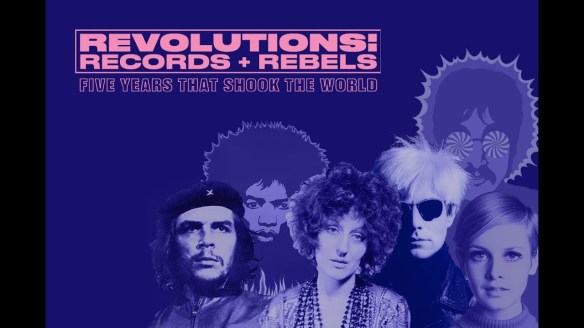
This ambitious and uneven exhibition spans the years from 1966 (The Beatles’ “Revolver”, The Beach Boys’ “Pet Sounds”, and Bob Dylan’s “Blonde on Blonde”) to 1970 (Deep Purple’s “Deep Purple in Rock”, Black Sabbath’s “Paranoid”, and The Stooges’ “Fun House”). Despite covering the peak psychedelic era of “Sergeant Pepper”, “Their Satanic Majesties Request” and “The Piper At The Gates Of Dawn”, the exhibition leaves you with the impression that Woodstock is the only enduring musical or cultural event from this time. Yet, the music portrayed in Woodstock is far from revolutionary – being mostly a bland collection of highly-derivative (and by then, almost passé) rock, blues and folk.

It almost feels like the curators of this exhibition set themselves up for failure. By trying to cover such a broad spectrum of political, social, economic and cultural themes, and then view them primarily through the rather narrow lens of popular music, the net effect is a grab bag of museum artifacts assembled with little coherence, all accompanied by a rather insipid soundtrack selection.

I’m not doubting the importance and lasting significance of the topics included (civil rights, peace movement, feminism, class war and gay liberation) – but the attempt to tack on some Australian relevance almost backfires. Let’s not forget that homosexuality was not decriminalised in Tasmania until 1997, and abortion is still not decriminalised in NSW. In fact, Australia was possibly more progressive on some issues in the early 1970s (anti-Vietnam War, ecology, feminism) than it is today with the current resurgence of populism, nationalism and religious conservatism.

Anyway, back to those “Records + Rebels”. I was surprised there was nothing about the radical developments in jazz or improvised music by the likes of Miles Davis (“In A Silent Way, “Bitches Brew”), The Art Ensemble of Chicago and Ornette Coleman, or labels like ESP, BYG and ECM. Absent also was any reference to the mod and early skinhead movements that were the antidote to hippiedom, embracing soul, r’n’b and reggae music. No mention of Soft Machine (who were contemporaries and colleagues of both Pink Floyd and Jimi Hendrix). Very little significance given to The Velvet Underground (probably the most influential band of the era in terms of inspiring the music that came after the hippie dream dissipated). And where were the likes of Can, Tangerine Dream, and Kraftwerk (their first album came out in 1970….) to represent the German rejection of traditional Anglo-American rock and roll?

On a somewhat depressing note, apart from Woodstock, two of the other enduring “brands” of this era that were on display were Richard Branson’s Virgin empire, and Time Out magazine…. So much for the Children of the Revolution.

Next week: Top 10 Gigs – revisited.
 

Jump-cut videos vs Slow TV

In last week’s blog on the attention economy, I alluded to the trade-off that exists between our desire for more stimulus, and the need to consume more (sponsored) content to feed that hunger. Given the increasing demands on our available attention span, and the rate at which we are having to consume just to keep up, it feels like we are all developing a form of ADD – too much to choose from, too little time to focus on anything.

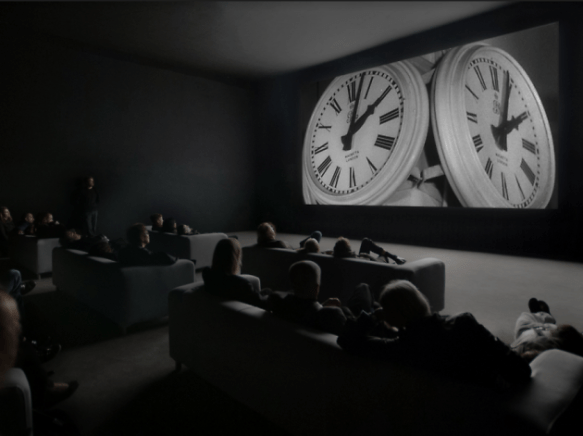
Christian Marclay – “The Clock” – image sourced from Time Out

Personally, I place a lot of the blame on music videos. Initially, this format merely reduced our attention span to the length of a 3-minute pop song. (Paradoxically, there was also a style known as the “long form music video”, which stretched those 3 minutes into a 10-20 minute extended narrative). Then, in recent years, the video format has been distilled to a series of jump cuts – no single shot lasts more than a few frames, and the back-n-forth between shots often has no narrative cohesion other than serving the technique of the jump-cut itself. I sometimes wonder if the reason for so many jump-cuts is because too few of today’s pop stars can really dance, forcing the director to distract our (minimal) attention from the poor moves. (Note: pop stars who can’t dance should take a leaf out of The Fall’s playbook, and call in the professionals, like Michael Clark…)

I have previously made a brief mention of Slow TV, which made a return to Australian channel SBS this summer in the form of trans-continental railway journeys, a UK barge trip (can it get any slower?) and a length-ways tour of New Zealand. These individual programs can screen for up to 18 hours, a perfect antidote to the ADD-inducing experience of jump-cut music videos and social media notifications.

Concurrently in Melbourne, two installation works are on display that, in their very separate ways also challenge the apparent obsession with rapid sensory overload in many of today’s video content.

The first is “The Clock”, by Christian Marclay – a sequence of finely edited clips sourced from a multitude of films and TV programmes that together act as a real-time 24 hour clock. The work also manages to reveal a beguiling (dare I say seamless?) narrative from such disparate and unrelated scenes that you really do begin to wonder how the story will end…. The fact that some of the scenes are quite mundane (and whose main function is to indicate the passage of time), while others are iconic cinematic moments, only adds to our real-time/real-life experience of the ebb and flow of the seconds, minutes and hours.

The second is almost the complete opposite. “Cataract”, by Daniel Von Sturmer comprises 81 screens, each showing looped sequences of somewhat banal events. Although each video event is no more than a few seconds, and none of the loops are synchronised with each other, it does not feel like a series of jump-cut edits. This is partly because the events, despite their brevity, are all engaging in their own way; and partly because even though we know it is a loop, we somehow expect something different to happen each time (maybe because our brain is wired to find a narrative even when none exists?).

According to the gallery’s description of “Cataract”, “the world is full of happenings, but it is only through selective attention that meaning is found”. Quite appropriate for the attention economy and jump-cut culture – meaning is where we choose to see it, but if we are not paying the appropriate amount of attention or if we are not viewing through a critical lens, we risk missing it altogether.

Next week: The Future of Fintech


MoMA comes to Melbourne

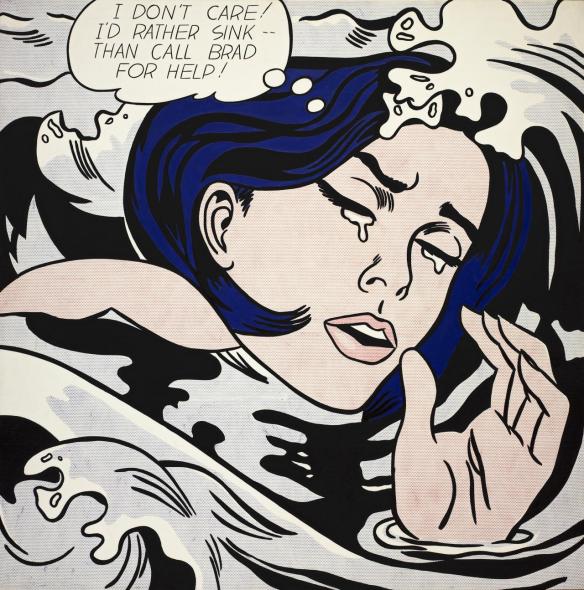
For its current “Winter Masterpieces”, Melbourne’s NGV International gallery is displaying around 200 works from MoMA’s permanent collection. And a finely selected, and well-curated exhibition it is. But this focus on the received canon of mainly 20th century European art has the inevitable effect of sidelining other eras/schools – and perhaps overlooks the importance of Australia’s own art movements.

Roy Lichtenstein (American 1923–97): “Drowning girl” (1963 – oil and synthetic polymer paint on canvas, 171.6 x 169.5 cm); The Museum of Modern Art, New York – Philip Johnson Fund (by exchange) and gift of Mr. and Mrs. Bagley Wright, 1971
© Estate of Roy Lichtenstein/Licensed by Copyright Agency, 2018

The NGV International display presents the work in a broad chronological sequence, but specifically collated by reference to key movements, themes and styles. It also takes in print-making, photography, industrial design, graphics and illustration, not just painting and sculpture.

Even though I have visited MoMA many times, and seen the bulk of these works in their usual setting (as well as when they have been on loan to other galleries), there were still some surprises – like Meret Oppenheim’s “Red Head, Blue Body”, which I don’t recall seeing before. And Salvador Dali’s “The Persistence of Memory” always feels like it is much smaller than the ubiquitous reproductions and posters imply.

Of course, one of the benefits of presenting a survey of modern art like this is that it affords us the opportunity to re-assess and re-calibrate the works within a contemporary context. Both to find new meaning, and to compensate for the over-familiarity that many of these images convey. While at times, we have to separate the artists’ lives and times from the legacy of their work – the changing conventions and social mores of our contemporary society cannot always be used to judge the behaviours, values or common prejudices that were acceptable 100, 50 or even 25 years ago.

Meanwhile, over at NGV Australia, there is a reconstruction of the exhibition that marked the opening of the gallery’s new building in 1968. In “The Field Revisited”, we have a fascinating opportunity to experience a slice of Australian art that feels over-looked and under-appreciated – ironic, given that at the time, this exhibition revealed the cutting-edge nature of young artists working in Australia, and divided opinion among established artists and the art establishment. “Where are the gum trees, where are the shearers, where are the landscapes, where are the figurative images?” might have been the refrain in response to this startling collection of bold colours, geometric designs, psychedelic undertones, modern materials, and unorthodox framing.

The fact that far more people are flocking to see the MoMA collection (and it is worth seeing), than are visiting the re-casting of The Field sadly confirms that Australia’s cultural cringe is alive and well….

Next week: Modern travel is not quite rubbish, but….


MoMA vs SFMOMA

As regular readers of this blog may have come to realise, any opportunity I have during my overseas travels, for business or pleasure, I always like to visit the local public art galleries. Apart from providing a cultural fix, these institutions can reveal a lot about current fashions, curatorial trends and even technology adoption in the elite world of marquee museums. Earlier this month, I was fortunate enough to visit MoMA in New York, and SFMOMA in San Francisco.

Mario Bellini – Olivetti TCV 250 Video Display Terminal (1966) – MoMA New York (Gift of the manufacturer) – Photo by Rory Manchee

Both museums are housed in contemporary buildings which, in keeping with a noticeable trend among modern galleries and museums, emphasise their vertical structure. Compared to say, the 18th/19th century museums of London, Paris and Berlin (with their long, languid and hall-like galleries), these 21st century constructs force us to look upwards – both physically, and perhaps metaphorically, as they aspire to represent “high” art in a modern context?

Although I have been to MoMA many times before, there is always something new to discover among the touring exhibitions and permanent collections. On this latest visit, there were four standout displays: Thinking Machines: Art and Design in the Computer Age (see illustration above); Louise Bourgeois: An Unfolding Portrait; Max Ernst: Beyond Painting; and Stephen Shore.

Apart from the latter, there is clearly a statement being made within the format of “Title/Name – colon – concept/context/subtext”. Stephen Shore is obviously an exception to this curatorial technique. Here is a photographer, whose name I was not familiar with, but whose work seemed both familiar (everyday images and popular icons) and exotic (otherworldly, outsider, alien); yet also pedestrian (repetitive, mundane) and alienating (elements of the macabre and voyeuristic).

The Thinking Machines display threw up some interesting juxtapositions: most of the devices and the works they produced were artisanal in approach – one-off pieces, requiring detailed and skilled programming, and not the mass-produced, easily replicated works we associate with most digital processes these days. Plus, even when the outputs were generated by a computational approach, the vagaries of the hardware and software meant the works were more likely to produce chance results, given the large role that analog processes still played in these systems-defined creations.

Louise Bourgeois’ work can still challenge our sensibilities, especially when conveyed through her lesser-known works on paper, even though many of the images are familiar to us from her sculptures and installation pieces (the latter represented here in the form of one of her giant spiders).

The exhibition of works on paper by Max Ernst also reveal another aspect of the artist’s oeuvre, although unlike Bourgeois, I feel there is greater affinity with his more formal paintings because, despite the different media in which he worked, there is a consistency to his image making and his visual language.

Across the country in San Francisco, this was the first time I had been to SFMOMA, so in the available time, I tried to see EVERYTHING, on all 6 levels. But I still manged to miss one entire floor, housing the late 19th century/early 20th century permanent collection.

The main exhibitions were Robert Rauschenberg: Erasing The Rules; SoundtracksWalker Evans; Approaching American Abstraction; and Louis Bourgeois Spiders.

So, less of the colon-delineated concepts compared to MoMA, and more literal titles – and you have to think that photographers, like Shore and Evans, don’t merit these sub-textual descriptions, because with photographers, what you see is what you get?  On the other hand, with Bourgeois’ Spiders, it contains what it says on the tin – giant spider sculptures.

I’d seen the Rauschenberg exhibition earlier this year at the Tate Modern in London, as it’s actually a touring show curated by MoMA itself. Seeing these (now familiar) works in another setting revealed aspects that I hadn’t appreciated before – such as the similarities between Rauschenberg’s collages and combines, and the mixed media works of Max Ernst and other Surrealists, for example.

The Evans exhibition was an exhaustive (and at times exhausting) career retrospective. In addition to many of his iconic images of crop farmers during the Great Depression, there were more urbane/mundane images of shop window displays, merchandising and branding – not too dissimilar to some of Shore’s serial photo essays.

Wandering through (or approaching…) the American Abstraction display was like immersing oneself in a who’s who of modern US art: Brice Marden, Sol Le Wit, Robert Motherwell, Clyfford Still, Cy Twombly, Adolph Gottlieb, Morris Louis, Sam Francis, Ellsworth Kelly, Lee Krasner, Agnes Martin, Sean Scully, Frank Stella, Joan Mitchell…. It struck me that despite the differences among these artists, and their individual mark making and contrasting visual languages, the collection was very much of a whole – the familiarity of many of these works, in close proximity, felt very comforting, even though the original intent was potentially to shock, challenge or disrupt. That’s not to say the works no longer have any impact, it’s just that our tastes and experiences have led us to adapt to and accommodate these once abrasive images.

Finally Soundtracks was probably the weakest of all the exhibitions I saw, pulling together a mish-mash of mostly sculptural and installation works embodying some form of audio element. My interest in this vein of work probably started when I saw the exhibition, “Ecouter Par Les Yeux” many years ago in Paris.

Despite a few banal pieces (too literal or pedestrian in their execution) this current incarnation had some individually engaging and landmark pieces: namely, Celeste Boursier-Mougenot’s “Clinamen”, a version of which has been on display at Melbourne’s NGV in recent times; and Brian Eno’s “Compact Forest Proposal”, which I only know of through its audio component – so here was a chance to walk through the fully realised, and dream-like installation.

As 2017 draws to a close, Content in Context will be taking a (much-needed) break for the holidays. Having made 8 overseas trips in the past 12 months, the author is looking forward to spending some down-time closer to home. Many thanks to all the people who have made 2017 such a truly memorable year for me – for all sorts of personal and professional reasons. You know who you are. Normal service will resume in January, and have a safe, peaceful and uplifting festive season.