Public art galleries need to attract paying customers if their funding derived from government grants is being cut. To pull in the punters, galleries have to resort to “blockbuster” exhibitions. In these uncertain, post lock-down times, the lack of international tourists means that galleries are forced to focus on local audiences. It’s good to showcase local talent in the shape of conquering heroes returning to their roots.
These may have been some of the arguments behind the Geelong Art Gallery‘s decision to mount a retrospective exhibition featuring the work of street artist Tryone Power (aka RONE). Of course, the planning began long before COVID struck, but otherwise the above assumptions would seem to be valid.
Let’s acknowledge the positives of this show: First, it is certainly pulling in the punters, and helping to bring in visitors and their wallets to the town. Second, it is hopefully creating a platform for future exhibitions, and public engagement with the Gallery itself. Third, it’s nice that a locally-born artist is being recognised (even if he has had to travel afar to make a name for himself at home).
Unfortunately, that’s where it ends, for me. My recent visit was probably the shortest time I have spent in an exhibition which I had paid to see. Overall, I found the work vapid – there was nothing of substance (nor anything challenging) underneath the painted surface, or behind the concept of “beauty and decay”. As a street artist, RONE does not have the wit or depth of a Banksy; as a conceptual/installation artist, he’s no Christo. The main images he creates or imposes on his work are highly stylised and extremely idealised portraits of young women – it’s a very limited exploration of “beauty”. At best, the work reveal something interesting about abandoned and overlooked locations. At worst, the installation reeked of interior decor magazines and displayed a taste for romanticised and sentimental kitsch.
Which is all a great shame, because given RONE’s apparent interest in deserted and decaying structures, there is a deep and rich vein of Australian Gothic he could have tapped into. (In comparison, think of the work of Nick Cave, Peter Weir, Peter Carey, Julia deVille, Rosalie Ham, etc.)
Despite the use of physical objects, this exhibition felt very one-dimensional. Artists as disparate as Helen Chadwick, Paola Rego, Cindy Sherman and Rachel Whiteread have all deployed notions of female beauty, decay, abandonment and destruction to far greater effect and impact.
The usual Silicon Beach rules applied – Round One featured 90-second pitches from each founder (and no slide decks), from which the judges shortlisted 3 startups for Round Two. The Round One presentations in order of appearance were (as usual, website links are embedded in the names):
Using “emotional phase shifting to accelerate personal growth and transformation through Insight, Manifestation and Neuroscience”, the impetus for this startup came about from the founder’s own experience. Designed to help overcome certain mental health issues associated with anxiety, the founder claims his technique can help practitioners overcome events such as panic attacks within 6 seconds (as opposed to 600 seconds with traditional CBT methods). Had been accepted into the Founders’ Institute, then COVID came along.
There is a growing demand for plant-based foods, both as a source of sustainable protein, and in response to the increased prevalence of food-based allergies (e.g., gluten and soy). Add concerns about GMOs, unsustainable agriculture and climate change, the founder is looking to develop a scalable process for extracting specific types of leaf protein, including arid-climate plants and Australian natives such as saltbush to counter soil salination. Currently seeking funding to pay for a CSIRO pilot to scale the protein extraction.
Essentially a toy-lending app, that provides an end-to-end process (source, distribute, cleanse, circulate) via a subscription model. In trials, already secured 50 customers and over 100 subscribers. Estimates there is a $2.4bn toy market in Australia – but it wasn’t clear how much of this market the founders aim to capture.
This app aims to bring childrens’ drawings to life, using AI/ML to scan a photo of the drawing, and convert it into an animated 3-D digital file that can be rendered within the app using augmented reality.
Using the oft-heard tag line “data is the new oil”, this B2B solution is designed to help companies organise, manage and extract more value from their data. It does this by resolving issues of data inconsistency, privacy, risk and governance. It also derives and assigns numerical factors to to individual datasets to assess the “value” of this data, and uses indices to benchmark that value.
This product feels like a cross between a wiki for academic research papers, and an open text search tool to find answers within the wiki database. I know from experience that repositories of published research reports (especially refereed and peer reviewed papers) are highly structured and tagged, with the emphasis being on classification, authorship and citation. Often, you sort of need to know in advance the rough answer to the question you want to pose. Significant resources are already allocated to maintaining and commercialising these existing databases, so I’m not sure how QuestionID will deal with IP and other rights associated with these reference resources.
HiveKeepers is designed to support beekeepers by helping them to establish and maintain healthier hives, and enhance their own livelihoods at a time when the industry is facing numerous challenges. At its core is a smart phone app that monitors IoT sensors (temperature, weather, weight, motion, sound, etc.) attached to the hive itself. Over time, the data will enable predictive analytics. With the launch of its MVP, HiveKeepers has already attarcted 700 customers globally.
Round Two
The three finalists selected from Round One were KidoPaint, LeafProtein and HiveKeepers. Each founder made a longer pitch, and then answered questions from the judges:
Kido Paint – The Q&A discussion centred on the commercial model (B2B/C, gift cards, in-app vouchers), the file conversion process (turnaround time can be 24- 48 hours), options for scaling, and getting the right price pint for user prices. So it’s not an instant result (which may disappoint some impatient younger users), and the 3-D rendering and animation is somewhat limited to the imagination of the AI/ML algorithms used in the conversion process.
LeafProtein – There was a further discussion on the approach to producing sustainable and allergen free plant proteins. For example, the attraction of pereskia is two-fold – a higher protein ratio, and an arid climate plant. Also, the aim is to counter mono-culture and GMO crops. A D2C brand has been launched (using small-scale production processes), while the CSIRO project is to designed to scale protein extraction, as well as develop an emulsifier for use in the food industry.
HiveKeepers – The founder talked more about the need to address climatic and environmental impact on hives. Having benefited from support from the La Trobe University and SVG Thrive AgriFood accelerator programs, this startup is seeking funding for product development – current price point is $105 USD per smart hive per annum. While the industry is seeing a 2% growth in new hives, it is also suffering significant hive losses due to parasites and diseases.
The art world in Melbourne is getting something of a boost from corporate commissions. Last year, Deloitte compiled one of the largest corporate art collections in recent years for their new offices on Collins Street, which was otherwise a lean time for local artists during the recent lock-downs.
Not everyone will get to see this collection, as the works are on selected floors within the building, and access will be limited to staff, business visitors and clients.
But elsewhere, there is a lot of work that is accessible to the public. Here are a few randon examples:
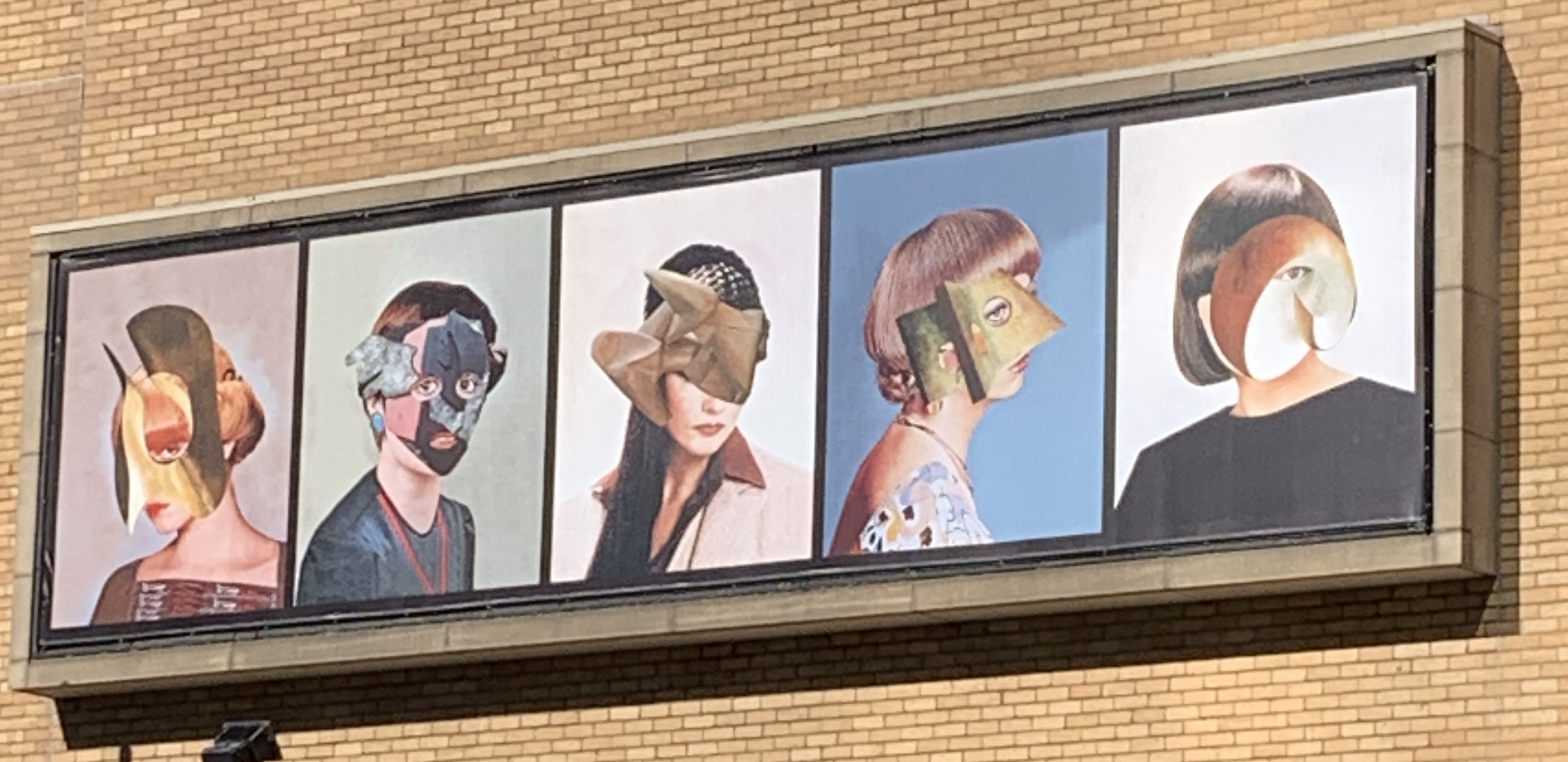
Collage mural, Hero Apartments, Russell Street
Hero Apartments – this former telephone exchange displays unique work on its western-facing wall, usually photographic in nature.
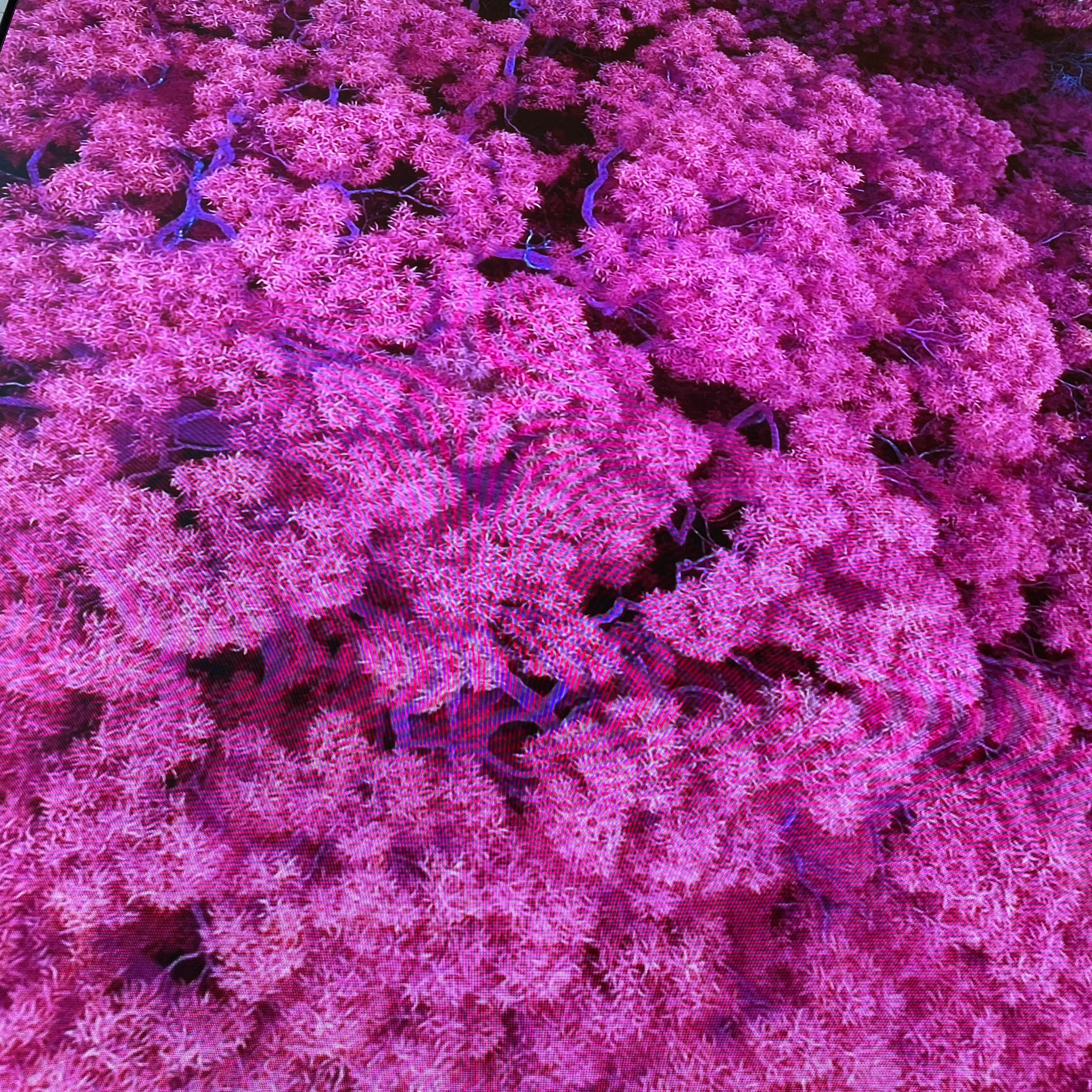
80 Collins Street – the revamped office block has recently undergone a major makeover, including an enormous digital screen in its ground floor lobby, for displaying newly-commissioned works.
Digital mural, 80 Collins Street
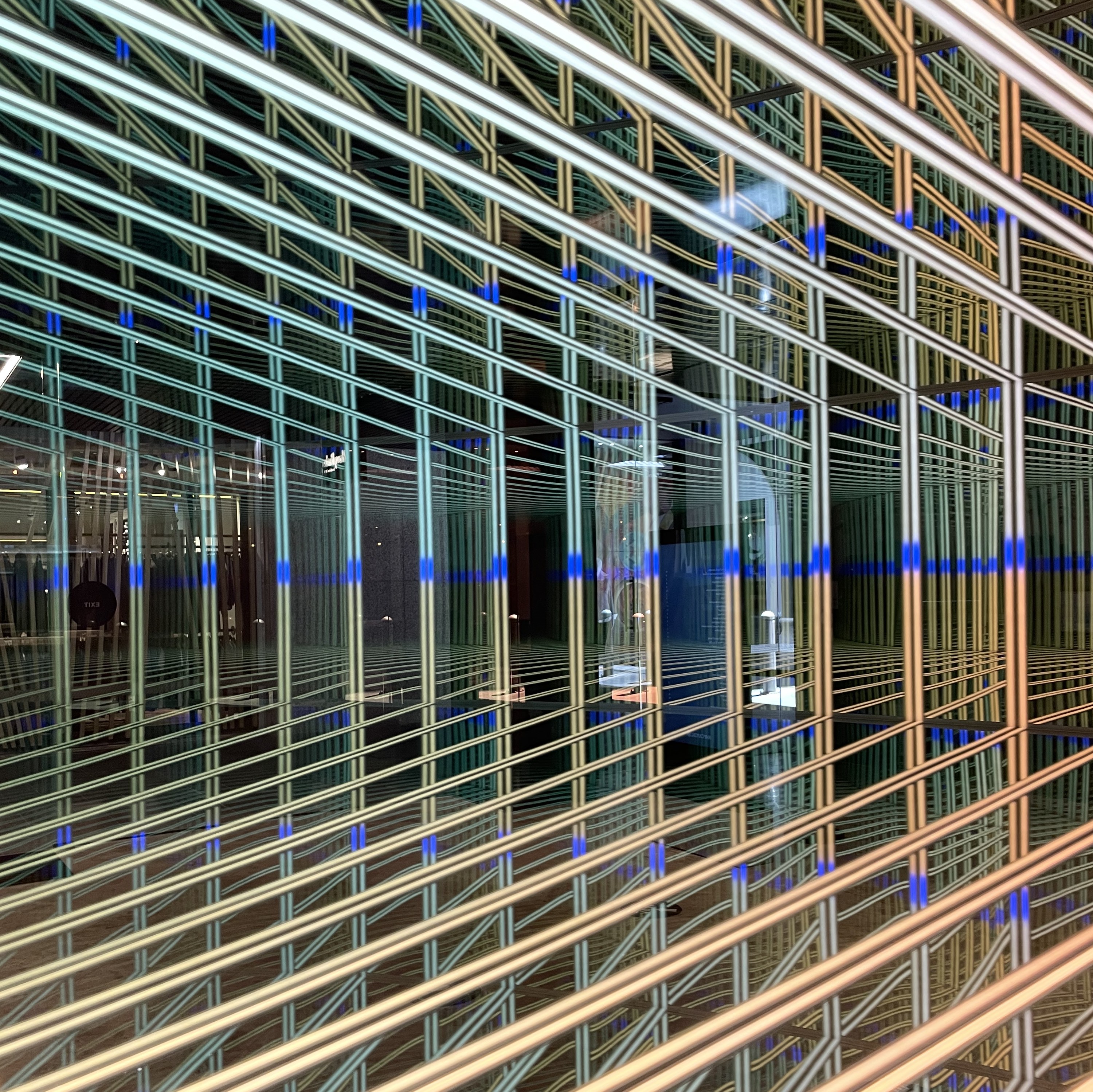
330 Collins Street – the lobby to this otherwise anonymous office building now features a striking piece of op art, in the form of a dual light box and mirror construction.
Lobby Op Art, 330 Collins Street
Grand Hyatt Hotel – as part of its major revamp more than a decade ago, the hotel installed some huge Bruce Armstrong bird sculptures to guard the main entrance.
Docklands – facing the waterfront opposite Marvel Stadium is John Kelly’s quirky “Cow Up A Tree” (which says what it is).
Yarra River – from Birrarung Marr to Webb Bridge (itself a great example of functional public art) there are a sequence of sculptures and installations, including further works by Bruce Armstrong.
Southbank Arts Precinct – not surprising given its function, this area houses numerous sculptural works, permanent installations architectural features, such as Ron Robertson-Swann’s “Vault” outside ACCA.
Laneways Street Art – of course, Melbourne is (in)famous for its extensive “collection” of graffiti and spray-paint murals, although works attributed to Banksy have either been vandalised, stolen or simply painted over.
As Melbourne and Victoria continue to emerge from lock-down, it was great to see that the NGV International has re-opened for the summer with the latest edition of its Triennial show. And while we should all be grateful to have the opportunity to visit this exhibition in person (rather than on-line), it’s not without some shortcomings.
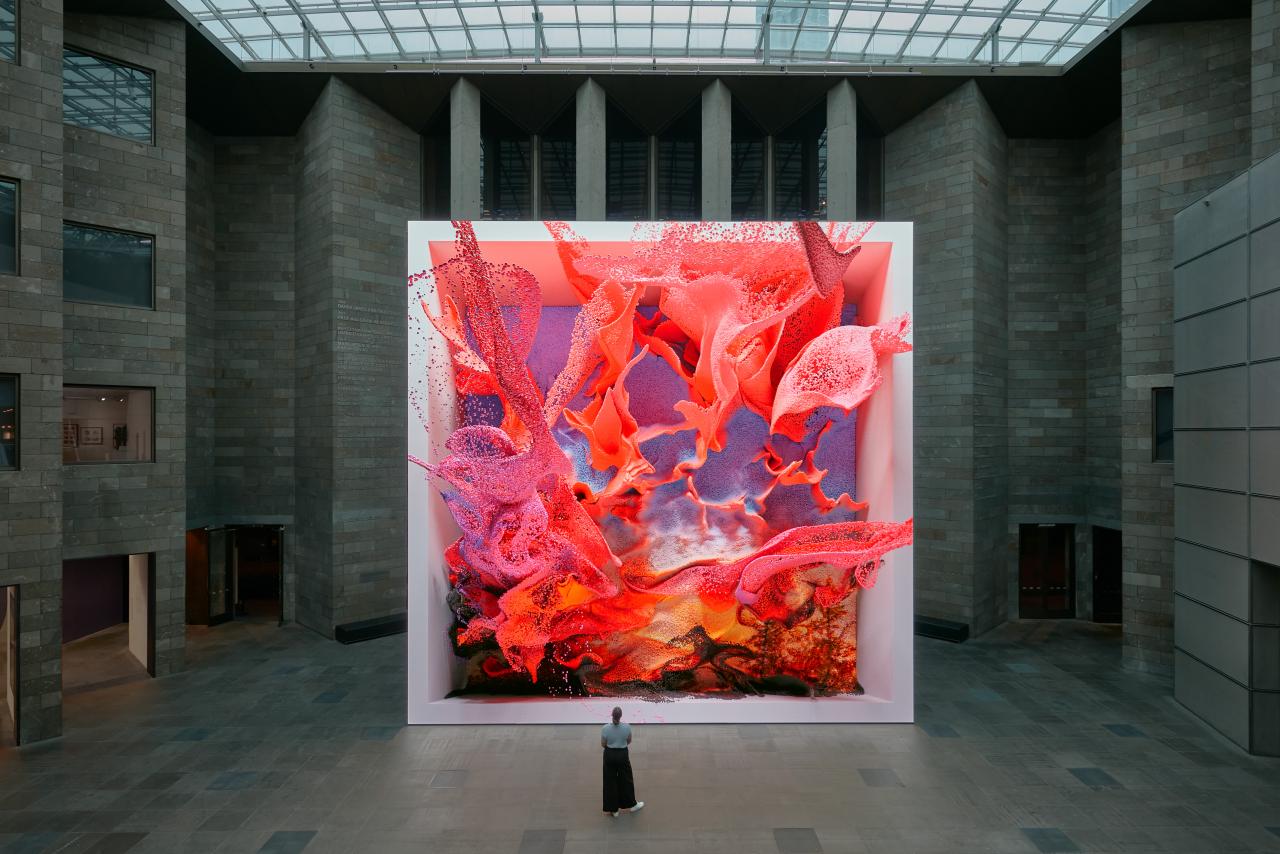
Refik Anadol: Quantum Memories (image sourced from NGV website)
First, the good news: no doubt it was a logistical headache to co-ordinate this exhibition while Melbourne was in strict lock-down for much of the past 10 months. Making admission free is also a wonderful public gesture given that the local population was starved of art exhibitions for most of last year – in particular, we missed out on the NGV’s winter blockbuster season.
The curators are also to be commended on assembling a diversity of artists, work and media; and for placing a great number of these new pieces among the NGV’s permanent collections, which forces visitors to assess these contemporary exhibits within the context of historic work.
But that’s probably where the positive ends.
A major drawback of this exhibition is the lack of anything truly ground-breaking, innovative or even challenging. It all felt very safe – but maybe that’s just what we needed after our extended social isolation: work that is comforting, familiar, cozy, cuddly, soothing, and certainly bright (lots of lively colours).
As a result, however, there seemed to be an emphasis of form over substance, technique over content, and scale over context. Much of the three-dimensional work felt flat and one-dimensional. Even the opening centrepiece, Refik Anadol’s “Quantum Memories” that dominates the entrance lobby, is a classic example of the “medium is the message”. Comprising a giant digital screen (incorporating a clever trompe-l’œil 3-D effect) to stream animated, computer-programmed images, ultimately gave the impression that this was all about the technology and the scale of the work. It was difficult to identify any meaning beyond mere decoration.
And unfortunately, “decorative” was a recurring theme, alongside some rather kitsch and lazy imagery – especially the digital and animated wallpaper that featured in several of the permanent galleries. These “displays” reminded me of cheesy son et lumière or pedestrian CGI effects – it may be technically adept, and even stylish to some degree, but that’s as far as it goes. Perhaps “deep” and “complex” are out of favour at the moment, as we make way for “shallow” and “simple”.
While some work might attempt to convey a more profound response, when shorn of its original context, the message is lost and the result is a void. I wasn’t necessarily looking for “deep and meaningful”, but I was hoping to be provoked or inspired. Or at least have my curiosity piqued.
 Content in Context