As part of the recent Australian Blockchain Week, YBF Ventures hosted a showcase of Blockchain start-ups – not a standard pitch event, but more an opportunity to hear how some teams are deploying Blockchain technology in their projects.
Here are the projects in order of presentation (links in the project names):
ProvenDB – developing immutable and tamper-proof document management, built on Hedera Hashgraph
BuildSort – a construction contract management solution to improve the industry supply chain and project management
Laava ID – product authentication via “smart fingerprints”
Verida – decentralized identity (with a focus on health records) – a user-centric solution focused on building user trust – resulting in hyper-personalisation
Cryptocate – crypto tax management service – with the growth in DeFi, there is a lack of data standardization or formal tax guidance on taxable events – e.g., how to handle crypto options?
Elbaite – a non-custody exchange using a “TraderTrust” verification system to support P2P transactions – platform confirms the exchange transaction on-chain, then the platform uses the transaction hash to release clients’ fiat funds from escrow – platform charges fees and commission
Sempo – a remittance service, with a particular focus on supporting migrant workers, the unbanked and refugees
Future CX – decentralized middle-ware development – e.g., data containers, NFTs, smart contracts – using a “proof of distribution” model
Luca+ – e-invoicing solution that integrates with major third-party accounting software
BC Gateways– using Blockchain to facilitate secure data transfer within the superannuation industry – recently acquired by IRESS – scaling from 10k transactions per day to 5m per annum
DayByDay – an asset management solution for the insurance industry
While this type of government largesse and targeted economic stimulus sounds welcome, I can’t help feeling the money could be better spent on covering some basic building blocks in the search for innovation and economic development – upgrading the primary, secondary and tertiary education for the 21st century (e.g, an integrated STEAM curriculum); funding budding entrepreneurs (e.g., job maker for the newly self-employed, especially those under 25); enhancing the SME loan market (e.g., making it easier to access working capital without first having to own real estate); and overhauling the procurement and “panel” regimes in the public and private sectors (e.g., giving more equitable access to start-ups and scale-ups).
The “reconstruction fund” talks about making equity stakes, and co-investing with the private sector and superannuation funds. This sounds great, but is it the role of government to pick winners? Surely it should be in the business of enabling innovation and facilitating the growth of SMEs (which is where much new employment is created, rather than in legacy industries and/or declining sectors). Also, because of the way their mandates are written (as well as their ROC models and fiduciary duties), traditionally, superannuation funds and other institutional investors find it very difficult to write cheques for less than, say, $200m. Such a figure is generally far beyond what most start-ups or scale-ups are seeking – so these institutional funds are often placed with external managers who can slice them up into smaller allocations, which adds to the overall investment costs.
The role model for the $15bn fund is the Clean Energy Finance Corporation, which returned a cumulative 4.75% as at June 30, 2020. Certainly a higher return than the cash rate, but hardly competitive with other asset classes or investment returns, if that is a key measure of success. The CEFC performance is currently running below its own benchmark, and while the efforts of the CEFC have no doubt led to more jobs in the renewables and sustainability sectors, hard data is not easy to come by. In its favour, the CEFC has made a large number of small scale investments, which may well provide a template for Labor’s manufacturing fund (although it’s not evident what form those investments have taken).
In speaking to a range of people over the past few weeks (civil servants, start-up founders, VCs, CEOs of listed companies, etc.), the following mixed messages emerged:
Well-meaning government officials tell you that they are “here to help” founders, start-ups, entrepreneurs, SMEs etc. Problem is, these bureaucrats can’t effect necessary systemic change in the way innovation is funded – they can only operate at a transactional level. Also, many entrepreneurs would politely suggest that the government could do more by getting out of the way…
One VC took issue with my suggestion that Australia needs a better manufacturing supply chain that produces more local components that are interoperable/interchangeable, and which also encourages more user-serviceable (and therefore more sustainable) devices and appliances – he was advocating in favour of sealed units and thus a continued dependance on the manufacturer/distributor service model; whereas I think self-sufficiency in manufacturing also means more consumer choice in post-sales support.
An innovative Australian fintech chose to list overseas because the local capital markets did not “get” its business model, while another locally-listed fintech faced similar obstacles with its own listing.
A start-up founder looking for a modest amount of money for an R&D project (in the sustainability sector) had already secured an equal amount of funding “in kind” from a government agency – but was finding it somewhat difficult to match it with the equivalent private capital.
Neighbours building a passive house have had to import energy-efficient triple-glazed window units – because they are not easily available locally, and the only supplier they could find would have cost at least 50% more.
Finally, the new Labor policy (especially if it aims to support the EV sector) will need to demonstrate it has learned the lessons of Australia’s subsidised car industry, and that the proposed fund is part and parcel of an integrated approach to public transport infrastructure, encompassing high-speed inter-city trains, smart cities with self-drive vehicles, better orbital routes connecting suburbs, and regional hubs that aren’t reliant on cars.
Last week, I mentioned that Australia’s headline employment numbers appeared to be making a strong post-lockdown recovery – however, the latest ABS data shows that while the unemployment rate has declined, the overall participation rate has remained the same, and the underemployment rate has actually increased. “Underemployed” is defined by the ABS as the number of “employed people who would prefer, and are available for, more hours of work than they currently have”. For many people, the traditional solution to bridging the gap between the amount of work they have, and the amount they want, is to juggle multiple part-time jobs, while others may choose to seek freelance work. Another approach is to create your own role, by becoming a startup founder, or joining a startup.
Of course, as I have written elsewhere, startups might not be for everyone. But until you try (or at least explore the idea), how will you know? This was one theme to have emerged from the recent Victorian Tech Startup Week, hosted by YBF Melbourne, with support from OVHcloud, AirTree Ventures, Silicon Beach Melbourne, the Victorian Government and YBF’s network of mentors, programme partners and community of members.
In part an effort to rekindle the local community of startups, in part a celebration of YBF’s Startup Immersion Programme, the week also showcased the benefits of co-working, and included sessions on startup funding, R&D grants, engaging with corporate clients, and a pitch night (more on that next week).
Of course, as a YBF member, and having worked with startups and founders for more than 10 years, I’m naturally biased. I have been working from their Melbourne co-working facility for the past two years (lock-down permitting), and I have been attending events and workshops there for many years (including participating in my very first hackathon….). I have also worked with some of their earliest startup founders.
Even though I am used to working from home and working remotely, the value of being on-site with other startup teams and founders within a supportive environment cannot be overestimated. And it’s not just about access to great facilities, and the many benefits that YBF offers. For one thing, as a member I get invited to meetings and events not open to the wider public. For another, I can host clients and other visitors without having to maintain my own office. But most of all, it’s the opportunity for chance encounters with potential clients, partners and suppliers, often triggered by casual conversations by the coffee machine or during other networking sessions.
A few years ago, it was reported that there were over 300 co-working spaces in Australia, and more then 80 of them in the Melbourne area alone. I’m not sure what those numbers are now, post-pandemic, especially as offices in Melbourne are still not back to full operating capacity. Nevertheless, co-working spaces are in demand again as (ex-)employees consider their future career options in light of the COVID recession, and as startups and their founders are expected to support the anticipated economic growth in areas like new technology, sustainability, smart manufacturing, healthcare and financial services. Of course, before making a decision on where to locate your new business or where to start co-working, it pays to do your due diligence.
Next week: Victorian Tech Startup Week – Pitch Night
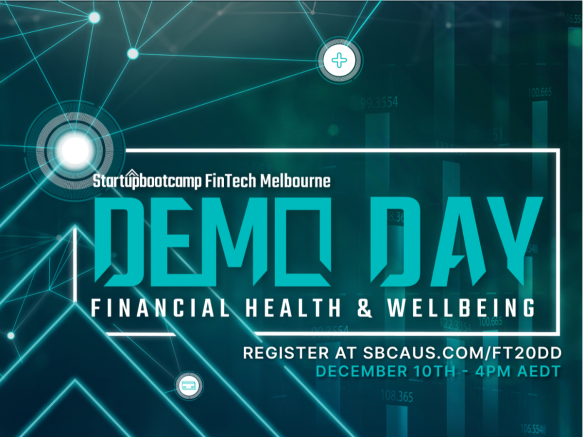
Taking its cue from some of the economic effects of the current pandemic, the latest Startupbootcamp Melbourne FinTech virtual demo day adopted the theme of financial health and well-being. When reduced working hours and layoffs revealed that many that people did not have enough savings to last 6 weeks, let alone 6 months, lock-down and furlough have not only put a strain on public finances, they have also revealed the need for better education on personal finance and wealth management. Meanwhile, increased regulation and compliance obligations (especially in the areas of data privacy, cyber security and KYC) are adding huge operational costs for companies and financial institutions. And despite the restrictions and disruptions of lock-down, the latest cohort of startups in the Melbourne FinTech bootcamp managed to deliver some engaging presentations.
Datacy allows people to collect, manage and sell their online data easily and transparently, and gives businesses instant access to high quality and bespoke consumer datasets. They stress that the data used in their application is legally and ethically sourced. Their process is also designed to eliminate gaps and risks inherent in many current solutions, which are often manual, fragmented and unethical. At its heart is a Chrome or Firefox browser extension. Individual consumers can generate passive income from data sales, based on user-defined permissions. Businesses can create target data sets using various parameters. Datacy charges companies to access the end-user data, and also takes a 15% commission on every transaction via the plugin – some of which is distributed to end-users, but it wasn’t clear how that works. For example, is it distributed in equal proportions to everyone, or is it weighted by the “value” (however defined or calculated) of an individual’s data?
Harpocrates Solutions provides a simplified data privacy via a “compliance compliance as a service” model. Seeing itself as part of the “Trust Economy”, Harpocrates is making privacy implementations easier. It achieves this by monitoring and observing daily regulatory updates, and capturing the relevant changes. It then uses AI to manage a central repository, and to create and maintain tailored rules sets.
Mark Labs helps asset managers and institutional investors integrate environmental and social considerations into their portfolios. With increased investor interest in sustainability, portfolio managers are adopting ESG criteria in to their decision-making, and Mark Labs helps them in “optimising the impact” of their investments. There are currently an estimated $40 trillion of sustainable assets under management, but ESG portfolio management is data intensive, complex and still emerging both as an analytical skill and as a practical portfolio methodology. Mark Labs helps investors to curate, analyze and communicate data on their portfolio companies, drawing on multiple database sources, and aligning to UN Sustainable Development Goals. The founders estimate that there are $114 trillion of assets under management “at risk” if generational transfer and investor mandates shift towards more ESG criteria.
MassUp is a digital white label solution for the property and casualty insurance industry (P&C), designed to sell small item insurance at the consumer point-of-sale (POS). Describing their platform as a “plug and sell” solution, the founders noted that 70% of portable items are not covered by insurance policies, and many homes and/or contents are either uninsured or under-insured. MassUp is intended to simplify the process (“easy, accessible, online”), and will be launching in Australia under the Sorgenfrey brand in Q2 2021. For example, a product known as “The Flat Insurance” will cover items in and out of your home for a single monthly premium. As MassUp appears to be a tech solution, rather than a policy issuer, underwriter or re-insurer, I couldn’t see how they can achieve competitive policy rates both at scale and with simplicity (especially the claims process). Also, as we know, vendors love to “upsell” insurance on tech appliances, but many such policies have been seen to be redundant when considering existing statutory consumer rights and product warranties. On the other hand, short-term insurance policies (e.g., when I’m traveling, or on holiday, or renting out my home on AirBnB) are increasingly of interest to some consumers.
Ontrack provides B2B white label digital retirement planning solutions for financial institutions to help their customers in a more personalised way. There is a general consumer reluctance to pay for financial advice, but retirement planning is deemed too complicated. Taking an “holistic” approach, the founders claim to have developed a “best in class simulation engine” – founded on expected retirement spending priorities (rather than trying to predict the cost of living in 20 years’ time). Drawing on their industry experience, the founders stated that a key challenge for many financial planning providers is getting members comfortable with your service. I would also add that reducing complexity with cost-effective products is also key – and financial education forms a big part of the solution.
In Australia, the past 10 years has seen a major exit from the financial planning and wealth management industry – both at the individual adviser level (higher professional qualification requirements, increased compliance costs, and the end of trailing sales commissions in favour of “fee for advice”); and at the institutional level (3 of the big 4 banks have essentially withdrawn from offering financial planning and wealth management services). At the same time, there have been a number of new players – including many non-bank or non-financial institution providers – offering so-called robo-advice and “advice at scale”, mainly designed to reduce costs. In addition, the statutory superannuation regime keeps being tweaked so it is increasingly difficult to plan for the future, with the constant tax and other changes. Superannuation (a key success story of the Keating government) is just one of the “pillars” of personal finance in retirement: the others are the Commonwealth government aged pension (means-tested), personal wealth management (e.g., investments outside of superannuation); and retirement housing (with the expectation of more people opting to remain in their own homes). I would also include earnings from part-time employment while in “retirement”, as people work longer into older age (either from choice or necessity) – how that aligns with the aged pension and/or self-funded retirement is another part of the constantly-shifting tax and social security regime.
This product describes itself as a customer data platform that powers stored value, and was described as a “Safe harbour” solution (I’m not quite sure that’s what the founders meant in this context?). According to the pitch, consumers gain a fair and equitable outcome (consumer discounts), while retailers get targeted audiences. The team have created a vertically integrated gift card platform (working with MasterCard, Apple Pay and GooglePay), and launched JamJar, a cashback solution.
Similar to Harpocrates (above), RegRadar is a regulatory screening platform that helps companies “to set routes and avoid crashes”. The tool monitors regulatory changes (initially in the financial, food and healthcare sectors) and uses a pro-active process to developing a regulatory screening strategy, backed by analysis and a decision-support tool.
Having worked in legal, regulatory and compliance publishing for many years myself, I appreciate the challenge companies face when trying to keep up with the latest regulations, especially where they may be subject to multiple regulatory bodies within and across multiple jurisdictions. However, improved technology such as smart decision-support tools for building and maintaining rules-based business systems has helped enormously. In addition, most legislation is now online, so it can be searched more easily and monitored via automated alerts. Plus services such as Westlaw and Lexis-Nexis can also help companies track what is currently “good” or “bad” law by tracking court decisions, law reports and legislative updates.


 Content in Context