A Music Buyer’s Guide to Japan (or Crate Digging in Kobe, Kyoto & Tokyo…)

For serious music collectors, Japan is like an oasis in a desert of digital downloads and streaming services. Not only does Japan still have bricks and mortar record shops, it also boasts a couple of well-known chain stores, in the guise of Tower Records and HMV, although both brands operate under local licenses totally unconnected with their original US and UK parent companies.
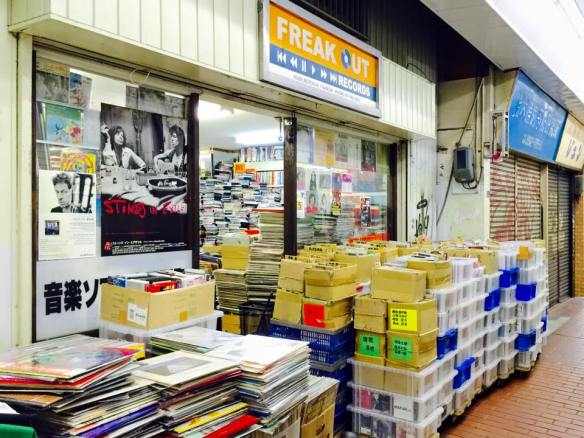
A Crate Diggers Paradise....

A Crate Diggers’ Paradise…. (Picture sourced from Facebook post)

On my recent tour of Japan, I spent several hours visiting some of the crate-digging hubs of Kobe, Kyoto and Tokyo. I barely scratched the surface, but still managed to come across some interesting finds.

“Big In Japan”

Whether it’s the country’s aging population, the love of tactile objects combined with a strong design aesthetic, or just that national obsession with detail and authenticity when it comes to pursuing hobbies and interests; whatever the reason, Japan has established a reputation for being a paradise for lovers of vinyl records, CDs and cassettes.

For collectors like myself, it seems like all the unwanted and discarded records from around the world have ended up in Japan’s second hand music shops to be (re)discovered and appreciated by audiophiles, hipsters and analogue enthusiasts.

Here is just a small glimpse of what dedicated music lovers and crate-diggers can experience in Japan.

Kobe

The Motoko market (a series of cramped arcades underneath the railway lines) has at least a dozen second-hand music stores stuffed with vinyl. A few of these shops specialise in particular genres, and some also sell new independent releases. What they all have in common are over-stacked racks and heaving shelf units shoved close together, forcing shoppers to crab-walk very carefully between piles of records, at considerable risk of triggering a vinyl avalanche.

Some of the stores arrange their stock meticulously by type and artist, but not much help if you don’t read Japanese; others seemed to have given up cataloguing the stock, so if you are searching for a specific record, it’s like looking for a needle in a haystack.

At times, it felt like this was the end of the line for many of the items on display – if they can’t find a buyer here, there probably isn’t much hope for them anywhere. No doubt there is a lot of on-line trading behind the scenes, and prices were generally reasonable, so maybe the shops are more like warehouses open to the public?

Poring through some of the 70s vinyl was something of an education, as I came across albums I had never seen before, even though I worked in a second-hand record store in London in the late 80s. I resisted the temptation to buy some of the older Japanese pressings (especially at Wild Honey Pie), even though they have a reputation for superior sound quality, but I did pick up a Japanese edition of the first Y.M.O. album on CD at Freak Out Records.

Kyoto

Armed with a handy crate-digging map of Kyoto, I checked out several shops located near City Hall. Unlike their Kobe counterparts, these were neat and orderly boutiques, and were easy to browse. None of the stores are at street level, so navigation can be challenging. The map lists stores by genre and other specialisations, although some of the music categories can seem bewildering.

I spent most time at 100000t alonetoco (I think it means something like “100,000 tonnes of records”?), which has a good range of vinyl and CD, from classic rock to contemporary sounds, from soundtracks to electronica, plus books and other memorabilia. The owner stocks numerous Japan-only releases by independent US and UK artists, many of which are highly collectible. Speaking of which, I found an absolute bargain – a 1987 compilation CD of the 2nd and 3rd albums by The Pop Group, which was only released in Japan. Copies of this particular pressing are currently listed for sale online from A$145 – mine cost a mere 600 yen….

Also worth checking out is Prototype, which leans toward reggae, soul and funk.

Tokyo

Around the hip Tokyo suburb of Shimokitazawa are a cluster of hi-quality specialist stores, including Jet Set, which is also a label and distributor for local and international releases, mainly indie, techno, beats, ambient and electronica. There are a couple of branches of Dorama, a chain of second-hand CD stores (plus comics, magazines, graphic novels, games and DVDs). Well worth checking out, especially for promotional releases, box sets, jazz, classical, Japanese pop and electronica, and alternative international rock. I managed to find very cheap (less than 300 yen each) and long-deleted Japanese releases by United Future Organization and the late Susumu Yokota. For the latest independent Japanese releases, the Village Vanguard book store has an intriguing music section.

Further towards the city, in Shinjuku, is the institution known as Disk Union (and not Disc Union as my Australian guide-book spells it…). With 10 branches in the Shinjuku area alone (plus more than 20 others across Tokyo and in Osaka), it would probably take several days to check them all out. While they do stock selected new releases, the real attraction of browsing in Disk Union is the sheer breadth of second-hand, deleted and promotional items on sale. A case in point being the special Japanese edition of the recent David Bowie “Five Years” box set – looks wonderful but too rich for my wallet.

Finally, no trip to Tokyo is complete without a visit to Tower Records in Shibuya. This landmark, multi-storey superstore is constantly being upgraded, even though sales of physical albums are generally on the decline. It caters for most tastes, and many new releases are discounted, making it popular with locals and tourists alike. It’s great for finding the Japanese pressings of international CDs, as they usually feature additional music or limited editions not included in the European or US releases. There’s now even a section just for cassettes, both new releases and re-issues. On this occasion, I found a couple of very limited edition albums by Japan’s Silent Poets, both on sale at regular price, but which I’ve since found listed online for upwards of A$50 each…

Next week: Another weekend, another hacakathon



Australian MPs recommend a ban on geo-blocking

In a recent blog about geo-blocking, I commented on the frustrations of Australian consumers in trying to access digital content. That blog was written in light of a parliamentary inquiry into IT price discrimination.

ImageA Report by the House of Representatives Infrastructure and Communications Committee has just been published, and makes for some fascinating reading.

The Report reveals a number of key themes:

  • There is strong evidence that Australian consumers pay between 50 and 100 per cent more for the same product than consumers in comparable markets.
  • Price differentials cannot be fully explained by the so-called “Australia tax” (i.e., the relatively higher costs of doing business locally, due to wages, taxes, market regulation, shipping costs, economies of scale, etc.).
  • Consumer complaints about price discrimination are not being taken seriously by the industry as a whole.
  • Industry participants either deflected responsibility for price discrimination to other parts of the supply chain, or blamed inconsistent market practices as justifying the need for different regional and national price policies.
  • Despite being given the opportunity by the Committee to defend their pricing practices in public, most industry participants declined to co-operate in full; this gave rise to Apple, Adobe and Microsoft each being compelled to give evidence.
  • A number of submissions made by industry participants appeared to be disingenuous, self-serving, evasive and even misleading.

The Committee accepts that IT vendors are entitled to run their businesses as they see fit, and there is nothing to stop them from charging whatever prices they like. There was also general acknowledgment that copyright holders must be able to protect their IP assets.

However, geo-blocking (especially of digital content) simply reinforces price disparity based on a customer’s geographical location, rather than protecting the interests of copyright holders. Further, although so-called “Technological Protection Measures” (TPM) or “Effective Technological Measures” (ETM) and “Digital Rights Management” systems (DRM) may have a legitimate role in controlling copyright (and as such they enjoy protection under the relevant Copyright Law), their net effect has been to limit competition and to lock consumers into “walled gardens” which places considerable power in the hands of IT vendors as to how, when and where consumers access content.

In short, the Committee made several recommendations designed to address price discrimination and restricted market access imposed on Australian consumers, including:

  • Remove any remaining restrictions on parallel imports (in a bid to increase market competition among distributors and retailers).
  • Clarify the legal circumvention of TPM/ETM/DRM barriers that are purely designed as geo-blocking tools (rather than copyright protection measures).
  • Educate Australian consumers about their ability to buy cheaper goods from overseas, or to legally circumvent geo-blocking (without compromising product warranties or infringing copyright).
  • As a last resort, place a ban on geo-blocking and outlaw contacts or terms of service that rely on and enforce geo-blocking.

Unfortunately, while this Report is of great significance to the Australian digital economy, and seeks to achieve a balance between the rights of copyright holders and the interests of consumers, it is likely to be overshadowed by concerns about tax avoidance in respect to multinational companies. No doubt Australian consumers will make a connection between global IT companies whose products they buy, and transnational tax minimization strategies linked to transfer pricing policies and the routing of content royalties and copyright licensing fees via low-tax jurisdictions.

Has digital killed the music industry?

Or, more specifically, has disintermediation broken the business model?

Image

Ever since the invention of compact cassettes in the 1960s and the arrival of the Walkman in the 1970s, pundits have been predicting the end of the music business (remember those “Home Taping Is Killing Music” campaign logos of the 1980s?) – a theory that look set to come true in the 1990s with the launch of mp3 players and peer-to-peer file sharing. Yet, rather like Mark Twain, the death of the record industry appears to be greatly exaggerated.

Most debate about the demise of the music industry is predicated on the impact of technology that facilitates music piracy, whereas in reality the business model has been broken as a consequence of digital disintermediation.

For most of its history, the recording industry was a model of vertical integration. The major record labels owned the content, the means of production (recording and manufacture), the publishing and licensing activities, the distribution channels – and in some cases, they even manufactured the hardware, owned the retail stores and promoted live concerts.

The 1970s began a rapid process of horizontal integration, as the major record labels merged with one another at such a rate that by the late 1990s there were really only four global companiesSony, Warner, Universal and EMI. At various times, each of these companies has also been affiliated to substantial film, electronics and publishing interests – further proof of the vertical and horizontal integration.

The “Big Four” have now been reduced to just three with the sale of EMI to Universal. European Union Competition rules resulted in parts of the EMI group of labels being divested to Warner, and the music publishing division being sold to Sony/ATV Music Publishing.

EMI was probably the epitome of vertical integration – but over the years, it was forced to sell or close assets like its UK manufacturing plant and the HMV retail chain, and came close to selling off London’s Abbey Road Studios (a decision that was reversed following public outcry and reinforced by a heritage listing). Some observers blame poor business decisions and weak digital strategies for EMI’s demise, but I would argue that the highly integrated model has been found wanting, and EMI was a dinosaur that could no longer survive in its current form. For example, despite some errors of judgement (such as putting “Copy Control” software on their CD’s which affected their ability to play on personal computers), in many ways EMI was something of a pioneer in digital music – being one of the first major labels to remove DRM from its downloads, and licensing its content for streaming services.

Despite the rampant corporate contraction, the growth of digital download platforms and the expansion of music streaming services, it’s clear that record labels still have a role to play in developing and distributing new content. Independent labels, distributors and retailers continue to wax and wane according to the fortunes of the wider industry, and technology makes it even easier for artists to self-release their recordings direct to the customer – but record labels provide the financial and marketing support that are critical to commercial success, and other intermediaries (publishers, distributors, licensees, retailers, promoters, etc.) continue to add value to the supply chain.

In fact, just this week, Billboard has been running a poll on whether Universal and Sony should break away from their parent entertainment conglomerates – the theory being that the music labels represent greater value on their own, especially when unencumbered by ailing electronics and movie businesses. Results so far suggest that ownership does not matter so much as having the best strategies for, and access to, the means of content creation and distribution.

At the same time, the music industry is going through another round of vertical and horizontal integration and disintermediation, driven by new technology, new distribution platforms and new business models linked to the way we access and consume content. So, while Apple’s iTunes platform has been accused of anti-competitive practices in its dealings with content owners, it also faces competition from music streaming services like Spotify, Rdio and Pandora, and new content platforms like Twitter’s #music and Vine. And if sales of new CD’s (and even mp3 downloads) are reportedly declining, there is still healthy demand for live music events especially those linked to the marketing of established back catalogue titles, which is where record labels come into their own as curators of re-released and re-packaged content.

In conclusion, here are some random reasons why I think the music industry is actually in good health: