Tech Talk on Crypto

There’s an adage about not investing in something you don’t understand. There’s another about not betting more than you can afford to lose. And then there’s crypto, which in the words of TV commentator, John Oliver represents “Everything you don’t understand about money combined with everything you don’t understand about computers.” So it was with great interest that I attended last week’s General Assembly’s Tech Talk on Crypto, presented by a team from Bitcoin.com.au.

This intro to crypto was actually very illuminating, as much for the audience questions as the presentation itself.

To begin with, there was an attempt to explain the underlying technology of Blockchain; which, thanks to a certain YouTube video, seemingly reduced Blockchain to a trading platform or networked database. There was also an analogy to the internet itself: first, we just had protocols like TCP/IP; then we had web browsers; next we had e-mail clients; now we have Netflix.

Next was a reference to Bitcoin‘s mining infrastructure, its associated monetary policy, and the specifics of Bitcoin’s tokenomics. And then we jumped straight to Ethereum and the development of smart contracts – with particular reference to their potential to disrupt/transform the legal profession and the insurance industry.

There was brief mention Venezuela’s “petro”, a government-issued, oil-backed cryptocurrency, as evidence of further disruption in financial markets (although the petro has raised a number of concerns in some quarters). And, in a week when revelations about Facebook and Cambridge Analytica dominated the news, the speakers talked about Blockchain applications displacing even core social media, offering more privacy and control over our personal data and content.

The first of the audience questions were about crypto valuations. “The market decides”, which prompted some comments about market volatility and speculation. There were also some comments about regulation, tax, privacy and security.

Next question: “What about hacking?” “That’s more of a problem with exchanges, than user wallets.” That lead to a brief discussion of different types of wallet, which I’m not sure everyone in the audience fully understood.

We then moved on to look at other types of coins, and specific Blockchain use cases (such as remittance services, patient healthcare records, identity, P2P solar energy trading, voting, education etc.). In particular, Golem (crypto-powered network computing), Brave (crypto-enabled web browser), Steemit (earn crypto from your content) and TenX (an everyday crypto payment solution) were projects that the presenters liked.

Finally, to underscore how little some people understand about fiat currency and traditional financial markets, one attendee, struggling to fathom how the price of Bitcoin was determined, insisted that with equity markets, “the Stock Exchange sets the price…”

Next week: Startup VIC’s Retail & E-Commerce Pitch Night


What should we expect from our banks?

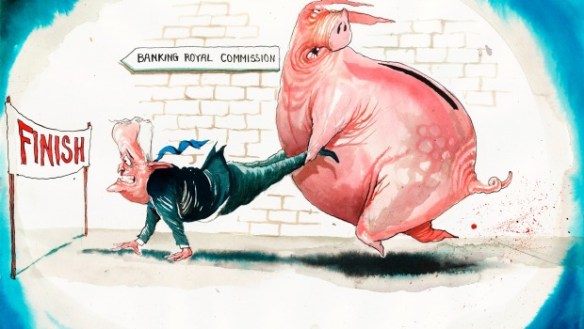
As I have written elsewhere, bank bashing is a favourite Australian pastime. In recent months, this has struck a new crescendo. There have been various allegations, legal cases and regulatory investigations surrounding such misconduct as mis-selling of products, rate fixing, over-charging and money laundering, all culminating in a hastily announced Financial Services Royal Commission.

Cartoon by David Rowe, sourced from the AFR, published November 30, 2017

The banks had tried to get on the front foot, by abolishing ATM fees, reigning in some of their lending practices, and appointing a former Labor politician to help them navigate the growing calls for a Royal Commission (largely coming from her former colleagues in the Labor party). But the (Coalition) government clearly decided enough was a enough, and sprung their own inquiry into the industry.

For the benefit of overseas readers, Australia has a highly concentrated banking sector, which is also highly regulated, highly profitable, and in some ways, a highly protected market oligopoly. There are only four major banks (also know as the four pillars, as they cannot acquire one another, nor can they be acquired by foreign banks), and a few regional banks. There is a smattering of non-bank financial institutions, but by their very nature, they don’t offer the full range of banking products and services. As an example of this market concentration, the big four banks traditionally account for something like 80% or more of all home loans.

Aside from the Royal Commission, there are a number of policy developments in play which will inevitably change the banking landscape, and the dynamic between market participants. In addition to the growth of FinTech startups aiming to disrupt through digital innovation, there are four key areas of policy that will impact traditional banking:

  1. Open Banking – giving customers greater access to and control over their own banking data
  2. Comprehensive Credit Reportingmandating the hitherto voluntary regime among the big four banks
  3. The New Payments Platform – designed to allow real-time payment and settlement between customers, even without using bank account details
  4. Restricted ADI Regime – to encourage more competition in the banking sector

The major banks have tried to laugh off, rebuff or diminish the threat of FinTech disruption. They believe they have deeper pockets than startups and just as good, if not better, technology processes. Moreover, customers are traditionally so sticky that there is an inherent inertia to switch providers.

But with banks having to set aside more risk-weighted capital to cover their loans, they may be vulnerable to startups focusing on very specific products, rather than trying to be a full service provider. Banks no longer have the technology edge, partly because of the legacy core banking systems they have to maintain, partly because they lack the know-how or incentive to innovate. And changing demographics will influence the way new customers interact with their banks: “mobile first”, “end-to-end digital”, and “banking for the gig economy” are just some of the challenges/opportunities facing the sector.

So what should we expect from our banks? I would say that at a minimum, a bank should provide: trust (but with Blockchain, DLT and trustless, zero-knowledge proof solutions, banks are no longer the sole arbiter of trust); security (linked to trust, but again, with biometrics, digital ID solutions and layered encryption, banks do not have a monopoly on these solutions); capital protection (although no bank can fully guarantee your deposits); reasonable fees (still a way to go on account keeping fees and some point of sale transaction fees – while disruptive technology will continue to challenge legacy costs); and an expectation that it will not bet against the direct interests of their customers (like, shorting the housing market, for example). The latter is particularly tricky, when banks are mainly designed to deliver shareholder value – although of course, most Australian bank customers also own shares in the banks, either directly, or indirectly through their superannuation.

In recent months, and based on personal experience, I think a bank should also know its customers. Not just KYC (for regulatory purposes), but really understand a customer as more than just a collection of separate products, which is how most banking CRM systems seem to work. Given how much banks spend on consumer research and behavioral data, and how much they talk about using big data, artificial intelligence and machine learning to anticipate customer needs, it’s a constant frustration that my bank does not really know me – whenever I contact them, for any reason, I always feel like it’s a process of “product first, customer second”.

Moreover, I can’t think of a single new product that my bank has launched in the past 15 years of being a customer. Sure, they have rolled out mobile apps and online banking, and they may have even launched some new accounts and credit cards – but these are simply the same products (accounts, loans, cards) with different prices and a few new features. Even the so-called “special offers” I get for being a “loyal” customer bear no relation to my interests, or even my spending patterns (despite all the data they claim to have about me). And because banks are product or transaction-driven, rather than relationship-driven, their internal processes fuel silo behaviors, to the extent that the left hand very often does not know what the right hand is doing.

Finally, with more and more of the working population becoming self-directed (self-employed, freelance, portfolio career, contracting, gig-economy, etc.) banks will have to innovate to meet the financial services needs of this new workforce. Bring on the disruption, I say.

Next week: Box Set Culture 


Equity crowdfunding comes to town

Earlier this month, the Australian Securities and Investments Commission (ASIC) announced it had approved the first seven crowdsourced funding platforms (CSFs). It seems that after much debate, equity crowdfunding is finally open for business.

Image: Aaron Pruzaniec, sourced from Wikimedia Commons

Although not named in the ASIC media release, the seven successful applicants are:

There are significant limitations to the CSF legislation – namely:

  • the type of eligible companies (only smaller, public unlisted companies);
  • the amounts individual investors can invest (up to $10,000 per company per 12 month period); and
  • how much companies can raise (no more than $5m in any 12 month period)

Also, there is no indication as to whether other CSF license applications are still pending, or which applications may have been rejected. It may also be difficult to assess the relative merits of each platform, since there only appears to be one class of license.

Meanwhile, legislation is already in the pipeline to extend the CSF regime to proprietary companies – which would significantly expand the potential number of issuers.

Compared to some of the largest initial coin offerings (ICOs) over the past 18 months, a $5m capital raise looks like small change. If anything, ICOs took the decade-old crowdfunding experience and supercharged it with Blockchain, cryptocurrency and decentralized issuance platforms. But then, regulators tend to lag markets and technology; plus, their primary focus is protecting the interests of less sophisticated retail investors (as well as market stability).

It’s also worth remembering that a limited crowdsourced funding model has been available in Australia for several years, almost as long as crowdfunding itself: Enable Funding (formerly ASSOB) was established in 2007, but with a much more restricted license than the latest CSF legislation. (And in other countries, early-stage companies have been able to more easily raise equity capital via market listings on secondary boards of the main exchanges – e.g., Mothers in Japan, GEM in Hong Kong, and AIM in London.)

The new CSF regime (and whatever else comes in its wake) does raise a few interesting points:

1. Although expressly confined to equity issuance in the form of common shares, by giving it a more generic name, does this mean CSF will be used for other types of securities (bonds, structured finance)?

2. What expectations has ASIC placed on the number of raises, and the total amounts to be raised, over the next 3-5 years – how will it measure or define the success of CSF?

3. More importantly, where is investor money expected to come from – will investors switch from property or other assets?

4. How will the increasing practice of issuing digital tokens as traditional securities (and potentially vice versa) add to the demand for CSF platforms and services?

It’s very early days, of course, and very small scale, but judging by the response so far to one of the first companies to take advantage of the CSF legislation, investors like what they are seeing.

Next week: Australia Post and navigating the last mile


FF18 pitch night – Melbourne semi-final

As part of the Intersekt FinTech festival, Next Money ran the Melbourne semi-final of their 2018 Future FinTech pitch competition.

Ten startups presented, in the following order, in front of a panel of judges representing different parts of the Melbourne startup ecosystem:

BASIQ

Describing itself as “the future of finance”, and quoting the trendy mantra of “Data is the new oil”, BASIQ is an API marketplace for financial data. Designed to counter-balance “the Faustian pact” of big data, social media and search, and to compensate for the information asymmetry of bank-owned data, BASIQ espouses open banking, even though it is backed by two bank-related VC funds (NAB Ventures & Reinventure – see last week’s blog). With a focus on the needs of app developers, the commercial model is based on a licensing fee per user per transaction. Leveraging the AWS security layer (presumably to maintain privacy and data integrity), the pitch also mentioned “screen scraping” – so it wasn’t clear to me whether the data is only coming from publicly available sources? Currently, the platform only connects to financial institutions in Australia and New Zealand.

Breezedocs

A participant in the FF17 Semi-Final earlier this year, Breezedocs is a robotic document processing solution. In short, it can read/scan, sort and extract relevant data from standard documents that need to be presented by customers in support of a loan application. Operating via an API, it can work with multiple document types and multiple formats: data can be structured, semi-structured, or even unstructured. The benefits for lenders and brokers are reduced loan approval times and increased conversion, with much
better CX for the loan applicant as well. The goal is to help the standard loan origination process to go paperless, and could be extended to life insurance, income protection insurance, and immigration and visa applications.

Doshii

Doshii ensures that apps and POS solutions can connect to one another, via a common POS API platform. Apparently, there are 130 different POS providers in Australia, and many merchants use multiple services. Now backed by Reinventure, Doshii has a focus on the hospitality sector. The biggest challenge is physically connecting a POS to the API, so Doshii has developed a SDK. However, so far, only five of the 130 providers have signed up.

egenda

I hope I got this right, but egenda appears to be the new product name for the WordFlow solution for board agendas and meetings. Offering an “affordable web-based solution for every meeting”, the product is currently being trialed by a number of universities. The platform can convert PDF/word files into HTML, transforming and enriching them into a single secure website.
The panel asked how egenda compares to say, Google productivity suite or IntelligenceBank. A key aspect seems to be that egenda is platform agnostic – so it doesn’t matter the source of the document (or where it needs to be published to?). A key challenge in managing board papers is that it’s like herding cats – so a single but highly functional repository would sound attractive?

HipPocket

This US-based app is looking to launch in Australia. A phone-based financial decision app linked to a user’s bank account, it is designed to help with personalised goal-setting, budgeting and financial engagement. Asked whether it can support long-term goals, the pitch referred to data that suggests an increasing number of people are effectively living from pay-day to pay-day, and have no capacity to meet even the smallest of unexpected  bills. Having attracted a grant from the Queensland government, they are currently experimenting with different customer acquisition models, but they hope to prove that with daily engagement, it is possible to build a long-term relationship.

ID Exchange

With a tag line of “privacy protection power”, ID Exchange addresses a key issue of the “consent economy” – how to control who has access to your personal data, and how much, and for what purpose. With the whole notion of “trust” being challenged by decentralised and trustless solutions such as Blockchain applications; the plethora of data connections with the growth of IoT; and the regulatory framework around KYC, AML, CTF, data protection and privacy, there is a need for harmonised solutions. Under an “OptOut/OptIn” solution (from the website, it looks like this is a partnership with digi.me?), the idea is that users take more responsibility for managing their own data. ID Exchange offers a $20 subscription service – but unfortunately, based on the pitch, it was not clear what does this actually meant or included.

Look Who’s Charging

This is a platform for analysing credit and charge card transactions, to identify anomalies and reduce disputed charges. Currently with about 7.5% market penetration (based on merchant volumes?), it can help with fraud checks and spend analysis, by combining AI, crowd-sourcing and data science. But from the pitch, it wasn’t clear where the data is coming from. Also, a key part of the problem might be the data mismatch between card acquirers (merchant services) and card issuers (banks and financial institutions). Given that the growth in credit card fraud is coming from online shopping and CNP (card not present) purchases, it would seem that a better solution is to tighten procedures around these transactions?

Plenty

Plenty describes itself as a “financial GPS”, and is designed to address the issue of poor financial awareness. Only 20% of people see a financial planner, but now with robo-advice tools, even personalised advice can be scalable. Essentially a self-directed financial planning tool, it is free for customers to create a basic financial plan and when searching for a mortgages. For a subscription fee, customers can begin to access other products and advisors, which generates commission-based fees to Plenty.

Proviso

Another of these FinTechs to have featured in this blog before, as well as competing at FF17, Proviso makes “financial data frictionless”, in particular the loan application process. With 250,000 users per month, and 150 financial institutions signed up, their success can be ascribed to the way they standardise the data and the UX. Plus, they can access more data, from more sources, quicker. And then there are the analytics they can offer their institutional clients. In the future, there will be open banking APIs, plus insights, such as the categorisation of transaction types, affordability analysis, and decision-metrics.

Trade Ledger

This is a new platform that supports SME lending based on receivables, that also reduces the effort for SMEs seeking this form of financing. Given that cashflow issues are inextricably linked to insolvency risk, Trade Ledger has developed a unique credit assessment method, and is product-type agnostic. It also aims to offer automated solutions, with an emphasis on the digital UX of products, and use machine learning to generate a predictive probability of default (PPD). Currently the biggest challenge is in the multiple variations of bank credit and lending processes and models that need to be integrated or streamlined.

Of the ten pitches on view, I have to say that none really had a “wow” factor (although if Trade Ledger can scale their PPD model, and if ID Exchange spent a bit more time on defining their key message, both could be huge products). They were mostly worthy ideas, but still defined by current banking and finance procedures. Maybe these platforms need to do more with the transactional and customer data they generate or process, to uncover more opportunities. Or think about what they could do to disrupt adjacent markets? Anyway, on the night, Proviso proved the favourite with the judges.

Next week: Conclusions from the Intersekt Festival