Talking Innovation with Dr Kate Cornick, CEO of LaunchVic

As a nice segue to last week’s blog on Techstars, I was fortunate to hear Dr Kate Cornick speak, just before the latest LaunchVic grants were announced. Organised by Innovation Bay, hosted by Deloitte, and facilitated by Ian Gardiner, the fireside chat plus Q&A was a useful insight on a key part of the Victorian Government’s innovation strategy.

launchviclogo innovationbay-feat-800x500At the outset, Dr Cornick stressed that LaunchVic is not an investment vehicle, and it doesn’t fund individual startups. Rather it seeks to support initiatives that help grow the local startup eco-system. (See also my blog on the consultation process that informed LaunchVic’s formation.)

Commenting on why Victoria (and Australia) has the potential to become a world-class centre for innovation, Dr Cornick pointed to a number of factors:

  • A collaborative culture
  • Positive economic conditions (comparatively speaking)
  • Governments (mostly) open to innovation
  • Strong research base

However, a few of the obstacles in our way include:

  • The notorious tall poppy syndrome, whereby Australians are suspicious, sceptical and even scathing of local success – except when it comes to sport and entertainment!
  • An inability to scale or capitalise on academic research
  • Insufficient entrepreneurial skills and experience to “get scrappy”
  • Lack of exposure for highly successful startups (c.$20m market cap) that can help attract more investment

From a startup perspective, Australia also has the wrong type of risk capital: institutional investors are more attuned to placing large bets on speculative mining assets, typically funded through public listings, and with very different financial profiles. (Or they prefer to invest in things they can see and touch – property, utilities, infrastructure, banks.)

So there is still a huge gap in investor education on startups and their requirements for early-stage funding. Part of LaunchVic’s remit is to market the local startup community, promote the success stories, and foster the right conditions to connect capital with ideas and innovation. After all, Australia does have one of the largest pool of pension fund assets in the world, and that money has to be put to work in creating economic growth opportunities.

As I have blogged before, we still see the “expensive boomerang”: Australian asset managers investing in Silicon Valley VCs, who then invest in Australian startups. Although when I raised a question about the investment preferences of our fund managers, Ian Gardiner did point out that a few enlightened institutions have invested in Australian VC funds such as SquarePeg Capital, H2 Ventures and Reinventure.

Dr Cornick also provided a reality check on startups, and added a note of caution to would-be founders:

First, it tends to be an over-glamourised sector. For one thing, founders under-estimate the relentless grind in making their business a success. And while eating pizza and pot noodles might sound like a lifestyle choice, it’s more of an economic necessity. Thus, it’s not for everyone (and not everyone should or needs to build a startup…), so aspiring entrepreneurs would be well-advised to do their homework.

Second, the success of any startup community will be reflected by industry demand. “Build it and they will come” is not a viable strategy. And I know from talking to those within the Victorian Government that unlike their inter-state counterparts, they are not willing (or able) to fund or invest in specific startups, nor in specific ventures such as a FinTech hub. Their position is that industry needs to put its money where its mouth is, and as and when that happens, the Government will look to see what support it can provide to foster and nurture such initiatives – particularly when it comes to facilitating between parties or filling in any gaps.

Third, don’t expect too many more unicorns, and don’t bank on coming up with simple but unique ideas that will conquer the world – meaning, new businesses like Facebook, Uber and Pinterest will be few and far between. Instead, drawing on her earlier comments about research, Dr Cornick predicts that it will be “back to the 90’s”, where innovation will come from “research-based, deep-tech solutions”.

If that’s the case, then the LaunchVic agenda (for the remaining 3 years of its current 4 year lifespan) will include:

  • Getting Victoria on the map, and positioning it as a global innovation hub
  • Raising the bar by educating startups and investors
  • Bringing more diversity to the startup sector, by providing greater access, striking better gender balance, and building a stronger entrepreneurial culture
  • Introducing a more transparent and interactive consultation process
  • Continuing to support the best accelerator programs that focus on startups
  • Making more frequent and smaller funding rounds, each with a specific focus

Asked what areas of innovation Victoria will be famous for, Dr Cornick’s number one pick was Healthcare, pointing to the strong research base coming out of both the Monash and Melbourne University medical precincts. Also in the running were Agriculture, and possibly Cyber-security. (Separately, there is a list of priority industries where the Government sees growth, employment and investment opportunities.)

If one of the biggest hurdles is commercializing research, Dr Cornick suggested that Universities have to re-think current IP practices, including ownership and licensing models, developing better career options in research, and doing more to re-calibrate the effort/reward equation in building research assets compared to building companies and commercial assets.

Finally, Dr Cornick offered an interesting metaphor to describe the current state of Victoria’s innovation potential:

“We have everything we need for baking a cake, but the missing ingredient is the baking powder to make it rise.”

Next week: Gigster is coming to town….


A few rules on pitching

As regular readers will be aware, I have watched a lot of startup pitches over the past 4 years: the good, the bad, and the plain ugly. Having experienced rather too many of the latter in recent weeks (the names have been withheld to protect the guilty…) I started jotting down a few practical rules on managing the technical logistics of your pitch.

Source: Scientific American, via Wikimedia

The art of pitching (Source: Scientific American, via Wikimedia)

Rule #1 Check Your Tech

That’s everything from the computer drive/USB to the projector and screen, from the mic to the PA, and all cables and connections in between. As in most things, the last mile in the delivery chain can seriously let you down. Plus, simply knowing how to hold and use a mic would be a bonus!

Rule #2 No Videos

Yes, I know videos can be “cool”, but in a pitch setting they end up being a distraction, and I feel that the use of videos can be a cop-out – like you couldn’t be bothered to prepare a proper deck. (Remember those lazy teachers at school who would prefer to show some ancient “educational film” rather than actually teach their subject?)

Plus, embedded web links and the myriad of different formats and hardware compatibility mean videos are notoriously prone to fail. Leave them out.

(As regards the use of live demos or live website connections, this really depends on the nature of the pitch event, and how reliable the technology is. While I have seen some great examples of live app demos, equally, I’ve seen otherwise good pitches derailed by slow internet connections…..)

Rule #3 Check Fonts, Colours, Slide Transition & Automation

As with video compatibility, different slide formats will likely render differently from device to device, from projector to projector. My suggestion is to create your deck with one of the most commonly-used software formats (i.e., not necessarily the latest open source graphics package that no-one else has heard of…), use universal fonts and colours wherever possible, and keep slide transition and animation simple.

Rule #4 Block audio interference over the PA

One recent pitch event I attended was beset with tech problems, including noise from another source that cut into the PA. This was not the fault of the teams pitching, but their presentations suffered as a result. Some simple planning, like making sure the PA is a closed loop or that wireless equipment isn’t on an open channel.

Rule #5 Clickers

Anything that keeps the tech “invisible” is a bonus, and a remote clicker can really make a difference for presenters who don’t have to stand behind/near a laptop or steer via a mouse. But, like all the other bits of tech, not all clickers are equal, and so a bit of familiarization is in order. And used poorly, they can become a distraction, or worse, a prop that becomes like a crutch. Again, it’s about the last mile of delivery, and making sure the tech has been tested in advance.

Rule #6 Know Your Audience

This might seem obvious, but as well as understanding the event format (and any competition rules if applicable), find out who you will be pitching to: is it an audience of fellow startup founders, or investors, or potential customers? What might be the general level of awareness for your industry, product or business model? Who are the judges? Who do you need to impress most? What would be the most important contact you could make as a result of your pitch?

Rule #7 Make The Organisers Accountable for the Tech

In all of this, there is a huge responsibility placed on hosts, venues and tech support at startup events to make sure the technology is there to help, not hinder, the pitch presentations. While organisers can’t necessarily determine the quality of the content, or the presenters’ performance, they can make sure each pitch is competing on a equal tech basis.

Ideally, presenters should all be using the same PC or device, to reduce changeover time and equipment errors. Even better if the decks can be loaded in advance, and each presenter is given time for an AV check beforehand. I also recommend event hosts and venues consider using monitor screens placed in front of the presenters, so they don’t have to keep looking over their shoulders at the big screen – this is especially helpful in large audience settings.

Finally, if the format requires more than one person at a time to be speaking, please make sure they each have a separate microphone……

Next week: The Maker Culture

The Startup of You v2.0

Through my blogs on startups, meetups and portfolio careers, I was recently interviewed by Peter Judd from News Corp., who is trying to bring the discussion on entrepreneurship, startups and innovation to a wider audience, particularly people who may be looking at a career change. (We both agree that the National Innovation and Science Agenda is not cutting through to the general public.)  Apart from being an advocate for portfolio careers, I also pointed out that entrepreneurship or working with startups is not for everyone. Instead, it may be possible to change your current role to the one you want. Alternatively, taking a new look at your current circumstances can provide some fresh perspective on finding your dream career.

Francis Kenna: The Unbearable Lightness of Seeing (2016) [Photo by Rory Manchee]

Francis Kenna: The Unbearable Lightness of Seeing (2016) [Photo by Rory Manchee]

The impetus following the 2012 publication of “The Startup of You” has done much to fuel the current entrepreneurial phenomenon, combined with lean startup business models and agile product development processes. The drive for innovation in response to digital disruption and lowering technology costs also means that launching your own venture can be increasingly de-risked.

For example, I recently saw some data by Ian Gardner from Amazon Web Services, that showed the “cost of failure” has come down from $5m to $5k, in just 15 years. This is based on a comparison between what it typically cost to launch a new business at the height of the dot.com boom/bust in 2000, and what it costs today. With a mix of open source tools, cloud computing, APIs, SDKs and social media platforms, launching a new business has never been cheaper or easier.

Of course, there is a paradox here: if an increasing number of people, especially younger graduates and new entrants to the workforce, are more interested in doing their own thing and less interested in joining large or established organisations, it’s going to get harder for employers to attract and retain the best talent; on the other hand, without appropriate experience, on-the-job training and personal development, how do these aspiring entrepreneurs acquire the necessary business, technical and leadership skills to succeed in their own ventures?

For some people, it may be appropriate to take their entrepreneurial spirit of adventure into a “traditional” role to test some of their ideas, as well as build networks and get some practical experience. Equally, I can see a huge opportunity for companies to create the right opportunities to engage employees for flexible roles aligned with specific projects or objectives (rather than plugging them into org charts). Companies are also finding new ways of tapping into their existing workforce to identify hitherto hidden and unknown skills and knowledge. Many employers also recognise that leadership roles will increasingly be filled by people who are comfortable with rapid change, increasing complexity and heightened uncertainty, as well as having enhanced soft skills. (There’s even some current thinking that utilising “rebel talent” is a good thing.)

Whether you are starting out on your entrepreneurial journey, looking to reboot your career, or searching for meaningful work that aligns with your values and purpose, there are numerous opportunities (via meetups, hackathons, pitch nights and networking forums) to explore your options before you make a decision. And for companies looking to re-invigorate your workforce and unleash hidden talent, there are many ways to experiment through taking informed risks, by building in-house innovation hubs, running consultative and collaborative workshops, and inviting ideas and inspiration from your existing people, who are familiar with the challenges you face.

Next week: Banksy – an artist for our times?

Food for thought at #StartupVic’s #pitch night

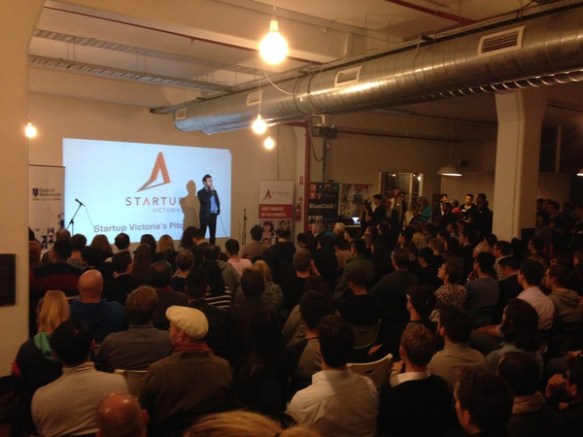
There was something of a different flavour at Startup Victoria‘s pitch night for September – including the new beverage sponsors! – which may have been helped by the large crowd, and the more polished presentations (judging by the feedback).

startupvic

Image sourced from Startup Vic’s Meetup page

I will comment on each pitch in order of appearance:

Studio Ninja

Studio Ninja is described as Client Management software for professional photographers. Aimed at the wedding industry, it also holds some appeal for other event planners, DJs, musicians, make-up artists, hairdressers, caterers and florists. But the primary focus is on weddings, and the specific needs of studio photographers, whose workflow is very particular (according to the founders).

Regular attendees at these pitch nights will recall similar CRM/project management tools for other sectors, such as architects and management consultants – which raises questions about how unique each profession really is?

In essence, the software handles lead management, invoicing and cashflow reporting. It is available via subscription, and integrates with payment systems such as Stripe and PayPal, and other service providers such as Uber, and will soon integrate with Xero.

With a reported 40 new sign-ups per day, and around 2,000 members (of which only 300 are currently paid subscriptions), the Studio Ninja team are aiming to grow to 10,000 users and revenue of $4m. Growth is being driven by strong SEO and organic discovery among photographers, and word of mouth referrals.

The panel of judges were interested to know how the software could be sold via peak bodies and professional associations, under a SaaS or white-labelling model, and what potential there is to integrate lead generation and referral solutions. The judges also thought that camera and photography equipment brands could offer a significant sales channel opportunity.

Deliciou

Something of a different pitch came from this bacon flavoured seasoning, which is actually bacon-free. (I should confess that I was once a vegetarian, but when I started to dream about bacon sandwiches, I realised I was missing out… Maybe if this product had been around all those years ago, things would have turned out different. But I digress.)

There was certainly no lack of passion in this pitch, and the founder had even made sure there were free samples to go around, so strongly does he feel about his product. With a 9% conversion rate from website visits, and 2,000 bottles sold this year, there is obviously a niche in the flavourings market for a “guilt-free” bacon experience.

A graduate of the Melbourne Accelerator Program, the founder has cleverly chosen to use a pop-up popcorn stall to generate market awareness, solicit customer feedback, and create visibility for a product that comes in a small jar, and will compete for valuable shelf space in supermarkets.

The business is seeking $100k in seed funding to expand the range of seasonings,
expand overseas, and to resolve issues with production lead times and logistics. But given the challenges in building consumer brands, especially in the food and beverage category, a better option might be to tie up with another snack food or convenience food brand, and use that vehicle for distribution and market reach.

Reground

Reground is another food-related startup, but this is all about recycling coffee grounds. The business turns coffee waste – which otherwise goes into landfill – into sustainable uses, thereby reducing the amount of methane gas released into the atmosphere.

With a waiting list of cafes who want to access the service (because cafe owners already pay their local council to take away the waste), Reground will divert part of those waste collection fees and can even help cafes save money. Reground also supplies community gardens with free material for their compost. Other uses for the coffee waste include mushroom production.

As well as offering waste assessment services and potential cost savings, Reground runs a newsletter and provides certification for participating cafes. There is also potential for this Melbourne-based business to go national and even to the USA.

They are also offering a customer app to support logistics around collection, and they operate their own van as there are council limitations on more waste trucks on our streets. Asked by the judges about scaling their business, the founders are considering to build their own waste processing plant. (After the event, I did a quick search, and found a similarly-named business in Canada.)

Allume Energy

Finally, Allume Energy, another sustainability business, this time in solar energy distribution. Or, in their own words, “Democratising access to renewable energy”.

As a social enterprise, Allume offers tenants easier access to cheaper solar energy. Basically, Allume contracts with the property landlord to provide initial funding to install and set up a solar system, and then tenants pay for their energy via a contract licensing system. In addition to working with community and social housing projects in remote locations, Allume also offers a shared system for apartment blocks.

Claiming to provide a 30-50% saving to tenants, Allume requires landlords to commit to a 15 year contract, with a 50% break fee (based on the initial installation and set up costs). Given some of the current challenges in renewable energy (weather events, phasing out of government rebates, and reduction in feed-in tariffs), this scheme to implement very local solar systems will no doubt appeal to landlords and bodies corporate.

And on the night, Reground was the people’s choice – probably because it was a simple but effective proposition, and it appealed to Melbourne’s environmentalists and coffee lovers alike!

Next week: A Tale of Two #FinTech Cities – Part 2