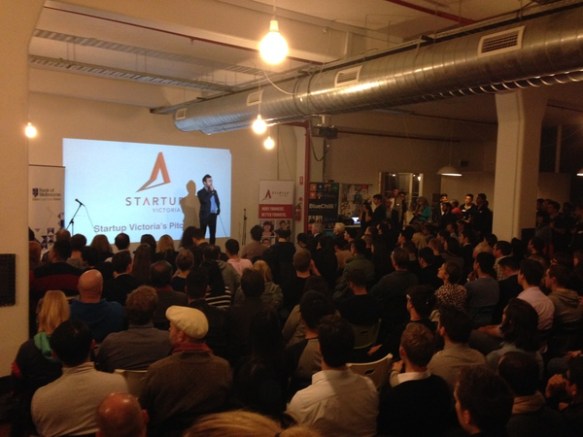
StartupVic’s E-commerce #Pitch Night

A new venue, and a new theme – last week’s Pitch Night organised by Startup Victoria was hosted at Kensington Collective, and featured four contestants each working in different areas of e-commerce.

With some high-profile judges (including Ahmed Fahour, outgoing CEO of Australia Post, and Kate Cornick, CEO of LaunchVic), and an audience warmed by hot soup and mulled wine on a very cold and wet Melbourne night, it was not surprising that the event was packed out, despite the weather.

In addition to hearing the competing pitches, attendees were also able to meet with a number of other e-commerce startups exhibiting in “silicon alley”, including: VolStreet (a new market place for consumer goods), Liven (a loyalty program for restaurants), Buying Intelligence (data on retail trends from the fashion industry) and Straight From Farmers (a D2C platform for agricultural produce).

As per the usual practice of this blog, the startups appear in the order in which they pitched (and click on the startup names for their website links):

 Passel

Passel’s business model is built on a crowdsourced solution for same day deliveries, so that shoppers can get their purchases quicker from omnichannel retailers. According to the founders, a high percentage of online cart abandonment is due to freight costs, and delivery times.

Using something akin to the Uber model, retailers will book a delivery that could be fulfilled by one of their own staff on the way home, or by another shopper if they are in the vicinity. Same day delivery is apparently more secure, and with a registration process for delivery “agents” and no charge to the retailer until proof of delivery, Passel is also designed to de-risk the delivery service. But, not quite delivery drones across suburbia!

Currently running a limited trial at Bayside Mall in Frankston, Passel is putting most of its efforts in to training staff at the stores they work with, to make sure the process is bedded down.

The judges had a range of questions and observations about the business proposition and assumptions behind the pitch, such as: Retailing can be quite a separate function to distribution and fulfillment, and for larger retailers stock management may cover several stores, or be handled by core distribution centres – so how will shops retailers be able to match orders and deliveries on a same day basis? Within large outlets, the time taken for delivery staff to actually locate an item may become burdensome, so has Passel considered geo-coding within stores? What is the opportunity outside Australia?

My own observations about this pitch included: what are the issues with insurance, what is the fit with click’n’collect services, and is there a bigger opportunity in solving current problems with the use of contract couriers on demand?

Vesta Central

Describing itself as “a marketplace for destination partners“, Vesta Central is also one of a growing number of Product Data Distribution Platforms (PDDP), between suppliers and retailers. Essentially, it offers an API to allow manufacturers to upload their inventories to support downstream distribution and sales.

Citing technological, time and cost barriers for product suppliers and retailers to upload and distribute product data, Vesta Central’s main proposition is to help move from physical to digital, via a centralised master data platform. From here, retailers can pull product data in real-time.

I’ve seen similar startups and businesses that also provide product manuals, technical specifications and even product training to sales staff, so the judges also felt that the founders need to gain a better knowledge and understanding of the competitor landscape. Another word of advice they had for the pitch was, “Let go of the PowerPoint…”

To Me Love Me

With a tag line of “Fashion Tech – Made To Measure“, this startup is trying to address the issue of incorrectly fitting clothes which is creating retail dissatisfaction.

Using key measurements and six data points, the service develops personal profiling
based on a proprietary algorithm according to body shape and style preferences. In return, it can offer curated, personalised, and even some custom-made suggestions and recommendations – but mostly ready-to-wear brands.

Aiming to help brands bond with their customers, the service also introduces social elements via peer/customer feedback. The service provides a seamless experience and offers a level of control to customers – but essentially, it’s a data play: collecting, aggregating and distributing customer statistics and profiles to the industry.

Although the pitch mentioned a SaaS model (with three tiers of service and pricing), the economic model was not fully outlined. However, the judges were clearly impressed by the founders’ international contacts in the US, UK & Europe, and their global ambitions.

CableGeek

With one simple sales proposition (“selling trusted mobile accessories at low prices“), CableGeek aims to address three common problems in this retail product category: Inconsistent product quality, high retail mark-ups, and difficulties in buying online (especially the shipping costs on lower-price items).

The CableGeek solution includes: free shipping from Australian suppliers, offering global brands, a focus on mobile (ApplePay), and key partnerships (instant pickup via Blueshift’s IBP, and fulfillment via eStore Logistics).

With a Google customer review rating of 4.8, CableGeek must be doing something right. Asked about what sets it apart from the competition, and how it will fend off competition, the founders cited the end-to-end automation plus their own full stack development – so any challenge is more likely to come from large retailers (who don’t necessarily have the focus or the in-house technical capabilities?).

However, given that the business was started by Ryan Zhou, who is also a co-founder of CoinJar, the judges wondered whether he would be over-stretched, or unable to commit 100% to this new business – especially as in this type of retail business, the only way to succeed is by dominating market share, which requires full-time commitment.

The judges were obviously won over by To Me Love Me‘s approach, as it took out first place on the night. There was also a sense that it was the only pitch that clearly had a real eye on international opportunities, and had demonstrated some serious industry credentials.

It was also interesting that a couple of the pitches referred to issues with delivery costs in Australia, especially for smaller, lower value items – something that the incoming CEO at Australia Post might want to address?

Finally, it was disappointing that there was no opportunity for questions or input from the audience – with one of the largest turnouts ever for a regular pitch night, Startup Victoria needs to think about how to incorporate more audience participation – these events should not just be a spectator sport.

Next week: Law & Technology – when AI meets Smart Contracts…

 

Spaceship launches the future of superannuation

Backed by some stellar names in the tech and startup worlds, Spaceship describes itself as a superannuation fund designed to “invest where the world is going, not where it’s been”. Squarely aimed at 18-35 year-olds (and savvy people in their 40s and 50s….), it is the brainchild of Paul Bennetts (a Partner at AirTree Ventures), Andrew Sellen (ex-Marketing Manager at Australian Ethical Investments) and two tech co-founders, Dave Kuhn and Kaushik Sen. Their central thesis is that global tech stocks are the future, and that these assets should form a greater part of a fully diversified portfolio, with a 10-year plus investment horizon.

spaceship-logo-03I first connected with Paul a couple of years ago, when I was working with a legal technology startup that was an early graduate of the Melbourne Accelerator Program. He was interested in what we were doing at Ebla, but the company was at too early a stage for him to invest in. But I’ve kept an eye on what Paul has been doing since, and have followed the Spaceship story quite closely. We last caught up very briefly during a recent roadshow event in Melbourne, as part of the Spaceship beta launch.

Any new superannuation brand, especially if it is neither an industry fund nor a retail fund backed by a major financial institution, is going to struggle to attract members: the industry and public sector funds have the benefit of workplace incumbency (sometimes backed by industrial awards), and the big retail funds have extensive distribution channels via advisor platforms, dealer groups and financial planners. As for corporate superannuation funds, in my experience, many of these employer-run funds are often a re-badged or customised version of an existing retail fund, or a highly outsourced business that retains the company name for brand recognition among employees.

Spaceship is challenging the market by using technology (and very targeted marketing) to streamline the recruitment and on-boarding process. As evidence of its marketing success, Spaceship claims to have built a waiting list of 12,000 prospective members in just 30 days, mostly through social media and word-of-mouth. And as evidence of its success in attracting “smart” money, witness some of the big names who have backed the venture as investors, or joined as members themselves.*

Not surprisingly, Spaceship is also developing some interesting content marketing and social media tactics to drive member engagement. This includes thought leadership on portfolio diversification, understanding investment horizons, accessing investments in early-stage tech companies, and investing in tech brands that its members love and use.

But while much of the media coverage for Spaceship has been positive, it has already drawn detractors (almost in the same breath…). Some of the latter reckon that it won’t achieve necessary scale to be sustainable (in light of APRA moves to drive consolidation among smaller funds), it will be highly concentrated in its exposure to tech stocks (which have a tendency to be more volatile), and without face-to-face contact with members, it will be harder to drive customer engagement.

Given that, following some delays, Spaceship does not launch to the general public until the end of this month (it is still running a waitlist), it’s probably a bit churlish to say it is doomed to failure before it has even really begun. Equally, having worked in financial market research myself, I have met with a number of industry, public sector, retail and corporate superannuation funds who cite member engagement and retention as one of their biggest challenges. The main issue is this: how do you interest an 18-year old in something from which they won’t derive any benefit for at least 40 years?  And once you have got their attention, how do you sustain that interest over the lifetime of their membership and into retirement?

Now technology is having a larger part to play in disrupting the superannuation industry, and changing the way members interact with their fund. As the COO of a major industry fund said recently at a FinTech Victoria event, “consolidating your super balances is only three clicks away” (to which Spaceship, replied “it’s now only one click!”). But it’s not enough to have a smart phone app to check your balances, switch investment options or make voluntary contributions. Members are looking for other services, such as financial education, estate planning, insurance, loans and mortgages, and tailored advice. Plus, they expect much more streamlined processes and pro-active member support.

I suspect that a key factor that will likely contribute to Spaceship’s potential success is the growth of the gig economy:

First, with more people working as freelancers, contractors or becoming self-employed, they will have no ties to a fixed workplace or a single employer – so they will be drawn to a fund product that appeals to their independence and flexibility.

Second, much of the gig economy lies in the tech and startup sectors, so again, prospective members might well be looking for a fund that invests in what they are interested and involved in themselves.

Third, if we are all expected to live and work longer, and if we are going to have to rely more on our own accumulated retirement assets, a fund that fully aligns with this long-term investment philosophy is hopefully going to be better placed to help us meet our financial goals.

Of course, it’s worth remembering that the Australian superannuation industry is both large ($2.1tn in assets as at September 2016, and the 3rd largest pool of pension funds in the world), and highly regulated (for very good reason). Equally, it has been slow to adapt to a changing economy and to different market factors, and is increasingly dominated by just a few big funds. Among some large industry funds, there is almost a cosy, symbiotic relationship between their members (who work in say, construction, energy, mining) and some of the assets the funds invest in (infrastructure, buildings, utilities). (But that may prove to be Spaceship’s USP – representing members who work in the tech sector?)

Although the Australian superannuation and managed funds sectors have established strong capabilities in administration, trustee, custody and asset management services, many of these back-office operations run on legacy IT systems which are potentially ripe for disruption. Plus, while government initiatives look for ways to attract more offshore institutions to place their assets with Australian fund managers, under various financial passport arrangements Australian institutions can invest in offshore funds domiciled and managed in key investment centres such as Luxembourg and Singapore.

Finally, new entrants to the superannuation industry are less likely to be reliant on incumbent and legacy service providers, and more able to take advantage of emerging technologies such as blockchain solutions (distributed ledger platforms), and fully integrated end-to-end CX (mobile apps and tools).

* Declaration of interest and disclaimer: I was successful in signing up to Spaceship in beta/waitlist, and have allocated a small portion of my own super to the fund. I do not have any other commercial connection with Spaceship or its founders. I have not been paid to write this article, nor should it be construed or interpreted as financial advice – it has been provided for general information only. BE SURE TO SEEK YOUR OWN INDEPENDENT FINANCIAL ADVICE BEFORE MAKING ANY FINANCIAL INVESTMENT.

Next week: Gaming/VR/AR pitch night at Startup Victoria

Bridging the Digital Divide

Is there still a digital divide in Australia? If so, how do we bridge that gap? If not, how do we address the apparent chasm that is leaving some “digital have-nots” behind? Is it as simple as rolling out the National Broadband Network and equipping every school child with their own tablet device? Or is it also about creating a digital mindset to ensure everyone can take advantage of the educational, social and economic opportunities that the range of digital technologies has to offer?

Mobile phone internet usage is projected to keep growing. Source: Statista

Mobile phone internet usage is projected to keep growing. Source: Statista

Based on consumer research, we would appear to be a well-connected country, with a high concentration of PC, smart phone and tablet devices, if data from Roy Morgan is any indicator. However, some recent research by Scott Ewing of Swinburne University based on ABS data has suggested that despite the narrowing of the divide, there is a deeper disconnect among those who do not have internet access.

There are multiple factors contributing to this disconnect: socio-economic, age, location and education. I would expect that within 5-10 years, age will be a far less relevant factor in who does or doesn’t have access to the internet. You could also argue that with more people accessing the internet via mobile devices, and with the increasing number of free WiFi zones across our cities (cafes, shopping centres, office buildings), public institutions (libraries, museums and galleries) and transport infrastructure (plus the reducing price of data and storage), cost may not be as much of an issue either. And once the NBN is complete, the percentage of the population without physical access to the internet should likewise be much smaller.

So that leaves education – according to the ABS-derived data, the more educated you are, the more likely you are to access the internet. Should this infer that we aren’t doing enough to teach digital skills in the classroom? Or are we teaching the wrong set of skills? Or is it a bit like learning English grammar or applied mathematics – unless you use them in your everyday life, you soon forget them, and never remember why it was important to learn them in first place?

Computer science, programming and coding courses are increasingly being taught in schools, either as part of the core syllabus or as extra-curricular activities. Many pupils have to use tablets as an integral part of their school lessons. And some schools are also running hackathons and entrepreneurial projects to help students navigate the new world of work shaped by innovation, digital disruption and the “gig” economy.

The changing nature of work is challenging schools and parents to think about how we should be preparing pupils for the future. It’s not just learning about the technology (important as it is to study data analytics, automation, robotics, AI etc.), it’s also about understanding the context and the potential for what it can do. It’s also increasingly apparent that more and more of today’s students want to do work that is meaningful, rewarding, challenging and which helps connect them to their values and “purpose”.

I like to think that as part of a well-rounded liberal education, today’s pupils will receive:

  • a solid grounding in digital literacy (as important and as vital as the 3 R’s)
  • an awareness of how “digital displacement” (through automation etc.) may impact their chosen career path (even in ways which we cannot yet predict – we must assume it will happen, as no profession, trade or vocation will be totally immune)
  • an appetite for lifelong learning (as one of the ways to cope with the inevitable changes they will face)
  • a set of life skills that instill self-awareness, curiosity, resilience, empathy, flexibility and adaptability.

Finally, if we are to truly grasp why this ability to adapt and change is important, we only need look beyond the digital debate and ask why the National Innovation and Science Agenda is failing to cut through. In large part, the NISA message failed to connect with the general electorate because many people could not identify with it, and therefore it did not resonate with them. Just as “necessity is the parent of invention”, so adversity often needs to be the catalyst for embracing change.

Notwithstanding the economic, environmental and societal challenges we face, there is considerable complacency and acceptance that “she’ll be right” – especially within the political, institutional and corporate elites that claim to lead us. As long as so few of the main actors among these bastions of power and influence decline to change their own culture, behaviours and ways of doing business, then it’s not surprising that the public feels unwilling or unable to change.

So our only real hope is to empower the next generations to shape their own future, not to be constrained by our traditional notions of “job” (in my view, an increasingly outmoded economic unit of value….) and think for themselves as to what change they want to create with all the technology, resources and opportunities at their disposal.

Next week: My Extended Gap Year

101 #Startup Pitches – What have we learned?

During the past 3 years of writing this blog, I have probably heard more than 100 startup founders pitch, present or share their insights. Most of these pitch nights have been hosted by Startup Victoria, with a few on the side run by the Melbourne FinTech Meetup and elsewhere.

Image sourced from Startup Victoria Meetup

Image sourced from Startup Victoria Meetup

Based on all these presentations, I have collated a simple directory of each startup or pitch event I have covered or mentioned in this blog, as well as a few key accelerators and crowdfunding platforms.

What have we learned over that time?

First, apart from the constant stream of new startups pitching each month, it’s been impressive to witness the Melbourne startup community collaborate and support one another.

Second, some of the international founders who have spoken are among the rock stars of startups – and we are fortunate that they have been willing to spend time in Melbourne.

Third, a number of the local startups who have pitched during this time have become well-established and well-known businesses in their own right.

This all means that besides creating great products and services, and being willing to share their experiences, the founders have helped aspiring founders and entrepreneurs to appreciate the importance of:

  • product-market fit;
  • working with agile processes and lean startup models;
  • tackling prototyping and launching MVPs;
  • learning what to measure via key metrics;
  • figuring out funding; and
  • knowing when to pivot or fold.

Looking at the cross section of pitch nights, panel discussions and guest speakers, there are some significant trends and notable startups to have emerged:

Industry focus: Not surprisingly, the pitches are heavily biased towards FinTech, MedTech, Education, Digital Media, Enterprise Services and Consumer Services. There are a some key startups focused on devices (e.g., SwatchMate and LIFX); a smattering in recruitment, fashion, gaming, health and well-being, property services, social media and even logistics. But there are surprisingly few in environmental technology or services.

Business models: Two-sided market places abound, as do customer aggregators, sharing platforms (“the Uber for X”, or “the AirbnB of Y”), freemium apps and subscription services (as opposed to purely transactional businesses). There are also some great social enterprise startups, but surprisingly no co-operative models (apart from THINC).

Emerging stars:  Looking through the directory of startups, some of the star names to have come through during this time, based on their public profile, funding success, awards (and ubiquity at startup events….) include:

CoinJar, LIFX, Tablo, SwatchMate, etaskr, DragonBill, Culture Amp, Eyenaemia, Timelio, Moula, nuraloop,  Konnective, OutTrippin and SweetHawk.

Acknowledgments: Some of the startups and pitches in the list are just ideas, some don’t even have a website, and some didn’t get any further than a landing page. However, I have not been able to include all the startups that turned up at Startup Alley, nor the many more startup founders I have met through these events (but whom I didn’t get to see pitch or present), nor the startup ideas that were hatched during the hackathons I have participated in. And there are a few startups that I could not include because I heard them pitch at closed investor events. Finally, I am and have been very fortunate to work with a number of the startups listed, in various capacities: Brave New Coin, Ebla, Re-Imagi, Slow School of Business and Timelio. To these startups and their founders, I am extremely grateful for the opportunities they have given me.

Next week: Putting a Price on Value