Telstar!

The quality of a song can often be reflected in the number and variety of cover versions it prompts. Think of tunes that have become jazz standards, or key songs like “Yesterday” or “My Way” which have become some of the most covered compositions in the pop canon. Sometimes, the original can be overshadowed by a later interpretation, to the point where it becomes the definitive recording. (For me, John Cale’s version of Leonard Cohen’s “Hallelujah” outclasses both the original and later, more popular renditions). Too often, though, cover versions are pale imitations, mere pastiche or karaoke cannon fodder for TV talent shows.
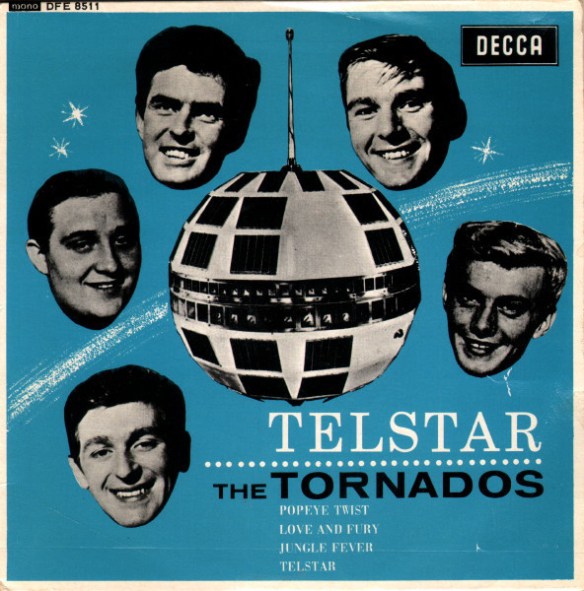
One of the first records I am conscious of hearing at home and playing on the family Dansette is “Telstar” by The Tornados (the 7″ version with the deep blue Decca label, and distinctive striped orange and white sleeve). Although the main melody is quite simple (and total ear-worm), the original 1962 version features strange noises and curious effects, while the overall instrumental tone is appropriately other-worldly. Both of its time (reflecting the emerging space age) and timeless, “Telstar” has given rise to numerous versions, and thanks to the current lock-down in Melbourne and the wonders of YouTube, last week I killed a few hours searching and compiling this playlist.

I’m sure there are many more tributes out there, but this list comprises 20 or so key recordings I came across during my internet trawl:

Chronologically, the first couple of tracks on the playlist are quite faithful renditions by The Tornados’ contemporaries, The Ventures and The Spotnicks. (Strangely, the latter put out a later, and rather pointless “updated” version.)

The record’s initial success led to a vocal version by Bobby Rydell which has a certain naive charm. This in turn inspired (directly or indirectly) a couple of wonderful European vocal recordings – by Slovenia’s Marjana Deržaj and Finland’s Laila Halme. They both stay just the right side of kitsch, and bring some unique elements of their own.

These vocal recordings are followed by a cluster of orchestral/easy listening renditions, typical of the time both in style and context: there’s Billy Vaughn‘s big band recording, featuring sax and guitar; The Hawaiians‘ exotica; and James Last‘s cheesy string arrangement. All great examples of the hits of the day played in styles to suit all tastes…

We shift gears for The Pyramid‘s ska take, followed by Al Casey‘s faithful version from the early 70’s, that features an interesting opening. Also around this time came Hot Butter‘s sanitized synths, that feels like a missed opportunity to go further out in space…

If we take “disco” to be a broad church, then the oddities by Venus Gang and Ovni would just about qualify in that category – while The Shadows‘ early 80’s take sounds like those awful Stars on 45 records.

Also in the 80’s, we find a couple of versions that are either ironic, or so post modern it hurts. The Models‘ 1981 recording attempts to add some new wave atmosphere, while Ad Infinitum‘s 1984 effort is notable for coming out on Manchester’s very hip Factory record label. (It also features a tongue-in-cheek piano bar version on the b-side.)

Finally, a couple of more recent versions that each add another dimension. First, from 1997, Takako Minekawa‘s neo-loungecore interpretation (very on message for the time), which would appeal to fans of Saint Etienne and Stereolab alike. Lastly, from 2014, Bill Frisell‘s restrained but lush slide guitar that presents a fitting tribute to this classic space age instrumental.

[“Telstar” cover versions that I wish existed: the outake from Bowie’s “Low” sessions; Kraftwerk’s 1975 sound check from London’s Festival Hall; Esquival’s bachelor pad stylings; Jacques Loussier channelling Bachian counterpoint; and Marlene Dietrich’s vocal rendition…]

Next week: Living in limbo
No-code product development

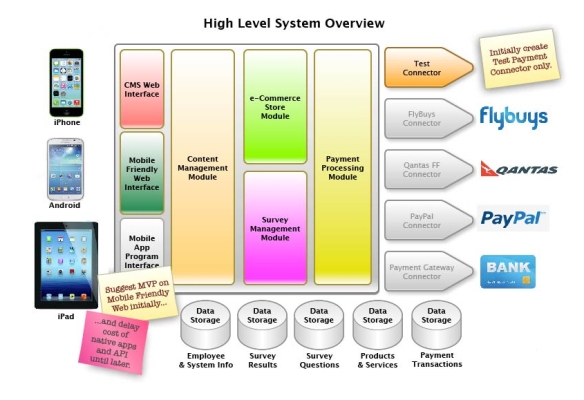
Anyone familiar with product development should recognise the image below. It’s a schematic for a start-up idea I was working on several years ago – for an employee engagement, reward and recognition app. It was the result of a number of workshops with a digital agency covering problem statements, user scenarios, workflow solutions, personas, UX/UI design and back-end architecture frameworks.

At the time, the cost quoted to build the MVP was easily 5-6 figures – and even to get to that point still required a load of work on story boards, wire frames and clickable prototypes….

Now, I would expect the developers to use something like a combination of open-source and low-cost software applications to manage the middle-ware functions, dial-up a basic cloud server to host the database and connect to external APIs, and commission a web designer to build a dedicated front-end. (I’m not a developer, programmer or coder, so apologies for any glaring errors in my assumptions…)

The growth in self-serve SaaS platforms, public APIs and low-cost hosting solutions (plus the plethora of design marketplaces) should mean that a developer can build an MVP for a tenth of the cost we were quoted.

Hence the interest in “low-code/no-code” product development, and the use of modular components or stack to build a range of repetitive, automated and small scale applications. (For a dev’s perspective check out Martin Slaney’s article, and for a list of useful resources see Ellen Merryweather’s post from earlier this year.)

There are obvious limitations to this approach: anything too complex, too custom, or which needs to scale quickly may break the model. Equally, stringing together a set of black boxes/off-the-shelf solutions might not work, if there are unforeseen incompatibilities or programming conflicts – especially if one component is upgraded, and there are unknown inter-dependencies that impact the other links in the chain. Which means the product development process will need to ensure a layer of code audits and test environments before deploying into production.

I was reflecting on the benefits and challenges of hermetically sealed operating systems and software programs over the weekend. In trying to downgrade my operating system (so that I could run some legacy third-party applications that no longer work thanks to some recent systems and software “upgrades”), I encountered various challenges, and it took several attempts and a couple of workarounds. The biggest problem was the lack of anything to guide me in advance – that by making certain changes to the system settings, or configuring the software a certain way, either this app or that function wouldn’t work. Also, because each component (the operating system, the software program and the third party applications) wants to defend its own turf within my device, they don’t always play nicely together in a way that the end user wants to deploy them in a single environment.

App interoperability is something that continues to frustrate when it comes to so-called systems or software upgrades. It feels like there needs to be a specialist area of product development that can better identify, mitigate and resolve potential tech debt, as well as navigate the product development maintenance schedule in anticipation of future upgrades and their likely impact, or understand the opportunities for retrofitting and keeping legacy apps current. I see too many app developers abandoning their projects because it’s just too hard to reconfigure for the latest system changes.

Next week: Telstar!


I got nothing

After nearly six weeks in Melbourne’s current lock-down (#6 if anyone is keeping count…), I have nothing to blog about this week.

The lack of external stimulus has finally beaten me, and I have nothing much to say. The muse is gone, the well is dry, and there’s only so much you can say about being confined to quarters.

One benefit of this enforced inactivity has been the opportunity to catch up on recent movies, that I either missed at the cinema, or which were not widely distributed upon release.

A few of these films seem perfectly suited to these times – mainly because nothing much happens. These particular stories are more concerned with slow observation and self-reflection.

In “The Truffle Hunters”, there is a stillness bordering on stagnation, as a group of elderly men respond in different ways to the changes being foisted upon their cottage industry. It’s not just the fact that their traditional way of life is coming to an end – it’s the nagging inevitability of their situation, and the growing realisation that there’s probably nothing they could have done to avoid this happening.

Stagnation of a different kind informs the main characters in “Another Round”. They see their lives as being stuck in a rut (although outwardly, they have a comfortable existence), and they feel relatively helpless. Until, that is, they stumble upon the idea of a social experiment, which involves maintaining a consistent blood-alcohol level. They embark on the project to see if they can enliven their mundane existence, with vastly different results.

A similar sense of helplessness pervades “Brad’s Status”. Similarly dissatisfied with his life, and with a growing awareness that perhaps he has misread key social relationships, a middle-aged father uses a trip with his son to re-assess his friends, reflect on his values, and re-connect with what sustains him. He also finds contentment in his achievements, and achieves a sense of acceptance about what he can and can’t change or control.

Finally, a journey of self-realisation also befalls the protagonist in “People Places Things”. When his marriage collapses (and he didn’t see it coming…), our hero finds a way to use his work to explore and resolve this apparent failure to read the situation. In the process, he learns how to communicate his feelings, and more importantly, he gets comfortable with who he is.

Next week: No-code product development


To be or NFT?

If there’s one consistent lesson to be learned from Blockchain and crypto is that the enabling technology often outpaces our understanding of the viable use case, commercial application or sustainable business model. For example, smart contracts have only recently proven their value with the rise of decentralized finance (DeFi). Even then, they are not perfect and if not well-coded can result in hacks, losses or other damage. Plus, until scaling (transaction throughput) and gas fees (transaction costs) are properly resolved, mass adoption is still some way off.

CryptoPunk #7523 (Image sourced from Reuters)

The latest crypto phenomenon is the market for NFTs (non-fungible tokens). Artworks in the form of digital files are being created, auctioned and traded for serious (or very silly?) amounts of money – just Google EtherRock, Beeple, CryptoPunk or Rare Pepe for recent examples.

NFTs are not just confined to digital art – animation, video, music and text are all being created in the form of NFTs. In addition, NFTs are being minted to represent ownership or other IP rights for physical artworks, real estate assets, collectibles and luxury goods.

Why would anyone pay the best part of US$12m for the original digital file of CryptoPunk #7523, a copy of which I have displayed above?

Perhaps we need to consider the following:

First, the image above is simply a low-res web image, easily reproduced via copy and paste – it’s not the “real” image as represented by the code or digital file embedded in the NFT. The original file is owned by the NFT buyer, and if it is an edition of one, then that is the only authentic version. Scarcity (as well as kudos) is a key market driver in NFTs – but only if someone else attaches financial value to the work (just as in any art market).

Second, owning the NFT does not necessarily mean you own the copyright or other rights associated with the art work. (I may own a Picasso painting, but I don’t own the image contained in the work.) So, apart from holding an NFT in your digital wallet or displaying it in a virtual art gallery, the only right you have is to re-sell the work. This means you can’t commercialise the image for t-shirts, on-line redistribution or reproduction (unless the owner has agreed to grant such rights within the NFT). (My use of the image here would be covered by the “fair use” principle, for the purposes of illustration and/or critical analysis.)

Third, unless you are able to export the NFT from the marketplace or platform that sold it, the NFT may “vanish” if the platform goes offline for any reason. (Doubtless, platforms need to enable token transfers to other market places and to users’ own digital wallets, otherwise there could be a lot of stranded and/or worthless NFTs in years to come.)

Fourth, the creator of the original work may be entitled to a % of the resale value of the NFT. This is obviously an important consideration for artists and other content creators, and I see this as a positive development. By extension, musicians, authors, film-makers and designers can more easily track and control the downstream revenue generated by the use and licensing of their works by third-party marketplaces, streaming platforms or 3D printing and fabrication services.

Fifth, NFTs support improved authentication, provenance and chain of ownership, as well as bringing more transparency to the world of art auctions – valuations, bidding and prices could all be hashed on the Blockchains that track the NFTs.

Finally, if NFTs are seen as a form of bearer bond (linking ownership to whomever controls the token), they could also be used to package up a portfolio of different crypto or digital assets, and auctioned as a single lot. The buyer could then unlock the disparate assets, and combine them into subsequent bundles – bringing a new dimension to block trades and the transfer of large bundles of stocks.

Next week: I got nothing