How to Survive a #Startup Weekend

A rite of passage for any startup founder or budding entrepreneur is a weekend hackathon, and a Startup Weekend is probably the best way to throw yourself in at the deep end. As part of Startup Week, the York Butter Factory hosted Melbourne’s first fintech event. Here’s how I managed to survive the ordeal….
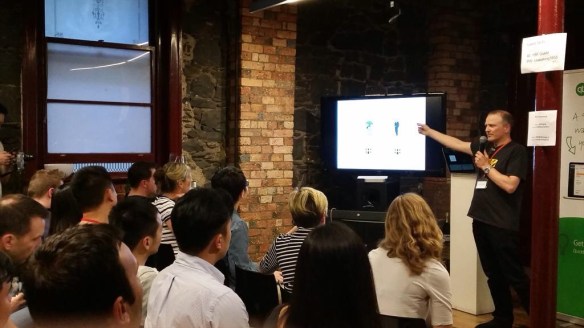
IMG_0210

Your correspondent in full flow at the Final Pitch…

Rather than provide an hour-by-hour account of my experience (the schedule is on the website and you can read the Twitter feed), here’s my thoughts on what it takes to participate and get the most out of the experience:

Courage

Take a leap of faith, step up and pitch an idea at the open mike session on the first night. Not only does this force you to craft your message, it also helps overcome any nervousness or awkwardness in joining a room full of total strangers with whom you will be working for the next 54 hours. My idea didn’t get enough votes, but it did spark several interesting conversations with other participants, such that I will probably take it further.

Stamina

Pace yourself. Yes, you could spend every available hour on finishing that customer validation, or refining the pitch, or making sure your demo site is up and running – all of which are important – but you also need to make time for rest, sleep, eating (all catering is laid on) and exercise. Again, 54 hours is a long time to spend on a single activity.

Open Mindedness

I had some idea from the program notes what to expect, but I still didn’t really know what it would it be like. So it was great to just go with the flow, to see what would happen. The format, structure and schedule (as well as the rules and requirements for the Final Pitch competition), pretty much define what goes on. But your attitude and willingness to be open to new ideas determine how much you get out of the experience.

I should also mention the value in having direct access to so many experienced mentors throughout the weekend – although I know from the experience, it’s hard not to get too defensive when mentors find fault with your project, and difficult to remain true to the idea when some of the feedback is contradictory.

Teamwork

Building teams to collaborate on a startup idea forms the basis of the hackathon model. As my own idea did not get enough votes at the open pitch, I looked to join a team that was a good fit in terms of the idea, the mix of skills to complement my own, and the ability to execute. As a “non technical” participant, I was extremely fortunate to be part of team that had a great balance of back-end and front developers, design skills and mobile deployment. Plus, given the theme was fintech, it was fantastic working with people from a banking IT background. (It also helped that several team members were veterans of Startup Weekend.)

Defining Roles

Although we didn’t spend a great deal of time creating or defining roles within the team, each of us played to our strengths, by self-determining what we would work on, and what our contribution would be. The only tricky decision was choosing who would present the Final Pitch to the panel of judges – but a process of elimination, preference and negotiation resulted in yours truly taking on the role.

Tools

In addition to the various software, hosting and domain name resources provided to each team, I was impressed by how many other tools the team plugged into – such as Trello, GoogleForms, Hangouts, ThemeForest, CanvasModel Design and Launchrock – most of which were free. We also spent some time reviewing competing and complementary products as part our MVP validation.

Less Is More

We could have spent a lot of time on customer validation – but we chose instead to talk to 3 or 4 key target customers for the MVP (qualitative), and run an on-line survey (quantitative) which generated around 100 responses overnight (not bad considering it was a weekend…). We also had more content than we actually used: the lean canvas business model was used sparingly, as was a competitor heat map; but it also meant that when we came to developing our pitch presentation, we had the luxury of being able to take stuff out and only focus on the important and most relevant points. Thanks, also, to a presentation template that one of the team had just used at a recent management course!

Practise

Having been chosen to make the Final Pitch on behalf of the team, and despite quite a lot of experience in making business presentations and in public speaking, I was extremely grateful for the coaching, feedback and rehearsals the team put me through. Getting to know the material, understanding the anchor points and how to navigate from topic to topic, helped me to give a presentation that flowed logically and hopefully demonstrated that the team had met the competition brief.

The Result?

Unfortunately our team did not win, nor did it place in the top 3. The judges pinged our presentation for being “too confident”, and for not demoing our prototype (we did briefly put up our beta website) – but given the working prototype mostly comprised some backend coding, it wouldn’t have been that interesting from a visual perspective.

Notwithstanding our disappointment on the night, the team is planning to get together to see how far we can take the idea, and separately I’ve been asked to join a new team at an upcoming hackathon.

(If anyone is interested, we designed a P2P payments tool called PayMee)

Next week: 3 Ways to Fund Your #Startup
“Why? Because we’ve always done it this way…”

A couple of blogs ago, one of my regular correspondents kindly laid down a challenge. He suggested that part of the answer to the problem I was writing about (i.e., how to manage data overload) could be found within Simon Sinek’s “Start With Why”.

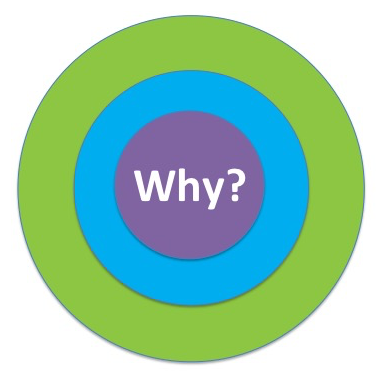
Why?I’m quite familiar with Sinek’s investigation of “Why?”, but I wasn’t sure it was applicable in the context of my topic. Don’t get me wrong – the “Golden Circle” is a great tool for getting leadership teams to explore and articulate their purpose, and it can help individual business owners to re-connect with the reasons they do what they do.

It can even facilitate new product and service development.

But, I believe it’s harder to apply at an operational or processing level, where the sorts of decisions I was referring to in my blog are typically being made: what tools to use, what systems to adopt, what software to deploy etc.

There are several reasons why organisations do things the way they do them. When undertaking a business process review, I frequently ask the question, “Why are you doing this?”

Here are some typical responses I’ve received (and my conclusions in parentheses):

  • “Because we have to” (compliance)
  • “Because we’ve been told to” (command and control)
  • “Because we’ve always done it like this” (inertia)
  • “Because everyone else is doing it” (cheap/easy/popular)
  • “Because our consultants recommended it” (cop-out)

In one experience, I had to implement a process change within a publishing team, comprising experts (writers) and technicians (editors). The problem was, that even though the content was published on-line, most of the production processes were done on hard copy, before the final versions were uploaded via a content management system. The inefficiencies in the process were compounded by a near-adversarial relationship between writers and editors, at times bordering on a war of attrition.

When I asked the team why they worked this way, their responses were mainly along the lines of “command and control” and “inertia”. Behaviours were reinforced by some self-imposed demarcation.

The writers felt it was their role as experts to demonstrate everything they knew about the topic (without necessarily saying what they actually thought); while the editors felt they were required to work within a rigid house style (to the point of pedantry), maintain writing quality (at the expense of timeliness), and to maintain content structure and format (over context and insight).

  • Both sides felt they were meeting the organisation’s purpose: to deliver quality information to their customers to help them make informed decisions.
  • Both believed they were following clear operational guidelines, such as production, technical, and compliance.
  • Both were passionate about what they did, and took great pride in their work.

Unfortunately, the procedures which they had each been told to follow were inefficient, at times contradictory, and increasingly out of step with what customers actually wanted.

Based on market feedback clients told us they:

  • favoured timeliness over 100% perfection;
  • preferred insights over data dumps; and
  • really wanted “little and often” in terms of content updates

Thankfully, the voice of the customer prevailed, and the introduction of more timely content management processes resulted in frequent updating (via regular bulletins) backed by the “traditional” in-depth analysis.

When starting a change management project, conducting a process review, or undertaking a root-cause analysis, if asking “Why?” doesn’t get you very far in getting to the bottom of a problem, I find that it can help to pose another question: “What would your customers think about this?” For example, if customers knew how many times a piece of data was handed back and forth before their order/request/enquiry was processed, what impression might that give about an organisation?

For most companies, their sense of purpose is driven by a strong or underlying desire to serve their customers better – it’s as simple as that.

Next week: The 3L’s that kill #data projects

Yet another #co-working space opens in #Melbourne – what’s going on?

Co-working spaces continue to pop-up all over Melbourne. The latest I’ve heard about is LSX (aka Lennox Street Exchange, in the heart of Richmond’s startup zone), which opened in September.

I’ve not had the opportunity to visit all of these venues – but I’ve been able to spend some time in a few of them such as York Butter Factory, the Hub, inspire9, Launchpad and Queens Collective. The decor and ambience are usually New York loft conversion meets warehouse chic meets funky cafe meets London Free School. Some offer little more than a serviced office with some added startup appeal; several are closely linked to incubator programmes and angel investors; and a couple want to create a whole philosophical/spiritual experience around personal development, collaboration and sustainability.

A key attraction of co-working spaces for early-stage startups and budding entrepreneurs is the relatively low-cost business accommodation. Plus, if you are new to being self-employed/freelance, or if you are just starting your own business, going to an office (at least once a week) can instil some discipline, provide a change of scenery to the home office (or garage), help with networking contacts, and offer the chance to meet people who can offer skills you don’t have.

But, these spaces are mostly open plan, have an itinerant population that comes and goes, and the communal kitchens sometimes remind me of the worst shared houses I have lived in….. So, you have to enjoy that sort of vibe, and as we know, open plan offices are not always conducive to productivity or personal concentration.

There are some genuinely philanthropic values inherent in a number of these venues, but others are more commercial and seem only interested in getting investors through the door to nurture the “talent” they think they have uncovered.

If you are thinking of signing up to a co-working space, it pays to do your due diligence:

  • Commitment – not just the cost, but time and other contributions that may be expected of you
  • Values – it helps if your values generally align with those of the hosts and other members; if you’re not a creative type, or if 3-D gaming development is not your thing, maybe look elsewhere
  • Location – proximity to prospective clients and/or partners and collaborators may be more important than a cool hot-desking venue in a trendy part of town
  • Services – what’s included in the membership fees and/or rent? are there any hidden extras?
  • Insurance – make sure the premises are up to date with their building and other statutory insurances; do you still need to take out professional indemnity/public liability policies; are your personal belongings and equipment covered while they are on site?
  • Ownership – are you buying a membership or a “share” in a business? if the former, does this carry any voting rights at member meetings? if the latter, could you be taking on more legal risk or financial liability if the venue fails?

No doubt there are some vibrant co-working communities, that offer great support and service to the growing number of people who want to “do their own thing” rather than join a more corporate environment. Even some banks seem to be getting in on the act, as they recognise an opportunity to engage with their business customers via co-working spaces and startup facilities.

Next week: Who’s making money in financial data?

Why #collaboration is not simply “working together”

Along with productivity, innovation and employee engagement, collaboration is fast becoming the new mantra for businesses seeking growth and/or competitor advantage. But while collaboration can take many forms, the mere act of “working together” does not of itself lead to sustainable collaborative outcomes.

The theme for last week’s inaugural class of Melbourne’s Slow Business School was “How to collaborate effectively with other businesses”. Hosted by Carolyn Tate and facilitated by Richard Meredith, the class did not arrive at any prescriptive processes or techniques for collaboration. But, as one student wryly observed, our discussions took the form of a dance without choreography, which is perhaps the highest form of collaboration. However, we did identify a few core attributes without which successful collaboration would be unlikely, if not impossible:

  • Shared values among the players
  • Defined roles
  • Common purpose or vision
  • Mutual trust between all participants
  • Voluntary (i.e., parties choose to be here)
  • Equitability (e.g., recognition of each contribution)

I would also add that from my experience, collaboration does not happen unless there are opportunities for the participants to be co-located at least some of the time.

Which leads me to those activities that are NOT collaborations:

  • A routine or regular project (“BAU”)
  • Outsourcing
  • Commissioning
  • Remote teamwork
  • Shared services
  • Trading transactions

For example, if I commission an architect to design a house, even if I am intimately involved in all the detailed decisions about materials, specifications and aesthetic choices, it is not a collaboration – it’s a transaction between client and professional. However, if I was a heating engineer, and I used my knowledge and experience to work with my architect to come up with some new energy-saving solutions (that could be used in future projects) that would be a collaborative outcome.

Collaboration certainly cannot happen if organisations operate within silos, but nor does it come about by happenstance – there has to be a deliberate and conscious decision to collaborate, even if at the outset there is no specific product or solution in mind other than a desire to collaborate (“Let’s see where the dance takes us”).

One aspect of this approach is “co-creation”, where companies embed themselves in their client’s world to identify what problems they can work on to solve together. In this way, collaboration leads to the outcome. Clearly, to be effective, co-creation would be backed by some formal product development or service design techniques, agreed ground rules and even a game plan – whether that is a lean canvas business model methodology, an iterative prototyping process, or a defined supply chain framework.

In any collaboration, one party may try to force the pace, but if this is not reciprocated, the mutuality will be lost – it becomes just another transaction (or a series of mis-timed steps). The best partnerships and joint ventures are founded on the commonalities of purpose, process and participation. Further, a successful venture will know when it has run its course – even if this means having those “difficult conversations”, which the class felt were also a vital feature of the best collaborations.

By strange coincidence, the same day Slow Business School was in session, Deloitte Access Economics published a research report commissioned by Google Australia. It concluded that greater collaboration by Australian companies could be worth $46bn to the local economy, based on increased productivity and reduced costs/wastage. Although the report reads more as an OD approach to collaboration (linked to the productivity, employee engagement and innovation mantras) it nevertheless offers some empirical evidence that companies who get it right will see benefits across a range of KPIs. If nothing else, employees who are given more opportunity to collaborate will display greater job satisfaction (this is part of the philosophy behind etaskr, about which I have written before).

For me, there are a few interesting data points in the Deloitte report:

  1. While technology has been important in enabling increased collaboration, the right workplace culture, management structure and team members are seen as paramount.
  2. Although “shared electronic resources” were seen as the single most important tool for effective collaboration, “common areas for staff to socialise” was not far behind, and “more meeting rooms” scored higher than “open plan office”, while having more technology solutions (collaboration software, video conferencing facilities and social media) all rated lower.
  3. Finally, just over a third of respondents reported that “collaboration helps them work faster” (and nearly a fifth said “their work would be impossible without collaboration”), but nearly a quarter felt that collaboration meant their work took longer.

So, a paradoxical interpretation of the report could be:

  • fewer open plan offices (but more meeting rooms);
  • more technology (but not just productivity tools); and
  • more teamwork (but not at the expense of getting my own work done).

A final thought: If we think that the prerequisite for collaboration is the “willingness to co-operate”, then this can get murky, as participants will only be prepared to operate at the level of trading favours (and only because they’ve been told they have to play nicely) rather than entering into the venture with enthusiasm and without ulterior motives.