The new education #2: Resilience

Week 2 of “What they should be teaching at school” – Resilience.

Life doesn’t always turn out how we hoped. Life isn’t always “fair”. And sometimes life just sucks. In the words of The Rolling Stones, “You can’t always get what you want.”

Given that:

  • people entering the workforce now are likely to be made redundant at least 5 times during their career;
  • within the next few years, 40% or more of the workforce will be self-employed, contractors, freelancers, or employed in the gig economy, and therefore will be more reliant than ever on their own abilities to generate an income; and
  • an increasing number of today’s jobs will disappear through automation or other technology advances;

it makes sense to include resilience on the curriculum, to prepare students for the reality of the new economy.

As we are all too aware, having a degree or other formal qualification is no guarantee that candidates will get a job or role in the career of their choice. And even if they do, sooner or later they will have to consider a career switch – which may include having to make a sideways or even a backwards move in order to go forward in a new field or discipline. Plus some re-training or skill updates wouldn’t go amiss.

Resilience helps us to deal with life’s disappointments and overcome personal and professional setbacks. It can also help us to learn from those experiences – what doesn’t kill us makes us stronger.

While it’s important to provide a safe and supportive learning environment, I’m not a fan of  helicopter parents, so-called tiger parenting, let alone stage parents. Over-coddled kids are more likely to come unstuck (or go off the rails) at the first obstacle or challenge they face, especially in circumstances where they might not like the choices life has presented them.

I may be drawing a long bow here, but I can’t help thinking there is some sort of correlation between current concepts of modern parenting and education, and the higher incidences of allergies and mental illness – and maybe stronger resistance through greater resilience would help pupils cope with whatever gets thrown at them. Just saying.

Next week: Curiosity


The fate of the over 50s….

In recent months, a number of my friends and former colleagues in their 40s and 50s have found themselves being retrenched. Nothing surprising in that, you might say – it’s a common fate of many middle and senior managers to be “delayered” by their organisations. And of course, redundancy is now something that everyone in the workforce must expect to face at least 3-4 times in their career.

What is surprising is that in most cases, these friends and associates have been taking deliberate steps to remain relevant, by retraining and upskilling, by keeping up to date on business trends, or by engaging with new opportunities via meetups and networking events. Nevertheless, their employers have found reason to cut their positions – and despite a bar on age discrimination, the likelihood of some of these older workers finding comparable roles is greatly reduced.

This scenario is not helped by the challenges younger workers are experiencing in finding their ideal job, at least during the first few years of their careers. I would probably dispute this assertion, for the simple fact that many younger workers do not really know what career they intend to pursue, or are not aware of what options are open to them. Plus, apart from areas like medicine, science and engineering, secondary and tertiary education should be less about getting formal qualifications and more about learning how to learn, how to engage with new ideas, how to explore different concepts, how to acquire different experiences, and above all about being prepared for life….. (In my own case, I probably didn’t find my “true” career path until about 5 years after joining the workforce – a process helped by undertaking some further training when the time and circumstances were right for me. But this “delay” did not prevent me from gaining valuable experience in a series of jobs – especially as employers did not expect younger new hires to stay more than 2 years in the same role.)

Some of the corporate job-cutting is no doubt driven by economic and financial necessity, in the face of automation – and this is a trend which probably puts older workers at a disadvantage, if they are deemed less able to learn or adapt to the new technology. But as I have argued before, being older should not mean being obsolete.

One friend noted that in transitioning to a new role, there was a higher expectation that they would adapt and learn the ropes more quickly than a younger new hire. Again, this puts older workers at a disadvantage as they will be cut less slack than a rookie in a similar role.

So it seems that older workers are seen as less able (or less willing?) to learn new technology; but at the same time, they are expected to deal with change and disruption more easily then some new entrants to the workforce. There is also a growing expectation that the older you are, or the longer you have been in your previous role, the longer and harder it will be to find a suitable new position. (Again, in my own case, after I left my last corporate gig, I spent 5 years doing a range of consulting projects and contract roles, before finding myself working in a totally new industry – one that is at the cutting edge of disruptive technology, and didn’t really exist at the time I left the corporate world.)

Finally, I was struck by the comment of a former colleague who is being tempted back into the workplace, having made a conscious decision to take earlier retirement:

“I like being retired. I also know that one day you’re the hero and the next day you’re considered part of the problem.”

Next week: Beyond Blocks, Tokyo


Bring Your Own Change

I receive frequent requests for advice or suggestions on how to make a career change. Having been through a significant career transition myself (in fact, I am probably on my 3rd or 4th career…), I am usually more than happy to help if I can.

Networking Image by Ghozt Tramp sourced from Wikimedia Commons

Anyone who has had to navigate a career change will no doubt have been introduced to the concept of networking, primarily as a means to access the hidden or non-advertised job market. The strategy usually involves targeting a particular industry (or even a specific company), and approaching a known contact in that sector (or company) with a view to learning more about their industry, their organisation or their role – and hopefully to gain an introduction to someone in their network who might be able to help in accessing or identifying a suitable role or opportunity.

Now, I am a strong proponent of networking – both to learn and to share – although I am not a huge fan of “open networking”. So I tend to be suspicious of unsolicited requests to connect with me – especially when there is no defined context, or there is no specific purpose underpinning the approach, other than a general desire to access my professional network, or a vague notion of hoping to learn from my experience.

I appreciate that making a career change is sometimes very difficult, especially in the challenging workplace environment (thanks to rapid change, digital disruption, and the gig economy, etc.). Change often becomes harder the older we are. Plus, our path may be complicated the more niche our qualifications, and/or the more generic our experience. (See my previous blog on generalists vs experts.)

I also acknowledge that the transition may not be made any easier because traditional notions of “work” and “employment” are no longer as relevant or as valid as they were. (Conversely, Australia continues to enjoy relatively low unemployment rates, in combination with strong new jobs growth, and greater workforce participation.) Plus, many large employers are still fixated on hiring square pegs to fill existing square holes.

Do I think that more needs to be done to help people transition into and within the new workplace environment? Absolutely. Even if it’s simply to provide them with encouragement, or to challenge their assumptions about what a contemporary career trajectory looks like. (As a society, we are not very good in helping people to make sideways moves, or to adjust their ways of working.)

So, having gone through significant career changes and work transition myself, I am a great believer in “bringing your own change” – i.e., start doing what you need to, in order to effect the change or transition you desire. But what worked or works for me, may not work for you, and my career choices may not be the right choices for you. I can maybe provide some insights on why/how/what I did, but in many situations, I was very fortunate that someone was willing to take a chance on me, and give me an opportunity. Yet equally, I probably helped to engineer these situations because I try to keep an open mind, I maintain a sense of curiosity and I like to think I ask the right questions. By demonstrating flexibility and a willingness to challenge the status quo, I believe it is possible to create the right environment to effect the change you seek in the type of work you do, or the role you perform.

Next week: Equity crowdfunding comes to town

More on Purpose

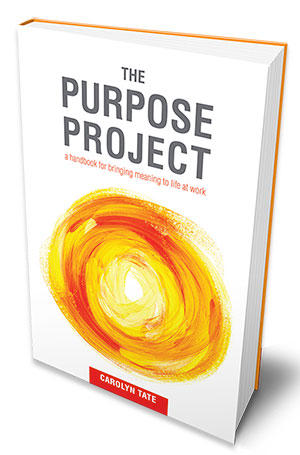
Regular readers may be familiar with the name Carolyn Tate from my previous blogs on purpose, and the Slow School of Business. Last week, Carolyn launched her latest book, The Purpose Project, a distillation of the past seven years of her work, and quite possibly a road map for anyone wanting to take control of their own destiny at work.

I would describe The Purpose Project as a cross between a first aid kit for a disillusioned workforce and a survival guide for the modern workplace. But as with defining your own “purpose”, the value is in the mind of the reader, rather than in any prescriptive solution or outcome.

Having spent the past few years working with Carolyn at Slow School, I know that her views on this topic have subtly changed. Slow School itself initially appealed to, and was designed for, independent consultants (“solopreneurs”) and aspiring consultants (“corporate escapees”). But as the concept of finding purpose in our work has started to take hold, Carolyn now encourages her readers to find their own purpose where they are, rather than rushing headlong into a new job, a new company, a new career or even into entrepreneurship (which as we know, isn’t for everyone).

I first connected with Carolyn at the Slow School, when I was exploring my own purpose as an independent consultant (and sometime corporate escapee….). Slow School provides a community of like-minded souls with a “safe” space to test new ideas, a playground to kick around new concepts, and an environment to challenge our own assumptions. Unsurprisingly, a key part of The Purpose Project is a list of 50 questions designed to help readers dig deeper into their own purpose, modeled on the Japanese concept of ikigai”. There are also some tools and practices to bring purpose to life in our current work.

In my own case, I still think my purpose is a work in progress, and is never settled – much of my career has been driven by a need for new ideas and experiences, work that is intellectually stimulating, and a willingness to engage in continuous learning (while feeding an enduring curiosity and maintaining a healthy dose of skepticism). These factors, even more than formal qualifications or faddish management theories, have helped me to build resilience and navigate a rapidly changing work environment.

One point where I may disagree with Carolyn is this notion about finding purpose through staying in your current role or workplace – that it’s not necessary to leave. While I agree that it may be possible to reshape your current job to suit your personal needs and preferences, staying in an unrewarding job or remaining with an organisation that does not value you is like persevering with an unhealthy relationship.

In short, I’m quite pessimistic about the ability for large corporations and large institutions (as they are currently framed and constituted) to help us connect with our individual purpose, or even to provide the space to do so. And of course, rapid changes in the very nature of work, the way we work, the economic structures and business models that have traditionally underpinned employment and the value exchange of labour require us to take more control over where, how and with whom we choose to spend our working time.

Next week: Agtech Pitch Night at SproutX