#Blockchain heralds a new railway age?

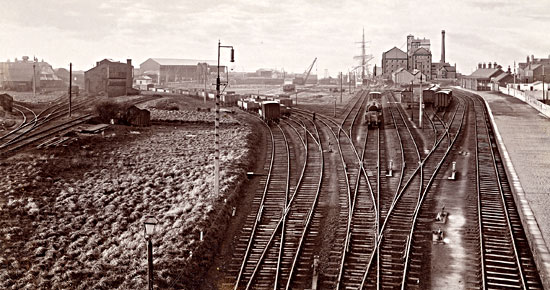
Last week, I suggested that digital currencies might be the new portals. Reflecting further on my work with Brave New Coin*, it also occurs to me that the growth of Blockchain resembles the railway mania of 19th century Britain. Hopefully it won’t end in the same over-investment and asset bubble – but there are some interesting similarities.

“Railway Mania” – Image sourced from Business Pundit

First, the railways displaced the canal system, just as canals overtook roads as the key means of transportation. For these purposes, if we compare roads to the Internet, and canals to the World Wide Web, then Blockchain is the next generation of the “information superhighway”. Blockchain and distributed ledger technology, along with crypto-currencies, digital assets and smart contracts are powering the “new” internet – the Internet of Things, the Internet of Money, the Internet of Value Exchange.

Second, and in a similar vein, the Internet was designed primarily as a means of communication. Then, the web enabled e-commerce, content distribution and on-line interaction. Now, Blockchain technology is supporting a range of new activities – such as tokenizing tangible and intangible assets; securing personal data and financial accounts; decentralizing networks, exchanges and registries; and validating immutable transaction data.

Third, the proliferation of public, private and permissioned Blockchains is prompting the development of technical standards for the design, architecture, security and taxonomy associated with this technology – as railway systems have implemented common safety and operating standards. There is also the need for interoperability between Blockchains, just as railway networks have had to address different track gauges among competing operators.

Of course, on the downside, railway mania led to heightened speculation, failed or over-optimistic prospectuses, and duplication of competing networks as developers sought to secure the most lucrative routes.

And let’s not overlook the issue of forking, which Blockchains are having to address in order to meet the demand for increased processing capacity and/or to iron out potential design weaknesses. In some ways this resembles the creation of railway branch lines – in some cases, these subsidiary routes would become more important than their parent main lines; and may even have outlived them, following the Beeching restructures in the 1960s.

Finally, for all the benefits that Blockchain undoubtedly holds, challenges remain with “on-ramp / off-ramp” access – a bit like disconnected transport interchanges or uncoordinated train timetables.

*Note: the opinions expressed here are my own, and do not represent the views of Brave New Coin or their clients.

Next week: Long live experts….


Digital currencies are the new portals

Once described as “The Internet of Money”, Bitcoin is much, much more: it’s software, it’s a store of value, and increasingly it’s being recognised as a legal form of payment. In its wake have come a multitude of other crypto-currencies, alt. coins, digital tokens and programmable assets. Each of them built on one or other blockchain protocol or using distributed ledger technology (DLT), and each of them seeking to serve a specific use case or to drive disruption in traditional markets and business models.

Based on my work with Brave New Coin (a market data vendor for these new asset classes)*, I was recently asked my opinion on all these “Initial Coin Offerings” (ICOs – although I prefer to call them Token Issuance Programs). My response was that digital currencies are becoming the new portals.

How?

First, they are building dedicated communities of interest. Many of them are designed for a specific audience or for a particular purpose. They are leveraging network effects to drive engagement and participation, such as MobileGo, for the online games community.

Second, they are becoming “destinations” in their own right, such as Steem for publishing, or CalcFlow, a market place for mathematical models. They are acting as repositories and resources for specialist content. They are also curating this content, and enabling users to contribute to the community, and get rewarded for doing so.

Third, they are building platforms that support e-commerce and other online transactions, such as SPHRE’s Air solution, and its XID token. In Air’s case, they are creating a paradigm shift in digital ID management: in contrast to most social media and old-school portals that monetize our personal data, our content and our search behaviour through the sale of advertising, Air is giving individuals more power over the use of their own data.

Finally, token issuance programs are creating new registries and alternative distribution networks for a range of tangible and intangible assets, such as MyBit for energy, and bitNatura, for natural capital.

So, as well as supporting P2P payments, facilitating cross-border remittances and enabling the purchase of electrical goods in Japan, Bitcoin and the like are becoming key tools in the new digital economy, just as AOL, CompuServe, Lycos, Yahoo!, Google and MSN were once the main public gateways to the internet.

*Note: the opinions expressed here are my own, and do not represent the views of Brave New Coin or their clients.

Next week: #Blockchain heralds a new railway age?

Personal data and digital identity – whose ID is it anyway?

In an earlier blog on privacy in the era of Big Data and Social Media, I explored how our “analog identities” are increasingly embedded in our digital profiles. In particular, the boundaries between personal/private information and public/open data are becoming so blurred that we risk losing sight of what individual, legal and commercial rights we have to protect or exploit our own identity. No wonder that there is so much interest in what blockchain solutions, cyber-security tools and distributed ledger technology can do to establish, manage and protect our digital ID – and to re-balance the near-Faustian pact that the illusion of “free” social media has created.

Exchanging Keys in “Ghostbusters” (“I am Vinz Clortho the Keymaster of Gozer”)

It’s over 20 years since “The Net” was released, and more than 30 since the original “Ghostbusters” film came out. Why do I mention these movies? First, they both pre-date the ubiquity of the internet, so it’s interesting to look back on earlier, pre-social media times. Second, they both reference a “Gatekeeper” – the former in relation to some cyber-security software being hijacked by the mysterious Praetorian organisation; the latter in relation to the “Keymaster”, the physical embodiment or host of the key to unleash the wrath of Gozer upon the Earth. Finally, they both provide a glimpse of what a totally connected world might look like – welcome to the Internet of Things!

Cultural references aside, the use of private and public keys, digital wallets and payment gateways to transact with digital currencies underpins the use of Bitcoin and other alt coins. In addition, blockchain solutions and cyber-security technologies are being deployed to streamline and to secure the transfer of data across both peer-to-peer/decentralised networks, and public/private, permissioned/permissionless blockchain and distributed ledger platforms. Sectors such as banking and finance, government services, the health industry, insurance and supply chain management are all developing proofs of concept to remove friction but increase security throughout their operations.

One of the (false) expectations that social media has created is that by giving away our own personal data and by sharing our own content, we will get something in return – namely, a “free” Facebook account or “free” access to Google’s search engine etc. What happens, of course, is that these tech companies sell advertising and other services by leveraging our use of and engagement with their platforms. As mere users we have few if any rights to decide how our data is being used, or what third-party content we will be subjected to. That might seem OK, in return for “free” social media, but none of the huge advertising revenues are directly shared with us as ordinary end consumers.

But just as Google and Facebook are facing demands to pay for news content, some tech companies are now trying to democratise our relationships with social media, mobile content and financial services, by giving end users financial and other benefits in return for sharing their data and/or being willing to give selected advertisers and content owners access to their personal screens.

Before looking at some interesting examples of these new businesses, here’s an anecdote based on my recent experience:

I had to contact Facebook to ask them to take down my late father’s account. Despite sending Facebook a scanned copy of the order of service from my father’s funeral, and references to two newspaper articles, Facebook insisted on seeing a copy of my father’s death certificate.

Facebook assumes that only close relatives or authorised representatives would have access to the certificate, but in theory anyone can order a copy of a death certificate from the UK’s General Register Office. Further, the copy of the certificate clearly states that “WARNING: A CERTIFICATE IS NOT EVIDENCE OF IDENTITY”. Yet, it appears that Facebook was asking to see the certificate as a way of establishing my own identity.

(Side note: A few years ago, I was doing some work for the publishers of Who’s Who Australia, which is a leading source of biographical data on people prominent in public life – politics, business, the arts, academia, etc. In talking to prospective clients, especially those who have to maintain their own directories of members and alumni, it was clear that “deceased persons” data can be very valuable to keep their records up to date. It can also be helpful in preventing fraud and other deception. Perhaps Facebook needs to think about its role as a “document of record”?)

So, what are some of the new tech businesses that are helping consumers to take control of their own personal data, and to derive some direct benefit from sharing their personal profile and/or their screen time:

  1. Unlockd: this Australian software company enables customers to earn rewards by allowing advertisers and content owners “access” to their mobile device (such as streaming videos from MTV).
  2. SPHRE: this international blockchain company is building digital platforms (such as Air) that will empower consumers to create and manage their own digital ID, then be rewarded for using this ID for online and mobile transactions.
  3. Secco: this UK-based challenger bank is part of a trend for reputation-based solutions (e.g., personal credit scores based on your social media standing), that uses Aura tokens as a form of peer-to-peer or barter currency, within a “social-economic community”.

Linked to these initiatives are increased concerns about identity theft, cyber-security and safety, online trust, digital certification and verification, and user confidence. Anything that places more power and control in the hands of end users as to how, when and by whom their personal data can be used has to be welcome.

Declaration of interest: through my work at Brave New Coin, a FinTech startup active in blockchain and digital assets, I am part of the team working with SPHRE and the Air project. However, all comments here are my own.

Next week: Investor pitch night at the London Startup Leadership Program
More on #FinTech, #Bitcoin and #Blockchain in Melbourne

The Melbourne FinTech community brought together a bunch of interested parties recently to find out what’s happening locally in Bitcoin and Blockchain. Organised by the Melbourne Bitcoin, FinTech and Silicon Beach Meetups, and hosted by the Melbourne Bitcoin Technology Centre (MBTC), the evening was part open house, part info sharing, and part pitch night.

BitcoinThe MBTC is now a recognised hub for Bitcoin and Blockchain activities, and currently hosts around a dozen startups within its co-working space. Offering a “full service” facility (it even has a Bitcoin miner on site), complete with staffed reception, meeting rooms, event space, a pod cast studio and an outdoor barbecue area, it’s something of a hidden gem in Melbourne’s Southbank. Regulars also get to attend Bitcoin “swap meets”…..

Last week’s event also featured a number of micro-pitches from Bitcoin and Blockchain startups, a few of the MBTC staff and tenants, and a couple of student projects from RMIT.

Given this was almost “speed pitching“, it’s probably not appropriate to go into too much detail:

  • Toodles – a dating app on a decentralized network, using a Blockchain solution for additional security and privacy
  • Blockfreight – the Blockchain for global freight, enabling cargo containers to be shipped around the world with minimal legacy documentation, based on smart contracts, RFID and Blockfreight tokens
  • blockTRAIN – a training provider and consultancy on Blockchain, smart contracts and digital currencies
  • Bitcoin Buskers v2 – sort of MySpace/Bandcamp/SoundCloud for Buskers, to promote their merchandise and to secure international festival bookings, all powered by Bitcoin
  • ACX – Australian Crypto Exchange, offering the largest single Bitcoin order book in Australia
  • Bitcoin Group – explaining that most Bitcoin mining is currently done in China due to cheaper electricity
  • Antstand – portable laptop stand (which you can buy with Bitcoin!)
  • Think Bitcoin – providing consulting and education services, particularly in schools
  • Lyra – an app to track and reduce your personal environmental impact, sort of Fitbit and Smart Meter combined
  • ImagineNation – innovation consultancy, backed by training and coaching, and featuring a 2-day startup game to help organisations transform cultural mindsets around agile, lean, design thinking, UX and incubator/accelerator concepts
  • Brave New Coin – the “Bloomberg for Bitcoin”, providing market data (prices, rates, indices, news) for Bitcoin and other digital currencies*

With the next Bitcoin halving due soon, and a significant uptick in FinTech, Blockchain and Digital Asset investments announced during Q2, this sector is going to look very interesting for some time to come, and it’s good to know that Melbourne, whose fortunes were founded on gold, is staking a claim in these new asset classes.

* Declaration of Interest: I have recently joined the team at Brave New Coin as Head of Business Development – more news to follow….

Next week: University Challenge – Startup Victoria’s Student Pitch Night