ANZ’s new CEO on #FinTech, CX and #digital disruption – 10 Key Takeaways

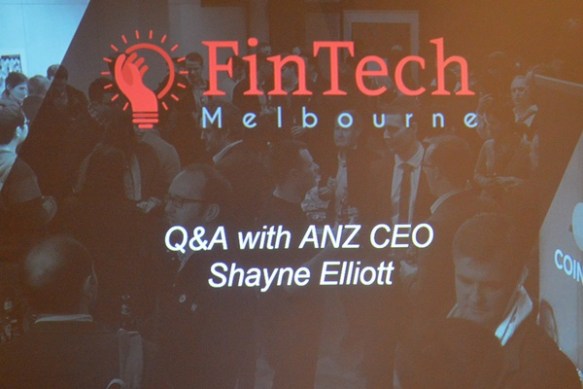
I went to the recent Q&A with the new CEO of ANZ, Shayne Elliott, organised by FinTech Melbourne. It was the first public speaking appearance by Shayne since becoming CEO (excluding his gig at the Australian Tennis Open), and followed a similar event last year with Patrick Maes, the bank’s CTO.

600_446693337The key themes were:

  1. Improving the customer experience (CX) is paramount
  2. Maintaining the high level of trust customers place in their banks is key
  3. Being aware of FinTech disruption is important, but remaining focused on core strategy is even more important
  4. FinTech can coexist with traditional banks, but the latter will win out in the end
  5. The bigger opportunity for FinTech is probably in SME solutions, rather than B2C
  6. Increased process automation is in support of CX, not about reducing headcount
  7. Big data and customer analytics are all very well, but have to drive CX outcomes
  8. Customers still see the relationship with their main financial institution in terms of basic transaction accounts, which is why payment solutions (a high volume/low margin activity) are vital to the banks’ sustainability
  9. ANZ is about to appoint a head of digital banking who will report direct to the CEO
  10. ANZ has been rated as one of the top global banks in terms of its use of Twitter and social media (but from what I have seen, much of the Big 4 banks’ social media presence can be attributed to their sports sponsorship…)

There was also some discussion around ANZ’s Asian strategy, and the statement last year that the “new” strategy is about becoming a digital bank. Shayne was quick to point out that they are not abandoning the Asian strategy (it’s not either/or) but because they embarked on Asia 8 years ago, most of the work has been done. Now they need to consolidate and expand the platform they have built. He also placed ANZ’s Australian business as being a comparatively small part of the group’s portfolio, and also took the view that despite ANZ’s size, resources and reach, digital products have to be developed market by market – it’s not a one size fits all approach. (Several FinTech founders in the audience took a very different perspective on this.)

And, in a bid to appear entirely approachable, both Shayne and Patrick were happy for people to contact them direct by e-mail… So if any budding FinTech founders have an idea to pitch to a major bank, you know who to contact.

Next week: Making the most of the moment…

Assessing Counterparty Risk post-GFC – some lessons for #FinTech

At the height of the GFC, banks, governments, regulators, investors and corporations were all struggling to assess the amount of credit risk that Lehman Brothers represented to global capital markets and financial systems. One of the key lessons learnt from the Lehman collapse was the need to take a very different approach to identifying, understanding and managing counterparty risk – a lesson which fintech startups would be well-advised to heed, but one which should also present new opportunities.

In Lehman’s case, the credit risk was not confined to the investment bank’s ability to meet its immediate and direct financial obligations. It extended to transactions, deals and businesses where Lehman and its myriad of subsidiaries in multiple jurisdictions provided a range of financial services – from liquidity support to asset management; from brokerage to clearing and settlement; from commodities trading to securities lending. The contagion risk represented by Lehman was therefore not just the value of debt and other obligations it issued in its own name, but also the exposures represented by the extensive network of transactions where Lehman was a counterparty – such as acting as guarantor, underwriter, credit insurer, collateral provider or reference entity.

Before the GFC

Counterparty risk was seen purely as a form of bilateral risk. It related to single transactions or exposures. It was mainly limited to hedging and derivative positions. It was confined to banks, brokers and OTC market participants. In particular, the use of credit default swaps (CDS) to insure against the risk of an obiligor (borrower or bond issuer) failing to meet its obligations in full and on time.

The problem is that there is no limit to the amount of credit “protection” policies that can be written against a single default, much like the value of stock futures and options contracts being written in the derivatives markets can outstrip the value of the underlying equities. This results in what is euphemistically called market “overhang”, where the total face value of derivative instruments trading in the market far exceeds the value of the underlying securities.

As a consequence of the GFC, global markets and regulators undertook a delicate process of “compression”, to unwind the outstanding CDS positions back to their core underlying obligations, thereby averting a further credit squeeze as liquidity is released back into the market.

Post-GFC

Counterparty risk is now multi-dimensional. Exposures are complex and inter-related. It can apply to any credit-related obligation (loans, stored value cards, trade finance, supply chains etc.). It is not just a problem for banks, brokers and intermediaries. Corporate treasurers and CFOs are having to develop counterparty risk policies and procedures (e.g., managing individual bank lines of credit or reconciling supplier/customer trading terms).

It has also drawn attention to other factors for determining counterparty credit risk, beyond the nature and amount of the financial exposure, including:

  • Bank counterparty risk – borrowers and depositors both need to be reassured that their banks can continue to operate if there is any sort of credit event or market disruption. (During the GFC, some customers distributed their deposits among several banks – to diversify their bank risk, and to bring individual deposits within the scope of government-backed deposit guarantees)
  • Shareholder risk – companies like to diversify their share registry, by having a broad investor base; but, if stock markets are volatile, some shareholders are more likely to sell off their shares (e.g., overseas investors and retail investors) which impacts the market cap value when share prices fall
  • Concentration risk – in the past, concentration risk was mostly viewed from a portfolio perspective, and with reference to single name or sector exposures. Now, concentration risk has to be managed across a combination of attributes (geographic, industry, supply chain etc.)

Implications for Counterparty Risk Management

Since the GFC, market participants need to have better access to more appropriate data, and the ability to interrogate and interpret the data, for “hidden” or indirect exposures. For example, if your company is exporting to, say Greece, and you are relying on your customers’ local banks to provide credit guarantees, how confidant are you that the overseas bank will be able to step in if your client defaults on the payment?

Counterparty data is not always configured to easily uncover potential or actual risks, because the data is held in silos (by transactions, products, clients etc.) and not organized holistically (e.g., a single view of a customer by accounts, products and transactions, and their related parties such as subsidiaries, parent companies or even their banks).

Business transformation projects designed to improve processes and reduce risk tend to be led by IT or Change Management teams, where data is often an afterthought. Even where there is a focus on data management, the data governance is not rigorous and lacks structure, standards, stewardship and QA.

Typical vendor solutions for managing counterparty risk tend to be disproportionately expensive or take an “all or nothing” approach (i.e., enterprise solutions that favour a one-size-fits-all solution). Opportunities to secure incremental improvements are overlooked in favour of “big bang” outcomes.

Finally, solutions may already exist in-house, but it requires better deployment of available data and systems to realize the benefits (e.g., by getting the CRM to “talk to” the loan portfolio).

Opportunities for Fintech

The key lesson for fintech in managing counterparty risk is that more data, and more transparent data, should make it easier to identify potential problems. Since many fintech startups are taking advantage of better access to, and improved availability of, customer and transactional data to develop their risk-calculation algorithms, this should help them flag issues such as possible credit events before they arise.

Fintech startups are less hamstrung by legacy systems (e.g., some banks still run COBOL on their core systems), and can develop more flexible solutions that are better suited to the way customers interact with their banks. As an example, the proportion of customers who only transact via mobile banking is rapidly growing, which places different demands on banking infrastructure. More customers are expected to conduct all their other financial business (insurance, investing, financial planning, wealth management, superannuation) via mobile solutions that give them a consolidated view of their finances within a single point of access.

However, while all the additional “big data” coming from e-commerce, mobile banking, payment apps and digital wallets represents a valuable resource, if not used wisely, it’s just another data lake that is hard to fathom. The transactional and customer data still needs to be structured, tagged and identified so that it can be interpreted and analysed effectively.

The role of Legal Entity Identifiers in Counterparty Risk

In the case of Lehman Brothers, the challenge in working out which subsidiary was responsible for a specific debt in a particular jurisdiction was mainly due to the lack of formal identification of each legal entity that was party to a transaction. Simply knowing the counterparty was “Lehman” was not precise or accurate enough.

As a result of the GFC, financial markets and regulators agreed on the need for a standard system of unique identifiers for each and every market participant, regardless of their market roles. Hence the assignment of Legal Entity Identifiers (LEI) to all entities that engage in financial transactions, especially cross-border.

To date, nearly 400,000 LEIs have been issued globally by the national and regional Local Operating Units (LOU – for Australia, this is APIR). There is still a long way to go to assign LEIs to every legal entity that conducts any sort of financial transaction, because the use of LEIs has not yet been universally mandated, and is only a requirement for certain financial reporting purposes (for example, in Australia, in theory the identifier would be extended to all self-managed superannuation funds because they buy and sell securities, and they are subject to regulation and reporting requirements by the ATO).

The irony is that while LEIs are not yet universal, financial institutions are having to conduct more intensive and more frequent KYC, AML and CTF checks – something that would no doubt be a lot easier and a lot cheaper by reference to a standard counterparty identifier such as the LEI. Hopefully, an enterprising fintech startup is on the case.

Next week: Sharing the love – tips from #startup founders
#FinTech – using data to disintermediate banks?

At a recent #FinTechMelb meetup event, Aris Allegos, co-founder and CEO of Moula, talked about how the on-line SME lender had raised $30m in investor funding from Liberty Financial within 9 months of launch, as evidence that their concept worked. In addition, Moula has access to warehouse financing facilities to underwrite unsecured loans of up to $100k, and has strategic partnerships with Xero (cloud accounting software) and Tyro (payments platform).

Screen Shot 2015-09-07 at 10.52.16 amMoula is yet one more example of how #FinTech startups are using a combination of “big data” (and proprietary algorithms) to disrupt and disintermediate traditional bank lending, both personal and business. Initially, Moula is drawing on e-commerce and social media data (sales volumes, account transactions, customer feedback, etc.). Combined with the borrower’s cashflow and accounting data, plus its own “secret sauce” credit analysis, Moula is able to process on-line loan applications within minutes, rather than the usual days or weeks that banks can take to approve SME loans – and the latter often require some form of security, such as property or other assets.

So far, in the peer-to-peer (P2P) market there are about half-a-dozen providers, across personal and business loans, offering secured and unsecured products, to either retail or sophisticated investors, via direct matching or pooled lending solutions. Along with Moula, the likes of SocietyOne, RateSetter, DirectMoney, Spotcap, ThinCats and the forthcoming MoneyPlace are all vying for a share of the roughly $90bn personal loan and $400bn commercial loan market, the bulk of which is serviced by Australia’s traditional banks. (Although no doubt the latter are waking up to this threat, with Westpac, for example, investing in SocietyOne.)

We should be careful to distinguish between the P2P market and the raft of so-called “payday” lenders, who lend direct to consumers, often at much higher interest rates than either bank loans or standard credit cards, and who have recently leveraged web and mobile technology to bring new brands and products to market. Amid broad allegations of predatory lending practices, exorbitant interest rates and specific cases of unconscionable conduct, payday lenders are facing something of a backlash as some banks decide to withdraw their funding support from such providers.

However, opportunities to disintermediate banks from their traditional areas of business is not confined to personal and business loans: point-to-point payment services, stored-value apps, point of sale platforms and foreign currency tools are just some of the disruptive and data-driven startup solutions to emerge. That’s not to say that the banks themselves are not joining in, either through strategic partnerships, direct investments or in-house innovation – as well as launching on-line brands, expanded mobile banking apps and new product distribution models.

But what about the data? In Australia, a recent report from Roy Morgan Research reveals that we are increasingly using solely our mobile devices to access banking services (albeit at a low overall engagement level). But expect this usage to really take off when ApplePay comes to the market. Various public bodies are also embracing the hackathon spirit to open up (limited) access to their data to see what new and innovative client solutions developers and designers can come up with. Added to this is the positive consumer credit reporting regime which means more data sources can be used for personal credit scoring, and to provide even more detailed profiles about customers.

As one seasoned banker told me recently as he outlined his vision for a new startup bank, one of the “five C’s of credit” is Character (the others being Capacity – ability to pay based on cashflow and interest coverage; Capital – how much the borrower is willing to contribute/risk; Collateral – what assets can be secured against the loan; and Conditions – the purpose of the loan, the market environment, and loan terms). “Character” is not simply “my word is my bond”, but takes into account reputation, integrity and relationships – and increasingly this data is easily discoverable via social media monitoring and search tools. It stills needs to be validated, but using cross-referencing and triangulation techniques, it’s not that difficult to build up a risk profile that is not wholly reliant on bank account data or payment records.

Imagine a scenario where your academic records, club memberships, professional qualifications, social media profiles and LinkedIn account could say more about you and your potential creditworthiness than how much money you have in your bank account, or how much you spend on your credit card.

Declaration of interest: The author currently consults to Roy Morgan Research. These comments are made in a personal capacity.

Next week: Rapid-fire pitching competitions hot up…..

The future of #FinTech is in Enterprise Solutions

Talk to anyone involved in FinTech, and apart from telling you the sector is “hot”, there’s little consensus on what happens next. Despite positioning itself as a disruptive force within financial services, much of what goes on in the sector is either driven by regulatory reform, or by technological developments in allied fields. Most of the disruption so far is in retail and B2C services, yet the more significant opportunities are likely to be found in enterprise and B2B solutions. But as The Economist commented recently, “The fintech firms are not about to kill off traditional banks.”

The Current State

In broad terms, FinTech is working in four main areas:

  • Cryptocurrencies
  • Payments
  • P2P lending
  • Financial Advice and Planning

The first two are responding to dual technological advances – namely, the use of block chains and cryptography; and increased sophistication around mobile and GPS. Patrick Maes, CTO of ANZ Bank, has stated that “Bitcoin and block chain are the first payments innovations in 2,000 years.” He also has a FinTech “wish list”.

The second two (at least, within Australia) are benefitting from regulatory changes, such as the new positive consumer credit reporting regime, and the Future of Financial Advice reforms. And when the National Payments Platform scheduled for 2017 mandates real-time settlements, everyone will have access to immediate inter-bank payment services.

Of course, there is some overlap among these categories, which in turn are also benefitting from developments in big data analytics, mobile solutions, social media platforms, and consumer trends like crowdsourcing and the shared economy.

CCE2z9TVIAENCcE

It may be interesting – but it’s not whole picture

Disintermediation May Not Be Enough?

Most of the FinTech disruption has been in the nature of disintermediation – displacing the role of traditional banks and merchant services in providing payment solutions, point-of-sale facilities and personal loan products. But given the relatively small margins on these services, you either need to have a totally different cost structure, or a significantly large market position to achieve scale and volume.

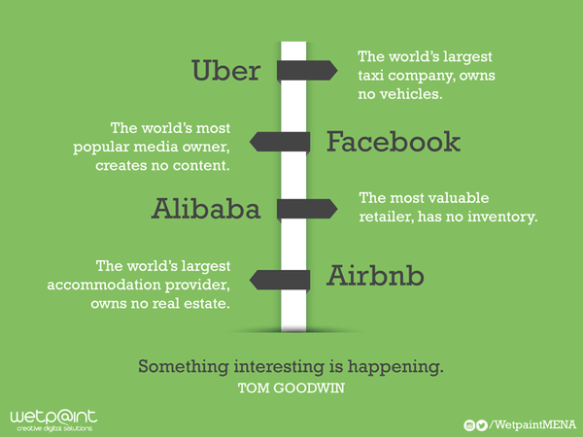
You will have seen the above infographic, often quoted with a sense of wonder at how these companies have built huge businesses seemingly without having to own any physical assets. Well, yes, but dig deeper, and what do we find? The banks have always worked on the same principle – they take customer deposits (which they don’t own), and then lend them to borrowers (whose secured assets they don’t own unless there is a default).

The main difference is that banks are highly regulated (unlike most of these digital market disruptors), and as such they have to hold sufficient capital assets to cover their exposures. Meanwhile, the banks finance the car loans taken out by Uber drivers, they provide credit facilities and export guarantees to Alibaba traders, they underwrite the mortgages on properties used for Airbnb, and will likely provide e-commerce services to advertisers who use Facebook.

For me, probably the last major FinTech disruptor was Bloomberg (founded back in 1981), because it changed the way banks and brokers accessed news and information to support their trading activities, by introducing proprietary analytics and data tools via dedicated terminals, screens and datafeeds. So successful has Bloomberg been that it now owns about one-third of the global market for financial data, and is the single-largest player (albeit by a very small margin over main rival Thomson Reuters – itself, a merger of two key data vendors). Plus Bloomberg is still privately held.

The Future State

I don’t believe FinTech can truly come of age until a major enterprise solution appears. For different reasons, Stripe and BlueDot could be on their way, but both are primarily operating in the consumer payments sector.

I have written previously on the areas where FinTech could impact institutional banking and securities trading, including loan origination, data analytics and risk management. I’ve also reported on the opportunity to disrupt traditional market data vendors by changing the pricing and consumption models. And elsewhere, I have hypothesized on how banks’ trade finance services could be disrupted.

The areas where “Big FinTech” could truly make a difference are:

  • Counterparty Risk Management
  • Predictive Credit Risk Analytics
  • Loan Pricing Models
  • Unit Pricing Calculations
  • Collateral Management
  • Portfolio Performance Attribution
  • Sentiment-based Trading and Risk Pricing

However, the final word should go to Patrick Maes, who suggested that a huge opportunity exists in deposit products linked to customer loyalty programs and frequent flyer points – what if your credit card points could be used to finance a car lease or as part of the deposit on your first home?

Next week: Change Management for Successful Product Development