An open letter to American Express

Dear American Express,

I have been a loyal customer of yours for around 20 years. (Likewise my significant other.)

I typically pay my monthly statements on time and in full.

I’ve opted for paperless statements.

I pay my annual membership fee.

I even accept the fact that 7-8 times out of 10, I get charged merchant fees for paying by Amex – and in most cases I incur much higher fees than other credit or debit cards.

So, I am very surprised I have not been invited to attend your pop-up Open Air Cinema in Melbourne’s Yarra Park – especially as I live within walking distance.

It’s not like you don’t try to market other offers to me – mostly invitations to increase my credit limit, transfer outstanding balances from other credit cards, or “enjoy” lower interest rates on one-off purchases.

The lack of any offer in relation to the Open Air Cinema just confirms my suspicions that like most financial institutions, you do not really know your customers.

My point is, that you must have so much data on my spending patterns and preferences, from which you should be able to glean my interests such as film, the arts, and entertainment.

A perfect candidate for a pop-up cinema!

Next week: Life After the Royal Commission – Be Careful What You Wish For….


The Future of Fintech

Predicting (or at least hypothesising upon) the Future of FinTech in 2019 at NextMoney last week were three brave souls from the Melbourne FinTech community: Alan Tsen, GM of Stone & Chalk and Chair of FinTech Australia; Christina Hobbs, CEO of Verve Super; and Paul Naphtali, Managing Partner at Rampersand. Referencing the latest CB Insights report on VC funding for Fintech, various regulatory developments in Australia (especially Open Banking), as well as the outcomes of the recent Royal Commission on Financial Services, the panel offered some useful insights on the local state of FinTech.For all the positive developments in the past 2-3 years (Open Banking, New Payments Platform, Comprehensive Credit Reporting, Equity Crowdfunding, ASIC’s Regulatory Sandbox, Restricted ADIs etc.) the fact is that innovation by Australian FinTechs is hampered by:

1) fallout from the Royal Commission (although this should actually present an opportunity for FinTech);

2) the proposed extensions to the Sandbox provisions (which are stuck at the Federal level); and

3) lack of regularity clarity on the new class of digital assets made possible by Blockchain and cryptocurrencies (cf Treasury Consultation on ICOs).

Overall, the panel agreed that the channels of distribution have been locked up in an oligopolistic market and economic structure, especially among B2B services. But things are changing in B2C, with the rise of P2P payment platforms, market places, mobile and digital solutions, and challenger brands (e.g., neo-banks).

However, there are under-serviced segments especially among the SME sector, and products and services for part-time employees, contractors and freelancers. For example, meeting the superannuation and insurance needs of the “gig economy”? (Maybe something will come out of the recent Productivity Commission review on Superannuation.)

A number of areas have already benefited from FinTech innovation and disruption – lending (origination, funding, distribution), robo-advice (at scale but not yet offering truly tailored solutions), and P2P payments (and which largely happened outside of the NPP).

When it comes to disrupting and innovating wealth management and financial advice, there is still a distribution challenge. Whatever your views are on the Royal Commission findings and recommendations, there is clearly a problem with the status quo. But is the appropriate response to “smash the banks” or to enable them?

One view is that we are going through a period of un-bundling of financial services. Personally, I think customers want ease of use and interoperability, not only standalone products that are best in breed. For example, if I have established sufficient identification to open and maintain a bank account with one ADI, shouldn’t I be able to use that same status to open a deposit, savings or transaction account with another ADI, without having to resubmit 100 points of ID? And even use that same ID status with an equivalent ADI overseas?

There is often a tension between incumbents and startups. Whether it’s procurement processes, long-term sales cycles, stringent payment policies (notwithstanding the BCA’s Supplier Payment Code) or simple risk aversion, it is very difficult for new FinTech companies to secure commercial supply contracts with enterprise clients. Even though a Blockchain platform like Ripples is working with major financial institutions, most times the latter don’t readily engage with FinTech startups.

Then there is the problem with “tech for tech’s sake”. For example, don’t offer “smart” solutions that actually make it harder or more complex. And don’t build great tech products that offer lousy UX/UI.

A key issue is defining “trust” – whether at the sector level (on the back of the Royal Commission); or at the individual level (the current environment of personal privacy, data protection, identity theft): or at the product level (e.g., decentralised and “trustless” platforms). As one panelist commented, despite the news, “headlines don’t change behaviours”. We love to bash our banks, but we rarely switch providers (mainly because it is far more difficult than it actually needs to be…) And the backlash against social media companies has not resulted in any major movement to unfriend them (witness the response to campaigns like QuitFacebookDay…).

So what are some of the predictions for the next few years (if not the next few months)?

  1. Within 5 years, the 5th pillar will be a challenger bank.
  2. A period of un-bundling followed by re-bundling
  3. A trend for “Financial Wellness” (especially financial education and literacy, not just wealth management and accumulation)
  4. A switch in personal asset allocation/accumulation from mortgages to superannuation – (i.e., new brands like Verve want to be your lifetime financial partner, so that “we invest together”)
  5. Superannuation funds will obtain banking licenses (or maybe one of the FAANGs will?)
  6. Personal Statements of Advice vs ASIC’s MoneySmart – who’s going to be paying for financial planning, advice, products and distributions?
  7. Capitalizing on the lack of trust among incumbents and centralised platforms
  8. More diversity and inclusivity in access to products and services
  9. Payments FinTechs that will disrupt lending (if they can solve the problem of
    going international)
  10. The growth of RegTech – a model of agile governance supported by great UX
  11. The equivalent of open banking for Personal Financial Management services
  12. Banks as data fiduciaries

Next week: An open letter to American Express

Banks under the spotlight (again)

About 6 months ago, I posted a blog on the current state of banking and financial services. It was published before the proceedings at the Royal Commission got underway, and since then we have heard a litany of complaints of malpractice and other inappropriate behaviour by some of our major financial institutions. We have also seen the publication of the Prudential Report into the CBA, commissioned by APRA. But despite the horror stories, is anyone really surprised by either of these findings?

Image: Jacob Edward; Source: Flickr; Some Rights Reserved

Some have suggested that our banking culture is largely to blame – but to me, that is somewhat simplistic, since I don’t think that the culture within our banks is so very different to that of other large companies or statutory corporations. (But I will explore this topic in a future blog.)

We have a love-hate relationship with our financial institutions, especially the 4-pillar banks. The latter have continued to be regarded as some of the most stable, profitable and prudent banks in the world – they are probably among the top 30 banks globally based on their credit ratings. Moreover, during the GFC, it was largely agreed that, despite their participation in complex financial products such as mortgage-backed securities, collateralized debt obligations and credit-default swaps, the big 4 banks helped to prevent a total meltdown in the local capital markets because they had reasonably strong balance sheets, and they worked closely with the RBA to avert the full effects of the GFC.

In fact, so enamoured are we of our banks that, despite the Royal Commission, the banks will not face significant regulatory reforms. One economist at a major fund manager I spoke to suggested that even an in-coming Labor Government would have to confine itself to some sort of bank tax. Anything that would undermine the 4-pillar policy (such as increased competition, rationalisation or foreign ownership) would likely be seen as unacceptable in the current political environment. In addition, since the financial sector makes up such a significant part of the market capitalization of the Australian stock market, most voters hold shares in the banks, either as direct or discretionary investments, or through their superannuation fund. Impacting the financial performance of the banks will have a knock-on effect for customers and shareholders alike.

Despite the relative strength of Australia’s financial services regulatory regime, it’s clear that part of the blame for the current malaise lies with the regulators themselves. None of the transgressions complained of at the Royal Commission or uncovered by APRA’s report on CBA suggest that new regulation is needed (unless we are talking about structural reforms…) In the wake of the GFC, and in line with global banking standards, banks have had to adjust the levels of risk-weighted capital they hold, and meet more onerous compliance costs – as well as rein in riskier lending practices. Yet, it feels like the regulators have not been as vigilant or as pro-active as they might have been – or there is such a “checklist” mentality towards compliance and risk management that banks and their regulators have lost sight of the substance of the law, not just the form.

Having read the APRA report on the CBA, there are a number of issues which need to be addressed, as I suspect that they are replicated (in whole or in part) among the other major banks:

  • All of the incidents covered by the APRA report occurred since the GFC – so, maybe increased compliance obligations are not the answer to these problems, but better supervision and enforcement?
  • Technology is only mentioned about a dozen times in the report – and technology was placed very low in the organizational framework for CBA’s Better Risk Outcomes Program (BROP) – yet banks are increasingly becoming technology businesses
  • Decision-making was seen as being too slow and too reactive, in part due to a collegiate and collaborative environment (surely, the signs of a positive culture?)
  • I would suggest there was a lack of external or independent input at the executive and even board level, and an over-reliance on in-house technical experts – especially in the areas of IT and risk
  • Further, the typical silo structures within large, complex organisations like banks, are the result of an over-emphasis on products and processes, rather than on customers and outcomes. To quote the APRA Report:

“…too many handoffs between silos and layers, with accountability often not clear enough and agreements hard to reach…”

  • Equally, a lack of delegation (especially to front line and customer facing staff) only compounds the lack of empowerment, accountability and transparent decision-making

Despite the strength of the 4-pillar banks and the market share they command, they face disruption and disintermediation from digital platforms, Blockchain technology, decentralized applications, P2P solutions and challenger brands. In fact, banks will increasingly become the digital custodians of our financial data – we will end up paying them to manage our data (rather than simply charging us transaction fees). Banks will also need to restructure their products and services around our personal financial needs and obligations according to our stage of life and other circumstances (rather than simply selling us products), along the lines of:

  • Essential – housing, living, education, health, retirement
  • Mandatory – superannuation, taxes
  • Discretionary – investments, holidays, luxuries

That way, banks will also have a much better “whole of client” view of their customers, rather than the current product bias.

Next week: Culture Washing


What should we expect from our banks?

As I have written elsewhere, bank bashing is a favourite Australian pastime. In recent months, this has struck a new crescendo. There have been various allegations, legal cases and regulatory investigations surrounding such misconduct as mis-selling of products, rate fixing, over-charging and money laundering, all culminating in a hastily announced Financial Services Royal Commission.
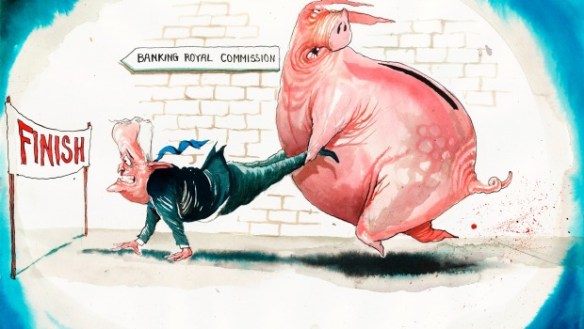
Cartoon by David Rowe, sourced from the AFR, published November 30, 2017

The banks had tried to get on the front foot, by abolishing ATM fees, reigning in some of their lending practices, and appointing a former Labor politician to help them navigate the growing calls for a Royal Commission (largely coming from her former colleagues in the Labor party). But the (Coalition) government clearly decided enough was a enough, and sprung their own inquiry into the industry.

For the benefit of overseas readers, Australia has a highly concentrated banking sector, which is also highly regulated, highly profitable, and in some ways, a highly protected market oligopoly. There are only four major banks (also know as the four pillars, as they cannot acquire one another, nor can they be acquired by foreign banks), and a few regional banks. There is a smattering of non-bank financial institutions, but by their very nature, they don’t offer the full range of banking products and services. As an example of this market concentration, the big four banks traditionally account for something like 80% or more of all home loans.

Aside from the Royal Commission, there are a number of policy developments in play which will inevitably change the banking landscape, and the dynamic between market participants. In addition to the growth of FinTech startups aiming to disrupt through digital innovation, there are four key areas of policy that will impact traditional banking:

  1. Open Banking – giving customers greater access to and control over their own banking data
  2. Comprehensive Credit Reportingmandating the hitherto voluntary regime among the big four banks
  3. The New Payments Platform – designed to allow real-time payment and settlement between customers, even without using bank account details
  4. Restricted ADI Regime – to encourage more competition in the banking sector

The major banks have tried to laugh off, rebuff or diminish the threat of FinTech disruption. They believe they have deeper pockets than startups and just as good, if not better, technology processes. Moreover, customers are traditionally so sticky that there is an inherent inertia to switch providers.

But with banks having to set aside more risk-weighted capital to cover their loans, they may be vulnerable to startups focusing on very specific products, rather than trying to be a full service provider. Banks no longer have the technology edge, partly because of the legacy core banking systems they have to maintain, partly because they lack the know-how or incentive to innovate. And changing demographics will influence the way new customers interact with their banks: “mobile first”, “end-to-end digital”, and “banking for the gig economy” are just some of the challenges/opportunities facing the sector.

So what should we expect from our banks? I would say that at a minimum, a bank should provide: trust (but with Blockchain, DLT and trustless, zero-knowledge proof solutions, banks are no longer the sole arbiter of trust); security (linked to trust, but again, with biometrics, digital ID solutions and layered encryption, banks do not have a monopoly on these solutions); capital protection (although no bank can fully guarantee your deposits); reasonable fees (still a way to go on account keeping fees and some point of sale transaction fees – while disruptive technology will continue to challenge legacy costs); and an expectation that it will not bet against the direct interests of their customers (like, shorting the housing market, for example). The latter is particularly tricky, when banks are mainly designed to deliver shareholder value – although of course, most Australian bank customers also own shares in the banks, either directly, or indirectly through their superannuation.

In recent months, and based on personal experience, I think a bank should also know its customers. Not just KYC (for regulatory purposes), but really understand a customer as more than just a collection of separate products, which is how most banking CRM systems seem to work. Given how much banks spend on consumer research and behavioral data, and how much they talk about using big data, artificial intelligence and machine learning to anticipate customer needs, it’s a constant frustration that my bank does not really know me – whenever I contact them, for any reason, I always feel like it’s a process of “product first, customer second”.

Moreover, I can’t think of a single new product that my bank has launched in the past 15 years of being a customer. Sure, they have rolled out mobile apps and online banking, and they may have even launched some new accounts and credit cards – but these are simply the same products (accounts, loans, cards) with different prices and a few new features. Even the so-called “special offers” I get for being a “loyal” customer bear no relation to my interests, or even my spending patterns (despite all the data they claim to have about me). And because banks are product or transaction-driven, rather than relationship-driven, their internal processes fuel silo behaviors, to the extent that the left hand very often does not know what the right hand is doing.

Finally, with more and more of the working population becoming self-directed (self-employed, freelance, portfolio career, contracting, gig-economy, etc.) banks will have to innovate to meet the financial services needs of this new workforce. Bring on the disruption, I say.

Next week: Box Set Culture