The Bitcoin halving – what happened?

Last Monday, May 11, at around 19:23 UTC, the third Bitcoin halving occurred. This event is currently scheduled to happen approximately every four years, and is a core mechanism in Bitcoin’s protocol. In short, combined with the finite supply of bitcoin (BTC), the halving acts as an anti-inflationary measure by reducing the number of BTC payable to the miners who confirm each block of transactions, and maintain the integrity of the blockchain ledger. By using dedicated, high-powered computers to solve Bitcoin’s complex algorithms, the miners earn BTC as rewards for their efforts (and to help recoup their energy costs). As a result, the halving is an integral component in measuring key metrics in BTC’s performance, including pricing, supply and mining profitability. What happened around the time of the halving provides for some interesting analysis before and after the event.
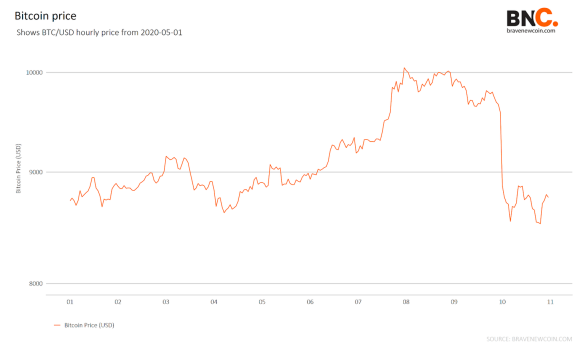
BTC price dropped dramatically just prior to the latest halving event – the above graph is plotted using the hourly closing value of Brave New Coin’s Bitcoin Liquid Index.

The halving is programmed to occur after every 210,000 blocks, which themselves are “mined” approximately every 10 minutes. Last week’s third halving was triggered when block number 629,999 was confirmed – from block 630,000 onward, the block reward reduced from 12.5 BTC to 6.25 BTC per block, and is designed to continue halving until the block reward reaches 1 Satoshi (0.00000001 BTC).

Usually, financial markets have already priced in events such as the halving, so traders don’t expect the event itself to have an immediate impact on price. (Think of the halving as just one type of “corporate action” that is peculiar to cryptocurrencies and digital assets. Others might include hard forks, coin burns, and token lock ups.) As with company results and profit announcements, traders and analysts are usually prepared for the best (or worst).

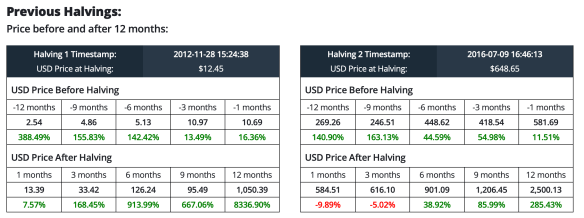
However, leading up to the latest halving, BTC briefly touched a 3-month high of US$10k, before going through an almost typical “market correction” of a 20% decline immediately prior to the halving event. BTC has since recovered some of those losses, and in any case, the price performance before and after each halving event has become yet another indicator of long-term price movement, as the following chart illustrates:
Other metrics to watch include: “hash rate” (the degree of difficulty, and therefore the amount of computing power, to solve the algorithms and mine each block); transaction fees (if miners can’t earn as much from mining activity, they are expected to start increasing their network fees); the price of electricity (as an input cost to mining); and even the cost of computing power itself (as older machines become less efficient and therefore less profitable, while newer, more powerful and more expensive processors come to market).

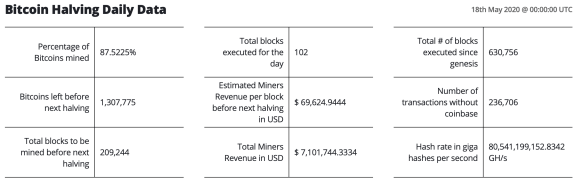
Indeed, different scenarios used to predict the exact date of the next halving are largely based on the hash rate, which has been relatively volatile before and since the halving, and transaction fees likewise escalated (and then settled down again) around the time of the halving. Key data to track as part of halving analysis and forecasting can be seen in the table below from Brave New Coin:
Other interesting developments around the time of this latest halving include a legendary hedge fund manager reported to be buying BTC as a hedge against inflation; an increase in open interest on CME’s BTC futures contracts (assumed to be coming from institutional clients); and an intriguing message attached to block 629,999 (“NYTimes 09/Apr/2020 With $2.3T Injection, Fed’s Plan Far Exceeds 2008 Rescue”). Given the recent quantitative easing measures pursued by many governments and central banks in response to the Covid-19 pandemic, this choice of headline echoed the message attached to the genesis or very first Bitcoin block, mined in 2009, soon after the GFC (“The Times 03/Jan/2009 Chancellor on brink of second bailout for banks”).

Finally, as more data and analysis attaches to the halving events, they form the basis of a fundamental aspect of understanding how financial instruments perform over time – giving rise to the BTC equivalent of a 1, 5 or 10 year yield curve, which in turn will create more sophisticated derivatives and hedging tools, and another level of comfort for traditional and institutional investors.

(My thanks to friends and colleagues at Brave New Coin and Apollo Capital.)

Next week: “How do I become a business strategist?”


Can we come out now?

At the time of writing, the Victorian government has just announced the State’s very own measures as part of the “3 Steps to Recovery”, designed to ease the Covid-19 lockdown restrictions, in a controlled and manageable way. This follows last week’s meeting of the National Cabinet, where broad agreement was reached on a plan to help “prepare Australians to go back to work in a COVID-19 safe environment and getting the economy back to a more sustainable level“.

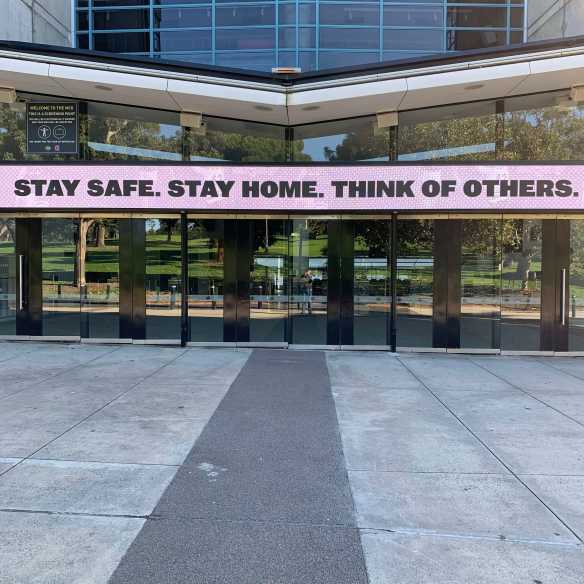
Even at the MCG, the advice is stay safe, stay home, and think of others

The biggest “winners” in Victoria will be our immediate friends and families (groups of up to 5 people can gather at each others’ homes), outdoor activities (groups of up to 10 people), wedding organisers and funeral directors (more people can attend ceremonies)…. oh, and the AFL (training can resume!).

But Premier Andrews has stressed that this is neither an excuse to host dinner parties every night, nor a reason to ignore established protocols and best practice on personal hygiene and social distancing. So no overnight raves or camping trips. And no dining-in at restaurants or cafes, and definitely no pubs, bars or clubs.

For some people, the continued Stage 3 restrictions seem too much to bear, with a few fringe elements (along with the anti-vaxxers and the anti-5Gers) being more vocal and more physical in their views. But they probably fail to see that no-one actually enjoys living under this regime, and nobody would do it if they had a choice or other safe options.

Thankfully, the majority of the population are willing to comply with the restrictions, however uncomfortable or inconvenient, because they realise the consequences of a second wave of infections (especially as we come into winter) would be worse than some temporary limitations on their freedom of movement. There is also a renewed albeit grudging respect for and trust in our political leadership (if not always felt towards individual ministers), and here in Australia we can also consider the political decisions and public advice in light of scientific data and medical evidence.

A large proportion of Covid-19 infections in Australia came via overseas travellers (cruise ships and ski trips), while some of thee first community infections came from gatherings such as weddings and religious services. And then there have been “hubs” within sectors such as aged care, meat processing and airport baggage handling.

There are still questions over plans to re-open schools, and sectors such as aviation, tourism and hospitality have a long way to go before “normal” service resumes. Parts of the retail sector have managed to survive thanks to on-line shopping and e-commerce solutions (supply chain logistics and delivery) but we should expect some businesses will never bounce back. Every employer will probably need to have a “Covid-19 Safe” operating plan before bringing staff back to work in significant numbers, whether as part of their best practices on risk management, or as a prerequisite to satisfy workplace health and safety obligations.

The apparent rush to get professional sport back on the field feels like a misplaced priority – especially given the controversy around NRL and AFL players who apparently lacked the self-discipline to comply with the social-distancing measures; and those players who are refusing the flu vaccine as a condition of rejoining their clubs. On this point, I rather admire the comments by Chelsea manager, Frank Lampard, who expressed his unease at the thought of professional footballers getting priority for Covid-19 testing, ahead of essential and front-line workers, simply to fast-track the resumption of the EPL.

Even with the various safety plans and gradual easing of restrictions, it’s up to each of us individually to be responsible for our own actions, and maintain a personal duty of care to each other so as not to risk spreading the infection, nor risk exposing others as a result of something we do or omit to do.

Next week: The Bitcoin halving – what happened?


Startupbootcamp’s Virtual Demo Day

Not to be defeated by the Victorian government’s Stage 3 Covid19 restrictions, Startupbootcamp decided to stream the latest Energy Australia Demo Day online. It was a bold move given that a key value of these events is the opportunity to see and meet the startup founders in person. But to the organizers’ credit, and with support from their corporate sponsors and mentors, as well as the founders themselves, it was an impressive event, and managed to connect the teams with their audience effectively.

The nine projects in the order they presented (website links embedded in the names) were:

17TeraWatts

Focused on “meeting the demands of the new solar customer”, 17TeraWatts monitors residential solar energy systems via a combination of data automation and behavioral science. It achieves this via “Bodhi 2.0”, a digital assistant for modern energy companies, designed to be the “heart and brains of home energy systems”. Once installed, it is forecast to to generate a recurring revenue stream for the 25-year life of a solar system, by delivering reporting and customer leads. At the other end, solar consumers are willing to pay for more information about, awareness of and control over their energy systems ans consumption. Currently exploring a partnership with DiUS, Bodhi 2 is also being deployed by a Victorian electricity retailer.

Renbloc

Another team addressing energy efficiency management, Renbloc provide a solution to help consumers by bringing transparency to the verification of renewable energy sources. For a monthly fee, it brings real-time monitoring and optimization to consumer energy consumption. Renbloc are also working with companies such as Asahi and Energy Australia to provide verification “certification”, a form of energy labelling that can be applied to a wide range of consumer products.

Machine Dreams

The founders at Machine Dream are deploying machine learning and data analytics to monitor equipment failure, by detecting defective power assets owned and managed by energy distribution networks. Using system-generated photos to train the algorithm, Machine Dream claim significant reduction in the time and cost it traditionally takes to monitor network equipment, and with higher accuracy rates. The overall effect is to enable the frequency of assessment, and the reduce the cost of assessment. Currently in trials with Ausnet to monitor the “poles and wires”, Machine Dream can also be used for other infrastructure assets such as bridges, railway tracks and roads. The team plan to offer licensing and SaaS business models to asset managers and manufacturers.

GenGame

This is a customer engagement platform, delivering consumer apps for energy retailers to help their customers track retail energy bills (optimization, rewards, incentives, etc.) using customized profiles. The founders claim that customer relationships become stickier, via the low cost/low touch engagement. The team comprises a mix of creatives, energy industry experts and software developers to license client solutions which are priced on the set-up costs and the number of end users. Apparently, only 10 out of 40 energy retailers in Australia have a mobile app, and GenGame has two pilot projects with Energy Australia.

Energy Master

Another solution for energy efficiency, Energy Master is focused on helping corporate clients manage their utility bills. Essentially a business information platform, the application reviews consumption, taxes and fees, tariffs and off-sets, carbon reduction and water savings. It charges 0.5% of managed energy costs as a recurring fee, and does not require any hardware investment by clients. Currently running clients trials with Energy Australia.

ELDO MeterStack

This team is also addressing energy data analysis, but at the level of the grid, particularly at the fringe end of the distribution network. Their thesis is that consumers are not engaged, and don’t know how to understand their utility data or how to value it; meanwhile, energy companies cannot access consumer data. Positioned as a data market place between consumers and energy service providers, it offers a turnkey solution for the new breed of “digital utility” companies, and is working with DiUS and MHC to support distributors and the fringe of the grid.

Energos

Describing its solution as “intelligent nodes for distributed energy systems”, Energos is using AI for energy monitoring, management and optimization. Focused on business and industrial clients, the system can operate across multiple sites and in multiple countries, ideal for multinational corporations. Adopting a monthly subscription fee model, Energos is working with Energy Australia on a pilot solution for a business client.

BEAD

Using a combination of sensors and software, the team at BEAD are delivering intelligence solutions to help building owners, managers and occupants to manage “over heating, over cooling, over lighting”. With tag lines such as “listening to your building”, and “intelligent buildings you deserve”, BEAD is aimed at telcos, smart cities and BMS & HVAC vendors. Their system analyses occupancy flow, and develops digital models of buildings to track body heat (an important consideration in the Covid19 era, as well as events such as building fires, floods and earthquakes). They also work with building insurers to deliver real-time monitoring via Blockchain and smart contracts. Claiming to deliver 30% savings in energy optimization and efficiency, BEAD is working with Energy Australia, Hydro Tasmania and Asahi.

Liquidstar

This startup deploys Blockchain enabled apps to monitor their partners’ IoT connected hardware (batteries and container charging stations). Liquidstar is an IoT solution designed to build a “wire-less grid”, with the aim of removing diesel and methane power from communities that do not have access to grid networks. One potential use case could be in battery management for Covid19 quarantine centres.

Next week: Can we come out now?

The lighter side of #Rona19

After several weeks of lockdown during #Rona19, and despite the serious challenges that we still face from the Pandemic and its consequences, it’s typical of the human condition and our spirit of resilience that people have managed to find humour and goodwill in the depths of despair.

In no particular order (and without any judgement) here are just some of the distractions and interactions that have been keeping us amused during social isolation, as well as a few of the apparent positive effects:

  • The video conference call bloopers (memo to team: pants on)
  • Clips of dogs vs cats navigating home-made obstacle courses
  • #MeAt20 flashbacks
  • Elderly family members accidentally gatecrashing Houseparty online drinks
  • Some introvert pupils actually enjoying schooling from home
  • Clients and suppliers displaying genuine concern for each others’ welfare in e-mails and on calls (I just hope this empathy endures beyond the Pandemic)
  • People reducing food waste (less shopping, less fussy about use-by dates)
  • Homemade videos and photos recreating scenes from famous movies and artwork 
  • More wildlife in urban areas (I’ve also seen more birds, bugs, bees, butterflies and beetles in my back yard and in nearby parks)
  • Public libraries of iconic images for use as video call backdrops (conference calls will never be dull again…)
  • An apparent drop in traditional crime rates, and fewer typical hospital casualties (people not going out getting drunk, getting into fights or overdosing)
  • Hosting virtual dinner parties (no need to organise a taxi home)
  • Many homes now have a “clearance corner” awaiting charity shops reopening (all that time to sort out cupboards and drawers)
  • A visible reduction in air pollution (as evidenced by before/after photos from various cities)

Next week: Startupbootcamp’s Virtual Demo Day