Pre-election Musings

At the time of publication, Australia is four days out from a General Election. At the time of writing, I have submitted my postal vote, as I will be overseas on polling day (May 18). I am certainly not going to call the result or predict the outcome, except to say it will probably be far closer than most people would have expected, maybe even a hung Parliament, with an even more fractious Senate. But I have to say that this has probably been the most difficult ballot I have had to complete.
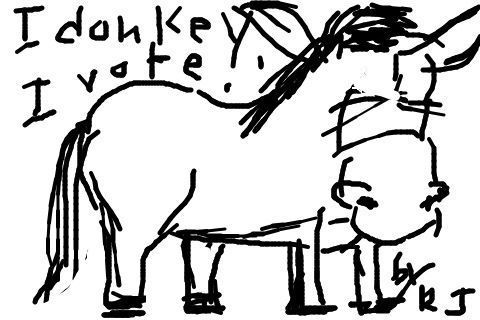
Image sourced from The Donkey Vote

For one thing, I can’t see why either of the major parties deserve my vote. Plus, in my own constituency for the lower house, the ALP candidate has been disendorsed, so as a result, I have been denied the option of voting for the official opposition. (More on this disendorsement later.) (Meanwhile the only Green Party MP who sits in the lower house and who represents my constituency, labelled himself an “independent voice”. Does that mean he no longer represents the views of the Green Party?)

Why do I feel this way about the two major parties?

First, neither party leader inspires me – they are purely products of their political organisations and their respective factions, and display very few leadership qualities other than they probably know how to stitch together half-baked policy deals in their party meeting back rooms. I doubt they have ever had an original idea, and certainly not since they became the leaders of their particular factions, let alone leaders of their parties.

Second, both parties have simply been sloshing around tax payers’ cash – funding here, pork barrels there, sleights of hand all over the place. I agree that most areas of public services and infrastructure demand a rethink on their current funding models, and some deserve more money. But from what I have been able to glean so far, most of these funding commitments and/or budget re-allocations are mostly about headline amounts, and not measurable outcomes, assuming they have been properly costed in the first place.

Third, despite all the money on offer, there have been few, if any, announcements on more fundamental issues of economic and structural reform such as competition policy, productivity measures, innovation, startups, etc. Yes, there have been some financial and tax incentives thrown out to small businesses who take on more staff, or who invest in new equipment, but these are just the usual tweaks. And there has been very little debate about the need to review the design, delivery, quality and accountability of public sector services.

Fourth, and the one main thing that the major parties have in common, is that the only policy levers they seem willing to push/pull are continued fiddling about with tax rates, superannuation and industrial relations. All of which is counterproductive, as it just means the focus is on winners and losers, and the resulting class-war based “politics of envy” and crass take-downs of the “big end of town”.

So let’s talk about jobs.

Much of the money ear-marked for particular industries or service sectors is intended to support job creation. Where are most people employed in Australia? By industry category, the top sectors are: Health Care; Retail; Construction; Professional, Scientific and Technical Services; and Education. Most of which are destined to be the recipients of tax payer-funded largesse after the election. And while I agree that Health, Education and Public Infrastructure need to be adequately and properly resourced, innovation and the high-tech jobs of the future will more likely come from the Professional, Scientific and Technical Services sector. (And $3m for a “Blockchain Academy” is woefully inadequate for long-term thinking and vision.)

But as should be obvious to anyone, industries don’t create jobs, companies do. And most people in Australia (70% of the working population) are employed by small to medium-sized businesses. Of the nearly 2.2m registered businesses, 60% have zero employees (mostly they are owner-operated sole traders, including self-employed tradespeople), more than a quarter of businesses employ fewer than 5 people, nearly 10% of businesses employ between 5 and 20 people, 2.4% employ between 20 and 200 people, and only 0.2% of businesses (c. 3,800 companies) employ more than 200 people. In addition, only 100,000 businesses have an annual turnover of $2m or more. Welcome to the long tail of the Australian economy.

As for the election outcome itself, it will largely be determined by swing voters in marginal seats. Five of the 10 most marginal seats are in Queensland. And with the Adani mine project being such a divisive topic, this one item could determine who takes government. And even if Labor wins a majority in the House of Representatives, the Senate will be even more split between minor parties, and whoever wins government will find it difficult to navigate the upper chamber. In my own state of Victoria, there are something like 30 party groupings and around 80 individual candidates standing for just 6 seats. Trying to research the minor parties and their candidates or their labyrinthine preference deals is virtually impossible, which cannot be healthy for the democratic process under the proportional representation system of the single transferable vote model.

The real issue, though, is that with 3-year Federal Parliaments, parties are in perpetual campaigning mode. There is very little long-term thinking or vision, while short-term compromises are the order of the day. All of which results in either total inertia when it comes to making any real structural change, or constant policy tweaking to keep ahead in the polls. All hot air and no momentum.

Finally, coming back to the disendorsed Labor candidate for the lower house in my constituency of Melbourne. The party was forced to act (albeit somewhat reluctantly and almost equivocally) when the candidate’s social media past caught up with him. At first, the party and its Leadership suggested that the 29-year old candidate should be forgiven his indiscretions because he was “only” 22 at the time said offensive remarks were posted. I think that argument is total hogwash. If you are not going to be held responsible or accountable for the consequences of your actions at the age of 22, then you should not have the right to vote, get married, have children, stand for election, serve on a jury, sign a contract or take out a mortgage because clearly you have not fully developed as a mature adult, and your capacity to think and make important decisions is obviously impaired, such that you cannot be relied upon to exercise reasonable judgement.

Next week: Trends in LegalTech


Pitch X

Organised by Academy Xi in conjunction with Melbourne Silicon Beach, the latest edition of Pitch X was hosted at YBF Ventures last week. The event sponsorship, prizes and judging panel came from Everest Engineering, Luna, Shiftiez, Lander & Rogers, LaunchLink and YBF Ventures itself.

Image sourced from Pitch X Eventbrite page

Each each start-up was given 90 seconds to pitch, followed by a one-minute Q&A with the judges. The best three presentations were then shortlisted and invited back on stage to make a 5-minute pitch, followed by a 2 minute Q&A.

Some of the pitches were really only ideas, a few had reached MVP status, and a couple were in advanced beta with actual customers. And most of the projects still at the drawing board lacked key tech skills and resources to execute on their ideas. So there was a bit of an imbalance across the initial presentations. It’s not for nothing that most successful hackathon teams comprise a hacker, a hipster and a hustler…

In order of presentation the pitches were (website links where available are embedded in the startup names):

Backyarda – “the spontaneous experience curator”, promoting unsold event inventory via Facebook Messenger. Needs a co-founder and development skills as well as seed funding. Takes a 30% sales commission, and is at MVP stage, targeting 18-35 year olds.

Virtual Amputee Experience – providing training to prosthetic users and raising empathy and public awareness. Positioned as a research tool and data acquisition model. Seeking funding for software and hardware development. It’s a spin-off from an academic research project. Judges asked about the revenue modelling and the data privacy issues.

Betabot – by Beta Launch – “Empowering teammates, Supercharging augmented teams”. Designed as a Slack plug-in. The solution is in fact a time-zone calendar management tool. (But as the MC noted, it’s also the name of a computer virus…)

The Neighbourhood Effect – “your local green living guide”. Making it easier (and financially positive) to be green. Employs gamification and behavioral science, for example a User Questionnaire model. Free version plus white label solution for local governments, and product providers. IP resides in the data mapping. Has had success in ACT via a rapid local campaign model.

The Good Bite – “providing financial independence to women who are suffering domestic violence”. A social enterprise for corporate catering, offering training and employment opportunities.

Young Adult Grief Space – “online counselling service”. Based on a P2P experience via shared narratives. Very much an idea at this stage, judges asked how sessions would be moderated, and how professional counsellors would be involved.

Pearlii – “dental checkups via selfie”. Aimed at early detection and prevention.
Uses a smart phone app to take 5 photos, then applies a diagnostic algorithm via ML and image processing. Freemium model – a basic account plus a premium profile management solution. Building their own tech/IP from scratch, and see future applications in tele-medicine, removing reliance on experts, placing trust in AI, image processing and analysis.

Inside Outcomes – “better communications between psychologists and their patients between sessions”. An app to chart personal outcomes etc. Judges asked how it integrates with existing patient management systems? Currently much of the work is done manually.

Abadog – “behavioural advice for dog owners”. Consultation via observed data and individual report delivered online. 20% of dogs have anxiety disorder. There is a lack of certification or legislated standards for best practice for dog trainers and behaviouralists. Aiming for a subscription model.

The Social Agenda – “Efficacy and Integrity in Government”. Talked about three different modules for public policy design, deliberation and decision-making. Goal is “Policy Certainty”. Wasn’t clear what the actual project involves, so hard to evaluate the concept.

Winners were:

1st prize –  Neighbourhood Effect

2nd prize – Pearlii

3rd prize – Abadog

Next week – Startup Vic’s SportsTech Pitch Night

Recap on the New Education

My series late last year on the New Education (Agility, Resilience and Curiosity) prompted several comments from friends and acquaintances, a number of whom work as teachers or in the broader education sector.

Some of the feedback expressed frustration with the rigid structure and expected learning outcomes of current curricula – some teachers feel constrained by what/how they can teach. Rather than taking into account the holistic learning needs of students, most primary, secondary and even tertiary education is fixated on quantitative results, much of it geared towards formal STEM subjects. Whereas, in early childhood education, there is more of a focus on well-being and resilience, along with core learning and life skills. (But of course, if that resilience, agility and curiosity is not re-enforced at home or sustained beyond the classroom during those formative years, it may be a wasted effort….)

No doubt STEM subjects are important (to build the core technical skills we need for the future). Just as important is the inclusion of the arts (STEAM), for without creative skills, it becomes harder to interpret and then apply our technical learning to new situations. And let’s not forget the importance of play, even in a learning environment. A friend of mine provides extra-curricula classes in coding and robotics to primary school children. She finds that once the students have grasped the basics, unless they remain curious and are willing to explore what they have learned through play, they can’t progress to adaptive tasks such as creative problem-solving or identifying bugs in their programs. So they get bored and frustrated. The situation is not helped by many parents who want to know when their 10-year old “genius” is going to get to degree level computer science….

At the other end of the age spectrum, it’s clear that if we stop learning, and if we stop being curious, our agility in adapting to the career demands of the new world of work will be seriously depleted. The need to pursue our goals, passions and interests was explored in a recent discussion about late stage career transition on ABC Radio National. A major point being that if don’t put effort into managing our career, someone else will decide our future for us. Or we end up resenting the work we do. Similarly, I get frustrated by some former colleagues, who reach out to me for advice on how they can find their next work opportunity. When I explain my own recent journey, how I participated in a number of weekend hackathons, joined various meet-up groups, and attended numerous networking events, they say things like, “That sounds like hard work” – well, of course it is, otherwise it wouldn’t be worth doing.

The final word on curiosity should go to style icon, Iris Apfel. She maintains that being curious, and having a sense of humour, are vital to our existence. In fact, she goes as far as suggesting that she doesn’t have time for people who are not curious.

Next week: Manchester, so much to answer for…


The new education #3: Curiosity

Week 3 (and final part) of “What they should be teaching at school” – Curiosity.

If curiosity is supposed to have killed the cat, then in my case, curiosity probably changed my life. Earlier in my career, I was offered the opportunity to relocate overseas. When I asked my manager why I had been chosen, he replied that I had “asked the right questions” to justify my selection. In fact, I had no idea that I was in contention for the role – I was simply interested in the new project from a business perspective. I hadn’t even considered whether I wanted the role itself – but my questioning apparently displayed the right amount of curiosity, and I was seen as the right fit for the job.

Being curious means you are less willing to simply accept something as “received wisdom”. It shows that you want to make sense of things for yourself. It helps you ask why things are done a certain way (especially if the answer is “because they’ve always been done this way…”). It demonstrates you want to find out how things work for yourself.

The downside is you may be more disbelieving, more sceptical, and prone to being suspicious. It can also mean you distrust certainty. But I would gladly take a level of ambiguity over a sense of complacency any day. A questioning nature can act as a defence mechanism against hype, cant and bullsh*t.

I hope kids learn how to take their early curiosity (and not just their knack for asking “but, why, mummy, why?”) into later life. Curiosity is how we learn to find our passions and interests outside the formal school curriculum and the set learning model. Our natural curiosity helps us to make sense of the world. I don’t think I would have developed any real critical thinking if I hadn’t strayed “off piste” and explored books that were not on the list of set texts.

Recently, I explained to a former colleague how I had participated in a number of startup and tech hackathons, even though I’m not a coder or programmer. My ex-colleague asked, almost in disbelief, “why would you do that?” Apart from being part of my journey into a new career path, my answer was simple: “Because I was curious, because I wanted to learn something, because I wanted to network and make new connections, and because I also wanted to get out of my comfort zone.”

In my view, if you stop being curious, you stop growing as a person, you stop developing your mental faculties, and metaphorically, you stop breathing.

Next week: Looking back on 6 years of blogging