The changing economic relationship of #work

Whether or not we are comfortable with the notion, the work we do can come to define us. In some societies, family names are derived from our forebears’ occupations or professions (Butcher, Baker, Smith, Cartwright, etc.).  The rapid shift to the knowledge economy is challenging our traditional economic relationship with work, and what it means to be an employer or employee. For example, the idea of a “job for life” within the same industry, let alone the same company, is no longer the norm.
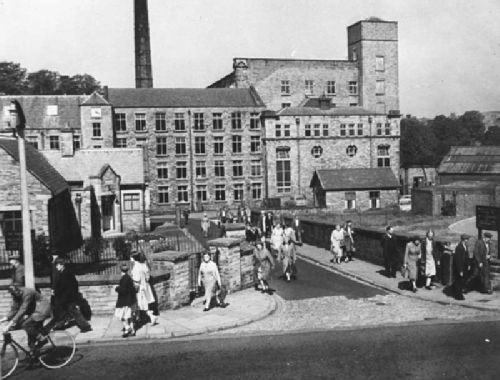
Workers leave Waterhouse Mill, Bollington, Cheshire, UK (1959)

Workers leave Waterhouse Mill, Bollington, Cheshire, UK (1959)

“Welcome to the working week”

This past week I have been listening to the latest thinking on the nature of “work”, from the perspective of technology and its impact on task-based activity (courtesy of Donald Farmer from Qlik), and from the perspective of organizational culture and its importance in motivating knowledge workers (courtesy of Didier Elzinga of Culture Amp). If you are not familiar with either of these thought leaders, than I thoroughly recommend them to anyone interested in organisational behaviour, career development, business transformation and lifelong learning.

Technology and changing demographics require each of us to reframe our ideas about work as a homogenous lifelong activity, because the economic bargain between employer and employee is no longer as simple as a 40 hour working week and a regular paycheck.

Reframing “employment” #1:

By 2020, average job tenure will be 3 years, and around one-third of the workforce will be employed on a casual basis (part-time, temporary, contractor, freelance etc.). The proliferation of services such as Freelancer, O-desk/Elance, Sidekicker, 99designs, Envato and Fiverr are evidence of this shift from employee to supplier.

“The Dignity of Labour, Pts. 1-4”

Around 200 years ago, at the height of the Industrial Revolution in England, the typical worker was employed in a factory or mill, lived in housing owned by the employer, and was paid some or all of his wages in the form of vouchers that could only be spent in shops also owned by the employer. A hundred years later, my grandparent’s generation were still exposed to the practices of indentured labour (“master and servant”) or the idea of “going into service” (as domestic workers). My father’s generation is certainly the last in my family to have had a 30-year salaried career within the same organisation.

So, in just a few generations we have transitioned from the idea that employment provides for all our needs, to the increasingly common perception that every worker is in fact a micro-business, supplying their labour to multiple employers or clients via fee-based services. (The potential irony here is that in a world of freelancers and contractors, the time-based or task-linked approach to employment pricing starts to resemble Marx’s idea of the labour theory of value…..).

“Cottage Industry”

It’s also interesting to note that before workers were employed in factories, and as agrarian labourers transitioned from toiling in the fields to working in manufacturing production, they were hired on piece-rates, working from home in the form of (literally) cottage industries. Of course, this was not exactly self-employment, as their tools (looms and lathes) were probably provided by their “client” who also set the prices (for raw materials and finished goods), had exclusive rights over the finished goods, and determined the number of units required. But, within the constraints of meeting target numbers and societal norms such as Sunday observance and customary holidays, these labourers were “free” to work for as many hours as they wanted, and at times that suited them. So, like many contemporary issues we still seem to be struggling with, flexible working arrangements are nothing new….

“Work is a four-letter-word”

Aside from connecting with your purpose, understanding your personal value proposition and knowing what you are “worth” in the market, one of the biggest challenges I see for employees/workers is the paradox between shorter careers (witness the increasing unemployment rates among older workers) and longer working lives.

Thanks to medical advances, we are living longer, but there is a mismatch between workforce participation rates and increased welfare and social security costs, leading to continuous policy tinkering on pensions, tax and superannuation.

As individuals, we need to build up sufficient financial assets to sustain us both post-retirement, and during erratic periods of personal income. As “free agents”, we have to learn to live with:

  • increasing job insecurity (companies continuously de-layering and restructuring)
  • significantly different career paths (compared to personal aspiration/expectation)
  • rapidly changing working environments (hot-desking, co-working spaces)
  • greater self-reliance (“bring your own device”) and
  • heightened resilience (“shape up or ship out”)

“Opportunity”

The good news is that the model of portfolio, portmanteau and protean careers means that new jobs and new forms of working are emerging all the time – and with personal resilience etc., come flexibility, adaptability, knowledge sharing, skills transfer and new opportunities for personal development, along with self-defined roles, self-directed learning, self-managed performance and self-determined accountability.

We are no longer defined just by what we do, but how/where/why/when we do it.

Reframing “employment” #2:

A friend recently asked me for some advice on how to transition from “employment” to “self-employment”. She has regular part-time work with one organisation (which she views as employment), but wants to find more of her “own work” with other clients. She does not want to give up the part-time gig just yet, but feels that it is preventing her from growing her own business. So I suggested that she should see herself as being self-employed already, and that the part-time work is her first client, allowing her to build a portfolio of new business.  

“Earn enough for us”

What does this brave new world of work mean for employers – in particular, what is the new economic bargain organisations need to have with their workers?

If companies are no longer willing/able to offer long-term, permanent employment opportunities, how do they manage their labour requirements, attract and retain the best talent (when they need it), and engage highly motivated and skilled people?

First and foremost, the idea of workplace flexibility has to be truly reciprocal – but obviously aligned and clearly articulated – to be of any real benefit to both parties.

Second, if employers are increasingly reliant on freelance resources, this does not obviate their obligations to invest in their workforce – whether that includes benefits, training or rewards and recognition – the same as they would have in their employees.

Third, companies will need to do an even better job of attracting and retaining the skills and knowledge they require – and be willing to offer different kinds of incentives (e.g., opportunities to work on engaging projects and to collaborate with interesting people) beyond basic pay and conditions.

Fourth, employers may have to adjust to the idea of “syndicating” their talent resources (“it’s the shared economy, stupid”) not just within their own workplaces, but across their client organisations, suppliers, service providers and other collaborators – sometimes, even their competitors. Employers can no longer expect to have a total monopoly on their workforce talents, unless they make it really interesting, financially or otherwise…

Fifth, if companies continue to espouse the message that “our people are our best asset” then they need to update their asset management model to demonstrate they mean what they say. For example, more needs to be done in helping employees to retrain and up-skill (for jobs and roles that haven’t yet been thought of), even if that may mean employees are more likely to move on. The amount of goodwill that this will create in the wider community cannot be underestimated.

Reframing “employment” #3:

Employers and HR managers are re-assessing how they evaluate employee contribution. It’s not simply a matter of how “hard” you work (e.g., the hours you put in, or the sales you make). Companies want to know what else you can do for them, how you collaborate, do you know how to ask for help, and are you willing to bring what you know to the role?  

Finally, rather like their employees, employers are increasingly expected to connect with their purpose and to align their values with their objectives. New entrants to the workplace are better informed about the organisations they work for and want to work for, because free agents know they have a choice.

Next week: How to work with Boards
Update: Health, AusPost, eTaskr and Slow School

Over recent months, I have blogged about health and the digital economy, the challenges facing AusPost, the progress of eTaskr and the birth of Slow School of Business. Here are some updates on each of these topics:

IMG_0211Apple launches developer platform for health apps

On top of launching “Health” with iOS8, Apple has released a software tool called ResearchKit designed to help researchers and developers build and test new health apps.

I think that while we hear a lot about the Internet of Things (#IoT), health is one area where the connection of the physical and the digital will really deliver tangible benefits (not just a fridge with a screen…).

Australia Post plans to raise the cost of sending letters

In the wake of declining letter volumes (and poorer financial performance), AusPost is considering jacking up the price of letter postage, and introducing a 2-speed letter service.

While this is not a surprising move, it does seem shortsighted. Given the increase in parcel volumes, especially from e-commerce and small online purchases, I reckon AusPost would be better off with more refined domestic parcel rates. For example, using exactly the same dimensions and weight, I can either send an item as a “large letter” for $2.10 (which is perhaps too cheap?), or as a “small parcel” for $7.45 (which is incredibly expensive for an item that might cost no more than $25). Maybe different band rates of 50g, from 100g up to 500g (the current weight limit for a small parcel/large letter) or even 1kg  might be a better option, coupled with improved payment and lodgment automation? Just saying…

etaskr secures seed funding

Described as a “private label elance”, etaskr is a graduate of the AngelCube accelerator program, and was a finalist at last year’s Big Pitch organised by Oxygen Ventures.

Following their appearance at the Big Pitch, etaskr have recently closed $1.3m in seed funding from Oxygen Ventures. As mentioned in an earlier blog, etaskr is starting to see traction among corporate clients, including overseas markets, but the nature of the B2B sales cycle has meant that investors, incubators and accelerators are traditionally wary of such startups. Hopefully, this latest development will start to change market perception.

Slow School founder in the news

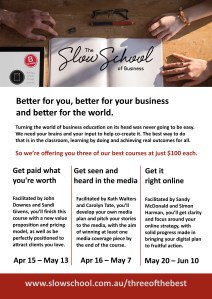
Finally, Carolyn Tate, the founder of Slow School of Business has been busy launching a new program of short courses (including Three of the Best) a new website and a new book. Oh, and she’s also become a B Corp. (Declaration of interest: I am a participant in, and adviser to, Slow School.)

Previously featured in Slow Living (required reading for the Slow Movement), Carolyn has taken a simple idea based on collaborative and peer-to-peer learning, and created a potentially disruptive platform for professional development and corporate training. Slow School is also tapping into the growing trend for people to work as independent contractors, freelancers and consultants (rather than permanent employees), and the dynamics of the digital economy where participants are also looking to make deep, personal connections rather than just online “friends”.

The new normal?

Post GFC, we’ve been told to expect a low/slow/no growth environment – that this is the “new normal”. I would add to that digital disruption, non-traditional commercial models and emergent ecosystems as being the other key influences on how we do business in this new environment. From what I have skim-read of the latest Intergenerational Report, the language is still couched in traditional terms of “jobs”, “productivity” and “industries”. Yes, there is mention of innovation, demographics, technology and flexible workplaces (i.e., deferring retirement?), but nothing that inspires me to think our political leaders understand what is really going on within the startup economy and the broader digital movement.

Next week: How to survive a Startup Weekend

CSIRO – what price #innovation?

Last week Startup Victoria invited scientists and researchers from CSIRO to come and talk about some of the projects they are currently working on. Around 400 people turned up to listen to fascinating presentations on flexible solar panels, 3-D titanium printing, flexible OLED lighting, robotics, wearable kinetic dynamos powering textile-based battery storage systems, high-speed instrumentation using FPGA, and micro-manufacturing processes.

logoFrom the outset, the emphasis of each presentation was on the practical application of these inventions. The goal of the evening was to encourage entrepreneurs and founders from the startup community to connect and engage with CSIRO’s project teams. There was an open invitation to co-operate with CSIRO, via R&D, prototyping, IP licensing and commercialisation initiatives.

The evening was generously sponsored by Cogent, PwC, Elance-oDesk and BlueChilli, hosted by inspire9, and ably compered by Leni Mayo; and in place of the usual Startup Alley was a team of experts offering free advice to startups, organised by Two Square Pegs.

As well as showcasing its latest developments in nano-technology, materials, fabrication, energy generation and workplace automation, CSIRO wanted to remind the audience that they have development and test facilities, which are available for commercial use at very economic rates to the right sort of project. It’s all part of a broader charm offensive, in part designed to raise awareness of the great innovation that has come out of CSIRO (e.g., WiFi…), in part to counter the challenges of reduced government funding ($111m in cuts over 4 years).

To me, CSIRO would appear to be pretty good value for money based on the $700m+ government contribution (which probably accounts for about 70% of current budget). CSIRO generates income from industry for research and other services, and earns royalties from patents and other IP it licenses. But its challenge is to demonstrate its true economic value, either as a contribution to GDP, or as a return on investment to the government (and to the wider community).

On the one hand, CSIRO is not an investment vehicle – yet on one level it operates as an early-stage VC fund, identifying which projects to “invest” in, and securing commercial returns via patents and other licensing streams. Nor is CSIRO a listed company, but without the benefit of its research and inventions, many companies traded on the ASX might not be as financially successful.

Ironically, CSIRO has been involved in research on the future of Australia’s $1.4tn superannuation assets – part of the effort to work out how to put these assets to better use, both to generate more sustainable income for Australian retirees, and to ensure the nation is investing in the right sort of infrastructure, innovation and international growth opportunities.

Traditionally, superannuation funds and other institutional investors have shied away from early-stage projects, especially home-grown startups, either because they are deemed too risky, or because the technology is not well understood. Yet some investors are willing to allocate part of their funds to Silicon Valley VC’s, only to see some of that money flow back into innovative Australian startups (a phenomenon I have previously described as an “expensive boomerang”.)

I’m no economist, but if there was some analysis done on the value of the “CSIRO Dividend”, it would both be able to secure current government funding, and attract long-term funding via the Future Fund or similar investment vehicle.

Post Script: Soon after this post was published, the Federal Government announced its Industry Innovation and Competitiveness Agenda, which among other things is seeking to generate a better return on investment on for innovation.

Next week: The Three Pillars Driving the Online Economy


Integrity and the Acid Test: How Would it Look as Front Page News?

We have been hearing a great deal recently about allegations of political corruption in Australia, culminating in the resignation of a State Premier. This has raised questions about integrity in public office, given the steady stream of stories concerning dubious donations to election campaigns, murky business deals involving politicians and party power-brokers, misuse of trade union members’ assets by officials who were also prominent party figures, opaque political lobbying by industry, tawdry backroom deals to preference election candidates… oh, and the gift of a $3,000 bottle of wine.

Premier Cru-elled de Chateau ICAC?

I won’t dwell on the whys and wherefores of Mr O’Farrell’s resignation, except to say this: If the Premier genuinely believed he did not receive the bottle of wine in question, and his assertion was subsequently shown to be wrong, does this amount to giving false witness? Surely, the act of giving false evidence involves the commission of a deliberate lie, either with the intention of causing a deception or creating an erroneous version of events. It seems that had Mr O’Farrell, as a Member of the New South Wales Parliament, remembered to declare the gift on his register of pecuniary interests, but later forgot about it or failed to recall it when giving evidence, he might have been made to look merely foolish. However, failing to register the gift was either a costly mistake or a grave error of judgement, and by forgetting it altogether (including his handwritten letter of thanks) it reveals a certain level of incompetence. Yet, how many foolish and incompetent politicians manage to keep their jobs, and even get re-elected?

Some commentators have suggested that the nature of the Premier’s resignation showed real integrity – but the truth is, once the facts contradicted his evidence, his position became untenable, and he realised he had no choice in the matter. (The relevant inquiry had in fact already cleared Mr O’Farrell of any suggestion of wrongdoing in the matter under investigation, but now his reputation is probably tarnished by the implication or perception of corrupt behaviour.)

The big lesson from these latest events is that when we get wrapped up in process or get sidetracked by personal, political or financial outcomes, we can easily lose sight of the need to act with integrity and to exercise our authority and powers of influence with transparency. Otherwise, we end up colluding which allows the smell of corruption to permeate. Politics is not alone in these matters – religious institutions, professional sport and corporate boardrooms have more than contributed to the current malaise.

I experienced a small but significant test of personal integrity early on in my career, when I was working as a paralegal in local government. Part of my role was to provide impartial legal advice to local residents facing housing problems. At the time, the area was undergoing intensive gentrification, and many private tenants were being “persuaded” to move out by landlords and property developers. In many cases, all I could do was advise parties of their respective rights, particularly the tenants who had protection from harassment and unlawful eviction under the relevant housing laws. In some cases, the council could mount criminal prosecutions for more serious offences, but this was rare.

So, one day, one of my “clients” (the advice service was free to the public) brought me a personal gift: a bottle of vodka and a bottle of champagne (probably no more than $50 in total value). I initially refused because I did not feel it was necessary or appropriate that he reward me in this way for simply doing my job. However, because my legal advice had enabled him to negotiate a lucrative payout from his landlord to vacate his home, and because he had been brought up to value displays of gratitude, he insisted I keep the gift and refused to take it back.

I could have just taken the bottles and not said anything to anyone, as there were no witnesses. But whether it was my conscience, or the thought that the client might have said something to a third party that may have compromised me, I immediately raised the matter with my manager. He acknowledged my honesty in reporting it (even though I wasn’t really sure what the council policy was on gifts), but said I could keep the present as it was of nominal value, and because I hadn’t sought or solicited a personal benefit. (He also said that if it was a bottle of gin, he might have taken it for himself… but I think he was joking?)

Nowadays, I’m not so sure that I would have got the same response, and over the years, having worked in some high-profile and highly regulated industries, I am aware that there is far more scrutiny around formal compliance, self-regulation, voluntary codes of conduct and business ethics. Of course, individuals need to feel comfortable about the organization they work for and the role they are expected to perform, to ensure there is alignment with their personal values. In addition, I’m often reminded of three questions you should ask yourself in corporate life whenever you have any doubts about the integrity of your actions:

  • Would you still do it if the CEO or Chairman was watching?
  • What might your clients or your shareholders think?
  • How would it look if it made front page news in the morning?

I think the problem for many modern politicians is that they hardly ever say exactly what they are thinking, for fear of letting slip a personal opinion that may differ from their public persona or their party’s stated policy position. (How often nowadays do Ministers resign on a point of personal principle?) Worse, it has been suggested that “loyalty to party” has been displaced by “loyalty to faction”. As a consequence, they are compromised because they forget about individual accountability; and they collude because they either prefer to toe the party line or hide behind the collective shield of cabinet, ministry or faction. In doing so they demonstrate a lack of personal integrity. Unfortunately, when even “benign” or “innocent” collusion emerges, corruption is never very far away.


POSTSCRIPT:

Since drafting this blog, I have heard several “wise after the event” comments from the chattering classes, which can be summarised as follows:

  • If the original enquiry was not interested in a bottle of wine, was the Premier “mere” collateral damage of the anti-corruption investigation?
  • How could he possibly have forgotten about such a significant gift, and his written note of thanks? What was going on? What was he thinking? What were his staff doing?
  • The 1959 Grange vintage is somewhat overrated (and well past its best drinking) – which might suggest it was worth less than $3,000 (NB: gifts under $500 do not need to be declared on the Parliamentary register of MPs’ pecuniary interests…)
  • On the other hand, bottles of 1959 Grange are being advertised at over $4,000 because the notoriety has boosted its value
  • It again raises questions about whether the electorate can trust any of our politicians – the backdrop being “lies” and “broken promises” over pre-election commitments