Bridging the Digital Divide

Is there still a digital divide in Australia? If so, how do we bridge that gap? If not, how do we address the apparent chasm that is leaving some “digital have-nots” behind? Is it as simple as rolling out the National Broadband Network and equipping every school child with their own tablet device? Or is it also about creating a digital mindset to ensure everyone can take advantage of the educational, social and economic opportunities that the range of digital technologies has to offer?

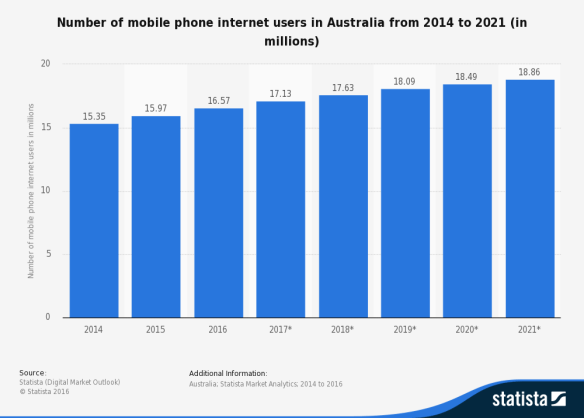
Mobile phone internet usage is projected to keep growing. Source: Statista

Mobile phone internet usage is projected to keep growing. Source: Statista

Based on consumer research, we would appear to be a well-connected country, with a high concentration of PC, smart phone and tablet devices, if data from Roy Morgan is any indicator. However, some recent research by Scott Ewing of Swinburne University based on ABS data has suggested that despite the narrowing of the divide, there is a deeper disconnect among those who do not have internet access.

There are multiple factors contributing to this disconnect: socio-economic, age, location and education. I would expect that within 5-10 years, age will be a far less relevant factor in who does or doesn’t have access to the internet. You could also argue that with more people accessing the internet via mobile devices, and with the increasing number of free WiFi zones across our cities (cafes, shopping centres, office buildings), public institutions (libraries, museums and galleries) and transport infrastructure (plus the reducing price of data and storage), cost may not be as much of an issue either. And once the NBN is complete, the percentage of the population without physical access to the internet should likewise be much smaller.

So that leaves education – according to the ABS-derived data, the more educated you are, the more likely you are to access the internet. Should this infer that we aren’t doing enough to teach digital skills in the classroom? Or are we teaching the wrong set of skills? Or is it a bit like learning English grammar or applied mathematics – unless you use them in your everyday life, you soon forget them, and never remember why it was important to learn them in first place?

Computer science, programming and coding courses are increasingly being taught in schools, either as part of the core syllabus or as extra-curricular activities. Many pupils have to use tablets as an integral part of their school lessons. And some schools are also running hackathons and entrepreneurial projects to help students navigate the new world of work shaped by innovation, digital disruption and the “gig” economy.

The changing nature of work is challenging schools and parents to think about how we should be preparing pupils for the future. It’s not just learning about the technology (important as it is to study data analytics, automation, robotics, AI etc.), it’s also about understanding the context and the potential for what it can do. It’s also increasingly apparent that more and more of today’s students want to do work that is meaningful, rewarding, challenging and which helps connect them to their values and “purpose”.

I like to think that as part of a well-rounded liberal education, today’s pupils will receive:

  • a solid grounding in digital literacy (as important and as vital as the 3 R’s)
  • an awareness of how “digital displacement” (through automation etc.) may impact their chosen career path (even in ways which we cannot yet predict – we must assume it will happen, as no profession, trade or vocation will be totally immune)
  • an appetite for lifelong learning (as one of the ways to cope with the inevitable changes they will face)
  • a set of life skills that instill self-awareness, curiosity, resilience, empathy, flexibility and adaptability.

Finally, if we are to truly grasp why this ability to adapt and change is important, we only need look beyond the digital debate and ask why the National Innovation and Science Agenda is failing to cut through. In large part, the NISA message failed to connect with the general electorate because many people could not identify with it, and therefore it did not resonate with them. Just as “necessity is the parent of invention”, so adversity often needs to be the catalyst for embracing change.

Notwithstanding the economic, environmental and societal challenges we face, there is considerable complacency and acceptance that “she’ll be right” – especially within the political, institutional and corporate elites that claim to lead us. As long as so few of the main actors among these bastions of power and influence decline to change their own culture, behaviours and ways of doing business, then it’s not surprising that the public feels unwilling or unable to change.

So our only real hope is to empower the next generations to shape their own future, not to be constrained by our traditional notions of “job” (in my view, an increasingly outmoded economic unit of value….) and think for themselves as to what change they want to create with all the technology, resources and opportunities at their disposal.

Next week: My Extended Gap Year

The arts for art’s sake…

Last week I wrote about the importance of learning coding skills. This prompted a response from one reader, advocating the teaching of STEM (science, technology, engineering and maths) in schools: “Coding and the STEM subjects are our gateway into the future.” I would agree. But, as other commentators have noted elsewhere, we also need to put the A (for art) into STEM to get STEAM to propel us forward….

Equivalent VIII (1966) Carl Andre (b.1935) Purchased 1972 http://www.tate.org.uk/art/work/T01534

Equivalent VIII (1966) Carl Andre (b.1935) Purchased by Tate Gallery in 1972 http://www.tate.org.uk/art/work/T01534

I recently attended a talk by renowned arts administrator Michael Lynch, as part of the FLAIR art event, where he expressed frustration at the state of the arts in Australia, the lack of a public arts policy, and the associated cuts to government funding. It can’t help that from John Howard onward, we have had a sequence of Prime Ministers who, while not total Philistines, have shown little enthusiasm, appetite or appreciation for the arts. And during Q&A, Mr Lynch referenced the conservative and “safe” nature of so much arts programming as evidenced by the lack of risk-taking and the stale and over-familiar choice of repertoire, although he did acknowledge some arts organisations were doing exciting work.

The debate then shifted to whether we need a new method to evaluate the benefits of a strong arts sector that is not purely dependent on economic terms or financial performance. It was not possible in the time available to come up with a suitable indicator, but I suggest we can derive a range of benefits from putting more emphasis on teaching, supporting and sponsoring the arts. This RoI might be measured in such terms as the following:

  • Enhancing creativity among students will benefit individual problem-solving skills and collective innovation;
  • A healthy arts scene is indicative of a balanced, self-assured and progressive society;
  • Participating in the arts can give people a sense of confidence and well-being;
  • Through art we can learn about culture, philosophy and history – especially of other societies;
  • Giving people the means to express themselves through art is an important outlet for their skills, talent and interests.

We agonize about the amount of investment in our Olympic athletes in pursuit of gold medals, and whether the money can be justified (goodness – Australia only just made the top 10!)  But no-one (yet) has suggested it’s not worth doing, even if we don’t win as many medals as is often predicted. And of course, together with the wider popular entertainment industry, professional sports attract more dollars, airtime and support through sponsorship, advertising, broadcasting rights, gambling revenue, club memberships and merchandise than the arts could ever hope to.

Part of the challenge lies in the popular notion that arts are either elitist, worthy, self-important, or simply frivolous – which makes it harder to build an economic case for the arts, but which can also lead to the worst kind of cultural cringe. Also, if the arts are really doing their job, they hold up a mirror to our society, and we may not like what we see. Populist politicians can’t afford to be associated or identified with such critiques – either as the targets or as de facto protagonists – so would they rather be seen shaking hands with gold medalists (or attending a Bruce Springsteen concert…) than maybe attending a cutting-edge performance by The Necks?

Next week: The latest installment of Startup Victoria pitch night

Moving #innovation from “permitted” to “possible”

As the dust settles on the Federal election results, the Turnbull government has already been taken to task for failing to get one of its key messages across to the public: how to take advantage of the economic, technological, scientific, social and cultural opportunities inherent in the “Innovation Agenda”.  It seems that the so-called “Ideas Boom” failed to resonate with much of the electorate because, apparently, no-one has explained to them how innovation actually impacts their lives.

Screen Shot 2016-07-18 at 8.39.24 PMUnfortunately, I think it goes deeper than that: the recent campaign debates were limited to concepts of “traditional” job-creation; reliance on conventional relationships between the State, the private sector and individual citizens; and the priorities of (pre)serving the interests of public institutions such as 3-year Parliaments and even political parties themselves. The electorate may (perhaps rightly) feel short-changed by the level of the debate, but voters also need to take some responsibility for not challenging candidates to raise their game: where were the mainstream discussions on climate change, new technology, the future of “work”, digital disruption, scientific advances, and the changing attitudes towards end of life?

There is also a core misconception, that the government is responsible for fostering  innovation, that only public policy (and public resources?) can set the innovation agenda. I don’t believe it is the role of government to “make it happen”, and certainly, such an approach is not going to occur overnight. At best, government can create a framework, highlight best practice, and encourage appropriate activity. Just as I don’t think you can “teach” creativity (only identify, support and nurture it), I don’t think innovation is something to be determined from the outside. As with creative inspiration, innovation has to come from within: from employees, from customers, from suppliers, etc.

The risk of relying solely on governments or other vested interests to shape innovation is that our thinking becomes constrained by what is “permitted”, rather than what is “possible”.

On a related theme, it was refreshing to listen to a panel of speakers at a seminar on “Innovation from the inside out” held during Melbourne Startup Week. The key messages were:

  • how to instill purpose in any organisational change, business transformation or innovation project;
  • how to empower all levels of an organisation to make ideas happen; and
  • how to incentivize intrapreneurship?

This naturally leads to a discussion of developing more adaptable and resilient career paths. If you don’t have transferable skills, or if you not prepared to update your knowledge, or if you think of your career path as a straight linear projection, it will be much harder to cope with the demands of a flexible work environment. If you think of yourself as only ever performing a specific job function, or identify only as your profession or job title, or define yourself only by your formal qualifications, you will only ever think about what roles you may be “permitted” to perform, rather than seeing what career opportunities may be possible. As a careers adviser in the Victorian Government’s Skills and Job Centre network told his audience at a recent Small Business workshop: it’s not the responsibility of the government or your employer to manage your career. Notwithstanding upskilling initiatives and structured outplacement programs, we are each responsible for shaping our own destiny – especially in the increasingly on-demand economy.

Back to the main topic, I’ve been participating in a series of workshops on the Future of Work, Money, Ageing, Death, Democracy etc. hosted by the Re-Imagineers, an on-line ideas playground that builds co-created artifacts to support people-led innovation. The model is designed to help organisations draw on insights from their in-house knowledge and skills, customer experience and feedback, and external expertise to originate new ideas and innovative solutions from within their own resources, and which align with their values and those of their stakeholders. It’s still early days, but all of the discussions have identified some amazing ideas and possibilities.

The team from Re-Imagineers will be visiting Australia during July and August, so if you or your organisation would like to hear about the key learnings from these forums, especially as they impact sectors such as finance, health care and IT, please contact me via this blog, and I will make the relevant introductions.

Next week: Update on the New #Conglomerates


Field report from Melbourne #Startup Week

The third Melbourne #Startup Week has confirmed Startup Victoria‘s pivotal role in supporting local entrepreneurs, founders, startups and anyone interested in innovation and disruption. Over the next few posts, I will be commenting on some of the events I attended. Meanwhile, here is a brief summary of the key themes that emerged.

Screen Shot 2016-06-26 at 1.43.16 PMFirst, there is a continued shift from B2C and 2-sided markets, to B2B and enterprise solutions among the startup pitches I saw. Medtech is also getting some renewed attention, as are XaaS business models. And of course, there has to be scale in the idea.

Second, nearly all of the feedback from the judges at the pitch events centred on “why you?” –  What makes your idea different to the competition? What is the problem statement? Where are the solution proof points?

Third, there was an interesting session on “innovation from within” and the rise of intrapreneurship. There were also discussions on whether (and how) aspiring founders should leave an existing job to embark on a startup project, and how to navigate an entrepreneurial career. (More on this to follow.)

Fourth, the notion of “disruption for disruption’s sake” is being challenged – it’s not enough to be disruptive, there has to be substance (and purpose) to back it up.

Fifth, the use of design thinking, human-centred design and CX mapping in fostering creativity is breaking through to large corporations, but it is just one of many available innovation techniques – without context and framing, it can simply become a process.

Finally, I heard very little (in fact, absolutely nothing) about the role of government(s) in fostering innovation and entrepreneurship, and in supporting startup founders – notwithstanding LaunchVic, and the National Innovation & Science Agenda. Maybe there is so much election campaign fatigue that the startup community has already discounted the impact politicians (of any persuasion) can have on their business aspirations. Certainly, the numbers of Gen X and Gen Y attending some of last week’s events is testament to how engaged younger citizens are in finding purpose through the type of work they do (and what sort of organisations they work for), that they are less focussed on securing a “job”, and more concerned about building a career.

Next week: Level 3’s Enterprise Pitch night