Will Social Media Eat Itself?

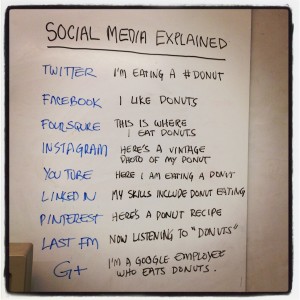
The Internet has shortened the use-by date of most content. Even our attention spans are getting shorter, in inverse proportion to the amount of content we consume and length of time we spend engaging in Social Media and other platforms. Paradoxically, some stuff grabs our attention, and goes viral as everyone posts, shares, likes, blogs and Tweets the same content. Which brings me to this infamous “infographic” on donuts as a signifier for Social Media:

Donuts_SocialMedia_ThreeShipsMedia

Content by Three Ships Media – Photo by Doug Ray

Recently, I saw this image appear as a status update and a “like” by the person posting it. There was no obvious acknowledgement, giving the impression it was an original piece of work. But I recalled having seen it before (more of which later), so I was intrigued as to the true source and provenance. On closer inspection, there was a reference to a third-party website, but this was a dead-end leading to an anonymous blog post.

After a brief search, I located what I believe is the original source for the infographic, Three Ships Media, as well as the photographer who captured the image, Doug Ray. Not that difficult to uncover, given that the post has been “liked” and Tweeted about well over 100,000 times, and written up in Three Ship Media’s own blog (about how this innocuous image had gone viral….).

Now, I don’t believe that the person who posted this image was trying to claim the content as their own work. And I doubt they were deliberately seeking to violate anyone’s intellectual property rights. Yet, the failure to acknowledge our sources (regardless of whether we are exploiting them for personal commercial gain or simply invoking the fair use provisions) threatens to undermine our credibility as commentators, critics and thought leaders. If we keep recycling other people’s work without attribution, the risk is that social media will simply implode as it chases itself in ever-diminishing circles.

Ironically, I realised that I had first seen this infographic at a seminar on the legal and practical aspects of Social Media. It was used by a lawyer to introduce his presentation on copyright issues and the Internet. All very well, except that he insinuated that he had come up with the infographic, and he certainly didn’t cite the original source….

Footnote: The title of this blog was inspired by the writer, David Quantick who coined the phrase “pop will eat itself” in the mid-1980’s, to describe the way modern music is self-referencing itself into oblivion.

Why it’s important to make time for play

Do we spend enough time playing? As adults, have we forgotten how to play? Have we in fact been conditioned to stop playing once we “grow up”?

Bigshot Front View

Most of us would probably recognise that a lack of play during our childhood can have serious consequences for our psychological development. Dr. Stuart Brown of the National Institute for Play makes the case that a lack of adult play has a negative impact both on our energy levels and on our mental well-being. Again, most people would appreciate that taking time out from our daily tasks and routine can lift our spirits and put us in a better frame of mind – it can also help us with problem-solving and creative thinking – but few of us make a conscious effort to schedule some dedicated and regular play activity into our day. (And I don’t mean simply spending an hour or two playing computer games.)

How we play is just as important as what we play with, and the type of play activity that engages us – in short, we are what we play. So the absence of any play may suggest something is missing in our lives.

When I was a child, some of my favourite toys enabled me to design and build things, to construct working models with clockwork and electric motors, to assemble, disassemble and re-assemble simple electronic circuits for radios, light-operated switches and walkie-talkies. I even built a rudimentary synthesizer using parts stripped from an old TV set, and a keyboard made from an ice cream tin. OK, so I wasn’t going to get a gig with Kraftwerk, but I did learn about capacitors, resistors, transistors, diodes, rheostats, transformers and relays, even if I couldn’t get a recognizable tune out of the instrument itself.

This avid curiosity about how things work once caused me to take apart a clockwork motor, which I was then unable to get to work again. My father, an engineer, simply said, “Never take something apart unless you know how to put it back together”, sage advice which is helpful even today in my role as a strategist, executive coach and business consultant.

I would suggest that there is a link between abandoning play in adulthood and a growing lack of curiosity about how things actually work once we get older, coupled with our increasing passivity towards new technology. For example, how many of us would know (or care) how to repair simple mechanical or electrical appliances in our homes?

While there has been an understandable effort aimed at encouraging children to learn how to write code, this emphasis on software comes at the expense of learning how machines work, how hardware is designed, how electronic and mechanical components combine together. This software bias has prompted a team of educationalists to launch the Bigshot digital camera kit designed to help children learn through play by making a real digital camera, and to understand the relationship between software and hardware. Others are teaching summer schools that combine software programming with engineering and robotics – but the broader goal is to develop problem-solving, logic, comprehension and reasoning skills.

Our pursuit of creative or constructive play in adulthood is not helped by the obsession designers and manufacturers have with producing “sealed units” – hardware that comes with “no user serviceable parts inside”*.  Even if we succeeded in taking the back off a gadget and having a look inside, it would probably invalidate the warranty and extinguish our consumer protection rights.

If we don’t understand how the things we use are designed to work, how can we tell if something is wrong, how can we learn to improve them, how can we find new ways of using them?

Smart companies and organizations understand the importance of learning through play and actively encourage their people to spend time “playing” – either through the pursuit of pet projects, or through creative, collaborative and social activities designed to instil innovation and fresh thinking.

As such, I’m very interested to hear from organizations that incorporate “play” into their regular activities, to understand why and how they do it, and to learn about the outcomes and benefits it delivers. I can be contacted via this blog, LinkedIn or Twitter.

*Note: Software is often just as bad with so-called “default” settings that get in the way of our ability to play around with and explore the programs we use.

6 Melbourne Graduates of Boot Camp for Start-Ups

Another Monday night in Melbourne’s silicon laneway, another Monday night meeting of Lean Start-Up Melbourne. This month’s event, generously supported by inspire9, Kussowski Brothers, BlueChilli and Alphastation, featured 6 start-ups who have recently completed the AngelCube accelerator programme.

Screen Shot 2013-08-18 at 11.51.49 AM

In no particular order, here are Angelcube’s Class of 2013:

A couple of the presenting founders, Tablo and Coinjar, have both been mentioned previously in this blog. I’m still very impressed with the simplicity of Tablo, a self-publishing platform for ebooks, and if they can figure out a B2B or aggregation model, I think they will have a great future.

As for Coinjar, the idea is right (a trading and merchant platform for Bitcoins) but there are still too many regulatory uncertainties and other risks associated with virtual currencies. And as the good people of Hong Kong know only too well, even established voucher schemes such as cake coupons backed by real money and physical goods can have a detrimental effect on local markets…

OutTrippin is a cross between 99Designs, TripAdvisor and Airbnb – selling curated travel itineraries and booking facilities for FITs (free and independent travellers). My sense is that while there is an opportunity in this space, the trick will be to successfully match trip planners and holidaymakers. Given the initial focus on the niche honeymoon market, it will be interesting to see how much traction OutTrippin can generate in the next 12-18 months (given the long-term planning logistics of most wedding events….).

etaskr is an insourcing solution for larger companies – combining elements of Elance, Freelancer, oDesk, Yammer and LinkedIn. It aims to match employee skills (not job function or department) with specific tasks, to enable organisations to better utilise available resources to meet fluctuating workflow volumes. Based on audience questions raised on the night, etaskr may need to look at back-end solutions that facilitate intra-company cost allocation and revenue recognition – good luck with that one!

I will be the first to admit that I can’t really get my head around c8apps – a mobile gaming platform for fantasy sports. I’m probably the wrong demographic for this type of offering, so I can’t really express a view – but the fact that c8apps claim to have some significant media deals in the pipeline and are engaging with several major sporting codes probably means they are doing something right; unfortunately, I just don’t get it myself.

Finally, OziRig is bringing custom-designed professional rigging equipment to the global  film and photography industry. Essentially a component sourcing and assembly model, OziRig aims to undercut the competition on price and service – but several members of the Lean Start-Up audience wondered about the risks of copyright and design infringement.

These 6 graduates of the boot camp for start-ups are now embarking on a round of investor pitches in the USA. I wish them well and every success.

Footnote: Thanks to the sponsors for some much appreciated beer and pizza on the night. And for a couple of alternative perspectives on the evening’s events, please check out my fellow bloggers: Chris Chinchilla and Innerloop.

Whose content is it anyway?

Faust 2.0

Every social media and digital publishing platform is engaged in a continuous battle to acquire content, in order to attract audiences and bolster advertising revenues.

Content ownership is becoming increasingly contentious, and I wonder if we truly appreciate the near-Faustian pact we have entered into as we willingly contribute original material and our personal data in return for continued “free” access to Facebook, YouTube, Google, Flickr, LinkedIn, Pinterest, Twitter, MySpace, etc.

Even if we knowingly surrender legal rights over our own content because this is the acceptable price to pay for using social media, are we actually getting a fair deal in return? The fact is that more users and more content means more advertisers – but are we being adequately compensated for the privilege of posting our stuff on-line? Even if we are prepared to go along with the deal, are our rights being adequately protected and respected?

In late 2012, Instagram faced intense public backlash against suggestions it would embark upon the commercial exploitation of users’ photographs. While appearing to backtrack, and conceding that users retain copyright in their photographs, there is nothing to say that Instagram and others won’t seek to amend their end-user license agreements in future to claim certain rights over contributed content. For example, while users might retain copyright in their individual content, social media platforms may assert other intellectual property rights over derived content (e.g., compiling directories of aggregated data, licensing the metadata associated with user content, or controlling the embedded design features associated with the way content is rendered and arranged).

Even if a social media site is “free” to use (and as we all know, we “pay” for it by allowing ourselves to be used as advertising and marketing bait), I would still expect to retain full ownership, control and use of my own content – otherwise, in some ways it’s rather like a typesetter or printer trying to claim ownership of an author’s work….

The Instagram issue has resurfaced in recent months, with the UK’s Enterprise and Regulatory Reform Act. The Act amends UK copyright law in a number of ways, most contentiously around the treatment of “orphan” works (i.e., copyright content – photos, recordings, text – where the original author or owner cannot be identified). The stated intent of the Act is to bring orphan works into a formal copyright administration system, and similar reforms are under consideration in Australia.

Under the new UK legislation, a licensing and collection regime will be established to enable the commercial exploitation of orphan works, provided that the publisher has made a “diligent” effort to locate the copyright holder, and agrees to pay an appropriate license fee once permission to publish has been granted by the scheme’s administrator.

Such has been the outcry (especially among photographers), that the legislation has been referred to as “the Instagram Act”, and the UK government’s own Intellectual Property Office was moved to issue a clarification factsheet to mollify public concerns. However, those concerns continue to surface: in particular, the definition of “diligent” in this context; and the practice of some social media platforms to remove metadata from photos, making it harder to identify the owner or the original source.

Meanwhile, the long-running Google book scanning copyright lawsuit has taken another unexpected twist in the US courts. From the outset, Google tried to suggest it was providing some sort of public service in making long-out-of-print books available in the digital age. Others claim that it was part of a strategy to challenge Amazon.

Despite an earlier unfavourable ruling, a recent appeal has helped Google’s case in two ways: first, the previous decision to establish a class action comprising disgruntled authors and publishers has been set aside (on what looks like a technicality); second, the courts must now consider whether Google can claim its scanning activities (involving an estimated 20 million titles) constitute “fair use”, one of the few defences to allegations of breach of copyright.

Personally, I don’t think the “fair use” provisions were designed to cater for mass commercialization on the scale of Google, despite the latter saying it will restrict the amount of free content from each book that will be displayed in search results – ultimately, Google wants to generate a new revenue stream from 3rd party content that it neither owns nor originated, so let’s call it for what it is and if authors and publishers wish to grant Google permission to digitize their content, let them negotiate equitable licensing terms and royalties.

Finally, the upcoming release of Apple’s iOS7 has created consternation of its own. Certain developers with access to the beta version are concerned that Apple will force mobile device users to install app upgrades automatically. If this is true, then basically Apple is telling its customers they now have even less control over the devices and content that they pay for.