AI vs IP

Can Artificial Intelligence software claim copyright in any work that was created using their algorithms?

The short answer is “no”, since only humans can establish copyright in original creative works. Copyright can be assigned to a company or trust, or it can be created under various forms of creative commons, but there still needs to be a human author behind the copyright material. While copyright may lapse over time, it then becomes part of the public domain.

However, the extent to which a human author can claim copyright in a work that has been created with the help of AI is now being challenged. A recent case in the USA has determined that the author of a graphic novel, which included images created using Midjouney, cannot claim copyright in those images. While it was accepted that the author devised the text and other prompts that the software used as the generative inputs, the output images themselves could not be the subject of copyright protection – meaning they are either in the public domain, or they fall under some category of creative commons? This case also indicates that, in the USA at least, failing to declare the use of AI tools in a work when applying for copyright registration may result in a rejected application.

Does this decision mean that the people who write AI programmes could claim copyright in works created using their software? Probably not – as this would imply that Microsoft could establish copyright in every novel written using Word, especially its grammar and spelling tools.

On the other hand, programmers and software developers who use copyright material to train their models may need to obtain relevant permission from the copyright holders (as would anyone using the AI tools and who uses copyright content as prompts), unless they could claim exemptions under “fair dealing” or “fair use” provisions.

We’re still early in the lengthy process whereby copyright and other intellectual property laws are tested and re-calibrated in the wake of AI. Maybe the outcomes of future copyright cases will depend on whether you are Ed Sheeran or Robin Thicke….

Next week: Customer Experience vs Process Design
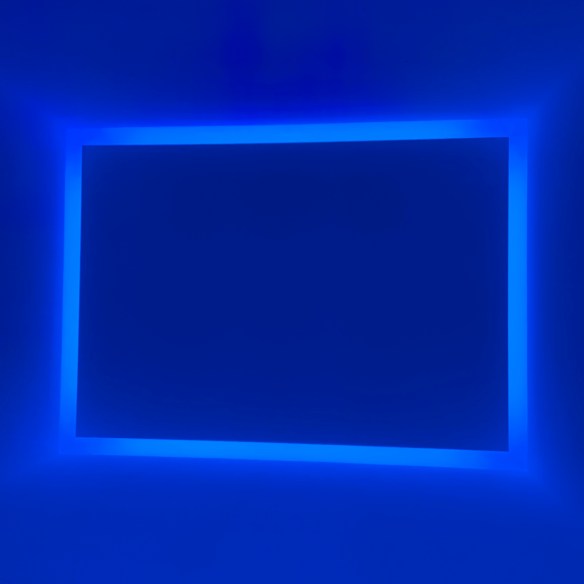
 

Let There Be Light

Q: What do a selection of 19th century oil paintings, a 50-year old piece of 16mm film, and a 21st century carpet have in common?

A: They are all exhibits in ACMI’s winter show, “Light”, based on works from the Tate’s Collection.

Image: James Turrell, “Raemar, Blue” (1969) on display at ACMI (Photo by Rory Manchee)

Despite ACMI’s brief to showcase the moving image, only three of the art works in the exhibition consist of film. A few more incorporate movement in the form of kinetic sculptures. But otherwise, this is mostly a collection of paintings and photography (and yes, a carpet).

Does it work? Yes, because just as light can be regarded as an essential building material, the use, portrayal and capture of light is essential to render colour, shadow, depth, perspective and narrative in all forms of art.

Arranged thematically, by theory or technique of how light is represented and rendered in art, the exhibition is both diverse and cohesive. It avoids the risk of overload because the selection is quite compact (given the wide remit of the topic). It also avoids choosing works based on technical prowess alone. Therefore, the exhibition succeeds through the combined principles of quality over quantity, and content over form.

It was timely to see mention of The Enlightenment as a key source of artistic exploration, as well as being a driver in the fields of of scientific discovery and liberalism. The exchange of ideas between and across different disciplines has always been essential to progress in the sciences, the arts and the humanities.

My favourite exhibits among the works I hadn’t seen before were by Olafur Eliason, Lis Rhodes and Peter Sedgley. And it’s always a pleasure to immerse yourself in one of James Turrell‘s installations. The only slight disappointment was that visitors are kept at quite a distance from Yayoi Kusama‘s The Passing Winter, an intriguing cube-shaped sculpture that is like one of her infinity rooms in miniature. The last time I saw it in London, it was possible to peer right in to get the full effect.

All in all, highly recommended.

Next week: Hands on the wheel

When is a print not a print?

Alongside drawing, painting and sculpture, print-making is one of the oldest forms of visual art. Although it wasn’t generally recognised as a fine art discipline in the west until the European Renaissance (with the work of Dürer, among others), the practice can be traced back to Paleolithic times when humans first made hand-prints on cave walls. It evolved largely through developments in paper-making and image creation, such as Japanese wood-block printing 1200 years ago, or metal plate engravings in the Middle Ages, and has developed alongside related technologies in lithography, etching, off-set press printing, photography, lino-cut and silk-screen printing, to name a few key methods.

Print-making in this “classical” sense uses a combination of mechanical, manual and chemical processes to transfer an image (created from one or more media) from one surface to another, using ink or paint to “carry” the image between the plate and paper or other printed surface.

While the printing industry has been using the same techniques for centuries (in the service of book publishing, newspapers, advertising, packaging, textiles, etc.) there are key differences between the commercial and the artistic.

First, traditional print-making still retains a high-degree of manual process, and the work is usually produced in limited numbers (sometimes in single editions), and even where multiple copies are generated, variations and differences will appear thanks to inherent “imperfections” of the process.

Second, despite the importance of technical process in print-making, the practice should not be seen as a mere mechanical exercise in reproducing an image – the resulting image is still far more important than the actual technique (i.e., content over form should be the order of the day).

Third, the role of “mark-making” in print-making is as significant as the brush strokes in an oil painting, and are part of the artist’s signature. Equally, choice of materials is also important, just as an artist working in oils will make specific decisions about their brushes, pigments, medium and canvass.

In terms of art curation, print-making can get lumped in with other “works on paper”, which may extend to collage, photography, photo-montage, graphic design and illustration. Photography itself can be used in the course of print-making (e.g., rayographs), but a photographic print of a film-based negative is not the same as print-making in this context.

Likewise, the use of digital processes to capture, create, manipulate, transfer and reproduce an image on paper (or other medium) is further blurring the boundaries as to what constitutes a “print” as opposed to a “technique”.

This delineation between traditional print-making and image creation processes was further highlighted by the recent Experimental Print Prize organised by Castlemaine Art Museum in Victoria’s gold field region. While there were examples of etching, lino-cut, lithography, photographic and other techniques on display, the prize is intended to push the boundaries into more conceptual notions of “what is a print?”.

Examples included the use of light-sensitive paper to create long-delay images, a neon-light to generate an after-image on the viewer’s retinas, and a muon particle detector to track and plot their “image” onto a computer monitor. Although these are all interesting approaches, they perhaps over-step the boundary of permanence, which is usually a feature of print-making, to the extent that the fixed paper and ink endure long after the artist has made his or her mark. Nevertheless, the museum is to be applauded for bringing a new dimension to an ancient art-form.

Next week: Literary legacies


RONE in Geelong

Public art galleries need to attract paying customers if their funding derived from government grants is being cut. To pull in the punters, galleries have to resort to “blockbuster” exhibitions. In these uncertain, post lock-down times, the lack of international tourists means that galleries are forced to focus on local audiences. It’s good to showcase local talent in the shape of conquering heroes returning to their roots.

These may have been some of the arguments behind the Geelong Art Gallery‘s decision to mount a retrospective exhibition featuring the work of street artist Tryone Power (aka RONE). Of course, the planning began long before COVID struck, but otherwise the above assumptions would seem to be valid.

Let’s acknowledge the positives of this show: First, it is certainly pulling in the punters, and helping to bring in visitors and their wallets to the town. Second, it is hopefully creating a platform for future exhibitions, and public engagement with the Gallery itself. Third, it’s nice that a locally-born artist is being recognised (even if he has had to travel afar to make a name for himself at home).

Unfortunately, that’s where it ends, for me. My recent visit was probably the shortest time I have spent in an exhibition which I had paid to see. Overall, I found the work vapid – there was nothing of substance (nor anything challenging) underneath the painted surface, or behind the concept of “beauty and decay”. As a street artist, RONE does not have the wit or depth of a Banksy; as a conceptual/installation artist, he’s no Christo. The main images he creates or imposes on his work are highly stylised and extremely idealised portraits of young women – it’s a very limited exploration of “beauty”. At best, the work reveal something interesting about abandoned and overlooked locations. At worst, the installation reeked of interior decor magazines and displayed a taste for romanticised and sentimental kitsch.

Which is all a great shame, because given RONE’s apparent interest in deserted and decaying structures, there is a deep and rich vein of Australian Gothic he could have tapped into. (In comparison, think of the work of Nick Cave, Peter Weir, Peter Carey, Julia deVille, Rosalie Ham, etc.)

Despite the use of physical objects, this exhibition felt very one-dimensional. Artists as disparate as Helen Chadwick, Paola Rego, Cindy Sherman and Rachel Whiteread have all deployed notions of female beauty, decay, abandonment and destruction to far greater effect and impact.

Next week: Intersekt FinTech Pitch Night