From EPICS to BISG: Trying to save the Australian publishing industry

At the dawn of the century, the Australian government funded a series of research projects on the future of the local book publishing industry, under the Enhanced Printing Industry Competitiveness Scheme (EPICS). Part of that research effort included the Ad Rem Report on “The Australian Book Industry: Challenges and Opportunities”, published in September 2001.

Scenario Planning

Via consultation with publishers, printers, distributors and book sellers, Ad Rem examined a range of possible scenarios the industry would face leading up to 2010.

Using rather quaint titles for each scenario, from utopian to apocalyptic, the report made a strong case for:

  • increased collaboration and consolidation across printing and supply chain logistics;
  • adoption of new technology (including “print on demand”); and
  • increased focus on adding value through improved customer service.

So, under “Paradise Found”, a loose federation of specialist companies would focus on either printing, publishing or distribution services predicated on increased consumer demand for books and content available from multiple outlets, underpinned by happy customers served by a responsive and proactive publishing industry.

More stoically, selfless cooperation and collaboration in the form of “Shoulder to Shoulder” would ensure that despite reduced demand, the industry could become a “national model of supply chain efficiency” by sharing distribution networks and market data, and adopting industry-wide standards.

Conversely, limited cooperation and the lack of a single, dominant business model would result in a “Dog Eat Dog” scenario, with few local winners. Overall consumer demand would diminish, industry participants would seek to operate all along the supply chain (introducing some market inefficiencies), and the industry would end up competing on price alone, and fighting tooth and nail for the next major “blockbuster” title.

Alternatively, if the “Land of the Giants” was to prevail, “highly diversified global companies from outside traditional media industries would come to dominate the Australian book industry.” Demand would be driven and met by technological changes, carried forward by bundled products and services, end-to-end integrated businesses, and “predominantly proprietary industry standards”.

The reality is, we have “Land of the Giants” (as far as global businesses are concerned), while the local players are fighting it out in a “Dog Eat Dog” world.

Technology

“Print on demand” was going to be the answer, because it would minimise the supply chain logistics, improve sales margins for retailers, and enshrine the protectionism afforded local publishers and distributors under the 30-day rule written into the Copyright Act. In addition, increased training and upskilling would help the industry meet the challenges of digital content and the new means of production and distribution. (The publishing industry has traditionally invested very little into structured training – see Jo Bramble writing in “Developing Knowledge Workers In The Printing And Publishing Industries”, Cope & Freeman (Eds.), University Press/Common Ground Publishing (2002))

However, while ebooks were already on the market in 2001 (mainly read on PDAs), and although online content was already widespread, probably nothing could have prepared the industry for what has happened in the past 10 years such as:

  • the growth of ebook readers such as Kindle, Nook and Kobo,
  • the impact of Apple’s iOS/iTunes/iBook/iPad ecosystem,
  • self-publishing solutions from Amazon to Tablo, or
  • controversial online “library” projects like Google Books.

Print-on-demand never came about, partly because the dot.com boom/bust of 2001-2002 put the dampener on many digital initiatives (remember the original push for “e-Government” in Australia?), partly because internet speeds were not up to scratch, but mainly because there was little or no appetite for industry collaboration and common standards.

Retailing

Infamously, Borders came along to shake up the local market, but ended up laying waste to much of Australia’s book selling industry as it imploded under the weight of expectation (and crippling debt). While a couple of national chains remain, many independent and specialist bookshops have managed to survive – some may even be thriving – as they find ways to develop deeper engagement with their customers, and offer a range of value-added services.

However, sales of books in Australia have maintained a steady (if unspectacular) growth rate); online purchases now account for around 12% of all book sales, of which more than half are generated by overseas websites; meanwhile, ebooks have gone from 1.5% of the local market in 2010 to 10%-12% of all book sales in 2013 (of which 90% are made by offshore retailers).

Geo-blocking

Regular readers of this blog will know I have a thing about geo-blocking* – so, while I am an advocate for intellectual property protections such as copyright, I am against territorial restrictions that prevent/impede customers buying content from wherever/whomever they choose just because content owners and/or their distributors have decided to carve up the market to suit themselves. (Piracy is piracy, but parallel importation is about giving customers choice.)

Amazon finally launched its dedicated store in Australia in late 2013, but only for ebooks, and with an initial focus on Australian authors and publishers. So, for print books, local customers still need to go to the US and UK sites. For whatever reason, Amazon feels it necessary to have a local online presence (to counter protectionism? to avoid arguments over collecting local GST on overseas online purchases? to annoy local retailers who have been selling Kindles?)

What came next? Much the same really…

I can’t help thinking that the combination of an apparent lack of cooperation around standards, reluctance to collaborate on supply chain logistics and an inability to read the technology trends have all contributed to a 2-speed publishing industry in Australia: a series of small, specialist and independent print publishers and bookshops trying to compete with the global digital behemoths of Apple, Amazon and Google.

Despite the considerable effort behind the Ad Rem Report, it’s fair to say that nothing of substance materialised.

Fast forward 10 years, and along came the Book Industry Strategy Group (BISG) which reported in September 2011. Among its 21 recommendations were:

  • consolidation/streamlining within and across the supply chain – to create greater efficiencies
  • adjustments to GST – i.e., abolish/reduce the rate on Australian books, or collect GST on sales under $1,000 by overseas websites
  • increased protection(ism)  – via direct and indirect support for the local industry
  • review copyright legislation – in relation to digital content creation and distribution

Fairly predictable stuff, but not much about technology or related innovation…

NOTES:

The original Ad Rem website was decommissioned some time ago. I do have PDF copies of the various reports and working group papers if anyone if interested – although they are the copyright of Accenture, I’m sure they wouldn’t mind if I distributed a few copies in the interest of research and commentary. Meanwhile, a couple of papers are still online:

Click to access Ad_Rem_Scenario_Planning.pdf

Click to access Ad_-Rem_Value_Chain_Analysis.pdf

*GEO-BLOCKING REFERENCES:
Geo-blocking: the last digital frontier?

Australian MPs recommend a ban on geo-blocking

Radio comes of age in the social media era

About a year ago, I posted a blog on “Steam Internet” which included some ideas about the importance of radio as a communications platform – even in the age of social media.

Among the individual responses I received, a former colleague recalled how he grew up with radio, and how it was a significant presence in his life as a source of news and entertainment – it kept him company while revising for exams, and allowed him to “share” songs with this friends (via personalised mixtapes). He commented that a pharmaceutical company in Indonesia uses radio as a mainstream outreach channel – because it is relatively cheap, it offers targeted demographics, and it provides access to a large-scale, mass market.

He went on: “Radio is probably still the most effective medium to reach out to large audiences – it is targeted, it is always ON, it is always entertaining, it has loyal followers, and it does not require the listener to have an expensive receiver. More importantly, radio traditionally reached a far larger percentage of the population than what the Internet does today, especially in large developing markets.”

Consumer interest in and demand for audio content is recognised by today’s media industry – hence the growth of podcasting, audio platforms like SoundCloud, streaming services such as Spotify and Pandora, and radio apps like TuneIn – not to mention the growth in Internet radio, digital stations and web-streaming broadcasts.

I tend to agree that radio, after more than 100 years, still offers “new” opportunities for reaching an audience, even Gen Y – but as with any content strategy, it pays to get the model right by:

1. Having great content (plus engaging presenters and skilled producers)
2. Enabling access (broadcasting via any platform, anywhere, any time)
3. Cultivating a strong programming culture (i.e., scheduling and curating a logical flow of information, and across multiple platforms)
4. Encouraging audience participation – radio thrives on giving people a voice, either through phone-in sections, community-made programming, or connecting via “traditional” media such as SMS and Twitter

Radio is also very local (despite global access/reach via apps like SoundCloud Radio) and is usually subject to broadcast regulation. I’ve been involved with a community radio station over the past 3 years, and it has made me aware that audience diversity can be a challenge for broadcasters (how to cater for smaller, minority audiences?), but at the same time many people feel unconnected to mainstream media, such that radio is actually their preferred platform to engage with the world.

Acknowledgment My thanks to Rudy J. Rahardjo for his input to this article.

Will Social Media Eat Itself?

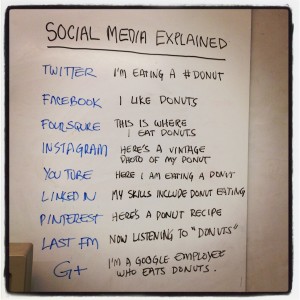
The Internet has shortened the use-by date of most content. Even our attention spans are getting shorter, in inverse proportion to the amount of content we consume and length of time we spend engaging in Social Media and other platforms. Paradoxically, some stuff grabs our attention, and goes viral as everyone posts, shares, likes, blogs and Tweets the same content. Which brings me to this infamous “infographic” on donuts as a signifier for Social Media:

Donuts_SocialMedia_ThreeShipsMedia

Content by Three Ships Media – Photo by Doug Ray

Recently, I saw this image appear as a status update and a “like” by the person posting it. There was no obvious acknowledgement, giving the impression it was an original piece of work. But I recalled having seen it before (more of which later), so I was intrigued as to the true source and provenance. On closer inspection, there was a reference to a third-party website, but this was a dead-end leading to an anonymous blog post.

After a brief search, I located what I believe is the original source for the infographic, Three Ships Media, as well as the photographer who captured the image, Doug Ray. Not that difficult to uncover, given that the post has been “liked” and Tweeted about well over 100,000 times, and written up in Three Ship Media’s own blog (about how this innocuous image had gone viral….).

Now, I don’t believe that the person who posted this image was trying to claim the content as their own work. And I doubt they were deliberately seeking to violate anyone’s intellectual property rights. Yet, the failure to acknowledge our sources (regardless of whether we are exploiting them for personal commercial gain or simply invoking the fair use provisions) threatens to undermine our credibility as commentators, critics and thought leaders. If we keep recycling other people’s work without attribution, the risk is that social media will simply implode as it chases itself in ever-diminishing circles.

Ironically, I realised that I had first seen this infographic at a seminar on the legal and practical aspects of Social Media. It was used by a lawyer to introduce his presentation on copyright issues and the Internet. All very well, except that he insinuated that he had come up with the infographic, and he certainly didn’t cite the original source….

Footnote: The title of this blog was inspired by the writer, David Quantick who coined the phrase “pop will eat itself” in the mid-1980’s, to describe the way modern music is self-referencing itself into oblivion.

Building a Personal Brand via Social Media – or the AAA Guide to Blogging

I’ve been working with content since I was a teenager – from writing articles for school magazines, to contributing gig reviews to a leading Manchester music magazine; from working for global media and information brands, to freelance editorial and writing projects.

Even now, as a business coach and consultant, I continue to focus on my clients’ content strategies – whether developing new products and services, managing IP, or capturing and commercialising in-house knowledge.

I have to admit to being an early sceptic about Social Media – but I soon recognised its importance, especially when building a personal brand on-line. Now it’s just another communication channel. I sometimes reflect on our ancestors who resisted the telephone, radio and television, and wonder if my own suspicions about Social Media will seem unfounded in retrospect.

About a year ago, I started this blog as a personal brand for my consulting work, as well as giving me a license to write about “Exploring the Information Age”, however tangential it might be to my professional work.*

After 12 months, I think I have found the essence to building a personal brand through social media – otherwise known as the AAA Guide to Blogging. Those elements are: Authenticity, Awareness and Attribution.

Authenticity

In an on-line environment where people hide behind avatars and aliases, you need to find the appropriate level of authenticity if you are going to be taken seriously by or establish trust with your audience. Being authentic means finding your “voice” to express yourself in any given situation, and to be true to yourself in that particular context.

I will admit to having several on-line profiles. For example, when connecting with my family and close friends, I am very circumspect about which Social Media platforms I use, and how I use them. My profile is extremely locked down and tightly controlled – you won’t be able to find me because I won’t let you in.

For my activities as a musician, I have another profile for self-promotion, sales and distribution, community engagement and beta testing new apps. You probably won’t find me because I use an alias, unless I am inviting you in.

Finally, in my professional life, I am very pro-active, interacting via an increasingly interconnected multi-channel strategy.

Does having multiple profiles mean I am being inauthentic? I would say no, because I am being authentic to who I am in those particular situations, and I don’t believe it is unreasonable to keep my private life, my personal interests, and my professional profile separate from one another. That’s why, even though I have a public profile on Facebook as part of my professional brand, I won’t be sharing my musical tastes because it’s not relevant (unless I might be going to a karaoke sessions with my clients?).

Awareness

Just as you need to be aware of the possibilities and limitations of different Social Media tools, you also need to understand your “character” when blogging, sharing and providing status updates. I see this as a natural extension to being authentic – in my professional life, should I really be sharing selfies (especially not at the client karaoke night…)?

There are 4 main categories of Social Media protagonists and bloggers:

1) Enthusiasts – personal stuff, “what I ate for breakfast”, no real purpose
beyond “sharing” or “look at me

2) Broad Experts – know their Yammers from their Spammers, their Blogrolls from their Facebook Trolls – understand how and where they need to engage, they know what works for them (they have found their own level)

3) Niche Specialists – the Twitterati (Stephen Fry), the star fashion bloggers, the political and media pundits, viral cat videos, and the quirky (@God) – NOT Katy Perry – she probably has people to do that for her, namely….

4) Professionals – so-called “prosumers” who use Social Media as part of their job or about their work, or it’s part of their public and personal profile, and the boundaries are increasingly blurred.

Attribution

As far as possible, I always attribute third party content or references I use in my blogs, even if they are deemed to be in the public domain, and I endeavour to acknowledge the original sources as far as possible.

Not only can this create reciprocal links and traffic to my blog, I just believe it is more ethical, rather than “sharing” content with no attribution. It’s not just about copyright law, or respecting IP, I happen to think it is more intellectually honest to acknowledge original ideas, rather than imply they are our own.

I came across a good example recently on LinkedIn, where a connection “shared” an infographic on social media, without providing the original source. In fact, it almost looked as if it was an original post. However, I was sure I had seen the same content elsewhere, and after a short Internet search, I was able to locate the original post and the author very easily. Maybe it’s laziness, or lack of consideration, but this common failure to attribute sources risks undermining your work and devaluing your creativity.

Final thoughts on blogging and Social Media

• No-one gets it right 100% of the time – and even when we do, we don’t always know why
• Conversely, everyone gets it a little bit wrong, so the real learning is in that collective experience
• Prospective employers, clients, customers all expect to find evidence of your Social Media and online presence – even if you are only engaged in Social Media in a professional/work capacity, you still need to develop a personal profile

*See previous blog 10 Rules for Effective Blogging. I recently did some analysis of my blog traffic, to see where my readers are coming from. I don’t use Google Adwords, and I don’t have any paid-for SEO – so I rely on my WordPress stats:

  • Nearly half of all traffic is coming from social networks
  • One third comes from search engines (of which Google accounts for 90%)
  • 10% comes from Reddit

Search results for my blog always come in the top 10 (plus it helps to have an unusual first and last name – always #1 search result!)

Footnote A slightly different version of this article was given as a presentation at the Australian chapter of PR over Coffee earlier this month