Pitch X’s Winter Solstice

The latest Pitch X event, organised by Academy Xi and hosted by YBF Ventures, was held a few days before the (Southern hemisphere) mid-winter – there may not have been any mulled wine, but there was still a warm atmosphere on a cold and wet Melbourne evening. The judging panel was drawn from YBF, Melbourne Angels, Linfox and Clearpoint Ventures.

The usual format applied: 11 startups were each given 90 seconds to pitch, followed by a 90 second Q&A with the judges. The top three were then brought back for a 5-minute pitch, and 4 minutes of Q&A.

The pitches, in order of presentation were (links in the names where available):

Startup 101

A self-styled online startup school, targeting university students and recent graduates. The core premise is that entrepreneurship is not being taught to undergraduates. The judges asked about the MVP, which was not clear, nor was there a breakeven forecast based on the number of students. The founder is offering a freemium model, based on memberships and services. Looking $500k for software development and marketing in China (a key demographic for this business).

Studio Ninja

This is a cloud and mobile PaaS solution for professional photographers. I first covered Studio Ninja in late 2016, when they pitched at a StartupVic event – and it’s great to see that they have managed to bootstrap themselves this far.

Professional photography is competitive, but margins are low. Studio Ninja offers an end-to-end platform for scheduling, contracts, payments etc. They have now integrated with Xero, QuickBoooks, Google, PayPal and Stripe, and have built a community via their chat app, Facebook group and Instagram account. At a basic $29.95 per month, they now have 4,000 paying subscribers, mainly in Australia, UK and US. but need to reinvest in product development, scaling and building further efficiencies. Users are offered a 30-day free trial, with an average 25% conversion rate, thanks to the hook of discounts for early sign-ups, plus a referral program.

RoamingDuck

Calling itself the “Uber of travel”, RoamingDuck offers travelers access to curated itineraries, based on their personal preferences. Using freelance resources (along the lines of Upwork and Airtaskr), the service uses a travel planning dashboard on which the customer and the curator can collaborate. With a quick turnaround, RoamingDuck can help customers build and review an itinerary within 12 hours. With the ability to consolidate and share, the content is easily accessible to users, who can plan anything – even supporting “self-plan” users with a search function.

Freelance curators come from the ranks of existing travel bloggers and services like Travelo, and are subject to a vetting process. There is also an escrow system, so freelances only get paid when the customer is satisfied. Normal travel agents are quite restricted on what they can access or offer, and services like Skyscanner are great for searching individual fares – RoamingDuck is solving the planning issue, and building the itinerary. Asked whether RoamingDuck can support actual bookings, the founder will likely implement this via APIs.

Wastr

According to the founder, households waste about 20% of the food they buy. Wastr is an AI-powered app that is designed to help consumers use what they purchase, rather than letting to go to waste. The solution allows subscribers to scan their grocery receipts, and in return they will receive recipes, notifications on expiry dates, plus other reminders. The app is offered under a freemium model, with a paid service starting at $2 per month.

VRWalker

Described as “VR for your foot” (or the “mouse” for VR), this is a motorised shoe device that allows wearers to experience”walking” within VR applications, without actually moving.
It’s an idea that has been around for a while, but the founder claims to have filed key patents. The shoes work on the concept of intuitive locomotion (linked to the dantian, or our centre of gravity), and are intended to be much cheaper and much more convenient than existing treadmill-based solutions. The founder hopes to have a working prototype by the end of this year. Likely customers will come from areas like construction, engineering and gaming. The judges asked about how insurance would be handled, and the device could be bundled with existing VR headset devices.

The Nurture Project

The Nurture Project is designed to teach life skills to deal with anxiety issues, which according to the founder, affect 30% of the population. Unlike other solutions, this treats the causes as well as the symptoms, using a well-being model built on 5 core pillars, and delivered via a 12-week online program. It is currently aimed at women in their 30s and 40s.

Natural MedTech

Designed to boost the immune, hormone and nervous system naturally, this has come out of a CSIRO project, with a scientific basis that has been peer-reviewed.

Magicast

This is a decentralised online podcast recording and editing service. Existing podcast software is either too complex, or too expensive. Instead, Magicast uses web-based programme development, publication and distribution, offering a two-sided marketplace for content, sound effects, music etc. The judges asked about international competitors, given that podcasting is very much a cottage industry, with relatively few barriers to entry.

Turtle

Something akin to an Uber courier service, Turtle enables customers to obtain goods from overseas that are not available where they live. Targeting expat and diaspora populations, the platform has an escrow function to provide a level of trust. It was not clear who would be responsible for tax, customs and quarantine issues.

Young Shaman Foundation

Having run a number of leadership development retreats on country for women in indigenous communities, the founder is now seeking funding to develop and extend the program she currently offers.

SecureStack

Helping companies to secure the cloud, with a focus on cyber security, the founder pointed out that key problems are caused by “cloud sprawl” – the uncontrolled proliferation of content, services and applications hosted and running on cloud-based servers. Using a proprietary cloud infrastructure security design, the startup has already secured two clients and $100k in revenues. Now looking to raise $2m, for an 18-month runway, in order to gain 100 clients. The solution is agnostic as to which cloud service clients use. Traditional cloud management and compliance is saturated, whereas SecureStack’s value proposition is in the security layers.

After much deliberation, the winners were:

1. StudioNinja
2. RoamingDuck
3. VR Walker

Next week: The Metaphorical Glass Jaw

Demo Day #2 – Startmate

The same day as the recent Startupbootcamp event, the latest cohort of 8 founders to complete Startmate’s programme in Sydney held their own Demo Day in Melbourne.

The pitches in order of appearance were (websites links embedded in the names):

Muso

A live music marketplace, connecting venues and artists. Venue booking managers are too busy to research available talent, and artists face an inordinate number of individual processes to manage bookings and post-event admin. So Muso joins the dots, curates the artists, and takes a share of the listing and booking fees. In a world where more and more independent artists are self-releasing their recordings via platforms like Bandcamp and SoundCloud, it makes sense to extend this to managing their own tour bookings. Muso already claims to have booked 400 gigs at an average fee of $300, and also plans to expand into the US, UK and NZ markets. Currently seeking $1.2m seed funding.

VAPAR

Fault detection in infrastructure is highly manual, subjective and very expensive. VAPAR is using machine learning and cloud hosting to automate the analysis of video footage for underground pipes and sewers. A task that can currently take 2 weeks to complete can now be done in 2 minutes. Clients upload their footage and fixed asset data via a web platform, and VAPAR generate a report based on the image scanning. The business model offers a free trial access, a paid pilot project engagement, and a price per metre of pipe. Currently seeking $500k in seed funding.

VEXEV

According to the founders, vascular disease is the single largest cause of death, so there is increased focus on detection and prevention. Measuring and tracking blood flow patterns can be expensive and invasive. VEXEV uses 3D imaging captured from safer and lower cost ultra-scan technology, to measure disease progression, and to monitor and predict patient outcomes. Already secured seed funding from Blackbird Ventures.

Glamazon

This is a marketplace for at-home beauty services, “bringing a salon experience to your own living room”. According to the founders, a beautician could earn $80 per treatment compared to $23 if they work in a salon. Glamazon also offers its own business management platform via a SaaS model.

Cogniant.co

An app to “predict and manage mental health disorders before they happen“. Offers a dashboard interface for clinicians to manage their client case load, using data collected on patients’ activity and behaviour via their smart phone devices and sensors. Looking to raise $1m in seed funding. My personal observation is that a key contributing factor towards certain mental health disorders appears to be increased screen time (social media, apps that track our every move, binge watching, constant content streaming and always being “on”), leading to increased isolation, among other symptoms. While I can see the value of the data capture and analysis, hopefully the process does not reinforce the negative connotations.

Pixelated Induction

Introducing ClickCharge, a scalable wireless charging system that enables any surface to become a conductive medium. Some may remember that Apple tried its own solution, AirPower, that quietly ran out of steam. ClickCharge claims to have 3 times the charging area of AirPower, and can even charge laptops, via its inter-connecting tile design. Having filed an international patent, the founders are seeking $1.7m in seed capital to fund the build of 40,000 units for which they are currently taking pre-orders.

Bioscout

A remote system for crop monitoring and disease detection, using airborne particle tracking and analysis. Having run some field trials with banana and avocado crops, the team has identified considerable cost savings for farmers, both in terms of produce protected, and reduced use of preventive chemicals. (With the industry currently spending $2.5bn on crop monitoring and disease prevention, yet still losing $2.4bn in damaged fruit, any savings must be welcome.) Remote devices provide real-time monitoring and alerts combined with an analytics dashboard. Cost is expected to be $30k per device, plus $2k per month. The latter is presumably to pay for satellite connectivity, as the founders discovered that a key challenge for farmers is the lack of mobile phone reception in remote and rural areas.

Live Graphic Systems

This startup is aiming to reduce the cost of creating branded graphics for live sports streaming, from $5k per game to $100 per game. Current solutions involve manual processes, custom software, expensive hardware and dedicated people to operate them. Live Graphic Systems offers a scalable solution that connects brands to live streaming events, at near-zero marginal cost.

Next week: Startup Vic’s EdTech Pitch Night


Gaming/VR/AR pitch night at Startup Victoria

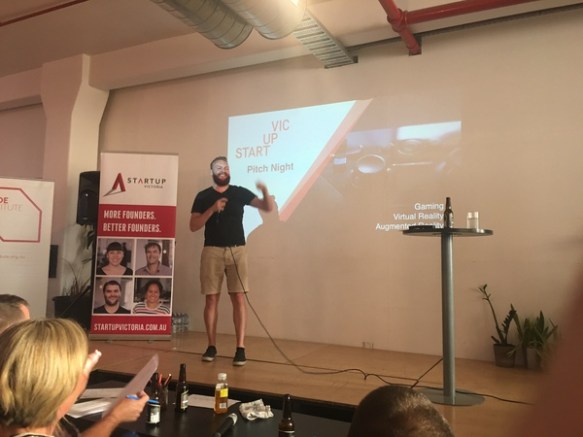
Building on the successful format that has been the mainstay of Startup Vic‘s regular meetups for the past few years, February’s pitch night kicked off a scheduled programme of thematic events for 2017. First up was Gaming, VR and AR.

Photo by Daniel C, sourced from the Startup Victoria Meetup page

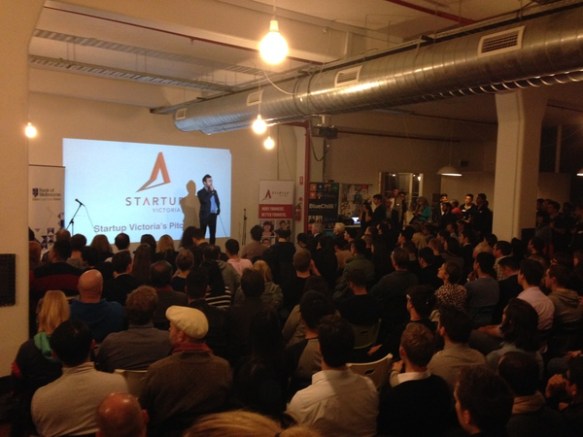
Hosted as usual by inspire9, the event drew a packed crowd, no doubt helped by the impressive panel of judges assembled by the organisers:

Dr Anna Newberry, responsible for driver-assistance technologies at Ford Australia; Stefani Adams, Innovation Partner at the Australia Post Accelerator; Tim Ruse, CEO of Zero Latency; Rupert Deans, Founder and CEO of Plattar; Samantha Hurley, Co-Founder and Director of Marketing Entourage; Gerry Sakkas, CEO of PlaySide Studios; and Joe Barber, a Commercialisation Advisor to the Department of Industry and Science, a Mentor at the Melbourne Accelerator Program (MAP), and angel investor.

Maintaining the tradition of this blog, I will comment on each startup pitch in the order in which they presented.

Metavents

This niche business offers an event planning app for festivals. At its heart is a tool that allows users to build a 3-D simulation of proposed events, combined with an AI capability to simulate risk management, logistics and team communications, plus a digital time capsule where event attendees can upload photos and other content.

Once licensed to event planners and organisers, the platform charges clients $1 per ticket sale, plus a 2.5% fee on donations and fees for other content and services such as the digital time capsule. In addition, Metavents is building strategic partnerships, and announced a relationship with the Vihara Foundation and its Rock Against Poverty programme from 2018.

All good so far. Then, things got a bit confusing. For example, in addition to festival and event logistics, Metavents claims to offer humanitarian support services in response to natural disasters, and emergency management capabilities for smart cities. There was also talk of a global network (linked to the UN?), and an impact investment fund.

I’m sure I wasn’t alone in thinking that the pitch was a bit disjointed and suffered from a lack of focus. But the pitch did reveal something of the founders’ core passion, and incorporated some impressive graphics – it just felt like a case of form over substance.

Second Sight

Second Sight is a game analytics service that “unlocks the secrets in player data”, by enriching existing big data sources with social media interactions. It does this by profiling players based on their behaviours, and providing this feedback and insights to game developers and product managers. Focusing on the mobile game market, Second Sight is initially targeting independent developers, and will then move on to corporate game businesses.

Second Sight’s own development path is to build automation tools first, then create a library of tasks and insights. With an estimated 1 million users (based on game statistics), 3 paying clients and another 27 beta clients, this startup is showing some promising market traction. However, there are a number of established competitors, including Omniata (which is more of a general user analytics engine, like Mixpanel or Flurry), GameAnalytics, deltaDNA and Xsolla, some of which offer free user services.

In response to the “ask”, ($500k in seed funding in return for 20% equity), the judges suggested that Second Sight might want to address the needs of a specific game sector.

Dark Shadow Studio

This presentation featured an application called Drone Legion, that merges drone experience with VR. Part simulation game, part training software, it was nice to see a demo of the app running in the background, without detracting from the pitch itself.

A key point made by the presentation is that the Civil Aviation Safety Authority (CASA), which is responsible for regulating drones in Australia, is in danger of falling behind other countries. For example, Drone Legion could be adapted to provide user training, testing and licensing before a customer buys a physical drone.

Although there are drone simulators available via Steam, they are not aimed at the general public. Drone Legion is also compatible with a range of gaming consoles.

The judges suggested that this pitch was more an individual game, rather than a business, so it was suggested that the founders should try to get funding from HTC or Oculus to build their first game. And given that one of the judges works for Australia Post (ostensibly a logistics company with a growing interest in drone technology….), there was the offer of a personal introduction.

Phoria

Phoria describes itself as an “immersive media business”, offering rapid 3-D visualisation (especially for the property development sector and the built environment),  and other services such as digital preservation.

But tonight, the pitch was about a plan to use “VR for social good”. Under the moniker “Dreamed”, Phoria is developing a niche health care solution, designing “patient experiences” to help them get out of their current care or treatment environment.

Predicated on an immersive therapy platform, Dreamed will offer a distribution service for cloud-based content, designed to be used alongside other, related assisted therapies that feature Animals, Nature and Music as stimulants for patient engagement and therapeutic outcomes. While not exactly a MedTech solution, Phoria’s “IP special sauce” is the use of VR as a constant dynamic feedback loop, which presumably learns from and adapts to user interaction and monitoring of appropriate patient diagnostics.

So, who pays for the service? Hopefully, hospitals will, especially if they can demonstrate reduced therapy costs and patient treatment times. (Maybe there will also be a consumer market alongside existing meditation apps?) But with some early-stage and potentially high-profile research underway via the Murdoch Childrens Research Institute, Phoria and Dreamed look to be making steady progress, notwithstanding the normally slow pace of medical research. Key to the research outcomes will be user acceptance and ease of service and content delivery, although a large number of unknowns remain in the context of the medical benefits. Meanwhile, Phoria continues to serve its core property market.

Finally, something which I found somewhat surprising, according to the presentation, there is no VR content licensing model currently available. Sounds like a job for a decentralized digital asset management and licensing registry (such as MyBit?).

On the night, and based on the judges’ votes, Phoria took out first place honours.

Next week: The Future of Work = Creativity + Autonomy


101 #Startup Pitches – What have we learned?

During the past 3 years of writing this blog, I have probably heard more than 100 startup founders pitch, present or share their insights. Most of these pitch nights have been hosted by Startup Victoria, with a few on the side run by the Melbourne FinTech Meetup and elsewhere.

Image sourced from Startup Victoria Meetup

Image sourced from Startup Victoria Meetup

Based on all these presentations, I have collated a simple directory of each startup or pitch event I have covered or mentioned in this blog, as well as a few key accelerators and crowdfunding platforms.

What have we learned over that time?

First, apart from the constant stream of new startups pitching each month, it’s been impressive to witness the Melbourne startup community collaborate and support one another.

Second, some of the international founders who have spoken are among the rock stars of startups – and we are fortunate that they have been willing to spend time in Melbourne.

Third, a number of the local startups who have pitched during this time have become well-established and well-known businesses in their own right.

This all means that besides creating great products and services, and being willing to share their experiences, the founders have helped aspiring founders and entrepreneurs to appreciate the importance of:

  • product-market fit;
  • working with agile processes and lean startup models;
  • tackling prototyping and launching MVPs;
  • learning what to measure via key metrics;
  • figuring out funding; and
  • knowing when to pivot or fold.

Looking at the cross section of pitch nights, panel discussions and guest speakers, there are some significant trends and notable startups to have emerged:

Industry focus: Not surprisingly, the pitches are heavily biased towards FinTech, MedTech, Education, Digital Media, Enterprise Services and Consumer Services. There are a some key startups focused on devices (e.g., SwatchMate and LIFX); a smattering in recruitment, fashion, gaming, health and well-being, property services, social media and even logistics. But there are surprisingly few in environmental technology or services.

Business models: Two-sided market places abound, as do customer aggregators, sharing platforms (“the Uber for X”, or “the AirbnB of Y”), freemium apps and subscription services (as opposed to purely transactional businesses). There are also some great social enterprise startups, but surprisingly no co-operative models (apart from THINC).

Emerging stars:  Looking through the directory of startups, some of the star names to have come through during this time, based on their public profile, funding success, awards (and ubiquity at startup events….) include:

CoinJar, LIFX, Tablo, SwatchMate, etaskr, DragonBill, Culture Amp, Eyenaemia, Timelio, Moula, nuraloop,  Konnective, OutTrippin and SweetHawk.

Acknowledgments: Some of the startups and pitches in the list are just ideas, some don’t even have a website, and some didn’t get any further than a landing page. However, I have not been able to include all the startups that turned up at Startup Alley, nor the many more startup founders I have met through these events (but whom I didn’t get to see pitch or present), nor the startup ideas that were hatched during the hackathons I have participated in. And there are a few startups that I could not include because I heard them pitch at closed investor events. Finally, I am and have been very fortunate to work with a number of the startups listed, in various capacities: Brave New Coin, Ebla, Re-Imagi, Slow School of Business and Timelio. To these startups and their founders, I am extremely grateful for the opportunities they have given me.

Next week: Putting a Price on Value