Can we come out now?

At the time of writing, the Victorian government has just announced the State’s very own measures as part of the “3 Steps to Recovery”, designed to ease the Covid-19 lockdown restrictions, in a controlled and manageable way. This follows last week’s meeting of the National Cabinet, where broad agreement was reached on a plan to help “prepare Australians to go back to work in a COVID-19 safe environment and getting the economy back to a more sustainable level“.
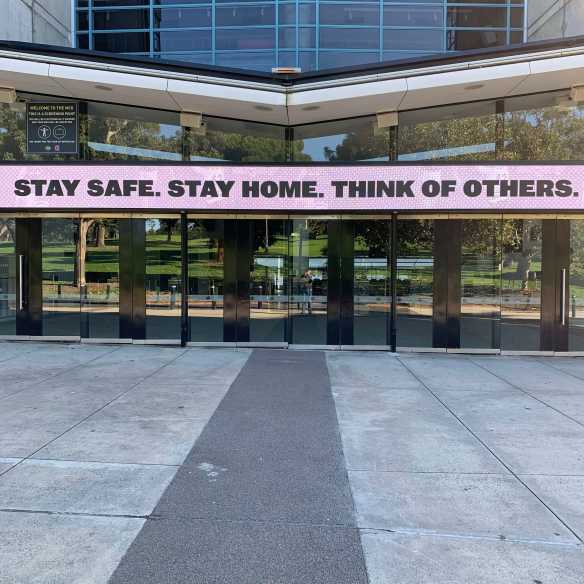
Even at the MCG, the advice is stay safe, stay home, and think of others

The biggest “winners” in Victoria will be our immediate friends and families (groups of up to 5 people can gather at each others’ homes), outdoor activities (groups of up to 10 people), wedding organisers and funeral directors (more people can attend ceremonies)…. oh, and the AFL (training can resume!).

But Premier Andrews has stressed that this is neither an excuse to host dinner parties every night, nor a reason to ignore established protocols and best practice on personal hygiene and social distancing. So no overnight raves or camping trips. And no dining-in at restaurants or cafes, and definitely no pubs, bars or clubs.

For some people, the continued Stage 3 restrictions seem too much to bear, with a few fringe elements (along with the anti-vaxxers and the anti-5Gers) being more vocal and more physical in their views. But they probably fail to see that no-one actually enjoys living under this regime, and nobody would do it if they had a choice or other safe options.

Thankfully, the majority of the population are willing to comply with the restrictions, however uncomfortable or inconvenient, because they realise the consequences of a second wave of infections (especially as we come into winter) would be worse than some temporary limitations on their freedom of movement. There is also a renewed albeit grudging respect for and trust in our political leadership (if not always felt towards individual ministers), and here in Australia we can also consider the political decisions and public advice in light of scientific data and medical evidence.

A large proportion of Covid-19 infections in Australia came via overseas travellers (cruise ships and ski trips), while some of thee first community infections came from gatherings such as weddings and religious services. And then there have been “hubs” within sectors such as aged care, meat processing and airport baggage handling.

There are still questions over plans to re-open schools, and sectors such as aviation, tourism and hospitality have a long way to go before “normal” service resumes. Parts of the retail sector have managed to survive thanks to on-line shopping and e-commerce solutions (supply chain logistics and delivery) but we should expect some businesses will never bounce back. Every employer will probably need to have a “Covid-19 Safe” operating plan before bringing staff back to work in significant numbers, whether as part of their best practices on risk management, or as a prerequisite to satisfy workplace health and safety obligations.

The apparent rush to get professional sport back on the field feels like a misplaced priority – especially given the controversy around NRL and AFL players who apparently lacked the self-discipline to comply with the social-distancing measures; and those players who are refusing the flu vaccine as a condition of rejoining their clubs. On this point, I rather admire the comments by Chelsea manager, Frank Lampard, who expressed his unease at the thought of professional footballers getting priority for Covid-19 testing, ahead of essential and front-line workers, simply to fast-track the resumption of the EPL.

Even with the various safety plans and gradual easing of restrictions, it’s up to each of us individually to be responsible for our own actions, and maintain a personal duty of care to each other so as not to risk spreading the infection, nor risk exposing others as a result of something we do or omit to do.

Next week: The Bitcoin halving – what happened?


Signing off for Saturnalia

According to a Gallup Report, in 2018 the world was “sadder and angrier than ever. If recent global events are anything to go by, 2019 will easily top that. And as I write, much of south east Australia is on fire (the bushfire season having started back in early August), only adding to the sense of rage. I can’t recall an angrier year, maybe not since the 1970s.

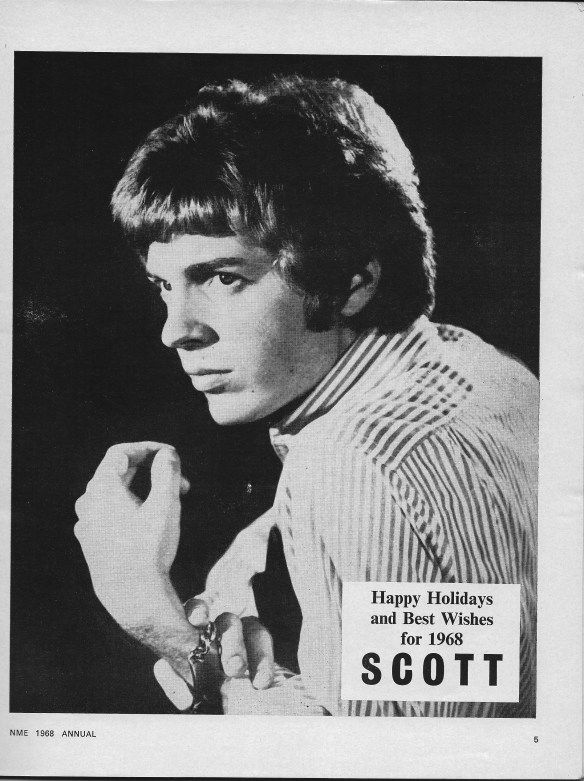
Image of Scott Walker scanned from the NME Annual for 1968

Reasons to be angry? World politics, climate change, fake news, growing nationalism, economic stagnation, and sectarian intolerance. Evidence of anger? Brexit, Impeachment, Hong Kong, France, Chile, Iran, India, Iraq, Adani, Extinction Rebellion, #MeToo, etc.

Meanwhile, considered academic debate has been reduced to very public slanging matches. Even popular music seems shoutier than ever, and no action movie is considered complete without gratuitous violence, hyperbolic pyrotechnics and pounding soundtracks.

So much noise, so much hot air (verbal and atmospheric) and so much sheer rage, not always easy to articulate or understand – and not easy to predict how that will translate at the ballot box, given the election results in Australia and the UK. Politicians of all persuasions are increasingly seen as being a key cause for voter anger, but in both cases, continuity was deemed preferable to change.

As we wind down for the holidays, it’s frustrating to think that the “season of goodwill” is limited to just a few weeks of the year. I’m not suggesting 12-month-long Black Friday Sales. Rather, can we find it in ourselves to be more civil to each other throughout the year, even if we disagree on certain things? In particular, I’m thinking of the growing evidence of sectarian strife. Established religions may condemn to hell (or even death) anyone who disagrees with their belief systems, but in a democratic, secular and pluralist society, the right to “freedom of religion” also means everyone is entitled to “freedom from religion”.

In light of that, I’d like to wish all my readers a safe and peaceful Saturnalia. Normal service will be resumed in the New Year.


Fitting your own oxygen mask first

Before I get into this week’s article, I want to stress that my reason for posting it is not intended to be self-serving, or self-aggrandising – I’m fully aware of such pitfalls, as captured wonderfully in The State of LinkedIn on Twitter. Instead, I hope it’s received as an example of paying it forward. And all starts with some advice I heard a number of years ago.

My erstwhile colleague, Dale Simpson, likes to use the following analogy when coaching his clients on career development, leadership and directorship:

“Be sure to fit your own oxygen mask first”

The reason being, how can you help others if you don’t take care of your own needs first? It’s not about being selfish, but about being present and able to serve others. It also recognises that in order to be useful, we need to work from a position of stability and resilience ourselves.

Dale also likes to use Maslow’s Hierarchy of Needs in his work. Both Maslow and the oxygen mask have clearly entered my own vernacular. A couple of weeks ago, I was listening to a neighbour at my co-working space talking about the work he was trying to do to help others become more resilient and overcome trauma. As the conversation went on, it was clear that his own circumstances were challenging, due to insecure accommodation, erratic income and other factors. He had also had to overcome a great deal of adversity and other challenges in his life.

I asked him if he had heard of Maslow – he hadn’t. I suggested that he consider what his own needs were, so that he would be better able to help others. A little while later, I went back to my desk and found the above note he had left for me.

I’m sure once he manages to sort out his own circumstances, he will be a fine coach and excellent mentor, because he was very certain of his purpose – he just needed to adjust his own oxygen mask first.

Next week: Steam Radio in the Digital Age

Pitch X’s Winter Solstice

The latest Pitch X event, organised by Academy Xi and hosted by YBF Ventures, was held a few days before the (Southern hemisphere) mid-winter – there may not have been any mulled wine, but there was still a warm atmosphere on a cold and wet Melbourne evening. The judging panel was drawn from YBF, Melbourne Angels, Linfox and Clearpoint Ventures.

The usual format applied: 11 startups were each given 90 seconds to pitch, followed by a 90 second Q&A with the judges. The top three were then brought back for a 5-minute pitch, and 4 minutes of Q&A.

The pitches, in order of presentation were (links in the names where available):

Startup 101

A self-styled online startup school, targeting university students and recent graduates. The core premise is that entrepreneurship is not being taught to undergraduates. The judges asked about the MVP, which was not clear, nor was there a breakeven forecast based on the number of students. The founder is offering a freemium model, based on memberships and services. Looking $500k for software development and marketing in China (a key demographic for this business).

Studio Ninja

This is a cloud and mobile PaaS solution for professional photographers. I first covered Studio Ninja in late 2016, when they pitched at a StartupVic event – and it’s great to see that they have managed to bootstrap themselves this far.

Professional photography is competitive, but margins are low. Studio Ninja offers an end-to-end platform for scheduling, contracts, payments etc. They have now integrated with Xero, QuickBoooks, Google, PayPal and Stripe, and have built a community via their chat app, Facebook group and Instagram account. At a basic $29.95 per month, they now have 4,000 paying subscribers, mainly in Australia, UK and US. but need to reinvest in product development, scaling and building further efficiencies. Users are offered a 30-day free trial, with an average 25% conversion rate, thanks to the hook of discounts for early sign-ups, plus a referral program.

RoamingDuck

Calling itself the “Uber of travel”, RoamingDuck offers travelers access to curated itineraries, based on their personal preferences. Using freelance resources (along the lines of Upwork and Airtaskr), the service uses a travel planning dashboard on which the customer and the curator can collaborate. With a quick turnaround, RoamingDuck can help customers build and review an itinerary within 12 hours. With the ability to consolidate and share, the content is easily accessible to users, who can plan anything – even supporting “self-plan” users with a search function.

Freelance curators come from the ranks of existing travel bloggers and services like Travelo, and are subject to a vetting process. There is also an escrow system, so freelances only get paid when the customer is satisfied. Normal travel agents are quite restricted on what they can access or offer, and services like Skyscanner are great for searching individual fares – RoamingDuck is solving the planning issue, and building the itinerary. Asked whether RoamingDuck can support actual bookings, the founder will likely implement this via APIs.

Wastr

According to the founder, households waste about 20% of the food they buy. Wastr is an AI-powered app that is designed to help consumers use what they purchase, rather than letting to go to waste. The solution allows subscribers to scan their grocery receipts, and in return they will receive recipes, notifications on expiry dates, plus other reminders. The app is offered under a freemium model, with a paid service starting at $2 per month.

VRWalker

Described as “VR for your foot” (or the “mouse” for VR), this is a motorised shoe device that allows wearers to experience”walking” within VR applications, without actually moving.
It’s an idea that has been around for a while, but the founder claims to have filed key patents. The shoes work on the concept of intuitive locomotion (linked to the dantian, or our centre of gravity), and are intended to be much cheaper and much more convenient than existing treadmill-based solutions. The founder hopes to have a working prototype by the end of this year. Likely customers will come from areas like construction, engineering and gaming. The judges asked about how insurance would be handled, and the device could be bundled with existing VR headset devices.

The Nurture Project

The Nurture Project is designed to teach life skills to deal with anxiety issues, which according to the founder, affect 30% of the population. Unlike other solutions, this treats the causes as well as the symptoms, using a well-being model built on 5 core pillars, and delivered via a 12-week online program. It is currently aimed at women in their 30s and 40s.

Natural MedTech

Designed to boost the immune, hormone and nervous system naturally, this has come out of a CSIRO project, with a scientific basis that has been peer-reviewed.

Magicast

This is a decentralised online podcast recording and editing service. Existing podcast software is either too complex, or too expensive. Instead, Magicast uses web-based programme development, publication and distribution, offering a two-sided marketplace for content, sound effects, music etc. The judges asked about international competitors, given that podcasting is very much a cottage industry, with relatively few barriers to entry.

Turtle

Something akin to an Uber courier service, Turtle enables customers to obtain goods from overseas that are not available where they live. Targeting expat and diaspora populations, the platform has an escrow function to provide a level of trust. It was not clear who would be responsible for tax, customs and quarantine issues.

Young Shaman Foundation

Having run a number of leadership development retreats on country for women in indigenous communities, the founder is now seeking funding to develop and extend the program she currently offers.

SecureStack

Helping companies to secure the cloud, with a focus on cyber security, the founder pointed out that key problems are caused by “cloud sprawl” – the uncontrolled proliferation of content, services and applications hosted and running on cloud-based servers. Using a proprietary cloud infrastructure security design, the startup has already secured two clients and $100k in revenues. Now looking to raise $2m, for an 18-month runway, in order to gain 100 clients. The solution is agnostic as to which cloud service clients use. Traditional cloud management and compliance is saturated, whereas SecureStack’s value proposition is in the security layers.

After much deliberation, the winners were:

1. StudioNinja
2. RoamingDuck
3. VR Walker

Next week: The Metaphorical Glass Jaw