Pop in Perpetuity

Exactly a year ago, I blogged about ageing rockers and their propensity to continue touring and recording. This past weekend I experienced two events that provided almost polar opposites as to how musicians will perpetuate their “live” legacy. (Of course, in theory, their recordings will last forever, in physical, digital and streaming formats – as long as the equipment, technology and platforms survive…)

On the one hand, there was the Sun Ra Arkestra, who since their founder’s death in 1993, have continued to play the music of Sun Ra, respecting the sound, format and spirit of the original band formed in the 1950s. Some of the current band members played with Sun Ra himself, so there is a thread of continuity that connects us back to the past. But even as these surviving members depart this world, the music of Sun Ra will live on in concert form through subsequent generations of players. This type of perpetuity is not uncommon among bands of the 60s, 70s and 80s, although in many cases, there is usually at least one original band member performing, or members who overlapped with the band founders. (Some notable exceptions: Soft Machine, who continue performing and recording, but whose remaining original member left nearly 50 years ago; and Faust, who split into at least two separate bands that still tour and record under the same name.)

On the other hand, there was the high-tech concert presentation by the late composer and performer Ryuichi Sakamoto, entitled KAGAMI. This involved the use of AR headsets and a 3D avatar of Sakamoto, captured in sound and vision performing a selection of his music, sat at a grand piano. The audience, initially seated in a circle around the virtual performance area in order to acclimatise to what they were seeing, was invited to move around the avatar, and even peer into the open grand piano. Two things were striking: first, the 360 degree image was very impressive in the level of detail; second, even if someone was standing between the viewer and the avatar zone, the headset still presented the image of Sakamoto sat at the keyboard. The technology not only captures a digital visualisation of the pianist in action, it also replicates the notes he played as well as the tonal expression and the timbres, resonances and acoustics of the physical instrument. While the audio HiFi was superior to the atavistic CGI, the latter will no doubt improve; as will the slightly clunky and heavy headsets – the 50 minute duration is probably the most I could have endured.

Neither format of the above concerts is better or superior to the other. Both are authentic in their own way, and true to the artistry of musicians they celebrate. Of course, if we end up using AI to compose “new” music by Sakamoto, that may undermine that authenticity. But given Sun Ra’s origin story, I wouldn’t be surprised if he started beaming his new works from Saturn.


AI and Deep (and not so deep…) Fakes

The New York Times recently posted a quiz“can you tell the difference between a photograph, and an image created by AI?”

Of the quiz examples, a mix of actual photos and AI-generated content, I was only able to correctly identify 8/10 as to which were which. My significant other claimed to have scored 10/10! In my defence, I correctly identified all of the AI images, but I mistook two authentic photos as being fakes. Of the latter, one featured a bunch of famous people, most of whom I did not recognise, and the photo had been significantly cropped, removing much of the visual context (I also suspect it had been subject to some additional photo-shopping, given it was a publicity shot). The other real photo had been taken at such an unusual angle that it distorted some of the natural perspective, so as to make some elements look wonky. (But maybe I’ve become more cynical or sceptical, and therefore I tend to disbelieve more of what I see, the more I know I am being exposed to AI-generated content?)

How can we remain alert to AI deceptions, while at the same time recognizing and embracing the potential that this amazing technology has to offer?

Taking my lead from the New York Times article, the following blog has been created using ChatGPT. All I did was enter some brief subject headings (including the title), a series of internet links, and a prompt to turn it into a blog on AI and fakes. Can you tell what is true, what is hallucination, and what important information has been left out?

AI and Deep (and not so deep…) Fakes

Artificial Intelligence (AI) has revolutionized numerous sectors, bringing forth innovations that were once unimaginable. However, one of the more controversial applications of AI is in the creation of deep fakes. These are hyper-realistic digital falsifications created using AI, capable of mimicking real people’s appearances and voices. This technology has sparked debates over ethics, security, and the future of digital media. Let’s delve into some recent examples and the implications they bring.

Dylan and Rodin: A Fabricated Encounter

A striking example of AI’s capacity to blur reality is the supposed encounter between Bob Dylan and the sculptor Auguste Rodin. In an article on Substack by Dave Haslam, the scenario of Dylan visiting Rodin’s Parisian studio is meticulously crafted, yet it’s a fabrication made plausible by AI tools. This fake story exemplifies how AI can create convincingly realistic yet entirely fictional narratives, challenging our ability to discern truth from fiction.

AI in Indian Elections

AI’s role extends beyond entertainment into more critical areas such as political campaigns. In the 2024 Indian elections, AI-generated deep fakes have been used to spread misinformation and manipulate public opinion. An article by ABC News details how AI is disrupting electoral processes, raising concerns about the integrity of democratic systems.

Mozilla’s Campaign Against Misinformation

In response to the growing threat of AI-generated misinformation, organizations like Mozilla have launched campaigns to protect the integrity of elections. Mozilla’s efforts aim to hold platforms like WhatsApp accountable for the spread of fake news and deep fakes, urging them to implement stricter controls to safeguard democratic processes.

Celebrity Persona Rights

AI’s ability to replicate real people has also sparked legal disputes, particularly concerning persona rights. Scarlett Johansson’s recent dispute with OpenAI highlights these issues. Johansson’s concerns about her likeness being used without consent underscore the broader debate about the ethical use of AI. As noted by Scientific American, the conflict brings to light questions about how AI-generated content can respect individual rights and privacy.

Legislative Actions on Deep Fakes

Governments are beginning to take action against the misuse of AI-generated content. In Australia, new laws are being proposed to combat the creation and distribution of deep fake pornography and other harmful images. The Guardian reports on legislative efforts to protect individuals from the malicious use of AI, reflecting a growing recognition of the need for regulation.

AI and Copyright

The intersection of AI and copyright law is another area of intense debate. A lawsuit involving famous authors against OpenAI raises questions about how AI uses copyrighted material for training and whether the content it generates can itself be copyrighted. This legal battle, reported by ABC News and Reuters, could set important precedents for how intellectual property laws adapt to the age of AI.

Conclusion

As AI technology continues to advance, its applications in creating deep fakes present both opportunities and challenges. While it can be used creatively and constructively, it also poses significant risks to privacy, security, and the authenticity of information. The ongoing developments in legislation, ethical guidelines, and technological safeguards will be crucial in shaping the future landscape of AI-generated content.

So, did you spot the “deliberate” error(s)? And what information was missing? Answers will be posted later this week.

Next week: AI & Music

Startup Victoria – Best of the Startup State Pitch Night

In support of Victoria’s reputation as “Australia’s Startup State”, last week’s Startup Victoria pitch night was designed to showcase four of the best local startups. Hosted by Stone & Chalk, the judges were drawn from Mentorloop, Brosa, Giant Leap Fund, Rampersand and Vinomofo.

The pitches in order of presentation were (website links embedded in the titles):

Code Like A Girl

Founded four years ago, Code Like A Girl’s stated mission is to bring greater gender diversity to the ICT sector (information and communications technology), within both the industry and education spheres. To do this, the founders say we need more female coders, which they plan to achieve via coding camps, internships, and community events. Positioning itself as a social impact enterprise, the business is active in four States, and 75% of interns are placed into full time roles.

To support the ongoing development of its “role ready” value chain and to prepare for possible overseas expansion, Code Like A Girl is seeking $1.5m in seed funding. Currently piloting the training model via education providers (RTOs, boot camps, universities, online code schools), the business takes a 10% commission on courses sold (held twice a year), plus it charges placement fees of $2k per person.

But the model is difficult to scale, especially as Code Like A Girl does not own or create the actual training content – it is acting as a sales channel for third party courseware, and providing platform for advocacy, engagement and influence. Its key metrics are based on things like social impact scores – such as 30% of kids return to boot camps. The panel felt that the community platform is a huge cost centre, and it might be preferable to try a TedX model, where Code Like A Girl provides branding and foundational support to build more of a network effect – but without its own curriculum, the business will still struggle to scale.

Seer Medical

The business claims to make epilepsy diagnosis easier, and is currently raising $14m for European expansion (UK & Germany). To improve current diagnosis, the model needs to capture time series data to distinguish epilepsy from other conditions, but do so faster, cheaper and more efficiently than current processes. Founded in 2017, Seer has already serviced more than 1500 patients via 200 clinicians.

Using the Seer Cloud infrastructure,  it can achieve diagnostic outcomes 10x faster than traditional methods, and the platform is using machine learning to train its algorithms. The service is subject to Medicare reimbursement, which has no doubt assisted adoption.

Asked by the judges if the platform could be used to diagnose other conditions, the founders mentioned cardio, sleep and other health domains. As for competition, this comes mainly from the status quo – i.e., hospital based services. With advocacy from neurologists, giving them access to customers, the founders have a strong track record in the research field, which helps to open doors with clinicians. Along with research partnerships, plus the public health cost reimbursement, data is the fuel of the business –  Seer even have access to some third party data on which to train their diagnostic.

Liven

A dining rewards app, Liven is also bringing a behavioral gamification layer to a real world use case. Currently, there is a poor linkage between loyalty programmes and gamification. So, Liven has launched a universal reward token (the LVN token) for use in a digital/real world context.  The details were scant, and the status of the LVN token sale is unclear, but it seems users can earn LVN tokens from completing certain “missions”. The token (using a standard ERC 20 token format on the Ethereum blockchain), is designed to be interoperable and fungible (but Liven does not yet appear to use blockchain in its end user app or merchant point of sale solution).

The said merchants pay a 10-25% commission on app-based sales, of which upto 40% is paid back to the end user in the form of LVN tokens – if I got the maths right, Liven itself is securing $15 profit on every $100 of sales. Currently only available in Melbourne and Sydney, the judges wanted to know what the appeal is to merchants. According to the founders, users typically spend more in an average transaction when they use the app. It also seems that the app only works in brick and mortar restaurants, cafes and bars. The path to scaling will be via channel partners such as PoS systems.

Although not yet deployed, in future, it was suggested that users will be able to pay in any crypto – which raises all sorts of questions about the tokenomics of the LVN token, and whether LVN will be subject to exchange rate volatility (and even token speculation) or act as a stable coin; if the latter, what will it be backed by or pegged to?

Phoria

Phoria is in the business of extended reality technology (XR). Started in 2014, Phoria was an entrant to the Melbourne Accelerator Programme (MAP), with the stated goal of moving VR into a mobile experience (“democratize VR”).  Having gained some clinical VR research experience, Phoria has since worked on commercial projects such as “Captured” (turning a 3D scan of a building or structure into a Digital Twin), “Rewild Our Planet” (a Singapore-based AR experience), and various art installations museum exhibits.

Phoria is commissioned by tech and media brands to create XR content. It has developed a SaaS model, whereby it can turn real space into virtual space (“virtualising internal space”).

The judges wondered where we are along the cycle of mass adoption vs peak hype. In response, the founders mentioned that the first wireless headsets are now available, although consumer-facing mixed reality hardware is still 3-5 years away. With a growing customer base in engineering and architecture applications, Phoria’s main focus is on spatial information.

After the votes were counted, the People’s choice was Seer Medical, who also won the overall prize.

Next week: 30 years in publishing

Gaming/VR/AR pitch night at Startup Victoria

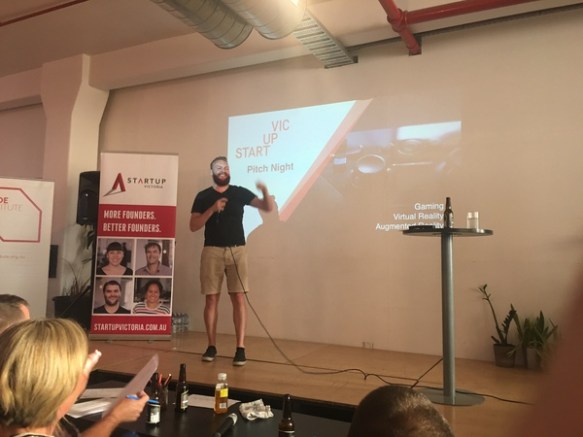
Building on the successful format that has been the mainstay of Startup Vic‘s regular meetups for the past few years, February’s pitch night kicked off a scheduled programme of thematic events for 2017. First up was Gaming, VR and AR.

Photo by Daniel C, sourced from the Startup Victoria Meetup page

Hosted as usual by inspire9, the event drew a packed crowd, no doubt helped by the impressive panel of judges assembled by the organisers:

Dr Anna Newberry, responsible for driver-assistance technologies at Ford Australia; Stefani Adams, Innovation Partner at the Australia Post Accelerator; Tim Ruse, CEO of Zero Latency; Rupert Deans, Founder and CEO of Plattar; Samantha Hurley, Co-Founder and Director of Marketing Entourage; Gerry Sakkas, CEO of PlaySide Studios; and Joe Barber, a Commercialisation Advisor to the Department of Industry and Science, a Mentor at the Melbourne Accelerator Program (MAP), and angel investor.

Maintaining the tradition of this blog, I will comment on each startup pitch in the order in which they presented.

Metavents

This niche business offers an event planning app for festivals. At its heart is a tool that allows users to build a 3-D simulation of proposed events, combined with an AI capability to simulate risk management, logistics and team communications, plus a digital time capsule where event attendees can upload photos and other content.

Once licensed to event planners and organisers, the platform charges clients $1 per ticket sale, plus a 2.5% fee on donations and fees for other content and services such as the digital time capsule. In addition, Metavents is building strategic partnerships, and announced a relationship with the Vihara Foundation and its Rock Against Poverty programme from 2018.

All good so far. Then, things got a bit confusing. For example, in addition to festival and event logistics, Metavents claims to offer humanitarian support services in response to natural disasters, and emergency management capabilities for smart cities. There was also talk of a global network (linked to the UN?), and an impact investment fund.

I’m sure I wasn’t alone in thinking that the pitch was a bit disjointed and suffered from a lack of focus. But the pitch did reveal something of the founders’ core passion, and incorporated some impressive graphics – it just felt like a case of form over substance.

Second Sight

Second Sight is a game analytics service that “unlocks the secrets in player data”, by enriching existing big data sources with social media interactions. It does this by profiling players based on their behaviours, and providing this feedback and insights to game developers and product managers. Focusing on the mobile game market, Second Sight is initially targeting independent developers, and will then move on to corporate game businesses.

Second Sight’s own development path is to build automation tools first, then create a library of tasks and insights. With an estimated 1 million users (based on game statistics), 3 paying clients and another 27 beta clients, this startup is showing some promising market traction. However, there are a number of established competitors, including Omniata (which is more of a general user analytics engine, like Mixpanel or Flurry), GameAnalytics, deltaDNA and Xsolla, some of which offer free user services.

In response to the “ask”, ($500k in seed funding in return for 20% equity), the judges suggested that Second Sight might want to address the needs of a specific game sector.

Dark Shadow Studio

This presentation featured an application called Drone Legion, that merges drone experience with VR. Part simulation game, part training software, it was nice to see a demo of the app running in the background, without detracting from the pitch itself.

A key point made by the presentation is that the Civil Aviation Safety Authority (CASA), which is responsible for regulating drones in Australia, is in danger of falling behind other countries. For example, Drone Legion could be adapted to provide user training, testing and licensing before a customer buys a physical drone.

Although there are drone simulators available via Steam, they are not aimed at the general public. Drone Legion is also compatible with a range of gaming consoles.

The judges suggested that this pitch was more an individual game, rather than a business, so it was suggested that the founders should try to get funding from HTC or Oculus to build their first game. And given that one of the judges works for Australia Post (ostensibly a logistics company with a growing interest in drone technology….), there was the offer of a personal introduction.

Phoria

Phoria describes itself as an “immersive media business”, offering rapid 3-D visualisation (especially for the property development sector and the built environment),  and other services such as digital preservation.

But tonight, the pitch was about a plan to use “VR for social good”. Under the moniker “Dreamed”, Phoria is developing a niche health care solution, designing “patient experiences” to help them get out of their current care or treatment environment.

Predicated on an immersive therapy platform, Dreamed will offer a distribution service for cloud-based content, designed to be used alongside other, related assisted therapies that feature Animals, Nature and Music as stimulants for patient engagement and therapeutic outcomes. While not exactly a MedTech solution, Phoria’s “IP special sauce” is the use of VR as a constant dynamic feedback loop, which presumably learns from and adapts to user interaction and monitoring of appropriate patient diagnostics.

So, who pays for the service? Hopefully, hospitals will, especially if they can demonstrate reduced therapy costs and patient treatment times. (Maybe there will also be a consumer market alongside existing meditation apps?) But with some early-stage and potentially high-profile research underway via the Murdoch Childrens Research Institute, Phoria and Dreamed look to be making steady progress, notwithstanding the normally slow pace of medical research. Key to the research outcomes will be user acceptance and ease of service and content delivery, although a large number of unknowns remain in the context of the medical benefits. Meanwhile, Phoria continues to serve its core property market.

Finally, something which I found somewhat surprising, according to the presentation, there is no VR content licensing model currently available. Sounds like a job for a decentralized digital asset management and licensing registry (such as MyBit?).

On the night, and based on the judges’ votes, Phoria took out first place honours.

Next week: The Future of Work = Creativity + Autonomy