The Bitcoin halving – what happened?

Last Monday, May 11, at around 19:23 UTC, the third Bitcoin halving occurred. This event is currently scheduled to happen approximately every four years, and is a core mechanism in Bitcoin’s protocol. In short, combined with the finite supply of bitcoin (BTC), the halving acts as an anti-inflationary measure by reducing the number of BTC payable to the miners who confirm each block of transactions, and maintain the integrity of the blockchain ledger. By using dedicated, high-powered computers to solve Bitcoin’s complex algorithms, the miners earn BTC as rewards for their efforts (and to help recoup their energy costs). As a result, the halving is an integral component in measuring key metrics in BTC’s performance, including pricing, supply and mining profitability. What happened around the time of the halving provides for some interesting analysis before and after the event.
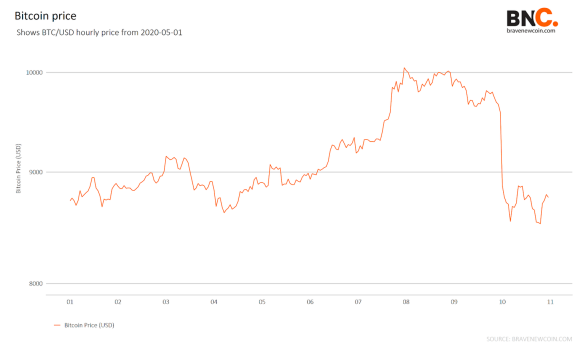
BTC price dropped dramatically just prior to the latest halving event – the above graph is plotted using the hourly closing value of Brave New Coin’s Bitcoin Liquid Index.

The halving is programmed to occur after every 210,000 blocks, which themselves are “mined” approximately every 10 minutes. Last week’s third halving was triggered when block number 629,999 was confirmed – from block 630,000 onward, the block reward reduced from 12.5 BTC to 6.25 BTC per block, and is designed to continue halving until the block reward reaches 1 Satoshi (0.00000001 BTC).

Usually, financial markets have already priced in events such as the halving, so traders don’t expect the event itself to have an immediate impact on price. (Think of the halving as just one type of “corporate action” that is peculiar to cryptocurrencies and digital assets. Others might include hard forks, coin burns, and token lock ups.) As with company results and profit announcements, traders and analysts are usually prepared for the best (or worst).

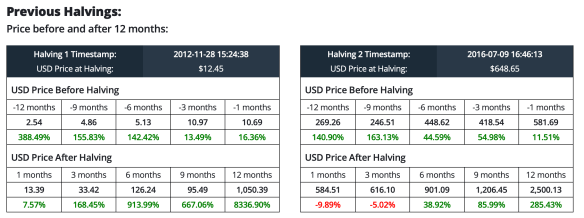
However, leading up to the latest halving, BTC briefly touched a 3-month high of US$10k, before going through an almost typical “market correction” of a 20% decline immediately prior to the halving event. BTC has since recovered some of those losses, and in any case, the price performance before and after each halving event has become yet another indicator of long-term price movement, as the following chart illustrates:
Other metrics to watch include: “hash rate” (the degree of difficulty, and therefore the amount of computing power, to solve the algorithms and mine each block); transaction fees (if miners can’t earn as much from mining activity, they are expected to start increasing their network fees); the price of electricity (as an input cost to mining); and even the cost of computing power itself (as older machines become less efficient and therefore less profitable, while newer, more powerful and more expensive processors come to market).

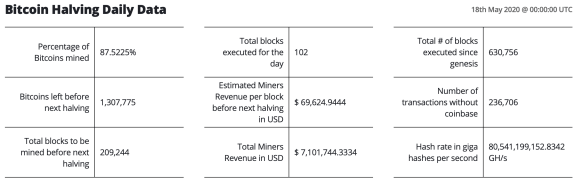
Indeed, different scenarios used to predict the exact date of the next halving are largely based on the hash rate, which has been relatively volatile before and since the halving, and transaction fees likewise escalated (and then settled down again) around the time of the halving. Key data to track as part of halving analysis and forecasting can be seen in the table below from Brave New Coin:
Other interesting developments around the time of this latest halving include a legendary hedge fund manager reported to be buying BTC as a hedge against inflation; an increase in open interest on CME’s BTC futures contracts (assumed to be coming from institutional clients); and an intriguing message attached to block 629,999 (“NYTimes 09/Apr/2020 With $2.3T Injection, Fed’s Plan Far Exceeds 2008 Rescue”). Given the recent quantitative easing measures pursued by many governments and central banks in response to the Covid-19 pandemic, this choice of headline echoed the message attached to the genesis or very first Bitcoin block, mined in 2009, soon after the GFC (“The Times 03/Jan/2009 Chancellor on brink of second bailout for banks”).

Finally, as more data and analysis attaches to the halving events, they form the basis of a fundamental aspect of understanding how financial instruments perform over time – giving rise to the BTC equivalent of a 1, 5 or 10 year yield curve, which in turn will create more sophisticated derivatives and hedging tools, and another level of comfort for traditional and institutional investors.

(My thanks to friends and colleagues at Brave New Coin and Apollo Capital.)

Next week: “How do I become a business strategist?”



The “new, new normal” post-Covid-19

After the GFC of 2007-8, we were told to get used to the “new normal” – of low/slow/no growth, record-low interest rates, constant tech disruption and market dislocation as economic systems became increasingly decoupled from one another. And just as we had begun to adjust to this new reality, along comes Covid-19 and totally knocks our expectations sideways, backwards and upside down, and with it some negative long-term consequences. Welcome to the “new, new normal”.

Just what the doctor ordered: “Stay home and read a book!”

In the intervening years since the GFC (and don’t those days seem positively nostalgic from our current vantage point?), we have already seen ever lower interest rates, even faster disruption in business models and services, and a gradual dismantling of the trend towards a global economy. The pre-existing geopolitical landscape has either exacerbated this situation, or has been a prime beneficiary of the dismantling of the established structures of pluralistic, secular, non-sectarian, social-democratic and liberal societies.

First, relations between the Superpowers (USA, Russia and China) have not been this bad since the Cold War. Second, nationalism has not been as rife since the 1930s. Third, political leadership has tended toward the lowest common denominator of populist sloganeering. Not to mention the rise of fundamental religious sects, doomsday cults and tribal separatist movements. Let’s agree that even before the current pandemic, our resistance was already low….

Whatever your favourite conspiracy theory on causes and cures for Covid-19, it’s increasingly apparent that populist leaders of both the left and the right will use the pandemic as vindication of their policies – increased xenophobia and tighter border controls, increased centralisation of power and resources, greater surveillance of their citizens, a heightened intolerance of political dissent, a continued distrust of globalisation, and a growing disregard for subject matter experts and data-driven analysis.

The writing’s on the wall? Message seen in East Melbourne

There are obviously some serious topics up for discussion when we get through this pandemic. Quite apart from making the right economic call (“printing money” in the form of Quantitative Easing seems the main option at the moment…), governments and central banks are going to have to come to grips with:

  • Universal Basic Income – even before Covid-19, the UBI was seen as a way to deal with reduced employment due to automation, robotics and AI – the pandemic has accelerated that debate.
  • Nationalisation – bringing essential services and infrastructure back into public ownership would suggest governments would have the resources they need at their disposal in times of crisis – but at the likely cost of economic waste and productivity inefficiencies that were the hallmark of the 1970s.
  • Inflation – as business productivity and industrial output comes back on-line, the costs of goods and services will likely increase sharply, to overcome the pandemic-induced inertia.
  • Credit Squeeze – banks were already raising lending standards under tighter prudential standards, and post-pandemic defaults will make it even harder for businesses to borrow – so whatever the central cash rates, commercial lenders will have to charge higher lending rates to maintain their minimum risk-adjusted regulatory capital and to cover possible bad debts.
  • Retooling Industry – a lot of legacy systems might not come out of the pandemic in good shape. If we have managed to survive for weeks/months on end without using certain services, or by reducing our consumption of some goods, or by finding workarounds to incumbent solutions, then unless those legacy systems and their capacity can be retooled or redeployed, we may get used to living without their products all together.
  • Communications Technology – government policy and commercial settings on internet access, mobile network capacity and general telco infrastructure will need to be reviewed in light of the work from home and remote-working experience.
  • The Surveillance State – I’m not going to buy into the whole “China-virus” narrative, but you can see how China’s deployment of facial recognition and related technology, along with their social credit system, is a tailor-made solution for enforcing individual and collective quarantine orders.

Another policy concern relates to the rate at which governments decide to relax social-distancing and other measures, ahead of either a reliable cure or a vaccine for Covid-19. Go too early, and risk a surge or second wave of infections and deaths; go too late, and economic recovery will be even further away. Plus, as soon as the lock-downs start to end, what’s the likelihood of people over-compensating after weeks and months of self-isolation, and end up going overboard with post-quarantine celebrations and social gatherings?

Next week: The lighter side of #Rona19


Cryptopia – The Movie

A quick plug for Torsten Hoffman‘s new documentary, Cryptopia: Bitcoin, Blockchains and the Future of the Internet. After a series of preview screenings around Australia and  New Zealand last last year, the film has its world premiere tonight in Melbourne.

Five years after producing Bitcoin: The End of Money As We Know it, the director has gone back and interviewed a number of key figures who appeared in the last film, to update their stories, and to dig deeper into the whole Blockchain, Bitcoin and crypto narrative.

I haven’t yet seen the latest film, but I first met Torsten when he was screening the previous documentary on the meetup circuit. He was kind enough to show me some early edits of Cryptopia, and I have to say the new content looks very promising.

Given the speed at which Blockchain and Bitcoin markets move (a week in crypto is often referred to as a year in any other asset class), it’s actually important that we stand back and take stock of where we are in this new paradigm for FinTech, decentralisation and distributed ledger technology.

Even if you can’t make it to the Melbourne premiere, look out for Cryptopia the movie as it tours globally.

Next week: Tarantino vs Ritchie

Brexit Blues

Reading the latest coverage of the Brexit farce combined with the inter-related Conservative leadership contest, I am reminded of Oscar Wilde’s description of fox hunting:

“The unspeakable in pursuit of the uneatable”

Whichever candidate wins the Tory leadership race and, as a consequence, becomes the next UK Prime Minister, they will inevitably fail to deliver a satisfactory Brexit solution, simply because there is no consensus position.

But the underlying cause for this impasse is a series of flawed processes:

First, the promise made by previous Prime Minister David Cameron to hold a referendum on EU membership was flawed, if not highly disingenuous – because from the start, there were no terms of reference. Cameron chose to make it part of his manifesto pledge ahead of the 2015 general election campaign. Even at the time it felt like a desperate ploy to appease the mainly right-wing and Eurosceptic faction of the Conservative party. Despite being generally in favour of the UK remaining within the EU (but with “looser ties”), Cameron probably never expected that he would have to deliver on his referendum promise let alone lead the Brexit negotiations. Behind in the polls, the Tories were expected to lose the election. Instead, they won, but with a much reduced majority – which should have been the first warning sign that all was not going to be plain sailing with Cameron’s EU referendum pledge.

Second, the referendum question put to the electorate in 2016 was itself flawed. Cameron had originally talked about renegotiating the UK’s terms of EU membership, much like Margaret Thatcher had done with some considerable success in the 1980s. There was certainly no mention at all in Cameron’s January 2013 speech of a “No-deal Brexit”. However, the referendum question put to the voters was a stark, binary choice between “Remain” or “Leave”. As some have argued, the design of the referendum should have been enough to render it invalid: both because the voters were not given enough reliable data upon which to make an informed decision; and because there was no explanation or guidance as to what type of “Leave” (or “Remain”) outcome the government and Parliament would be obliged or expected to negotiate and implement. Simply put, the people did not and could not know what they were actually voting for (or against). I am not suggesting that the voters were ignorant, rather they were largely ill- or under-informed (although some would argue they were actually misinformed).

Third, the respective Leave and Remain campaigns in the 2016 referendum were both equally flawed. The Leave campaign was totally silent on their proposed terms of withdrawal (I certainly don’t recall the terms “Hard Brexit” or “No-deal Brexit” being used), and their “policy” was predicated on the magic number of “£350m a week“. And the Remain campaign failed to galvanize bipartisan support, and was totally hindered by the Labour leadership’s equivocation and ambivalence towards the EU (which has only deepened as Jeremy Corbyn refuses to confirm what his policy actually is).

Finally, the Parliamentary process to implement Brexit was flawed from the start. Cameron jumped ship and ending up passing the poisoned chalice to Theresa May. The latter had supported Remain, but now had to lead the UK’s withdrawal from the EU. However, rather than trying to build consensus and broker a truly bipartisan solution (this is not, after all, a simple, one-dimensional party political issue), May proved to be a stubborn, inflexible and thick-skinned operator. Now, there are threats to prorogue Parliament in the event that MPs vote against a No-Deal or Hard Brexit, if a negotiated agreement cannot be achieved by the October 31 deadline. May’s negotiation tactics have only resulted in deeply entrenched and highly polarised positions, while she ended up painting herself into a corner. Good luck to her successor, because if nothing else, Brexit is casting division and national malaise across the UK.

Next week: Pitch X’s Winter Solstice