When is a print not a print?

Alongside drawing, painting and sculpture, print-making is one of the oldest forms of visual art. Although it wasn’t generally recognised as a fine art discipline in the west until the European Renaissance (with the work of Dürer, among others), the practice can be traced back to Paleolithic times when humans first made hand-prints on cave walls. It evolved largely through developments in paper-making and image creation, such as Japanese wood-block printing 1200 years ago, or metal plate engravings in the Middle Ages, and has developed alongside related technologies in lithography, etching, off-set press printing, photography, lino-cut and silk-screen printing, to name a few key methods.

Print-making in this “classical” sense uses a combination of mechanical, manual and chemical processes to transfer an image (created from one or more media) from one surface to another, using ink or paint to “carry” the image between the plate and paper or other printed surface.

While the printing industry has been using the same techniques for centuries (in the service of book publishing, newspapers, advertising, packaging, textiles, etc.) there are key differences between the commercial and the artistic.

First, traditional print-making still retains a high-degree of manual process, and the work is usually produced in limited numbers (sometimes in single editions), and even where multiple copies are generated, variations and differences will appear thanks to inherent “imperfections” of the process.

Second, despite the importance of technical process in print-making, the practice should not be seen as a mere mechanical exercise in reproducing an image – the resulting image is still far more important than the actual technique (i.e., content over form should be the order of the day).

Third, the role of “mark-making” in print-making is as significant as the brush strokes in an oil painting, and are part of the artist’s signature. Equally, choice of materials is also important, just as an artist working in oils will make specific decisions about their brushes, pigments, medium and canvass.

In terms of art curation, print-making can get lumped in with other “works on paper”, which may extend to collage, photography, photo-montage, graphic design and illustration. Photography itself can be used in the course of print-making (e.g., rayographs), but a photographic print of a film-based negative is not the same as print-making in this context.

Likewise, the use of digital processes to capture, create, manipulate, transfer and reproduce an image on paper (or other medium) is further blurring the boundaries as to what constitutes a “print” as opposed to a “technique”.

This delineation between traditional print-making and image creation processes was further highlighted by the recent Experimental Print Prize organised by Castlemaine Art Museum in Victoria’s gold field region. While there were examples of etching, lino-cut, lithography, photographic and other techniques on display, the prize is intended to push the boundaries into more conceptual notions of “what is a print?”.

Examples included the use of light-sensitive paper to create long-delay images, a neon-light to generate an after-image on the viewer’s retinas, and a muon particle detector to track and plot their “image” onto a computer monitor. Although these are all interesting approaches, they perhaps over-step the boundary of permanence, which is usually a feature of print-making, to the extent that the fixed paper and ink endure long after the artist has made his or her mark. Nevertheless, the museum is to be applauded for bringing a new dimension to an ancient art-form.

Next week: Literary legacies


How digital brands are advertising

During a recent visit to the cinema, I was surprised to see adverts for major digital brands on the big screen, ahead of the main feature.

I’ve always thought of cinema advertising as falling into one or more of the following categories:

  • ads you don’t see on TV (often longer than their small screen counterparts)
  • luxury names and aspirational brands (travel, spirits, fashion, financial services)
  • local businesses (the pizzeria “just a short walk from this theatre…”)
  • movie tie-ins (highlighting the product placement in the film you are about to see)
  • seasonal themes (especially Christmas)

What struck me on this occasion were the ads by three DNBs (digitally native brands), featuring LinkedIn, Tik Tok and Audible. Despite the disparate nature of their businesses, I realised that there was a common element.

As the above-linked McKinsey report states, successful DNBs are really good at connecting with (and understanding) their audience, identifying and fulfilling very specific needs with unique solutions, and leveraging the very technology they are built on to promote their services and engage with their customers. Witness the well-timed “alerts” from food-delivery platforms in the early evening, the viral campaigns designed to enforce brand awareness, and the social media feeds designed to build customer engagement and loyalty. (Note that the report features Peleton as a poster child for its thesis, before the personal exercise brand ran into recent difficulties.)

If you look at most DNB campaigns, they are primarily generating demand via very specific human drivers:

1. Aspirational – the pure FOMO element (not unique to DNBs, of course, but they do it more subtly than many consumer brands)
2. Experiential – highlighting the tangible benefits (of mostly intangible products)
3. Socialisation – the paradox of building a trusted relationship through hyper-personalisation and constant sharing…

These three cinema ads each contained implicit “story-telling“. LinkedIn positioned itself as a platform for establishing our own narrative (telling our own truth?); Audible promoted its audio content (books and podcasts) as a means to find authentic stories that resonate with us (and this was long before the recent shenanigans over at Spotify); and Tik Tok used a well-known viral video as the basis for building community around shared stories.

Of course, story-telling is hardly a new concept in brand marketing, and has been eagerly adopted by digital brands (think of campaigns during the pandemic which have featured on-line connectivity and remote working). However, it has become an over-used technique, and is often cynically exploited in the service of corporate green-washing, jumping on social bandwagons, and blatant virtue signalling.

Call me jaded, but I’m old enough to remember the fad of consulting firms pitching their clients on building a “corporate narrative“, drawing on employee stories and customer experiences, as the foundation for those anodyne mission/vision “statements” – but they typically ended up as exercises in damage control in case the truth got out.

These particular cinema ads managed to use story-telling to create a human dimension (authenticity, connectivity, community, sharing, etc.) that is more than simply “buy our product” or “use our tech” (although obviously that’s the ultimate goal). It would be very interesting to read the briefs given to their creative agencies, given that the ads were all in the service of corporate branding.

Next week: Doctrine vs Doctrinaire


Facebook and that news ban

On February 18 this year, Facebook decided to “ban” news content in Australia. This meant that Australian Facebook users (including media companies) could not post news content or links, nor could they access local or overseas news. The move was a preemptive strike (and a somewhat crude negotiation tactic) by Facebook in an attempt to circumvent the Media Bargaining Code, which requires social media and search engine platforms (specifically, Google and Facebook) to pay news providers for the use of their content. Despite the gnashing and wailing among some sectors of the Australian community, the world did not end. And while Facebook has somewhat relented (following some concessions from the Federal government), the story has generated some useful debate about the power of certain tech platforms and the degree of influence or control they exercise over what we see on our screens each day.

Image sourced from Wikimedia

Personally, I did not find the ban an inconvenience, because I rarely use my Facebook account, and I certainly don’t rely on it for news or information. Instead, I prefer to access content direct from providers. One result of the ban was more downloads for Australian news apps such as the ABC and Inkl. Another (unforeseen?) result was a block on information posted by public and voluntary sector bodies, including essential services, health, community and charitable organisations.

Regarding the former, this can only be a good thing. Seriously, if we are relying on Facebook for news content, THAT is the real problem. As for the latter, it suggests a lot of organisations have become over-reliant on Facebook to reach their audience.

Meanwhile, Google (which had already struck a deal with Australian media companies) was eagerly promoting the number of Australian “partner publications” it offers in its News Showcase. This was something of a U-turn, because Google had threatened to remove search in Australia in response to the same Media Bargaining Code. While that might have been drastic, nevertheless, other search engines are available.

It was also interesting to see Microsoft (no stranger to anti-trust action during the so-called browser wars) promoting BuzzFeed via Twitter on the day of the Facebook ban. I also received a number of e-mails from various organisations reminding me that I could still access their content direct from their website or via their newsletter. These moves to re-connect direct with audiences started to make Facebook look very silly and petulant.

Just as there are other search engines besides Google, other social media platforms are available – so why do so many people appear to be against the Media Bargaining Code, and would prefer to give Facebook a free monopoly over which content they read?

I have written previously about Facebook’s relationship with “news”. For those people who felt “cheated” that they couldn’t access news, they should realise that a “free” social media account comes with a price – the consumer is the product, and is only there to serve up eyeballs and profiles to be sold to Facebook’s advertisers. In short, Facebook only sees news as a magnet for its own advertisers, so it seems only fair that they should pay for this piggyback ride on someone else’s content. (And we all know what else Facebook does with our personal information, as the Cambridge Analytica scandal revealed.)

Some commentary suggested that Facebook is providing a type of “public service” by enabling links to news stories – so much so, that they question whether it is equitable to force Facebook to pay for the privilege, under the new Code. In fact, some argued that Facebook should be charging the media companies for linking to their stories, since this drives traffic to third-party news sites, which in turn generate advertising income based on their own readership. But this overlooks the reality of the economic bargain being struck here: Facebook might like to argue that it is doing you a “favour” by serving up news content in your personal feed; whereas, the social media giant “curates” what you see in your feed purely to generate ad revenue.

Alternatively, if news content has no value to Facebook, why has it been happy to distribute it for “free” all these years? Because, I repeat, they know full well that without readers and content, they can’t sell advertising. Maybe Facebook should invest in journalism and create their own news content? Oh wait, they don’t want to be regulated like a newspaper. Remember in 2013 when Facebook said it wanted to be “the world’s newspaper”, but then they realized they’d have to comply with media laws (libel, racial vilification etc.) and quietly dropped the plan?

In short, Facebook is not interested in being a news publisher (nor being subject to relevant media laws) but they are happy to “leverage” third-party content. Now, they will have to pay a fair price to use that content.

The conclusions from this Facebook episode (and some clumsy messaging from the Federal government) are pretty obvious:

  1. There is no such thing as a free lunch – a “free” social media account comes with a price; and there is also a cost attached to using someone else’s content
  2. Taxation of tech company revenues like Facebook, Google, Apple, Netflix and Amazon should be at the point of sale and consumption (i.e., where the consumer value is created and the income is generated, not where the revenue is recognised).
  3. Other search engines and social media platforms are available and content can be accessed direct from the source (but we’re probably too lazy to change our habits….)
  4. In part, this is about the continued demise of the 4th estate – no-one wants to pay for content, so social media platforms are getting a free ride having already destroyed the newspapers’ classified and display advertising business model
  5. But it’s also about the attention economy – consumers are the product when it comes to social media, so perhaps we should get paid more for our own time spent looking at ads?
  6. As ever, tech outstrips legislation – the law lags behind and is playing catch up
  7. And politicians really don’t have a clue how to go about this…..

Next week: Rebooting the local economy

NGV Triennial

As Melbourne and Victoria continue to emerge from lock-down, it was great to see that the NGV International has re-opened for the summer with the latest edition of its Triennial show. And while we should all be grateful to have the opportunity to visit this exhibition in person (rather than on-line), it’s not without some shortcomings.

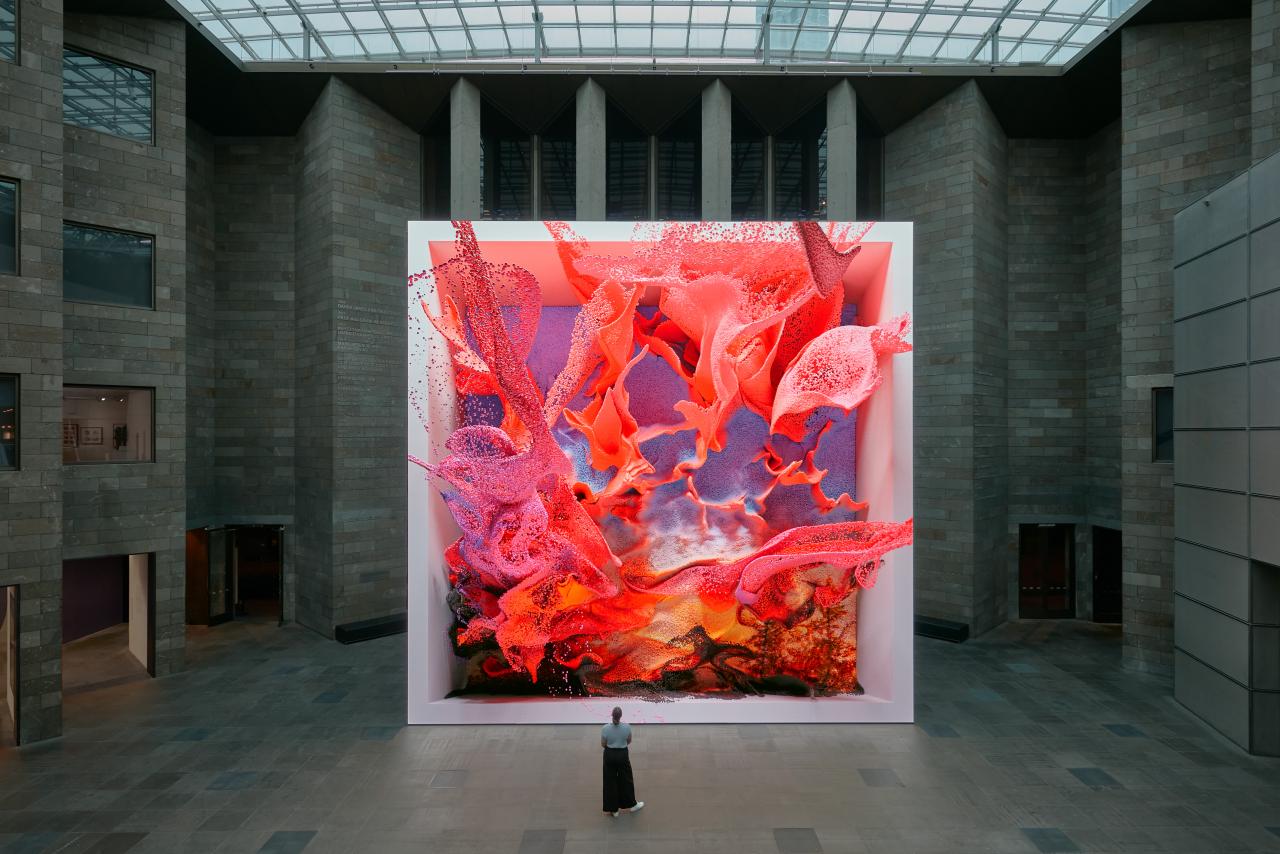
Refik Anadol: Quantum Memories (image sourced from NGV website)

First, the good news: no doubt it was a logistical headache to co-ordinate this exhibition while Melbourne was in strict lock-down for much of the past 10 months. Making admission free is also a wonderful public gesture given that the local population was starved of art exhibitions for most of last year – in particular, we missed out on the NGV’s winter blockbuster season.

The curators are also to be commended on assembling a diversity of artists, work and media; and for placing a great number of these new pieces among the NGV’s permanent collections, which forces visitors to assess these contemporary exhibits within the context of historic work.

But that’s probably where the positive ends.

A major drawback of this exhibition is the lack of anything truly ground-breaking, innovative or even challenging. It all felt very safe – but maybe that’s just what we needed after our extended social isolation: work that is comforting, familiar, cozy, cuddly, soothing, and certainly bright (lots of lively colours).

As a result, however, there seemed to be an emphasis of form over substance, technique over content, and scale over context. Much of the three-dimensional work felt flat and one-dimensional. Even the opening centrepiece, Refik Anadol’s “Quantum Memories” that dominates the entrance lobby, is a classic example of the “medium is the message”. Comprising a giant digital screen (incorporating a clever trompe-l’œil 3-D effect) to stream animated, computer-programmed images, ultimately gave the impression that this was all about the technology and the scale of the work. It was difficult to identify any meaning beyond mere decoration.

And unfortunately, “decorative” was a recurring theme, alongside some rather kitsch and lazy imagery – especially the digital and animated wallpaper that featured in several of the permanent galleries. These “displays” reminded me of cheesy son et lumière or pedestrian CGI effects – it may be technically adept, and even stylish to some degree, but that’s as far as it goes. Perhaps “deep” and “complex” are out of favour at the moment, as we make way for “shallow” and “simple”.

While some work might attempt to convey a more profound response, when shorn of its original context, the message is lost and the result is a void. I wasn’t necessarily looking for “deep and meaningful”, but I was hoping to be provoked or inspired. Or at least have my curiosity piqued.

Triennial? Could try harder.

Next week: Expats vs Ingrates?