Doctrine vs Doctrinaire

The recent “debate” surrounding the Federal Government’s proposed Religious Discrimination Bill was a staggering example of political overreach combined with poor policy management. It was also a stark reminder that although we live in a secular, pluralistic and liberal democracy, some politicians cannot refrain from bringing religion into the Parliament and on to the Statute Books, even where there was neither a strong mandate nor an overbearing need to change the existing law in the way the Government attempted.

As far as I can tell, the Bill was originally intended to give people of faith additional protection against discrimination on the basis of their religion. But when linked to related Sex Discrimination legislation, it would likely have given religious institutions some degree of protection against claims of discrimination in the areas of gender and sexual orientation, particularly in respect of children’s access to education and in relation to employment by faith-based organisations.

If that wasn’t worrying enough, the Bill was underpinned by a controversial “statements of belief” provision. As drafted, this would have granted a person immunity from prosecution for the consequences of their words or actions if such deeds were based on a “genuine” religious belief. I find this particularly troublesome, not because I think people should be vulnerable to persecution for their faith; rather, it sets a dangerous precedent for what religiously-motivated people may feel emboldened to do in the name of their particular faith, especially where their actions cause actual or genuine apprehension of harm (the “God told me to do it” defence).

The shift from doctrine to doctrinaire is all too palpable. It’s one thing to believe in Transubstination, yet another to use a public platform (including social media) to proclaim that “gays will burn in hell”  unless they renounce their ways. The problem with a very literal application of ancient religious texts (most of which are open to wide and sometimes contradictory interpretation) is that this approach does not allow for any concept of progress (scientific, cultural, societal). It also gives rise to extreme forms of fundamentalism, such as banning music or refusing to ordain women priests. History has also shown us that people purportedly adhering to the same religion frequently disagree, leading to turbulent schisms, violent sectarianism and untold bloodshed. Then there are the religious death cults that kill themselves and their children for the sake of achieving their own “beliefs” (in which their offspring surely couldn’t have been compliant or willing participants).

As Luke Beck wrote recently in The Conversation, “There is broad agreement a person should not be discriminated against on the basis of their faith or lack of faith. However, the extent to which religion should be a licence to discriminate against others remains enormously contentious.”

This putative “license” may be an unintended consequence of the Bill, but the implications, should it be enacted, could be far-reaching: archeologists being sacked for saying the earth is older than 6,000 years; anthropologists for saying that the first humans were living 2 million years ago; astronomers for saying the earth orbits around the sun…. And that’s just in the area of science.

I understand that a person of faith may have a deep-seated belief against birth control, or pre-marital sex, or alcohol, or tattoos, or marriage equality – but that doesn’t mean their faith should impose their choices on the rest of the population. (Just as people of faith aren’t being forced to consume booze or get inked against their will.) As it is, religious institutions enjoy significant tax benefits, public funding and legal exemptions, and this current “debate” is bringing some of these discrepancies into sharp focus.

The last time I looked, here in Australia we aren’t living in a theocracy, people of faith aren’t being fired from their jobs because of their religion, and secularists, agnostics and atheists aren’t calling for places of worship to be demolished. What the latter do expect is people of faith not to use their beliefs either as a pretext to justify any form of discriminatory, pejorative or harmful acts or statements, or as a protection against being accountable for their words and deeds.

Next week: When is a print not a print?
Same, same – but different?

At the time of writing, Melbourne and the rest of Victoria are waiting to know when (if?) the current lock-down will be lifted.

Just to recap: Melbourne is presently in its sixth shut down since March of last year, and the fourth so far of 2021. All combined, Melbourne has now clocked up more than 200 days under lock-down. The present measures were introduced on August 5, originally scheduled to last one week, and came barely a week after the previous lock-down ended. Lock-down #6 was soon extended by another week, and then by another two weeks, and will now extend beyond September 2. This is not counting the “stay at home” directive that was in place for most of 2020, along with the various limits and restrictions on social interaction, workplace capacity, public gatherings, hospitality, events, sport, gyms, retail, schools, funerals and weddings. We also have a night-time curfew for good measure.

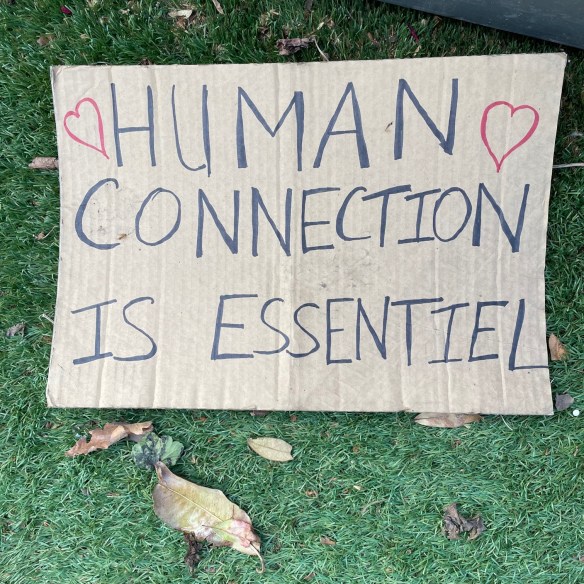
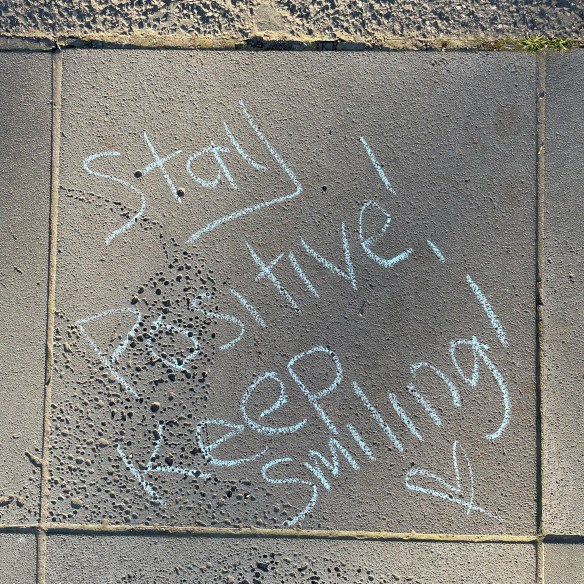
The following two pictures convey similar human sentiments, but they also represent very different responses to the situation we are living under. One is an example of the numerous messages of hope and encouragement that I see around my neighbourhood on my statutory daily walks. The other is a discarded placard seen a few days after an anti-lock-down protest.

The first reflects a “let’s grin and bear it” attitude – nobody likes being in lock-down, but we are all in this together, and if we can just remain positive, we will come through it OK.

The second is more reactive, and emotionally charged – the enforced isolation brought on by the lock-down is having an enormous effect on peoples’ mental health.

It’s hard to argue with either message….

I thought I would be able to cope better with each successive lock-down. Building a daily routine, maintaining some physical discipline (courtesy of the permitted daily exercise), managing at least 2-3 AFDs per week, treating myself to a nice restaurant-prepared meal now and then, catching up on films that I didn’t get to see at the cinema. But despite the recurring groundhog scenario, this lock-down seems different, and much harder to manage mentally.

First, the uncertainty of when it will end creates a sense of dread that we could be like this for 100 days or more (like lock-down #2). Second, the daily drip feed of data and the endless press conferences only reinforce the sense that we are not being given the full picture. Third, the sense of helplessness that for all our individual sacrifices of the past 18 months, we don’t seem to be any further ahead (if anything, we have gone backwards on so many counts). Fourth, State politicians seem to view this public health scare as a war of attrition between themselves and the voters (and their interstate and Federal counterparts). Gone is any sense that we are all in this together.

Quite apart from the cracks in Federation that the pandemic and its response has exposed, entire sections of the community are being driven apart and/or pitted against one another. Despite the so-called “National Plan” that the Commonwealth, State and Territory governments have all signed-up for, it’s clear that individual Premiers each reserve the right to interpret it differently, and will continue to impose internal border closures if they see fit. So, while Victoria and New South Wales seem aligned on this National Plan, Western Australia and Queensland in particular are more circumspect. Then there is the “race” to vaccinate their respective populations (or, as has been said a few times already, “our State citizens”, rather than “our Commonwealth citizens”).

At what point will the 70% and 80% vaccination levels be achieved to herald the promised social and economic freedoms? Is it the % of total population, or only the adult population, or only the eligible population, or only those between certain ages? Is it going to be calculated Federally, or at the State/Territory and/or LGA level? What about mandatory vaccinations for essential and front line workers, and those that have face-to-face dealings with the public? What about employers who require their staff to be fully vaccinated, but face resistance from unions?

Continued lock-down risks becoming a blunt instrument, and a tool of first (rather than last) resort. As such, it also risks alienating the majority of the population who are doing the right thing, in observing the public health directions and getting vaccinated (like, where’s the benefit?). And a prolonged lock-down risks undermining the efficacy of the vaccine, so we’ll need booster shots before we know it!

It seems that Covid19 is challenging our notions of the social contract between the government and the governed, and even testing the social license to operate we grant to big business (especially monopolies and cozy duopolies). The pandemic is also demonstrating the limits of individual responsibility and accountability, and potentially undermining the duty of care we owe to one another. If I knowingly, recklessly or carelessly (and as a result of breaching public health orders or OH&S measures) infect my family, my neighbour, my colleague or my customer, am I culpable? Does that mean I forfeit certain of my rights, especially if infection leads to death?

Just on the data, another reason the current lock-down seems different is because the information is being presented is not the same. Last year, everything was about the R0 number, flattening the curve, and “double-donut days”. There was also confusion over agreed terminology for “clusters”, “unknown cases”, “hot spots”, “red zones”, “complex cases” and “linked cases”. Politicians and bureaucrats talked about “settings”, “circuit breakers”, and “gold standards” for contact tracing. This year, it’s all about the “number of days infected”, “chains of transmission”, “mystery cases”, as well as the number of tests and vaccinations – much less analysis, it seems, on the number of confirmed cases per 1,000 tests or per 1,000 of the population, recovery rates or deaths as a percentage of cases.

From what I can glean, the stubborn levels of “mystery” cases can only be explained by the following:

  • more asymptomatic cases (are people building natural immunity?);
  • legacy cases shedding (a result of long Covid?);
  • longer incubation (and reporting) periods (less obvious initial symptoms?);
  • novel forms of transmission (or the virus is lingering longer on outdoor surfaces?);
  • QR codes and contact tracing not working (or the data is not usable?);
  • confusion over domestic/social/workplace/health/retail settings (e.g., extended families and multi-generational households?);
  • people being unclear about their movements (for fear of being victimised?).

Finally, I’m also not sure if lessons are being learned from elsewhere. We are still applying 14 day quarantine/isolation periods (albeit now with a day 17 test), yet in Hong Kong, for example, quarantine was extended to 21 days some time ago.

Next week: To be or NFT?


Is Federation still working?

As three of the six Australian States (and one of the two Territories) grapple with fresh COVID outbreaks, their respective lock-down measures reveal quite different responses to what should be considered a common problem. It’s not just the differences within their own borders, but also how they react in relation to each other in terms of classifying “hot spots” and imposing travel restrictions. It’s a fresh example that despite defining itself as a single nation, the Commonwealth of Australia remains a patchwork quilt, hurriedly stitched together from the remains of colonialism, under the pretext of “Federation”.

Federation feels even more of an artificial construct than the former British colonies themselves. In my view, the inconsistencies between each State and Territory in dealing with COVID, and their fractious collective and individual relationships with the Commonwealth, can be linked to questions of national identity, the legacy of imperialism, a lack of consensus on a Treaty with our First Nations people, and the failure of Republicanism to pave a way forward.

For a start, Australia tries to maintain four different codes of professional football – yet not every State or Territory is represented in the national competitions. Of these codes, one is essentially a Victorian competition, with a couple of other States brought in on merit, and a couple of the others only included after some fabricated interstate franchises. (And how long before a Victorian club has to relocate to Tasmania?)

Another football code runs an interstate competition, but only two States compete – and sometimes they compete in another State (just for the hell of it, or to try and instill “national” relevance?)

Cricket may rightfully claim to be a national sport at a professional level, but even the major Sheffield Shield competition excludes the two Territories.

These observations may appear flippant, but in a sport-loving nation, such examples might help explain why we don’t feel a very cohesive place – not all of us even get to barrack for our own State or Territory on the playing field!

There are many other examples of arbitrary differences between the States – e.g., unicameral or bicameral Parliaments; recognition of Public Holidays; the calculation of State election dates; the width of railway tracks; connectivity with energy grids; the minimum legal age for driving a car; the size of beer glasses in pubs; and the term for a “corner shop”.

Back in 1901, Federation must have felt like part of a grand scheme towards a modern era, designed to galvanize a bunch of colonies into a cohesive whole, and forge a new nation. But we don’t formally celebrate its existence with a public holiday. Rather, each State prefers to mark the Queen’s Birthday (albeit on different dates…) instead of recognizing the Act of Federation, which was supposed to confirm Australia’s independence from the UK. Not only that, but the “National Day” we do observe is Australia Day, which is highly contentious and increasingly overshadowed by its association with foreign invasion, imperial expansion and colonial oppression.

Back to COVID: recent events have shown that the “social contract” between the Commonwealth of Australia on the one hand, and the States and Territories on the other, is purely transactional. In respect to the pandemic, the Federal government has had two primary responsibilities: 1) international border control and quarantine; 2) vaccine acquisition and distribution. Although they have maintained closed borders, the Commonwealth has “delegated” quarantine arrangements to the States, with all the resulting inconsistencies and glaring mistakes. The Commonwealth has also fudged the vaccination roll-out (too many reasons and causes to go into here).

On the need for dedicated quarantine centres: while the States have taken on (or been lumped with) an unenviable task, after 18 months of the pandemic, I don’t understand why the States haven’t taken it upon themselves to build their own facilities, and then stick the Federal Government with the bill. If landlords won’t undertake essential property repairs when brought to their attention, I think most of us would agree that their tenants would have a valid case for getting the work done themselves and deducting the cost from the rent.

Except that the States don’t have that sort of leverage over the Federal Government (despite what Queensland and Western Australia might say and think).

In short, Federation is merely a way to distribute taxes levied by the Commonwealth – even then, this distribution is mired in political horse-trading and pork-barreling. The States, unable to raise their own revenue (other than via payroll tax, stamp duty, land tax and fees from providing certain services, issuing permits and granting licenses), are heavily reliant on Federal handouts. While this allocation is often dressed up in the guise of achieving minimum targets and standards, in reality funding is tied to political objectives.

I suppose even after 120 years, Federation can still be called a work in progress. Whatever the future debate on Australia Day and an indigenous Treaty (plus constitutional recognition and parliamentary representation), and whatever the prospect of a Republic, we may need to consider that the States, as currently constituted, have had their time and are increasingly redundant. Part of me thinks we might be better off by dissolving them (along with our local authorities) and re-constituting regional government and administration around the lands of the original settlers to this island. Just a thought.

Next week: Startup Vic FinTech Pitch Night

The Day That Can’t Be Named…

Today’s date, January 26th, has developed a deep identity crisis, much like the Australian psyche: who are we, how did we get here, and what does this day actually mean? A celebration of colonialism – or a day of indigenous mourning?

Leading up to this year’s public holiday, there has been: a muted response to suggested changes to the current National Anthem; a bewildering comment by the Prime Minister about finding equivalence in the circumstances of people sailing on the First Fleet and the impact those arrivals had on the indigenous population; constant bickering between the State and Federal governments about pandemic-related border controls (hardly an advertisement for Federation); renewed angst about the Australian cricket team (always a measure of the public mood); and an apparent drop in public support for an Australian Republic.

And there lies the nub of the issue. For some time now, it has felt that progress on a number of constitutional and cultural reforms has been hampered by the fact that Australia still hasn’t reached the maturity of declaring itself a Republic. The impediment to moving forward is the adherence to the post-colonial model of a Federation retaining the British Crown as the Head of State. The fact that we don’t formally recognise or celebrate Federation is in itself very telling.

Lack of maturity is endemic – from the habitual need to shorten words and phrases verging at times on baby talk (why on earth do the Prime Minister and the Leader of the Opposition choose to refer to themselves by their nicknames, “Scomo” and “Albo”?); to the suspicion of anything subtle, sophisticated or successful (the tall poppy syndrome).

Another foil to constitutional progression is the disproportionate influence (and position of privilege) that religious institutions retain in what is supposed to be a secular society.

Then there is the inability or reluctance to celebrate national success (apart from on the sporting field). Yes, Australia does “punch above its weight” in many areas, but there is so much inherent conservatism (small “c”) built into the system. The combination of 2-party politics, 3-tiers of government, cosy commercial duopolies, complex taxation, rigid regulatory frameworks, the laggardly trade union movement (not to say timid public policies on the environment, science, technology, education and the arts) inhibits innovation and experimentation. This institutional inertia (or conspiracy) all adds up to on overwhelming sense of acceptance, complacency and “she’ll be right”.

What if we had to work from the basis of some alternative histories? How would that change our views about January 26th? For example, what if either the French, Dutch, Spanish or Portuguese had colonised this land in the 17th or 18th century instead of the British arrived? What if the First Nations of Australia had developed metal tools and had fought back and won? What if Chinese fishing fleets or Indian trading vessels had established control of Australian waters and harbours long before the Europeans arrived? What if Indonesian or Malay tribes had settled here even further back than that? What if Japan had won the Pacific War?

This is not to excuse or justify the actions of the British in colonising the many nations that already existed in Australia, and all that followed from that. After all, the British Isles themselves had been invaded and conquered on many occasions over the centuries, so the First Fleet could be seen as a logical extension of that sequence of events. But perhaps this perspective can provide some additional context, helping us to reflect on the events and circumstances that have brought us to this point, and hopefully point to a way forward.

Next week: The Return of Cultural Cringe