At the risk of coming across as some sort of Luddite, recent commentary on Artificial Intelligence suggests that it is only natural to have concerns and misgivings about its rapid development and widespread deployment. Of course, at its heart, it’s just another technology at our disposal – but by its very definition, generative AI is not passive, and is likely to impact all areas of our life, whether we invite it in or not.
Over the next few weeks, I will be discussing some non-technical themes relating to AI – creativity and AI, legal implications of AI, and form over substance when it comes to AI itself.
To start with, these are a few of the questions that I have been mulling over:
– Is AI working for us, as a tool that we control and manage? Or is AI working with us, in a partnership of equals? Or, more likely, is AI working against us, in the sense that it is happening to us, whether we like it or not, let alone whether we are actually aware of it?
– Is AI being wielded by a bunch of tech bros, who feed it with all their own prejudices, unconscious bias and cognitive limitations?
– Who decides what the Large Language Models (LLMs) that power AI are trained on?
– How does AI get permission to create derived content from our own Intellectual Property? Even if our content is on the web, being “publicly available” is not the same as “in the public domain”
– Who is responsible for what AI publishes, and are AI agents accountable for their actions? In the event of false, incorrect, misleading or inappropriate content created by AI, how do we get to clarify the record, or seek a right of reply?
– Why are AI tools adding increased caveats? (“This is not financial advice, this is not to be relied on in a court of law, this is only based on information available as at a certain point in time, this is not a recommendation, etc.”) And is this only going to increase, as in the recent example of changes to Google’s AI-generated search results? (But really, do we need to be told that eating rocks or adding glue to pizza are bad ideas?)
– From my own experience, tools like Chat GPT return “deliberate” factual errors. Why? Is it to keep us on our toes (“Gotcha!”)? Is it to use our responses (or lack thereof) to train the model to be more accurate? Is it to underline the caveat emptor principle (“What, you relied on Otter to write your college essay? What were you thinking?”). Or is it to counter plagiarism (“You could only have got that false information from our AI engine”). If you think the latter is far-fetched, I refer you to the notion of “trap streets” in maps and directories.
– Should AI tools contain better attribution (sources and acknowledgments) in their results? Should they disclose the list of “ingredients” used (like food labelling?) Should they provide verifiable citations for their references? (It’s an idea that is gaining some attention.)
– Finally, the increased use of cloud-based services and crowd-sourced content (not just in AI tools) means that there is the potential for overreach when it comes to end user licensing agreements by ChatGPT, Otter, Adobe Firefly, Gemini, Midjourney etc. Only recently, Adobe had to clarify latest changes to their service agreement, in response to some social media criticism.
Last week I was invited to participate in a Virtual Demo Day for students enrolled in the Monash University Boot Camp, for the FinTech, Coding and UX/UI streams. The Demo Day was an opportunity for the students to present the results of their project course work and to get feedback from industry experts.
While not exactly the same as a start up pitch night, each project presented a defined problem scenario, as well as the proposed technical and design solution – and in some cases, a possible commercial model, but this was not the primary focus. Although the format of the Demo Day did not enable external observers to see all of the dozen-plus projects, overall it was very encouraging to see a university offer this type of practical learning experience.
Skills-based and aimed at providing a pathway to a career in ICT, the Boot Camp programme results in a Certificate of Completion – but I hope that undergraduates have similar opportunities as part of their bachelor degree courses. The emphasis on ICT (Cybersecurity and Data Analytics form other streams) is partly in response to government support for relevant skills training, and partly to help meet industry requirements for qualified job candidates.
Industry demand for ICT roles is revealing a shortage of appropriate skills among job applicants, no doubt exacerbated by our closed international borders, and a downturn in overseas students and skilled migration. This shortage is having a direct impact on recruitment and hiring costs, as this recent Tweet by one of my friends starkly reveals: “As someone who is hiring about 130 people right now, I will say this: Salaries in tech in Australia are going up right now at a rate I’ve never seen.” So nice work if you can get it!
As for the Demo Day projects themselves, these embraced technology and topics across Blockchain, two-sided marketplaces, health, sustainability, music, facilities management, career development and social connectivity.
The Monash Boot Camp courses are presented in conjunction with Trilogy Education Services, a US-based training and education provider. From what I can see online, this provider divides opinion as to the quality and/or value for money that their programmes offer – there seems to be a fair number of advocates and detractors. I can’t comment on the course content or delivery, but in terms of engagement, my observation is that the students get good exposure to key tech stacks, learn some very practical skills, and they are encouraged to follow up with the industry participants. I hope all of the students manage to land the type of opportunities they are seeking as a result of completing their course.
The usual Silicon Beach rules applied – Round One featured 90-second pitches from each founder (and no slide decks), from which the judges shortlisted 3 startups for Round Two. The Round One presentations in order of appearance were (as usual, website links are embedded in the names):
Using “emotional phase shifting to accelerate personal growth and transformation through Insight, Manifestation and Neuroscience”, the impetus for this startup came about from the founder’s own experience. Designed to help overcome certain mental health issues associated with anxiety, the founder claims his technique can help practitioners overcome events such as panic attacks within 6 seconds (as opposed to 600 seconds with traditional CBT methods). Had been accepted into the Founders’ Institute, then COVID came along.
There is a growing demand for plant-based foods, both as a source of sustainable protein, and in response to the increased prevalence of food-based allergies (e.g., gluten and soy). Add concerns about GMOs, unsustainable agriculture and climate change, the founder is looking to develop a scalable process for extracting specific types of leaf protein, including arid-climate plants and Australian natives such as saltbush to counter soil salination. Currently seeking funding to pay for a CSIRO pilot to scale the protein extraction.
Essentially a toy-lending app, that provides an end-to-end process (source, distribute, cleanse, circulate) via a subscription model. In trials, already secured 50 customers and over 100 subscribers. Estimates there is a $2.4bn toy market in Australia – but it wasn’t clear how much of this market the founders aim to capture.
This app aims to bring childrens’ drawings to life, using AI/ML to scan a photo of the drawing, and convert it into an animated 3-D digital file that can be rendered within the app using augmented reality.
Using the oft-heard tag line “data is the new oil”, this B2B solution is designed to help companies organise, manage and extract more value from their data. It does this by resolving issues of data inconsistency, privacy, risk and governance. It also derives and assigns numerical factors to to individual datasets to assess the “value” of this data, and uses indices to benchmark that value.
This product feels like a cross between a wiki for academic research papers, and an open text search tool to find answers within the wiki database. I know from experience that repositories of published research reports (especially refereed and peer reviewed papers) are highly structured and tagged, with the emphasis being on classification, authorship and citation. Often, you sort of need to know in advance the rough answer to the question you want to pose. Significant resources are already allocated to maintaining and commercialising these existing databases, so I’m not sure how QuestionID will deal with IP and other rights associated with these reference resources.
HiveKeepers is designed to support beekeepers by helping them to establish and maintain healthier hives, and enhance their own livelihoods at a time when the industry is facing numerous challenges. At its core is a smart phone app that monitors IoT sensors (temperature, weather, weight, motion, sound, etc.) attached to the hive itself. Over time, the data will enable predictive analytics. With the launch of its MVP, HiveKeepers has already attarcted 700 customers globally.
Round Two
The three finalists selected from Round One were KidoPaint, LeafProtein and HiveKeepers. Each founder made a longer pitch, and then answered questions from the judges:
Kido Paint – The Q&A discussion centred on the commercial model (B2B/C, gift cards, in-app vouchers), the file conversion process (turnaround time can be 24- 48 hours), options for scaling, and getting the right price pint for user prices. So it’s not an instant result (which may disappoint some impatient younger users), and the 3-D rendering and animation is somewhat limited to the imagination of the AI/ML algorithms used in the conversion process.
LeafProtein – There was a further discussion on the approach to producing sustainable and allergen free plant proteins. For example, the attraction of pereskia is two-fold – a higher protein ratio, and an arid climate plant. Also, the aim is to counter mono-culture and GMO crops. A D2C brand has been launched (using small-scale production processes), while the CSIRO project is to designed to scale protein extraction, as well as develop an emulsifier for use in the food industry.
HiveKeepers – The founder talked more about the need to address climatic and environmental impact on hives. Having benefited from support from the La Trobe University and SVG Thrive AgriFood accelerator programs, this startup is seeking funding for product development – current price point is $105 USD per smart hive per annum. While the industry is seeing a 2% growth in new hives, it is also suffering significant hive losses due to parasites and diseases.
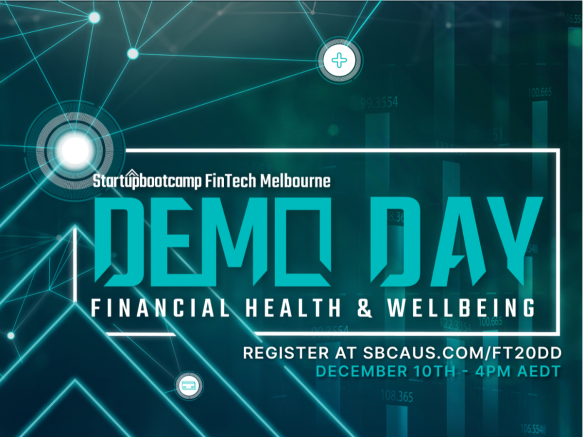
Taking its cue from some of the economic effects of the current pandemic, the latest Startupbootcamp Melbourne FinTech virtual demo day adopted the theme of financial health and well-being. When reduced working hours and layoffs revealed that many that people did not have enough savings to last 6 weeks, let alone 6 months, lock-down and furlough have not only put a strain on public finances, they have also revealed the need for better education on personal finance and wealth management. Meanwhile, increased regulation and compliance obligations (especially in the areas of data privacy, cyber security and KYC) are adding huge operational costs for companies and financial institutions. And despite the restrictions and disruptions of lock-down, the latest cohort of startups in the Melbourne FinTech bootcamp managed to deliver some engaging presentations.
Datacy allows people to collect, manage and sell their online data easily and transparently, and gives businesses instant access to high quality and bespoke consumer datasets. They stress that the data used in their application is legally and ethically sourced. Their process is also designed to eliminate gaps and risks inherent in many current solutions, which are often manual, fragmented and unethical. At its heart is a Chrome or Firefox browser extension. Individual consumers can generate passive income from data sales, based on user-defined permissions. Businesses can create target data sets using various parameters. Datacy charges companies to access the end-user data, and also takes a 15% commission on every transaction via the plugin – some of which is distributed to end-users, but it wasn’t clear how that works. For example, is it distributed in equal proportions to everyone, or is it weighted by the “value” (however defined or calculated) of an individual’s data?
Harpocrates Solutions provides a simplified data privacy via a “compliance compliance as a service” model. Seeing itself as part of the “Trust Economy”, Harpocrates is making privacy implementations easier. It achieves this by monitoring and observing daily regulatory updates, and capturing the relevant changes. It then uses AI to manage a central repository, and to create and maintain tailored rules sets.
Mark Labs helps asset managers and institutional investors integrate environmental and social considerations into their portfolios. With increased investor interest in sustainability, portfolio managers are adopting ESG criteria in to their decision-making, and Mark Labs helps them in “optimising the impact” of their investments. There are currently an estimated $40 trillion of sustainable assets under management, but ESG portfolio management is data intensive, complex and still emerging both as an analytical skill and as a practical portfolio methodology. Mark Labs helps investors to curate, analyze and communicate data on their portfolio companies, drawing on multiple database sources, and aligning to UN Sustainable Development Goals. The founders estimate that there are $114 trillion of assets under management “at risk” if generational transfer and investor mandates shift towards more ESG criteria.
MassUp is a digital white label solution for the property and casualty insurance industry (P&C), designed to sell small item insurance at the consumer point-of-sale (POS). Describing their platform as a “plug and sell” solution, the founders noted that 70% of portable items are not covered by insurance policies, and many homes and/or contents are either uninsured or under-insured. MassUp is intended to simplify the process (“easy, accessible, online”), and will be launching in Australia under the Sorgenfrey brand in Q2 2021. For example, a product known as “The Flat Insurance” will cover items in and out of your home for a single monthly premium. As MassUp appears to be a tech solution, rather than a policy issuer, underwriter or re-insurer, I couldn’t see how they can achieve competitive policy rates both at scale and with simplicity (especially the claims process). Also, as we know, vendors love to “upsell” insurance on tech appliances, but many such policies have been seen to be redundant when considering existing statutory consumer rights and product warranties. On the other hand, short-term insurance policies (e.g., when I’m traveling, or on holiday, or renting out my home on AirBnB) are increasingly of interest to some consumers.
Ontrack provides B2B white label digital retirement planning solutions for financial institutions to help their customers in a more personalised way. There is a general consumer reluctance to pay for financial advice, but retirement planning is deemed too complicated. Taking an “holistic” approach, the founders claim to have developed a “best in class simulation engine” – founded on expected retirement spending priorities (rather than trying to predict the cost of living in 20 years’ time). Drawing on their industry experience, the founders stated that a key challenge for many financial planning providers is getting members comfortable with your service. I would also add that reducing complexity with cost-effective products is also key – and financial education forms a big part of the solution.
In Australia, the past 10 years has seen a major exit from the financial planning and wealth management industry – both at the individual adviser level (higher professional qualification requirements, increased compliance costs, and the end of trailing sales commissions in favour of “fee for advice”); and at the institutional level (3 of the big 4 banks have essentially withdrawn from offering financial planning and wealth management services). At the same time, there have been a number of new players – including many non-bank or non-financial institution providers – offering so-called robo-advice and “advice at scale”, mainly designed to reduce costs. In addition, the statutory superannuation regime keeps being tweaked so it is increasingly difficult to plan for the future, with the constant tax and other changes. Superannuation (a key success story of the Keating government) is just one of the “pillars” of personal finance in retirement: the others are the Commonwealth government aged pension (means-tested), personal wealth management (e.g., investments outside of superannuation); and retirement housing (with the expectation of more people opting to remain in their own homes). I would also include earnings from part-time employment while in “retirement”, as people work longer into older age (either from choice or necessity) – how that aligns with the aged pension and/or self-funded retirement is another part of the constantly-shifting tax and social security regime.
This product describes itself as a customer data platform that powers stored value, and was described as a “Safe harbour” solution (I’m not quite sure that’s what the founders meant in this context?). According to the pitch, consumers gain a fair and equitable outcome (consumer discounts), while retailers get targeted audiences. The team have created a vertically integrated gift card platform (working with MasterCard, Apple Pay and GooglePay), and launched JamJar, a cashback solution.
Similar to Harpocrates (above), RegRadar is a regulatory screening platform that helps companies “to set routes and avoid crashes”. The tool monitors regulatory changes (initially in the financial, food and healthcare sectors) and uses a pro-active process to developing a regulatory screening strategy, backed by analysis and a decision-support tool.
Having worked in legal, regulatory and compliance publishing for many years myself, I appreciate the challenge companies face when trying to keep up with the latest regulations, especially where they may be subject to multiple regulatory bodies within and across multiple jurisdictions. However, improved technology such as smart decision-support tools for building and maintaining rules-based business systems has helped enormously. In addition, most legislation is now online, so it can be searched more easily and monitored via automated alerts. Plus services such as Westlaw and Lexis-Nexis can also help companies track what is currently “good” or “bad” law by tracking court decisions, law reports and legislative updates.
 Content in Context