What might we expect in 2017?

On a number of measures, 2016 was a watershed year. Unexpected election results, fractious geopolitics, numerous celebrity deaths, too many lacklustre blockbuster films, spectacular sporting upsets (and regular doping scandals), and sales of vinyl records are outpacing revenue from digital downloads and streaming services. What might we expect from 2017?

Detail from "The Passing Winter" by Yayoi Kusama (Photo by Rory Manchee)

Detail from “The Passing Winter” by Yayoi Kusama [Photo by Rory Manchee]

Rather than using a crystal ball to make specific predictions or forecasts, here are some of the key themes that I think will feature in 2017:

First, the nature of public discourse will come under increased scrutiny. In the era of “post-truth”, fake news and searing/scathing social commentary, the need for an objective, fact-based and balanced media will be paramount. In addition, the role of op-ed pieces to reflect our enlightened liberal traditions and the need for public forums to represent our pluralist society will be critical to maintaining a sense of fairness, openness, and just plain decency in public dialogue.

Second, a recurring topic of public conversation among economists, politicians, sociologists, HR managers, career advisors, bureaucrats, union leaders, technologists, educators and social commentators will be the future of work. From the impact of automation on jobs, to the notion of a universal basic income; from the growth of the gig economy, to finding purpose through the work we do. How we find, engage with and navigate lifelong employment is now as important as, say, choosing high school electives, making specific career choices or updating professional qualifications.

Third, the ongoing focus on digital technology will revolve around the following:

  • The Internet of Things – based on a current exhibit at London’s Design Museum, the main use cases for IoT will continue to be wearable devices (especially for personal health monitoring), agriculture, transport and household connectivity
  • Fintech – if a primary role of the internet has been for content dissemination, search and discovery, then the deployment of Blockchain solutions, the growth in crypto-currencies, the use of P2P platforms and the evolution of robo-advice are giving rise to the Internet of Money
  • Artificial Intelligence – we are seeing a broader range of AI applications, particularly around robotics, predictive analytics and sensory/environmental monitoring. The next phase of AI will learn to anticipate (and in some cases moderate) human behaviour, and provide more efficacious decision-making and support mechanisms for resource planning and management.
  • Virtual Reality/Augmented Reality – despite being increasingly visible in industries like gaming, industrial design, architecture and even tourism, it can feel like VR/AR is still looking for some dedicated use cases. One sector that is expected to benefit from these emerging technologies is education, so I would expect to see some interesting solutions for interactive learning, curriculum delivery and student assessment.

Fourth, and somewhat at odds with the above, the current enthusiasm for the maker culture is also leading to a growing interest in products that represent craft, artisan and hand-made fabrication techniques and traditions. Custom-made, bespoke, personalized and unique goods are in vogue – perhaps as a reaction to the “perfection” of digital replication and mass-production?

Fifth, with the importance of startups in driving innovation and providing sources of new economic growth, equity crowdfunding will certainly need to come of age. Thus far, this method of fund-raising has been more suited (and in many cases, is legally restricted) to physical products, entertainment assets, and creative projects. The delicate balance between retail investor protection and entrepreneurial access to funding means that this method of startup funding is constrained (by volume, amounts and investor participation), and contrary to stated intentions, can involve disproportionate set up costs and administration. But its time will come.

Finally, as shareholder activism and triple bottom line reporting become more prevalent (combined with greater regulatory and compliance obligations), I can see that corporate governance principles are increasingly placing company directors in the role of quasi-custodians of a company’s assets and quasi-trustees of stakeholder interests. It feels like boards are now expected to be the conscience of the company – something that will require directors to have greater regard to the impact of their decisions, not just whether those decisions are permitted, correct or good.

One thing I can predict for 2017, is that Content in Context will continue to comment on these topics, and explore their implications, especially as I encounter them through the projects I work on and the clients I consult to.

Next week: The FF17 Semi Finals in Melbourne
101 #Startup Pitches – What have we learned?

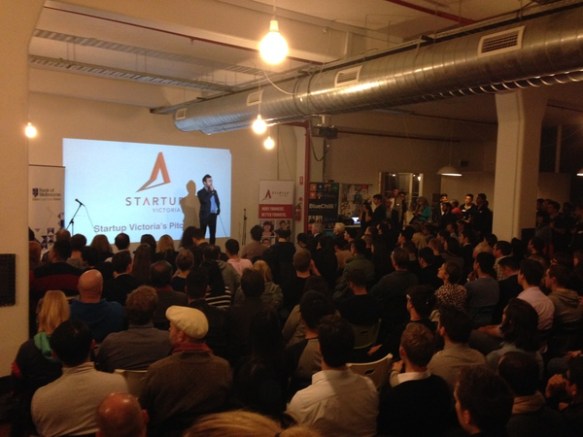
During the past 3 years of writing this blog, I have probably heard more than 100 startup founders pitch, present or share their insights. Most of these pitch nights have been hosted by Startup Victoria, with a few on the side run by the Melbourne FinTech Meetup and elsewhere.

Image sourced from Startup Victoria Meetup

Image sourced from Startup Victoria Meetup

Based on all these presentations, I have collated a simple directory of each startup or pitch event I have covered or mentioned in this blog, as well as a few key accelerators and crowdfunding platforms.

What have we learned over that time?

First, apart from the constant stream of new startups pitching each month, it’s been impressive to witness the Melbourne startup community collaborate and support one another.

Second, some of the international founders who have spoken are among the rock stars of startups – and we are fortunate that they have been willing to spend time in Melbourne.

Third, a number of the local startups who have pitched during this time have become well-established and well-known businesses in their own right.

This all means that besides creating great products and services, and being willing to share their experiences, the founders have helped aspiring founders and entrepreneurs to appreciate the importance of:

  • product-market fit;
  • working with agile processes and lean startup models;
  • tackling prototyping and launching MVPs;
  • learning what to measure via key metrics;
  • figuring out funding; and
  • knowing when to pivot or fold.

Looking at the cross section of pitch nights, panel discussions and guest speakers, there are some significant trends and notable startups to have emerged:

Industry focus: Not surprisingly, the pitches are heavily biased towards FinTech, MedTech, Education, Digital Media, Enterprise Services and Consumer Services. There are a some key startups focused on devices (e.g., SwatchMate and LIFX); a smattering in recruitment, fashion, gaming, health and well-being, property services, social media and even logistics. But there are surprisingly few in environmental technology or services.

Business models: Two-sided market places abound, as do customer aggregators, sharing platforms (“the Uber for X”, or “the AirbnB of Y”), freemium apps and subscription services (as opposed to purely transactional businesses). There are also some great social enterprise startups, but surprisingly no co-operative models (apart from THINC).

Emerging stars:  Looking through the directory of startups, some of the star names to have come through during this time, based on their public profile, funding success, awards (and ubiquity at startup events….) include:

CoinJar, LIFX, Tablo, SwatchMate, etaskr, DragonBill, Culture Amp, Eyenaemia, Timelio, Moula, nuraloop,  Konnective, OutTrippin and SweetHawk.

Acknowledgments: Some of the startups and pitches in the list are just ideas, some don’t even have a website, and some didn’t get any further than a landing page. However, I have not been able to include all the startups that turned up at Startup Alley, nor the many more startup founders I have met through these events (but whom I didn’t get to see pitch or present), nor the startup ideas that were hatched during the hackathons I have participated in. And there are a few startups that I could not include because I heard them pitch at closed investor events. Finally, I am and have been very fortunate to work with a number of the startups listed, in various capacities: Brave New Coin, Ebla, Re-Imagi, Slow School of Business and Timelio. To these startups and their founders, I am extremely grateful for the opportunities they have given me.

Next week: Putting a Price on Value


A new co-operative model for equity #crowdfunding

**Updated with some clarifications** Last week, I attended the launch of a new equity crowdfunding scheme, called The Innovation Co-op (THINC). It’s the latest model I have seen that is trying alternative approaches to startup and SME funding – given that equity crowdfunding still isn’t possible in Australia.* There’s been the venture bank model, straightforward sweat equity, slicing the pie, and of course, the small-scale offering approach. What they are all trying to do is connect three core assets: capital, ideas and expertise.

Screen Shot 2016-05-16 at 7.01.28 PM

THINC works on the basis that the Co-operatives National Law allows members to come together for a common benefit. This includes the financial benefit of generating economies of scale via the collective purchase of goods and services, the use of capital for the group’s common interest, and the distribution of profits to members from investment and trading activities. Co-operatives fall outside the Corporations Law (so, are not regulated by ASIC), but are subject to the State-based Consumer Affairs and/or Fair Trading authorities.

Participation in THINC involves three types of membership:

  1. Custodians – the founders of THINC, who form the initial Board of Management and represent the “expertise“, will provide commercial services to the companies that THINC invests in (see #2). As founders, they also control 50% of the equity in THINC itself. Based on a notional valuation of the cash and in-kind contributions they have made in setting up THINC, they calculate that they have provided around $1m in contributed equity.
  2. Pioneers – entrepreneurs, founders and SME owners (the “ideas“) in whose businesses THINC will take an equity stake (initially 10%, but may rise to 50%), in return for which the Pioneers receive help in the form of commercialisation strategies and other support to grow their companies. Pioneers are subject to a number of selection criteria, and are expected to use the shared managed services offered by the Custodians (at discounted rates).
  3. Champions – general members of THINC, who also provide the “capital” as investing members by buying Capital Contribution Units (CCU). Collectively, they hold the other 50% of THINC’s equity (albeit as a different class of share to the Custodians) and will also split any distributions or dividends with the Custodians (the latter can only attract a maximum 12% of any dividends, leaving the rest for distribution to Champions, for operating capital, and for maintaining cash on hand).

I should say upfront, that I have applied for membership of THINC as a Champion, but I haven’t yet decided whether or not to invest via the purchase of the CCU scheme. I am seeking clarification on the legal and financial structure, as it is quite complex, and not as straightforward as buying shares or bonds in a company, purchasing units in a managed fund, or becoming a member of a “traditional” mutual such as a credit union, building society or member-owned community bank, for example. Also, I am not qualified to say if this is a good investment, and anyone interested should seek their own professional advice.

Some advantages of this co-operative model are that, unlike other small-scale offerings limited to “sophisticated” investors (legally defined), anyone can invest, and there is no cap on the number of investors. Each CCU costs $500, and Champions may invest up to $5,000 (any more may breach the maximum individual shareholdings of a co-operative). On the other hand, regardless of how many CCUs a member owns, they only have one vote (whereas with normal equity, voting weight is in proportion to the number of shares). And while the CCUs are tradeable, they can only be sold or transferred to other members.

THINC expects to exit each investment it makes after 5 years. I understand that THINC itself may be dissolved or divested, and the final proceeds distributed to the relevant members in proportion to their CCU holdings.

Whatever else, the organisers behind THINC must be applauded for their ingenuity – innovation comes from pushing the envelope. (There is even a patent pending on the model – generating an additional revenue stream from licensing opportunities?) However, I am somewhat wary of schemes that are largely designed to get around either tax issues or legal impediments. Generally, I would say it is preferable to start with a clear set of goals and objectives, and choose the most appropriate funding vehicle or legal structure to achieve that outcome, rather than identifying a structure and fitting the business model to fit.

* Footnote: Although there’s some draft legislation going through Parliament, it hasn’t been passed by the Senate, and some commentators say that the Bill does not achieve the stated goals of what most people would regard as an equity crowdfunding model.

Next week: Design thinking is not just for hipsters….

#StartupVic showcases the next batch of startup hopefuls

Startup Victoria‘s monthly pitch event is gaining momentum, and continues to draw a good crowd at inspire9. It can’t just be the beer’n’pizza, can it? April’s event brought together an intriguing mix of startups – from the FinTech, SoMe, health food and enterprise sectors.

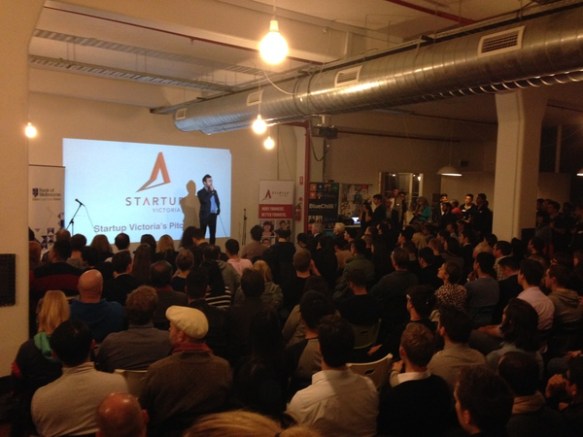
If it's the last Tuesday in the month, it must be Startup Vic's pitch night at inspire9.... (Photo sourced from Meetup)

If it’s the last Tuesday in the month, it must be Startup Vic’s pitch night at inspire9…. (Photo sourced from Meetup)

Liive

This app-based solution claims to have more than just its finger on the pulse of Melbourne’s nightlife, in the form of a “Teleportation” experience. If you want to check out what’s going on at that club or bar before you leave home, Liive will beam visitor and sponsor sourced content onto your smart phone. It’s sort of a social media cum streaming cum location-based service, which promoters and venues can license and then encourage patrons to share their video grabs (in return for free drinks….).

While the app is free to download and use by individual customers, revenue comes from event and venue promotion, and is pitched as a user experience that enables patrons to “try before they buy”. Liive reckons it has got the CPA down to A$1.68, and is experiencing 20% weekly growth based on user numbers.

Already signing up some significant leisure businesses, Liive seems to be making a splash within a relatively short space of time. In the words of one of the judges, I’m probably not the target demographic, so it’s difficult to relate to this concept. Unsurprisingly, students are a key market, but having spent time this past week facilitating a team of international students, I hope the founders can think of culturally inclusive uses and ways to promote their app.

I was also reflecting on things like privacy, content ownership, and whether this is a solution in search of a need – why not just use other, existing SoMe platforms? But it was good to hear that the content is moderated and subject to take down notices.

Estate Baron

This FinTech business is bringing equity crowdfunding to property development – and is clearly designed to displace banks. With a background in residential mortgage-backed securities (RMBS) the founder has some relevant market experience.

The business model does away with the need for traditional investor syndicates, and is offering an alternative source of funding for property developers. To be clear, investors are taking equity in the entity (usually a special purpose vehicle – SPV) that is launching the development, not the properties themselves – so they do not get any title over individual units or apartments.

Given the need to be fully compliant with AFSL and MIS requirements, Estate Baron has a retail financial services license, and issues full product disclosure statements for each venture. So far, it has raised over $2m in project funding, from over 1100 investors.

The pitch was at pains to explain that Estate Baron holds an RG146 license for general advice only, not individual advice, so potential investors are advised to seek professional financial and investment advice suitable and appropriate to their own needs and circumstances.

Estate Baron charges a capital raising fee, which allows developers who don’t typically hold a financial license to access more investors. Currently, funding is usually done via syndicates, off-line, or via managed property funds etc.

The founders acknowledge that the idea originated overseas, and is part of a global movement. They even mentioned the possibility of using a Blockchain solution for deal origination and management.

Personally, the idea of crowdfunding for property development is appealing, but I’d like to see more market engagement before determining whether this is the right (or only) model.

Athlete’s Gift

Originally launched under the name “The GeneSpark”, this food business is promoting customised menus and recipes based on customers’ individual DNA. I think the recent change of name was prompted by brand confusion, rather than any medical concerns, but I was still left unclear as to what this business actually offers.

If I am understanding correctly, the products are special mixes of super foods, nuts, seeds and berries designed for high-protein, high-energy or recovery – using all-natural, organic and raw ingredients. Customers make their own product selections, and can even develop personal recipes to suit their DNA. But the business does not conduct DNA tests, and I don’t believe there is any verification process to ensure customers are making appropriate or safe choices – which would possibly stray into medical territory?

I sort of understand the business model (3-month subscription packages, distribution via gyms and sports clubs, etc.), and I even applaud the long-term goal of reducing chronic diseases. But I was left with the question: Is this proven science, another food fad or a product placement strategy?

Konnective

Konnective has developed an enterprise solution that brings an employee messaging tool for frontline staff, regardless of their location or whether they have access to a desktop computer.

The tool was originally developed for schools (to replace the paper-based parent communications), but is finding traction within the health care, hospitality, mining, manufacturing and services sectors. To my personal surprise, many workers in these industries do not have corporate e-mail addresses. Based on push technology, it’s cheaper than SMS. The app is free to end users, but businesses pay a tiered price based on the number of employees, at $10 per person per annum.

It’s flexible enough to support mixed content types, and is managed via a back end admin platform. Already, some major public companies are on board, with the founders claiming to have 100+ clients.

To clarify, this app is about broadcasting, not team collaboration or project management. It can be used for two-way communications with employees, but only for structured content such as surveys and polls. It was not clear whether the back-end allows messaging to be targeted by location, function, department, team or even seniority – maybe not everyone in the company will have the same information needs?

I can see an opportunity among organisations that engage large numbers of contractors, freelancers and casual staff who might not have company-based individual e-mail accounts. But part of me thinks that with increased smart phone usage and BYOD (plus the fact that most e-mail clients are easily configurable to mobile devices), what makes Konnective attractive? Clearly it’s doing something right as it took out first place!

Next week: A new co-operative model for equity crowdfunding