Last week I blogged about ageing rockers and the growing number of septua- and octo-genarian musicians still touring and recording. Perhaps they never got The Who‘s memo about hoping to die before they get too old? Anyway, it’s enough to make you think Jethro Tull should update the lyrics to their 1970’s song….
Over in the world of sport, it seems ageism is still a thing. At the Australian Tennis Open in January this year, there was much media commentary (even surprise, disbelief and incredulity) that a 43-year old player reached the men’s doubles final, and had the temerity to win. In doing so, he become the oldest Grand Slam winner, and oldest to achieve a #1 ranking. Goodness knows what those same sports writers will make of a 41-year cricket player becoming the first fast bowler to claim 700 Test wickets.
Meanwhile, the US Presidential election looks like it will be fought out between an increasingly frail 81-year old incumbent, and an erratic 77-year old challenger, who has the audacity to say his adversary is not fit to stand on grounds of age and cognitive impairment. (To say that this contest will be far from elegant or dignified is an understatement!)
However, very few of us ever get to run for President – but most of us will experience something akin to the Grey Ceiling. We will reach a point in our working life when we are considered too old for promotion, or too old to hire, or too old to be retrained, or too old to be kept on.
In some roles and industries, there are compulsory retirement ages. And I get that.
What I can’t understand is the notion that just because someone is in their 50s or 60s, they are on the scrap heap of their career. The last time I was made redundant from a corporate role in a multinational organization, I had just turned 50. I can’t prove anything (because that would be age discrimination), but I had sense that it was “easier” for the company to let me go than a younger colleague: I had no dependencies, I hadn’t quite reached the full entitlement of long service leave, and I was not an expat so there were no relocation costs to consider.
At one job interview following that redundancy, the interviewer had the audacity to suggest that due to my age, experience and seniority, I would be less likely to “get my hands dirty” with day-to-day business operations and commercial decisions, and more likely to sit back and “direct traffic”. There was also a suggestion that I would be less willing/able to adapt to new technology, giving the overall impression he thought at my age, I was simply looking for an easy life.
Thanks to such attitudes which I also encountered elsewhere, I am glad I went to work as a freelance consultant and contractor with smaller businesses, start ups, owners and founders, and also in the cutting-edge technology of blockchain, crypto and digital assets – I have learned so much more in the past 10 years than I probably did in the previous 20 years of my career.
One thing I definitely don’t miss from corporate life is office politics!
And if neither ageing rock stars, nor 40-year old sports people at the peak of their careers, inspire you in your own journey (or as you hit the Grey Ceiling), perhaps some of the stories in The Guardian’s “Life After 60” series will inspire you.
My Twitter and LinkedIn feeds are full of posts about artificial intelligence, machine learning, large language models, robotics and automation – and how these technologies will impact our jobs and our employment prospects, often in very dystopian tones. It can be quite depressing to trawl through this material, to the point of being overwhelmed by the imminent prospect of human obsolescence.
No doubt, getting to grips with these tools will be important if we are to navigate the future of work, understand the relationship between labour, capital and technology, and maintain economic relevance in a world of changing employment models.
But we have been here before, many times (remember the Luddites?), and so far, the human condition means we learn to adapt in order to survive. These transitions will be painful, and there will be casualties along the way, but there is cause for optimism if we remember our post-industrial history.
Second, the technology at our disposal will inevitably make us more productive as well as enabling us to reduce mundane or repetitive tasks, even freeing up more time for other (more creative) pursuits. The challenge will be in learning how to use these tools, and in efficient and effective ways so that we don’t swap one type of routine for another.
Third, there is still a need to consider the human factor when it comes to the work environment, business structures and organisational behaviour – not least personal interaction, communication skills and stakeholder management. After all, you still need someone to switch on the machines, and tell them what to do!
Fourth, the evolution of “bring your own device” (and remote working) means that many of us have grown accustomed to having a degree of autonomy in the ways in which we organise our time and schedule our tasks – giving us the potential for more flexible working conditions. Plus, we have seen how many apps we use at home are interchangeable with the tools we use for work – and although the risk is that we are “always on”, equally, we can get smarter at using these same technologies to establish boundaries between our work/life environments.
Fifth, all the technology in the world is not going to absolve us of the need to think for ourselves. We still need to bring our own cognitive faculties and critical thinking to an increasingly automated, AI-intermediated and virtual world. If anything, we have to ramp up our cerebral powers so that we don’t become subservient to the tech, to make sure the tech works for us (and not the other way around).
Adopting a new approach means:
not taking the tech for granted
being prepared to challenge the tech assumptions (and not be complicit in its in-built biases)
question the motives and intentions of the tech developers, managers and owners (especially those of known or suspected bad actors)
validate all the newly-available data to gain new insights (not repeat past mistakes)
evaluate the evidence based on actual events and outcomes
and not fall prey to hyperbolic and cataclysmic conjectures
Finally, it is interesting to note the recent debates on regulating this new tech – curtailing malign forces, maintaining protections on personal privacy, increasing data security, and ensuring greater access for those currently excluded. This is all part of a conscious narrative (that human component!) to limit the extent to which AI will be allowed to run rampant, and to hold tech (in all its forms) more accountable for the consequences of its actions.
Last week’s Jobs and Skills Summit hosted by the Federal Government in Canberra was clearly designed to be a statement of intent by Prime Minister Anthony Albanese and his Labor administration. Part policy endorsement, part policy road map, the Summit was hailed (by the Prime Minister at least) for reaching agreement on “36 immediate initiatives”. By all accounts, it was a jolly affair and everyone in the Government sounded very pleased with themselves. The reality is that despite some significant pronouncements, most of them lack detail, many of them relate to existing initiatives, a number of the “36 agreements” were largely concluded and/or telegraphed ahead of the Summit – and of course, the one item that got most attention was the most divisive: the renewed prospect of multi-employer collective bargaining.
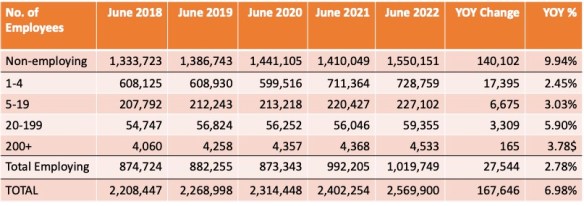
Number of Australian companies by employment size, 2018-2022 (Source: ABS)
There were some contentious views about the small business association’s pre-Summit MoU with the ACTU. Some peak industry bodies and other commentators felt that COSBOA had “sold out” in apparently agreeing to sector-wide negotiations on pay and conditions. However, this does not appear to be the case – COSBOA is merely seeking better co-operation and consultation on areas of mutual interest, and is not endorsing any form of enforced unionisation or compulsory sector bargaining. There have been suggestions that sector-wide collective bargaining will result in higher wages, but without more detail, and pending greater clarity on the “Better Off Overall Test”, this will simply add friction to the current debate about wage and employment growth.
If we do return to a previous form of Industrial Relations policy, it’s interesting to look at the latest ABS data on Australian businesses by employment size (table above). I think it’s worth noting the number of working people in Australia who are employed by SMEs. Large employers are actually small in number, so if multi-employer collective bargaining does come into effect, it could mean tens of thousands of businesses will be involved, and many probably for the first time. On the other hand, in an industry like construction, which is both highly unionised and covered by significant industry awards, many workers are either self-employed or they are employed by independent sub-contractors.
Representation at the summit was reasonably well-balanced, between Unions (including Industry Superfunds), Business (individual companies and industry associations), the NFP and Community sectors, Academia, Think Tanks, and of course Politics. The absence of the Leader of the Federal Opposition meant that his voter base was effectively disenfranchised, although his Deputy (and Leader of the National Party) did attend. Go figure.
Much was said about “streamlining” and “updating” parts of the Industrial Relations regime. Like Australia’s tax laws, the system of Modern Awards as overseen by the Fair Work Commission feels unwieldy, unnecessarily complex, over-bureaucratic, at times vague, and often archaic bordering on arcane. There are currently over 140 different awards in place – some of them relate to an individual company, some to a particular trade or profession, and some cover a whole industry. Interpretation is often in the eye of the beholder as to whether or not it applies to a particular employer and/or employee – here is an extract from one award:
“NOTE: Where there is no classification for a particular employee in this award it is possible that the employer and that employee are covered by an industry modern award or a modern award with occupational coverage.” (Emphasis added.)
I should add that one reason given by the Labor Government for removing the prohibition on sector-wide collective bargaining is because the process for employers to request an exemption from the relevant Minister is “too cumbersome”. I don’t see how this is so given that much of the IR system is overly bureaucratic. Surely the reason for this administrative process is to avoid collusion and other cartel-like activities that would otherwise fall foul of competition law and anti-trust provisions.
The Summit had some notable things to say about gender equality and pay parity, (“Legislate same job, same pay”), training, immigration and child care; but some proposals sound vague without defined objectives (“Boost quantum technology research and education”); draconian if they inhibit workplace flexibility, especially in seasonal industries (“Limit the use of fixed-term contracts”); or too aspirational without more detail such as specific goals and measurable targets (“Leverage greater private capital into national priority areas, including housing and clean energy”). We know that Labor ministers have been vocal in their dislike of the so-called “gig economy” (a “cancer” on the economy, and “I’d like to regulate the sh*t out of it”), but perhaps they need to do more to understand why some workers actually prefer it, and what benefits it brings in terms of workplace flexibility, especially in start-ups and emerging sectors, many of which are SMEs from where much of our longer-term innovation and employment opportunities actually come.
One item that didn’t receive as much attention was the “Digital Apprenticeships Scheme”, which (subject to details…) would likely have the combined support of the Tech Council of Australia and the ACTU. Certainly, despite a vibrant and innovative IT sector, and some notable high-tech and high-end manufacturing businesses in Australia, we lag behind in STEM education, and lack basic digital literacy skills in the wider population. (Hence the need for adjustments to the skilled migration scheme?) A friend of mine who runs a small manufacturing business in Melbourne recently hired an Office Assistant. The successful candidate claimed to be proficient in standard productivity tools such as Word and Excel. In fact, they didn’t know how to COPY-PASTE, nor how to use the SUM-ALL function, which are both very basic routines. They thought they could “wing it” by watching a YouTube video…
Finally, if there is one note of caution or concern about the Summit, it is the niggling thought that this was more of a talk-fest, and that any new ideas to have emerged were either covered by existing programmes and “policy settings”, or were already in train. Going through the list of Outcomes, I counted at least three dozen separate initiatives (Plans, Schemes, Agreements, Reports, Statements, Codes, Programs, Compacts, Task Forces, Working Groups or Funds) many of which already exist, or were part of Labor’s election promises, or have been proposed prior to the Summit. (And that list excludes Federal Ministries and Government Departments.) Sounds a lot like “Talks about Talks”, with “new” money already allocated and spoken for (hence Labor’s push back on some of the implied costs of the Summit proposals). At worst, this “wish list” represents a huge amount of expensive and bureaucratic overlay, whereas we need agile and flexible economic, education and employment measures.
This week, Melbourne is trying to get back to some semblance of normality, following 11 weeks of the current lock-down. But it’s far from “business as usual”.
Based on casual observations, people were desperate to queue up for personal grooming services, restaurants and outdoor shopping. (I did see at least one classic mullet, but I wasn’t sure if it was a fashion statement or just another case of Covid hair…)
Despite the latest changes announced by the Victorian Government over the past week, the ongoing public health provisions mean there will still be a “work from home” directive, retail and restaurants will be subject to density limits (and vax certificates) and masks will be required indoors.
One cafe in my neighbourhood, which has kept going during lock-down with serving takeaways, is deferring opening up for dining-in because they can’t get enough staff. This demand for talent within the hospitality sector means that employers are having to offer sign-on bonuses and higher wages.
While this should be good news for job seekers, the resulting upward pressure on staffing costs will likely trigger a rise in inflation (and higher interest rates?), and possibly further disruptions in supply chains.
Added hiring shortages will come from those employees who have used the lock-down to reassess their career options, and have decided to change jobs – also known as the “Great Resignation”.
Even among those employees who are returning to the office, many of them are only intending to be there 2-3 days a week. This will create a mid-week bulge in the CBD, with various knock-on effects: traffic jams, cramped public transport, and erratic trading patterns for small businesses in retail and hospitality. Employers will also be stressing how they maintain productivity levels with the adoption of extended weekends.
Finally, some industries such as tourism and international travel will take several months to get back to pre-pandemic levels – expect to see steep prices while capacity and supply remain constrained.