Tourism: Time to Get #Digital

In the latest State of the Nation report, Roy Morgan Research shone a spotlight on Australian tourism, an industry which has the potential to make a larger contribution to national GDP following the commodities boom. But the industry needs to get smarter at leveraging digital technology and embracing disruptive business models to ensure sustainable growth.

Melbourne's White Night Festival (Photo: Paul Jeffers for The Guardian)

Melbourne’s White Night Festival (Photo: Paul Jeffers for The Guardian)

As the report highlights, digital is disrupting traditional operators through “automation and variable pricing of everything from hotel rooms to airline seats”, which combined with huge changes in media consumption “is impacting the very essence of the industry”.

What does this mean for the industry, and how should it respond? Here is a quick overview:

1. Tourism is a major contributor to exports and to GDP

According to data from the Department of Foreign Affairs and Trade, tourism generated over $14bn in exports in 2014, and is #5 after iron ore, coal, natural gas and education.

In particular, revenue from Chinese tourists, especially “Free and Independent Travellers” (FIT), grew 19% in 2014, and now accounts for around one-third of in-bound tourism revenue.

With an increasing proportion of Australia’s population born overseas (in large part driven by people coming here to study or to work from China, India and South East Asia), it’s only natural that their friends and family will come to visit them for holidays. And since they are likely to be more affluent visitors, they can afford to curate their own itineraries, rather than be locked into package tours.

2. Great attractions need even better infrastructure and UX

It’s no longer enough that Australia can boast many of the best natural, cultural and lifestyle tourism attractions in the world. Increasingly, catering for the “visitor experience” means that travel operators, hotels, resorts, attractions and destinations need to consider things like:

  • Multilingual and multicultural capabilities
  • Internet & WiFi access
  • Smartphone compatibility
  • Signage and navigation aids
  • Integrated services (e.g., transportation and visitor attractions)
  • Content and interpretive tools

3. Market and digital disruption means more choice for travellers

Disruptive market forces mean that tourists have more choice, and can access the sharing/informal economy, such as Uber and AirBnB.

Digital disruption also means a myriad of ways to discover, book and pay for transport, accommodation and services, aided by numerous apps that can bypass official travel and tourism services.

Visitors not only have more choice, they are more likely to be well-informed, having done their research before they arrive, aided by social platforms that offer personal reviews and recommendations.

4. What are the reasons tourists come to Australia (and what do we do with them once they are here)?

I don’t have any official data, but anecdotally, tourists come to Australia because in general they believe it’s safe (notwithstanding shark attacks and venomous insects), it’s clean, it’s unique, it has variety, and for some the language is also a convenience.

Whether it’s natural scenery, food and wine, cultural events, sport, historical sites, gambling, surfing, trekking, arts festivals, fashion weeks, galleries, museums, beaches, or just hanging out in coffee shops, Australia has a lot to offer.

I’m obviously biased, but Melbourne alone hosts a full calendar of cultural, sporting, culinary and commercial events – there’s something significant happening every month of the year:

  • Major Festivals – Jazz, Comedy, Film, Arts, Fringe and Cabaret (plus the Laneways Festival)
  • Special Events – White Night, SuperSense, Winter Masterpieces, Gertrude Street Projection Festival
  • Sport – Tennis, Spring Racing Carnival, AFL Grand Final, F1 Grand Prix, Boxing Day Test
  • Commercial – Food & Wine Festival, Design Week, Fashion Week, Art Fair, Trade Expos, Professional and Industry Conferences

And did I mention the coffee shops???

5. Some further opportunities?

Digital won’t displace these attractions; in fact it should make it much easier for tourists to discover, connect to and interact with them before, during and after their visit.

Digital can also help curate the whole end-to-end experience, from suggesting thematic itineraries, managing personalised bookings and organising customised events, to providing travel information and advice in advance, updating information throughout their stay, and keeping in contact with visitors once they leave.

And a personal plea – can Melbourne’s trendy restaurateurs that don’t accept bookings offer an app to let customers know when their table comes up on the waitlist?

Declaration of interest: The author currently consults to Roy Morgan Research. These comments are made in a personal capacity.

Next week: Update on AngelCube


The future of #FinTech is in Enterprise Solutions

Talk to anyone involved in FinTech, and apart from telling you the sector is “hot”, there’s little consensus on what happens next. Despite positioning itself as a disruptive force within financial services, much of what goes on in the sector is either driven by regulatory reform, or by technological developments in allied fields. Most of the disruption so far is in retail and B2C services, yet the more significant opportunities are likely to be found in enterprise and B2B solutions. But as The Economist commented recently, “The fintech firms are not about to kill off traditional banks.”

The Current State

In broad terms, FinTech is working in four main areas:

  • Cryptocurrencies
  • Payments
  • P2P lending
  • Financial Advice and Planning

The first two are responding to dual technological advances – namely, the use of block chains and cryptography; and increased sophistication around mobile and GPS. Patrick Maes, CTO of ANZ Bank, has stated that “Bitcoin and block chain are the first payments innovations in 2,000 years.” He also has a FinTech “wish list”.

The second two (at least, within Australia) are benefitting from regulatory changes, such as the new positive consumer credit reporting regime, and the Future of Financial Advice reforms. And when the National Payments Platform scheduled for 2017 mandates real-time settlements, everyone will have access to immediate inter-bank payment services.

Of course, there is some overlap among these categories, which in turn are also benefitting from developments in big data analytics, mobile solutions, social media platforms, and consumer trends like crowdsourcing and the shared economy.

CCE2z9TVIAENCcE

It may be interesting – but it’s not whole picture

Disintermediation May Not Be Enough?

Most of the FinTech disruption has been in the nature of disintermediation – displacing the role of traditional banks and merchant services in providing payment solutions, point-of-sale facilities and personal loan products. But given the relatively small margins on these services, you either need to have a totally different cost structure, or a significantly large market position to achieve scale and volume.

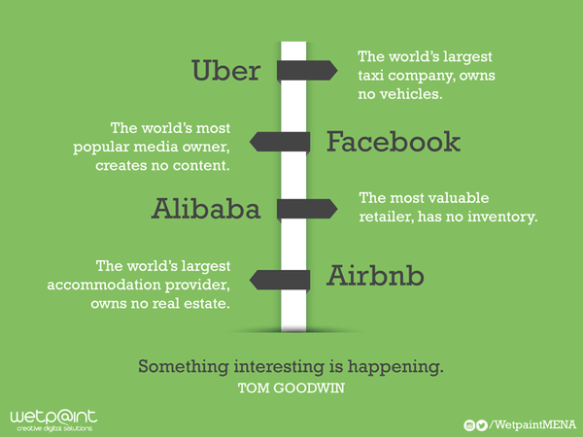
You will have seen the above infographic, often quoted with a sense of wonder at how these companies have built huge businesses seemingly without having to own any physical assets. Well, yes, but dig deeper, and what do we find? The banks have always worked on the same principle – they take customer deposits (which they don’t own), and then lend them to borrowers (whose secured assets they don’t own unless there is a default).

The main difference is that banks are highly regulated (unlike most of these digital market disruptors), and as such they have to hold sufficient capital assets to cover their exposures. Meanwhile, the banks finance the car loans taken out by Uber drivers, they provide credit facilities and export guarantees to Alibaba traders, they underwrite the mortgages on properties used for Airbnb, and will likely provide e-commerce services to advertisers who use Facebook.

For me, probably the last major FinTech disruptor was Bloomberg (founded back in 1981), because it changed the way banks and brokers accessed news and information to support their trading activities, by introducing proprietary analytics and data tools via dedicated terminals, screens and datafeeds. So successful has Bloomberg been that it now owns about one-third of the global market for financial data, and is the single-largest player (albeit by a very small margin over main rival Thomson Reuters – itself, a merger of two key data vendors). Plus Bloomberg is still privately held.

The Future State

I don’t believe FinTech can truly come of age until a major enterprise solution appears. For different reasons, Stripe and BlueDot could be on their way, but both are primarily operating in the consumer payments sector.

I have written previously on the areas where FinTech could impact institutional banking and securities trading, including loan origination, data analytics and risk management. I’ve also reported on the opportunity to disrupt traditional market data vendors by changing the pricing and consumption models. And elsewhere, I have hypothesized on how banks’ trade finance services could be disrupted.

The areas where “Big FinTech” could truly make a difference are:

  • Counterparty Risk Management
  • Predictive Credit Risk Analytics
  • Loan Pricing Models
  • Unit Pricing Calculations
  • Collateral Management
  • Portfolio Performance Attribution
  • Sentiment-based Trading and Risk Pricing

However, the final word should go to Patrick Maes, who suggested that a huge opportunity exists in deposit products linked to customer loyalty programs and frequent flyer points – what if your credit card points could be used to finance a car lease or as part of the deposit on your first home?

Next week: Change Management for Successful Product Development

The David and Goliath of #Startup #Pitching

Anyone wanting to follow the startup scene in Melbourne will quickly discover that there are meetups, hackathons and user groups nearly every night of the week. Who needs a social life when we’ve got startup happenings to keep us entertained, busy and off the streets! The frequency and close proximity of these events can lead to some interesting contrasts; one such example came when Oxygen Ventures‘ annual splash The Big Pitch was held the same week as UpWork‘s more modest Networking & Pitch Night (part of The Pulse Meetup). It was almost a case of David and Goliath…


Screen Shot 2015-06-19 at 5.58.28 pmScreen Shot 2015-06-19 at 5.58.57 pmThe biggest difference between the two events was the prize on offer – the Big Pitch offers the winners up to $5m in venture capital funding; The Pulse offers $500 in Upwork credits (and high fives all round). No doubt, the application, screening and selection process is more onerous for the former than the latter. And as was frequently pointed out once The Big Pitch gala proceedings got underway, this competition is “serious” and “adult”. But that’s not to say that the entrepreneurs pitching at The Pulse weren’t equally passionate or serious. Most of the finalists at The Big Pitch had already launched products and were gaining market traction, as had several of those presenting at The Pulse.

So, in the interest of objectivity (and pure entertainment), here are the 10 pitches I watched across the two competitions, in no particular order, with my personal comments on each. Without going to the respective websites, can you work out which startup finalists belong to which competition?

LaundryRun

Too little time, long day at work, or just can’t be bothered doing your washing? Let LaundryRun pick up your dirty clothes at a time of your choosing, and bring them back when you need them all nice and clean. Tapping into the trend for concierge services for busy inner city hipsters, hackers and hustlers, LaundryRun is joining the likes of YourGrocer to outsource domestic services.

Given that the founders already have a traditional laundry and dry-cleaning business, one assumes they know to make the economics work (they claim the customer pricing is comparable to walk-in trade). Plus they have had some early media coverage, and it makes sense to focus on higher-density neighbourhoods, especially if they can establish regular pick-up and drop-off schedules.

But the problem will be in getting enough repeat business, although if most of the collection and delivery is done in the evenings, maybe that addresses the need for consolidation (and gets round peak traffic hours).

Gamurs

As I have confessed before, gaming is not my thing. I don’t see the appeal, I barely understand the jargon, and I certainly don’t have any aesthetic appreciation for the advertising, graphics and branding that goes into these products. But I accept that it’s a big business, and that the gamers of today are possibly the software geniuses of tomorrow.

Gamurs claims to be the ultimate social network for all things gaming. It has had some user interest (probably because it is a free platform), but it felt that there was nothing really new here. Despite a dedicated team, and some impressive growth projections (albeit only for Australia) it was difficult to see where the revenue would come from as there are competing channels, and the games industry is built around platform and brand verticals.

The pitch mentioned “content consumption” a lot, but I had no idea what that meant, and I was left thinking this was simply an on-line magazine for enthusiasts and hobbyists.

EpicCatch

I’ve seen this exact same pitch before. It’s cute, and has an interesting angle on the online dating model. Sort of MeetUp meets Tinder, with a focus on curated dating experiences. But other than some neat one-liners, this presentation was really an in-person advert designed to drive customer usage.

I’m sure the business will do well among its target demographic (although not quite sure they have this totally figured out), but unsurprisingly it did not win because according to some recent research, VC’s don’t like the dating business model.

  Biteable

This self-serve provider of templates for animated videos presents a very neat idea, and was established to fill the gap between expensive agency services, complicated pro tools and clunky DIY apps. It’s free to use, but for $99 you can remove the Biteable watermark.

There are limited options for changing some aspects of the template content, but maybe this will form part of the up-sell model. However, the numbers look questionable – how many repeat users would there be, and wouldn’t frequent users go for professional solutions anyway?

Perhaps there are strong niches or use cases that Biteable could explore, rather than trying to gain traction across a wide market?

CoreCool

Referring to the number of fatalities in India’s recent heat wave, CoreCool demonstrated a human need for their simple low-energy heating and cooling solution, especially for the elderly and the infirm. Using tested technology to regulate core body temperature (in essence, a contact heat exchange unit), CoreCool also sees a market in the recreational and well-being sectors.

If the product makes any claims as to its medical or health care benefits, it may need to comply with the relevant class of therapeutic goods regulations. It was not clear whether any clinical trials have been undertaken or whether the product is subject to any patents. However, there was lots of support for the idea among the audience.

Development challenges include scaling production to achieve retail pricing, and maximizing battery life.

FLEET

This was a project that proved very popular with the audience, even though it is still at concept stage – quite literally, it has not yet got off the ground. FLEET plans to bring cheap satellite internet to the estimated 60% of the world’s population that are not connected, or don’t have access.

With impressive scientific credentials, a passionate presenter and market research to back her case, it was easy to see why this pitch was many people’s favourite. But without the co-operation of incumbant telcos and their willingness to trade with a third-party platform, FLEET may struggle to establish a business case, unless they can hook into alternative distribution technology and supply chains.

At the very least, FLEET could provide a shot in the arm for Australia’s satellite industry.

Blinxel

Pitches always look better when the presenter can provide a product demo. Such was the case with Blinxel, a startup that is looking to bring simple and low-cost AR/VR video and hologram-like content to your smart phone or tablet.

Using a dedicated depth camera, Blinxel can capture video content, then upload the file via the cloud to your device. The team behind Blinxel is a bunch of enthusiastic 3-D content producers who want to disrupt the current high-cost model, which is also wasteful, as little content is recycled and OEM’s are apparently locked into proprietary technology.

I can see many uses, from education to tourism, as long as the content creation process is scalable, the need for stand-alone technologies can be minimised, and the price/speed/quality equation makes sense.

SocialStatus

Aiming straight for the marketer’s heart, SocialStatus aims to provide social media analytics on steroids – although only supporting Facebook pages at present. With a focus on peer and industry benchmarking, SocialStatus is building its expertise around the key metrics of engagement, growth and click-thru rates.

Adopting a freemium model (plus a 2-tier subscription price) and using simplified tools (canned reports and automated data from streamlined metrics), SocialStatus looks clean, easy to use and speaks directly to content marketers and community managers.

Unless they can protect their analytical IP, and extend coverage to other social media platforms, I think SocialStatus may find it difficult to defend their position.

Meet&Trip

A simple pitch: if you are travelling overseas, and want to connect with fellow travellers who might be interested in planning and sharing a road trip, this is the solution for you. Claiming that Facebook and other social networks don’t allow you to create time and location-based forums that are both moderated, curated and for a specific purpose, Meet&Trip aims to connect users with similar interests and lifestyles.

It’s a nice idea, but other than being specialist bulletin/message board, I can’t see what else Meet&Trip has planned, or how it intends to fund itself.

In the analogue world, most major cities and tourist destinations used to publish magazines dedicated to the interests of travellers, backpackers and itinerant expats. They had classified adverts of the kind: “planning a trip to Uluru; share expenses and driving; no boofheads”. Maybe this still happens? As an aside, London’s Antipodean community used to park and trade their dormobiles along the Thames Southbank – so anyone looking to buy a VW Combi and “do” Europe with like-minded travellers knew exactly where to go.

Storie

I have to admit, when I heard this pitch, my immediate reaction was, “Oh. Yet more video content that I don’t have time to watch (or care about).” And despite the apparent novelty of being able to capture, edit and share content from within the same app (i.e., build a series of scenes into a story before you hit “publish”), it felt like yet another social media pitch in search of a business solution.

Kudos to the young team for bringing their idea to our attention – but to me it felt like it was trying to take the best bits of YouTube, Vine, Instagram, Facebook and Tumblr without adding anything radically new.

As with Biteable (above), my recommendation to Storie would be to explore commercial opportunities among deep or niche content-rich markets, rather than trying to scale across shallow, thin and widely dispersed public audiences.

Conclusions

  • The winners in their respective competitions were SocialStatus and CoreCool, with honourable mentions for LaundryRun, FLEET and Blinxel.
  • We are starting to see some further variegation among startup pitches – more firmware, hardware, B2B – but the bulk are still pushing consumer-based, ad-backed products targeting the (over)crowded markets for sharing social, mobile and video content.
  • Reflecting Melbourne’s ethnically diverse startup scene, a significant number of these pitches were made by recent migrants to Australia.
  • Several pitches confined their growth potential to the domestic market – which is understandable, but self-limiting. Despite its reputation as a relatively early adopter of new technology, by and large Australia is still quite conservative, with a tendency to favour incumbant brands that operate in semi-protected duopolies and oligopolies (supermarkets, telcos, banks, newspapers, automotive).
  • I don’t believe in disruption for its own sake, but few of the pitches offered truly disruptive business models, other than through pricing (i.e., charge nothing and hope that advertising will cover the costs) or via self-service solutions. I would like to have seen more disruptive intent around supply chains, distribution and channels to market.

Next week: Deconstructing #Digital Obsolescence

 

Getting Stuck – and how to deal with it

We’ve all witnessed (or even experienced) those moments when a speaker or presenter gets stuck. They stumble over their material, they offer an inappropriate response to a tricky question, or they simply go off topic and stray into verbal quicksand. And although they realise they are in difficulty, they carry on regardless, only to wade deeper and deeper into the mire. Some of our current political leaders know exactly how that feels…

Photo by Mark Roy - Licensed under Creative Commons

Photo by Mark Roy – Licensed under Creative Commons

In my experience, many small business owners do the same thing when they get stuck. They carry on doing the same as they’ve always done, even though they know they need to change course, take another approach, or try a different tactic. Which is where someone like me comes to the rescue. As a consultant, I can bring an objective, external and independent perspective that can help clients navigate away from the problem, and steer them back onto the right track.

The Inflexion Point

The typical scenario is that the business is faltering. Most often it’s about sales and business development – either not enough new customers, or too few of the “right” customers (and too many of the “wrong” ones). Sometimes it’s about an aspect of their strategy that isn’t working. It could be a problem with their operations, such as workflow, resourcing or IT systems. Or it might be that they have lost their way and are facing some sort of external challenge. Or maybe there is a disconnect between the products and services that they offer, and what their customers actually need. Or it could be a need to recast their financial information to get a better idea of how the business is really tracking.

Whatever the issue, the common feature is a point of inflexion – the business is either stuck, has hit a plateau, or come to a fork in the road.

So, how do they get help?

The 3-Step Recovery Program

First, the client has to realise that doing the same thing won’t work, doing nothing is not an option, and they have to be open to the idea of change. They recognise that bringing in some external help will relieve the log jam (even though at this stage, they don’t know what form that help will take, or where it will come from).

Second, they do some basic research, or get a referral from their networks, on where they can get help. Much of my work comes via word-of-mouth and personal contacts, and in large part this is due to the need for trust in any consulting relationship. Sometimes, a prospective client has liked something they read in my blog, or heard something in our conversation that has clicked with their own needs. There has to be a connection or match with what the business needs, and what someone like me can offer. It’s a bit like finding a GP, financial planner or personal trainer – there has to be a fit.

Third, they are able to define a specific problem that needs addressing, or at least prioritize the issues. This requires some reflection, self-awareness, and willingness to have their assumptions challenged. There is a need for honesty, and even vulnerability, if the intervention is going to succeed.

Helping clients get back on track

I will say upfront that my services are not suited to everyone. If your business is running like a well-oiled machine, I probably can’t add much value, unless you are looking to improve an area of your operations, or embark on a new initiative where you need help in getting it off the ground. Alternatively, I may be able to help if you simply want to tap into some external perspectives to challenge your current thinking, or if you require some specific expertise that draws on my knowledge and experience. Otherwise, my role is to help clients get free of what is bogging them down.

One of my clients recently said that working with me felt like “keyhole” surgery, rather than undergoing open heart surgery. I think I know what he means, and that he meant it as a compliment….. In my experience tackling “the whole” is not always practical. Rather, zooming in on a particular aspect of the business allows for incremental change, that if applied appropriately, can have a multiplier effect. Such an approach is hopefully less disruptive, and therefore less threatening, to the existing business.

As part of my consulting work, I tend to break the business down into its component parts, look at the business model, review the revenue streams, and analyse the workflow, both internal operations and customer-facing services. For example, clients often have a slightly misplaced perception of where/how they add customer value – so, if they spend a lot of time on a particular task or activity, they naturally assume that this should form the greater part of what their customers pay for. Whereas in reality, the customers may value something else the business does, but the business has not realised that value.

It’s always important to encourage clients to develop an action plan, with specific goals, responsibilities and timelines. I’m not talking about a 50-page business plan, but a more manageable working document for the next 6, 12 or 18 months (depending on their circumstances). A key outcome of this is a list of priorities, plus agreement on which activities to wind-down or discontinue. Despite limited resources, businesses often make the mistake of trying to continue doing everything they’ve always done, plus all the new stuff – the law of physics suggests that something has to give, so they need to stop doing things that are no longer relevant, or are no longer working.

Making a Difference

When it comes to more direct business coaching, I know from the client feedback I receive that the insights I offer and the way I reframe their situation are as valuable as a re-engineered business plan. By analysing the problem, taking it apart and putting it back together again, it allows me to share my observations and offer fresh thinking – which is sometimes all the client may need to get back on track.

If you feel your own business could use some external assistance in getting back on track, or if you think you may be stuck as to what to do next, please get in touch via this blog.

Next week: The David and Goliath of #Startup #Pitching