Unknown's avatar

About Content in Context

Content in Context helps companies to define the market for their products and services, to identify customers and build the business pipeline, and to develop their content marketing strategies. By working with our clients to design, build and grow their business, our primary focus is to extract commercial value from unique assets, including knowledge, data, know-how, processes and transactional information.

The Grey Ceiling

Last week I blogged about ageing rockers and the growing number of septua- and octo-genarian musicians still touring and recording. Perhaps they never got The Who‘s memo about hoping to die before they get too old? Anyway, it’s enough to make you think  Jethro Tull should update the lyrics to their 1970’s song….

Over in the world of sport, it seems ageism is still a thing. At the Australian Tennis Open in January this year, there was much media commentary (even surprise, disbelief and incredulity) that a 43-year old player reached the men’s doubles final, and had the temerity to win. In doing so, he become the oldest Grand Slam winner, and oldest to achieve a #1 ranking. Goodness knows what those same sports writers will make of a 41-year cricket player becoming the first fast bowler to claim 700 Test wickets.

Meanwhile, the US Presidential election looks like it will be fought out between an increasingly frail 81-year old incumbent, and an erratic 77-year old challenger, who has the audacity to say his adversary is not fit to stand on grounds of age and cognitive impairment. (To say that this contest will be far from elegant or dignified is an understatement!)

However, very few of us ever get to run for President – but most of us will experience something akin to the Grey Ceiling. We will reach a point in our working life when we are considered too old for promotion, or too old to hire, or too old to be retrained, or too old to be kept on.

In some roles and industries, there are compulsory retirement ages. And I get that.

What I can’t understand is the notion that just because someone is in their 50s or 60s, they are on the scrap heap of their career. The last time I was made redundant from a corporate role in a multinational organization, I had just turned 50. I can’t prove anything (because that would be age discrimination), but I had sense that it was “easier” for the company to let me go than a younger colleague: I had no dependencies, I hadn’t quite reached the full entitlement of long service leave, and I was not an expat so there were no relocation costs to consider.

At one job interview following that redundancy, the interviewer had the audacity to suggest that due to my age, experience and seniority, I would be less likely to “get my hands dirty” with day-to-day business operations and commercial decisions, and more likely to sit back and “direct traffic”. There was also a suggestion that I would be less willing/able to adapt to new technology, giving the overall impression he thought at my age, I was simply looking for an easy life.

Thanks to such attitudes which I also encountered elsewhere, I am glad I went to work as a freelance consultant and contractor with smaller businesses, start ups, owners and founders, and also in the cutting-edge technology of blockchain, crypto and digital assets – I have learned so much more in the past 10 years than I probably did in the previous 20 years of my career.

One thing I definitely don’t miss from corporate life is office politics!

And if neither ageing rock stars, nor 40-year old sports people at the peak of their careers, inspire you in your own journey (or as you hit the Grey Ceiling), perhaps some of the stories in The Guardian’s “Life After 60” series will inspire you.

Next week: Unstructured Hours



Ageing Rockers

A few years ago, I mentioned the phenomena of ageing pop stars, that bunch of musicians from the 60s and 70s still recording and touring in their 70s and 80s – retrospective proof that for some, rock was a viable career move after all. Since their professional longevity has extended way beyond anyone’s original expectations, it does mean for us music fans we should make an effort to go and see their live shows, especially as more of these artists shuffle off this mortal coil – because we may never get the opportunity again.

Michael Rother – a sprightly 73-year old continues to record and tour (picture sourced from Melbourne Recital Centre)

A case in point is Kraftwerk, who visited Melbourne last December. The only original member, Ralf Hütter is now in his late 70s, but he stood and led his team of younger musicians for a 2-hour performance that was almost like a tribute show to themselves. Kraftwerk has not released any new music for more than 20 years, but continue to harvest their legacy via regular live shows and careful curation of their back catalogue. I hope they do continue touring but I suspect the chance to see them again in Melbourne may have passed (at least in human form, and not as resurrected VR projections or avatars, although Kraftwerk clearly anticipated this many, many years ago… ).

Last week, a one-time member of Kraftwerk, Michael Rother performed at the Melbourne Recital Centre, to celebrate 50 years of his old band Neu! A fit and sprightly-looking 73-year old, he looks like he still enjoys touring, and seemed very happy to be back in Melbourne. However, this concert was re-scheduled from a couple of years ago, when Rother experienced some health issues that prevented him from travelling to Australia. And the last time he was here, in 2012, he was joined by another stalwart of the German music scene of the 70s and 80s, Dieter Moebius (of Cluster and Harmonia) – who passed away in 2015. Given Rother’s connection to Kraftwerk and his key role in forming the sound of “kosmische Musik” (plus his work with Brian Eno, and the tantalising prospect that he might have played on David Bowie’s “Heroes” album if things had gone differently…) his continued presence on the live circuit is most welcome, especially as very few of his German contemporaries are still with us as going concerns.

Later this month, I’m going to see Laraaji, octogenarian jazz, ambient and new age musician who is coming to Melbourne to perform for the first time in his career (I believe). Another former collaborator of Brian Eno, this promises to be a very special concert.

Meanwhile, Eno himself still shies away from live performance, but an interesting documentary about him has started touring the world – and which, in typical Eno-esque fashion, is never the same film twice. And another documentary showing this month in Melbourne is “Opus”, the final recorded performances of the late Ryuichi Sakamoto (whom I was fortunate to see on his last visit to Melbourne in 2018).

The moral of the story? Get ’em while you can….

Next week: The Grey Ceiling


The Mercurial Music of Calexico

In addition to Taylor Swift and Katy Perry, Melbourne recently played host to US band Calexico. Given the hype surrounding those pop divas, you’d be forgiven for not noticing the latter’s sell-out concerts at the Recital Centre.

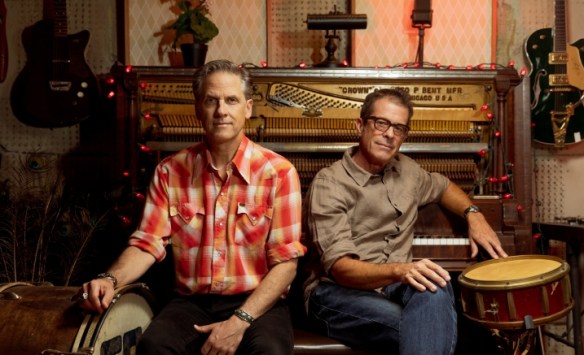
Calexico photo sourced from Melbourne Recital Centre

After nearly 30 years and as many albums, Calexico have a deep back catalogue to draw on, but the focus on the current tour is their 2002 album, “Feast of Wire”, featured in full alongside a few of their greatest hits and a couple of inspired cover versions.

My interest in Calexico stems from the late 1990s, via their involvement with a couple of other bands, Giant Sand and The Friends of Dean Martinez. Alongside these and other groups such as Lambchop and Wilco, Calexico brought a fresh perspective to Americana – that strand of North American music that has its roots in Alt Country, but which eschews many of the conservative (even regressive) styles and values of mainstream country and western music. What sets these bands apart is their willingness to embrace other musical influences, and explore more experimental sounds.

Calexico themselves have collaborated with a range of DJs and producers for some inspired remixes, and have featured on compilation albums alongside their US post-rock counterparts as well as European electronic artists. So quite eclectic company. In fact, Calexico’s own music incorporates Tex-Mex, Mariachi, dub and electronica, Morricone’s spaghetti western soundtracks, Tortoise-style instrumental arrangements, Tindersticks’ atmospherics, and Tijuana trumpets. Having been to California a few times myself (including a road trip from LA to northern Mexico), and having visited Colorado and New Mexico last year, Calexico’s music readily evokes memories of the Anza-Borrego desert, the border town of Tecate, the Skytrain from Santa Fe to Lamy, and the hills of the Tejon Pass.

Live, the core duo of Joey Burns and John Convertino handle vocals/guitar and drums respectively, while a team of four multi-instrumentalists take care of bass, guitar, keyboards, vibes, trumpets and accordions. The technical production is great, and like many visiting musicians, the band enjoy playing with the superb acoustics of the Recital Hall itself.

As for the night’s cover versions, there were two: Love’s “Alone Again Or”, a minor hit for Calexio when first released as a non-album single, and which perfectly suits their “Sounds of the South-West”; and Joy Division’s “Love Will Tear Us Apart”, a song I hadn’t heard played live since one of Joy Division’s last gigs in 1980, and which prompts some emotional audience participation – a brave choice!

Next week: Ageing Rockers


Non-binary Politics?

Regular readers to this blog may have noticed the absence of new posts in the past few weeks. This silence is in large part due to other personal priorities. There is also an overwhelming sense that all is not well in the world, and it hardly seemed appropriate to add to the endless commentary and op-eds on current events.

As world leaders grapple with yet another breakout of ideological warfare, I can’t help being reminded of the Bush Doctrine, built on President George W’s edict that “if you are not with us, you are against us”.

Such binary perspectives overlook the fact that no dispute can be neatly categorised in stark, polarised terms. Yet on so many geopolitical and social issues, we are being forced into making “yes/no”, “either/or”, “left/right”, “A/B” decisions. Ironic, given that in many domains we are also being encouraged to adopt non-binary views!

Whatever happened to bipartisan politics, consensus building, or non-equivalence? Why are we being co-opted into taking unequivocal positions? Have we forgotten that two wrongs don’t make a right?

I’m trying to get more comfortable with ambiguity and ambivalence – especially when few things can be cast in purely “black or white” terms. In fact, the more we can say “it’s OK to be in the grey”, the better our public discourse should become.

Next time: The Mercurial Music of Calexico