Who needs banks? My experience of “We R One World”

This past weekend, I participated in the “We R One World” game hosted by Carolyn Tate on behalf of the Slow School of Business, and facilitated by Ron Laurie from MetaIntegral. The game is an immersive learning experience in the form of a simulated global strategy workshop, based on the work of Buckminster Fuller. I joined a team whose role was to represent the interests of the commercial banks. It was a rather sobering experience, because as the workshop unfolded, it soon became clear that in the context of the game the banks were almost redundant – which partly reflects what is going on in the real world, as banks face increased disintermediation and disruption by FinTech, crowdfunding and the shared economy.

The Fuller Projection or Dymaxion Map

The Fuller Projection or Dymaxion Map

The Premise – Earth as Spaceship

Without going into too much detail, “We R One World” mimics elements of the board games “Risk” and “Monopoly”, and takes the form of a narrative-based hackathon, combined with a meetup and an unconference. Played out on a floor-size version of the dymaxion map, the game also draws on Fuller’s concept that the Earth is a spaceship, of which the players are the crew, and the “fuel” is the inventory of global resources at the crew’s disposal, including people, technology, capital, food, energy, munitions, water, etc. The participants form teams to represent various geo-political regions, supranational NGOs, multinational corporations and banks. The goal is to achieve (through trade negotiations), the best socio-economic outcomes for everyone, with a few surprises along the way!

There is a lot of information to absorb, as well as the structure of the game. One challenge for the players is to not get hung up on the presented “data” (which is more representative, rather than precisely factual). Even though we live with access to real-time, on-line statistics and research, and despite the Internet and search engines, in real life we still experience considerable information asymmetry.

The Prelude – We Are Star Dust

As a prelude, we were shown the documentary “The Overview Effect”, which includes the comment by former Apollo astronaut Edgar Mitchell that we are made of star dust (a now common concept echoed in various songs such as Moby’s “We Are All Made of Stars” or Joni Mitchell’s “Woodstock”, depending on your musical taste/cultural perspective).

It was also a timely connection, given the increased media coverage of space exploration, and Hollywood’s renewed interest in space travel. The recurring theme (in reality as much as in fiction) is that human survival will depend on relocating to, or harnessing other planets.

As examples, in the real world, we have the latest discovery of an Earth-like planet, tweets from Philae on a frozen comet, and the remarkable images from Pluto. While the entertainment world is enjoying critical and popular success with films such as “Moon”, “Gravity”, “Elysium” and “Interstellar” (plus the forthcoming “The Martian”). Even veteran Sci-Fi writer Brain Aldiss has bowed out with his final space novel, “The Finches of Mars”.

The Banks – Increasingly dispensable

But back to the game, and what we might conclude from the outcomes.

From the start, in the role of the banks we had a strategy for encouraging “good” behaviour, and punishing the “bad”. We had a catalogue of regional problems, and a set of possible solutions. “Good” behaviour was predicated on regions finding creating solutions to their problems, based on partnering, prioritization, planning and promotion. “Bad” behaviour might include late or failed interest repayments, misuse of funds (e.g., deploying more military hardware ahead of feeding their population), or actions that led to worsening conditions (increased poverty, hunger and illiteracy, or depleted natural resources).

At the outset, the banks’ role was to manage existing loans (by collecting interest due), and to originate new loans for development and commercial projects. In the initial stages, despite Japan’s attempt to renegotiate its existing repayment terms on the fly, the commercial banks managed to collect all interest due, on time and in full (with a small surplus, thanks to some regions’ lax monetary management). One region paid up without much prompting, cheerfully (or ironically?) commenting that “we must keep the banks happy!”.

However, as the game progressed, the banks were basically ignored, as regions switched their focus to responding to new circumstances, such that the consequences of not servicing their debts seemed irrelevant. Even the risk/threat of bankruptcy did not carry much persuasion, as regions were more willing to find new ways to trade with each other, less reliant on bank capital, and more focussed on alternative value exchanges (part of the game’s secret sauce).

For example, we received only two loan applications throughout the game: one was for a worthy but ambitious development project, but when asked to resubmit the request with some further information, the loan did not materialise; and the other was more in the way of a short-term deposit with the bank, to generate interest income to buy food. Given that deposit rates are low, our response was to suggest using the capital (with additional bank funding) to increase food production, but our offer was declined, maybe because of the need to trade out of a short-term food shortage rather than investing in long-term supply.

Towards the end, the banks were almost mere spectators in the game, and were reduced to protecting their self-interests: namely their capital, and their stalled/stagnant loan assets. If borrowers don’t want the banks’ money, where and what will the banks invest in order to generate depositor, investor and shareholder returns? As one regional participant commented, “we are all bank shareholders”. Just as in real life, we deposit money with the banks, we invest in their financial products (especially through our superannuation and pension funds), and we may even buy their shares and bonds. And of course, following the GFC, many taxpayers found themselves indirect shareholders of banks that were bailed out by their respective governments.

The Conclusion – An alternative approach?

I’m not going to give the game away (you can experience it for yourself in September) but the conclusion and outcome reinforce the view that in order to tackle the world’s problems, we all have to take a different perspective – whether that is challenging existing structures, subverting traditional business models, or questioning our personal motives and objectives. For myself, I recognise that this means an increased awareness of “living lean” (mostly around personal preferences and lifestyle choices), and (multi-)lateral thinking.

For institutions like banks (as well as governments, corporations and NGOs) this alternative approach means re-assessing their roles and contribution (which can also be framed as re-connecting with their “purpose”), remodelling their processes and systems, and redefining the measures of their success. As my team member concluded, “the other players only see the banks as a source of capital, rather than a resource for knowledge, expertise and networks”.

Footnote

Declaration of interest: I participated in the game at the kind invitation of the Slow School of Business.

Next week: “I’m old, not obsolete”


Change Management for Successful Product Development

Recently, there have been a number of commentaries on the current trend/fad for applying Agile and Lean product development methodologies to corporate management. I’ve also noticed an increasing focus on “Product Management” as a formal discipline by training and professional development providers. Consequently, I’ve been revisiting some work I did many years as part of a Change Management Diploma.

Situational Leadership

My thesis is that different Change Theories of Management can be applied to each stage in the Product Development Cycle*, to ensure that the organisation is aligned with the business needs as they relate to strategy, capabilities, capacity and execution. This is also the context in which organisations use Situational Leadership techniques to cope with constant change in technological, social, economic and environmental forces.

(*This work was based on a reading of Theories of Organisational Change as Models for Intervention by Dunphy & Griffiths (published by Australian Graduate School of Management – Centre for Corporate Change, University of New South Wales, 1994). For a copy of my model, please contact me: rory_manchee@yahoo.com.au)

1. Fit for Purpose

Various skill sets are needed along the journey from ideation to production, and management has to harness appropriate resources to increase the potential for success. Organisations may need to consider restructuring to maximise their ability to develop sustainable product development systems that incorporate continuous improvement, feedback loops and market responsiveness.

For example, moving from annual software updates to quarterly releases might simply suggest some production rescheduling, but it may also mean changes to documenting user requirements, customer billing systems and client support tools.

2. Playing to Our Strengths

The person who is great at capturing the design specs may not be the best person to undertake market testing with beta users. And it’s generally accepted that someone who is adept at working in a production or QA role on an established product may need some re-training before they get to work on building a prototype.

3. The Model Approach

In conclusion, my analysis reveals that at each stage in the Product Development Cycle, there is a need to review the relevant Business Challenges, address the corresponding Change Issues, and apply appropriate Change Management models or techniques.


Update on Perspective – Introducing the “We R One World  Game”

In a recent post on “Perspective”, I commented on the value of stepping back and taking a different look at current ways of doing things. For an immersive, interactive and experiential learning opportunity on how to gain a new perspective on problem solving and how we might address global challenges, the Slow School of Business is running the “We R One World Game” on Saturday, July 25 in Melbourne

Dymaxion_map_ocean2

The Dymaxion or Fuller projection is a world map, which can be rendered in 2-D.

Facilitated by Ron Laurie, and based on the pioneering work of Buckminster Fuller, this event promises to combine a hackathon, a meetup and an unconference all in one! Tickets available here.

Next week: Who needs banks?

The future of #FinTech is in Enterprise Solutions

Talk to anyone involved in FinTech, and apart from telling you the sector is “hot”, there’s little consensus on what happens next. Despite positioning itself as a disruptive force within financial services, much of what goes on in the sector is either driven by regulatory reform, or by technological developments in allied fields. Most of the disruption so far is in retail and B2C services, yet the more significant opportunities are likely to be found in enterprise and B2B solutions. But as The Economist commented recently, “The fintech firms are not about to kill off traditional banks.”

The Current State

In broad terms, FinTech is working in four main areas:

  • Cryptocurrencies
  • Payments
  • P2P lending
  • Financial Advice and Planning

The first two are responding to dual technological advances – namely, the use of block chains and cryptography; and increased sophistication around mobile and GPS. Patrick Maes, CTO of ANZ Bank, has stated that “Bitcoin and block chain are the first payments innovations in 2,000 years.” He also has a FinTech “wish list”.

The second two (at least, within Australia) are benefitting from regulatory changes, such as the new positive consumer credit reporting regime, and the Future of Financial Advice reforms. And when the National Payments Platform scheduled for 2017 mandates real-time settlements, everyone will have access to immediate inter-bank payment services.

Of course, there is some overlap among these categories, which in turn are also benefitting from developments in big data analytics, mobile solutions, social media platforms, and consumer trends like crowdsourcing and the shared economy.

CCE2z9TVIAENCcE

It may be interesting – but it’s not whole picture

Disintermediation May Not Be Enough?

Most of the FinTech disruption has been in the nature of disintermediation – displacing the role of traditional banks and merchant services in providing payment solutions, point-of-sale facilities and personal loan products. But given the relatively small margins on these services, you either need to have a totally different cost structure, or a significantly large market position to achieve scale and volume.

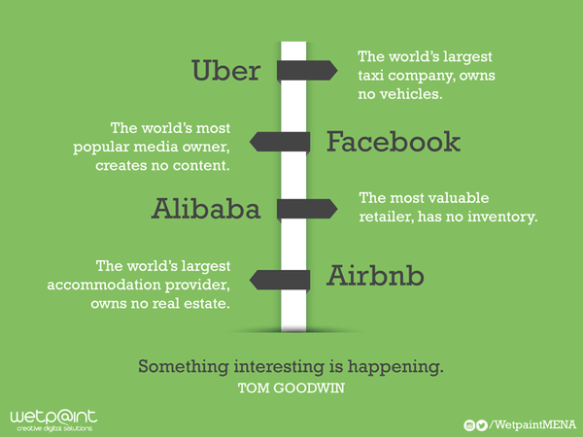
You will have seen the above infographic, often quoted with a sense of wonder at how these companies have built huge businesses seemingly without having to own any physical assets. Well, yes, but dig deeper, and what do we find? The banks have always worked on the same principle – they take customer deposits (which they don’t own), and then lend them to borrowers (whose secured assets they don’t own unless there is a default).

The main difference is that banks are highly regulated (unlike most of these digital market disruptors), and as such they have to hold sufficient capital assets to cover their exposures. Meanwhile, the banks finance the car loans taken out by Uber drivers, they provide credit facilities and export guarantees to Alibaba traders, they underwrite the mortgages on properties used for Airbnb, and will likely provide e-commerce services to advertisers who use Facebook.

For me, probably the last major FinTech disruptor was Bloomberg (founded back in 1981), because it changed the way banks and brokers accessed news and information to support their trading activities, by introducing proprietary analytics and data tools via dedicated terminals, screens and datafeeds. So successful has Bloomberg been that it now owns about one-third of the global market for financial data, and is the single-largest player (albeit by a very small margin over main rival Thomson Reuters – itself, a merger of two key data vendors). Plus Bloomberg is still privately held.

The Future State

I don’t believe FinTech can truly come of age until a major enterprise solution appears. For different reasons, Stripe and BlueDot could be on their way, but both are primarily operating in the consumer payments sector.

I have written previously on the areas where FinTech could impact institutional banking and securities trading, including loan origination, data analytics and risk management. I’ve also reported on the opportunity to disrupt traditional market data vendors by changing the pricing and consumption models. And elsewhere, I have hypothesized on how banks’ trade finance services could be disrupted.

The areas where “Big FinTech” could truly make a difference are:

  • Counterparty Risk Management
  • Predictive Credit Risk Analytics
  • Loan Pricing Models
  • Unit Pricing Calculations
  • Collateral Management
  • Portfolio Performance Attribution
  • Sentiment-based Trading and Risk Pricing

However, the final word should go to Patrick Maes, who suggested that a huge opportunity exists in deposit products linked to customer loyalty programs and frequent flyer points – what if your credit card points could be used to finance a car lease or as part of the deposit on your first home?

Next week: Change Management for Successful Product Development

Deconstructing #Digital Obsolescence

Remember the video format wars of the 1980s? At one point, VHS and Betamax were running neck and neck in the consumer market, but VHS eventually won out (although the also-ran V2000 was technically superior to both). Since then, we’ve had similar format battles for games consoles, video discs, computer storage, CD’s and e-books. It’s the inevitable consequence of operating platforms trying to dominate content – a continuing trend which has probably reached its apotheosis with the launch of Apple’s Beats 1 streaming service. This convergence of hardware and software is prompting some contrary trends and, if nothing else, proves our suspicion of hermetically sealed systems…

about-format2

Trevor Jackson embarks on a format frenzy….

1. Digital Divergence

Earlier this year, UK music producer Trevor Jackson released a collection of 12 songs, each one pressed on a different media format: 12″, 10″ and 7″ vinyl; CD and mini-CD; cassette; USB; VHS; minidisc; DAT; 8-track cartridge; and reel-to-reel tape. Of course, he could have also used 78 rpm shellac records, digital compact cassettes, Digital8 tapes, 3.5 and 5.25 inch floppy disks (still available, I kid you not) or any of the multitude of memory cards that proliferate even today.

While Jackson’s “Format” project might seem gimmicky, it does demonstrate that many digital formats are already obsolete compared to their analogue counterparts (and until very recently, I could have played 8 of the 12 formats myself – but I’ve just donated my VHS player to our local DVD store).

As I have blogged previously, there is an established body of digital/analogue hybrids, especially in data storage, and I can only see this continuing as part of the creative tension between operating systems and content formats.

2. Digital Archeology

Each new hardware/software upgrade brings a trail of digital obsolescence (and a corresponding amount of e-waste). It’s also giving rise to a new discipline of digital archeology, combining forensics, anthropology and hacking.

Back in 2002, it was discovered that a 15-year old multimedia version of the Domesday book was unreadable* – yet the hand-written version is still legible, and available to anyone who can read (provided they can decipher 1,000-year old Norman English). Apparently, it has taken longer to decrypt the 1986 video disc than it took to create it in the first place.

More digital archeologists will be needed to mine the volumes of data that reside in archival formats, if we are to avoid losing much of the knowledge we have created since the advent of the personal computer and the public internet.

3. Digital Provenance

We’re used to managing our data privacy and computer security via password protection, network protocols and user authentication. If we think about it, we also question the veracity of certain e-mails and websites (phishing, scamming, malware, trojans etc.).

A while ago I blogged about the topic of digital forgeries, and the associated phenomenon of digital decay. Just as in the art world, there is a need to establish a method of digital provenance to verify the attributes and authenticity of content we consume.

We are already seeing this happen in the use of block chains for managing cryptocurrencies, but I believe there is a need to extend these concepts to a broader set of transactions, while also facilitating the future proofing and retrofitting of content and operating systems.

4. Digital Diversity

In response to closed operating systems, sealed hardware units and redundant formats, there are several interesting and divergent threads emerging. These are both an extension of the open source culture, and a realisation that we need to have transferable and flexible programming abilities, rather than hardwired coding skills for specific operating systems or software platforms.

First, the Raspberry Pi movement is enabling richer interaction between programming and hardware. This is especially so with the Internet of Things. (For a related example, witness the Bigshot camera).

Second, Circuit Bending is finding ways to repurpose otherwise antiquated hardware that still contain reusable components, processors and circuit boards.

Third, some inventive musicians and programmers are resuscitating recent and premature digital antiques, such as Rex The Dog‘s re-use of the Casio CZ-230S synthesizer and its Memory Tapes to remix their first single, and humbleTUNE‘s creation of an app that can be retrofitted to the original Nintendo Gameboy.

These trends remind me of those Radio Shack and Tandy electronics kits I had as a child, which taught me how to assemble simple circuits and connect them to hardware. (And let’s not forget that toys like LEGO and Meccano started incorporating motors, electronics, processors and robotics into their kits many years ago.)

 5. Salvaging the Future

Finally, as mentioned above, built-in digital obsolescence creates e-waste of the future. A few recycling schemes do exist, but we need to do a better job of reclaiming not just the data archives contained in those old disks, drives and displays, but also the materials from which they are made.

* My thanks to Donald Farmer of Qlik for including this in his recent presentation in Melbourne.

Next week: #FinTech – what’s next?