Level 3’s Enterprise #Pitch night

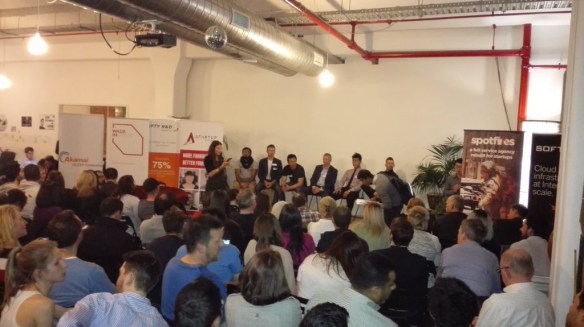
As part of the recent Melbourne #Startup Week, IT consulting firm, Versent hosted a B2B pitch event at their product development lab, Level 3. Introduced by Thor Essman, the judges for the evening were Grant Thomson from York Butter Factory, Paul Naphtali of VC fund Rampersand, and Carl Rigoni, Head of Digital at Australia Post. It presented a very focussed cohort of enterprise solutions, that covered employee comms and engagement, design thinking and cybersecurity.

Screen Shot 2016-07-03 at 2.14.42 PMPax Republic

Pax Republic is positioned as an employee engagement platform that grew out of the founders’ background in mediation. Recognizing that organisational change programs have a high failure rate, the founders explained that lack of project or employee data isn’t the problem; it’s a shortage of actionable insights and recommendations.

The solution offers text-based content and scripted dialogue combined with AI and online facilitators. Many traditional enterprise tools don’t work, either because they don’t reduce time and cost, or they can’t scale.

When asked if AI can measure sentiment or mood, the founders explained that the system makes use of emoticons to capture employee feedback plus keystroke analysis. In terms of a commercial model, the goal is to train up internal facilitators to deliver the service, rather than getting involved with specific change management projects.

The judges felt that the pitch needed to refine the problem statement and the solution proof points, as well as explain what makes this solution different. In particular, who is the buyer? It’s also important to tell the sales story, and expand on the risk transfer and pricing benefits.

Forticode

Forticode has developed an elegant and deceptively simple password protection solution, to remove the risk and costs of password resets for their corporate clients. Basically, it can support multi-factor authentication using colour coding and a randomized keypad, incorporating character sets as well as emojis.

It can provide context aware authentication, and native protection from endpoint hacking attacks, via a plug-in architecture and 3-factor authentication, using patented technology.
According to the founders, finger prints are immutable, but still do not provide 100% identity confirmation on touch screen devices.

There were questions from the judges and the audience about alternative solutions. Compared to an IPA gateway for trust and authentication or password aggregators, Forticode offers a much more robust solution and can support machine-to-machine verification.

The sales model is to target security teams within risk and compliance departments, and price on a per user per month basis. Importantly, there is no third-party software in the stack. And, there was even an offer to introduce the founders to Auspost….

Naked Ambition

With the tag line of “Always Be Creating”, Naked Ambition is a consultancy for innovation and design thinking. Their process is to focus on future needs, help clients get closer to their customers, and in doing so, help employees to leverage customer insights. The ultimate goal is to make design thinking skills ubiquitous. Naked Ambition’s aim is to embed the teaching in the organisations they work with.

The judges questioned who exactly is the customer, and what segments do they work in? There was also some discussion whether the service was more about personal branding and intrapreneurship, rather than pure solution design.

In particular, the judges wanted to know what gives Naked Ambition the “license” to offer their services? Despite hiring a leading design thinking expert from IBM, there was a sense that there is an oversupply of similar services, and that clients are not looking for yet another program. Instead, they are thinking about “buying units of innovation” for specific projects, as and when they need them.

Konnective

Last to present was Konnective, a business I have blogged about before. In short, this is an employee messaging app for frontline staff, many of whom do not have corporate e-mail addresses, let alone access to a their own desktop computer.

As part of the product development, Konnective now offers Groups, dashboards, analysis of what’s working and employee reach. Charging a basic annual fee per employee, Konnective has clients in mining, healthcare and manufacturing. The platform supports OH&S comms, promotes shift availability that can reduce agency hiring fees, and help reach hourly employees who don’t access corporate e-mail.

The judges asked about BYOD, and the risk of/resistance to having organisational data on personal mobile phones. Plus, why Konnective and not, say Yammer or Slack? These are answers that need to be made more explicit. Finally, Konnective is still working on data analytics, and there was a suggestion of opportunities among travel companies and tour guides, but that would require some multilingual capabilities.

On the night, Forticode won the judges over and took out first prize. This was the second of these events, and I look forward to attending more in future.

Next week: Startup Victoria’s #Pitch Night for #Startup Week

Field report from Melbourne #Startup Week

The third Melbourne #Startup Week has confirmed Startup Victoria‘s pivotal role in supporting local entrepreneurs, founders, startups and anyone interested in innovation and disruption. Over the next few posts, I will be commenting on some of the events I attended. Meanwhile, here is a brief summary of the key themes that emerged.

Screen Shot 2016-06-26 at 1.43.16 PMFirst, there is a continued shift from B2C and 2-sided markets, to B2B and enterprise solutions among the startup pitches I saw. Medtech is also getting some renewed attention, as are XaaS business models. And of course, there has to be scale in the idea.

Second, nearly all of the feedback from the judges at the pitch events centred on “why you?” –  What makes your idea different to the competition? What is the problem statement? Where are the solution proof points?

Third, there was an interesting session on “innovation from within” and the rise of intrapreneurship. There were also discussions on whether (and how) aspiring founders should leave an existing job to embark on a startup project, and how to navigate an entrepreneurial career. (More on this to follow.)

Fourth, the notion of “disruption for disruption’s sake” is being challenged – it’s not enough to be disruptive, there has to be substance (and purpose) to back it up.

Fifth, the use of design thinking, human-centred design and CX mapping in fostering creativity is breaking through to large corporations, but it is just one of many available innovation techniques – without context and framing, it can simply become a process.

Finally, I heard very little (in fact, absolutely nothing) about the role of government(s) in fostering innovation and entrepreneurship, and in supporting startup founders – notwithstanding LaunchVic, and the National Innovation & Science Agenda. Maybe there is so much election campaign fatigue that the startup community has already discounted the impact politicians (of any persuasion) can have on their business aspirations. Certainly, the numbers of Gen X and Gen Y attending some of last week’s events is testament to how engaged younger citizens are in finding purpose through the type of work they do (and what sort of organisations they work for), that they are less focussed on securing a “job”, and more concerned about building a career.

Next week: Level 3’s Enterprise Pitch night

University Challenge – #Startup Victoria’s Student #Pitch Night

There were around 500 people in the audience for last week’s #StartupVic University Startup Battle, which either says there was nothing better to do on a chilly Melbourne evening, or that this new Meetup format is working – or that the students of today are less interested in finding a job, and more interested in building their own career opportunities that connect with their purpose. (Our political leaders should take note….)

A sell out audience for the University Startup Battle (Image by Stefan Welack sourced from Twitter)

A sell out audience for the University Startup Battle (Image by Stefan Welack sourced from Twitter)

After a series of campus competitions, the finalists on the night were representing 6 of Victoria’s universities, and revealed a wealth of talent, ideas, innovation and inspiration. In order of appearance, the pitches were:

InternMe – (Victoria University)

With a tagline of “Experience the Experience”, this is a 2-sided market for graduate recruitment, that revealed some interesting stats about the student employment market.

Revenue is expected to come from fees for successful placements, and job advertisements. The business plans to cover work experience, internships, part-time and temporary work during study, as well as permanent and full-time roles.

Currently sourcing leads via LinkedIn and social media (notably Instagram), the founders say they may include psychometric profiling tools for better matching applicants with opportunities.

The pitch was to raise $100,000 for website development, but as the judges commented during the Q&A, the biggest challenge is engaging employers. As regular attendees to these pitch nights will recall, this mismatch or disconnect between students/graduates and employers continues to provide startup opportunities.

Printabox – (Swinburne University)

This website is designed to reduce the time, cost and complexity of ordering short-run branded boxes. Basically a self-serve model, the founders have spent $500,000 in development costs, primarily on a proprietary design tool. The resulting products come in 3 standard sizes – perhaps more customisation will become available?

The target clients are the 44,000 online stores in Australia who often need small numbers of branded boxes for sending out customer orders. But as the judges noted (based on a quick online search) there does appear to be a lot of competition. And although Printabox claims that their source code is protected, they have not applied (or are unable to apply) for a design patent.

Mech X Innovation – Project Ora – (Deakin University)

The founders have developed a hardware device that fits on standard tablet computers, and is designed to help children reduce and prevent eyesight damage caused by too much screen time, and by being too close to the device.

Essentially a Bluetooth-enabled accessory linked to an app, Ora monitors the amount of user screen time, proximity to the device and ambient lighting, and can be used in conjunction with “time outs”, scheduled messages and reminders to “go and do something else”. It can be semi-customised, so that parents can create a reward system, for example.

According to the designers, the competitor products (Appomate and samtime) are app-based only, and focus on time and distance – not lighting. Ora may also integrate with other devices, e.g. FitBit, but the target market is children and teenagers up to age 18, and their parents.

Asked about their path to market, they are planning a crowdfunding campaign. The key to adoption, though, will be via schools (who either provide or prescribe what devices pupils use) and schools suppliers (e.g., digital text books and e-learning tools).

ICallDibs – (Monash University)

This idea grew out of direct user experience, namely how can overseas students coming to Melbourne buy and sell furniture? The business is aiming to provide a market place for “Second Hand Furniture, First Class Deals”.

The biggest challenges faced by international students when buying/selling furniture are transportation, timing and finding buyers/sellers. The business will offer bundled services, including storage and removals/delivery, via partnerships.

The company aims to target international student agencies, and will ensure better matching between buyers and sellers (although they may want to consider changing the name unless they can trademark it….).

Rather than an “Ask”, the team offered a “Give” in the form of a customer discount for the evening’s attendees.

When asked about logistics and insurance, the founders clarified that the counterparts (buyer and seller) bear the direct risk. The business takes their commission upfront, then release the order details to the customers.

Assignment Hero – (Melbourne University)

It felt that this app, a collaboration tool for group work (sort of Slack for education?) was speaking to the converted, given the audience response. In short, having access to lots of different collaboration tools sounds great, but they each only do one or two things (albeit, really well). And if you use more than one app, you end up with too many tools and too many notifications.

While students may hate group assignments, they’re an important aspect of learning how to work with other people and acquiring other soft skills. They also seem to comprise a greater component of student assessments – possibly because they require less direct teacher-student face time?

Rather than build a whole new system, the founders have opted for native integration with Google Docs, plus some dashboard reporting tools (including the amount of individual input to a project).

The app is free to end users, but will generate revenue from education providers (enterprise sales) and on-demand services and commissions. When asked about existing tools like Moodle and Blackboard, the founders noted that these were designed for teaching, not collaboration.

It was also noted that existing productivity apps are not easily accessible by students (although no doubt, as with education content providers, enterprise app vendors will make student versions and pricing available). Plus, the “edtech” sector is of particular interest when linked to life-long learning, professional development and self-directed study.

Eat Up – (RMIT)

Finally, Eat Up is a social enterprise trying to address the number of school children who turn up at school without anything for lunch – estimated to be as many as 1 in 8 schoolchildren. Personally, I find this an indictment on our society – why should anyone in Australia need to go without basic food? – but the causes/reasons are far too complex to address here.

Essentially a partnership for sourcing, assembly and distribution, Eat Up has created a service model which they hope to roll out in more and more schools. They tap into the established Food Bank network for supplies, engage TAFEs to prepare the lunches, and use OzHarvest and SecondBite for logistics. There has also been support from Virgin Australia, ygap, Karma Canteen and Education Changemakers.

Eat Up aims to avoid passing on the costs to kids, parents or schools, and in part takes inspiration from another social enterprise, Thank You Water.

During a panel Q&A, the founders were asked about the apparent lack of technical skills or resources on their teams. In response, it was noted that there are many open source apps, available templates and market places for code and plugins. One founder commented that despite studying computer science, he used very little of what he learned to develop his app.

Revealing another apparent weakness in their pitches, the founders were quizzed on their respective sales models, costs of acquisition and pathway to revenue. The responses suggested that the startups risk being limited by their own inexperience, and that they each need to do more market analysis, assessment of customer willingness/ability to pay, and identify the best ways to scale their businesses.

There was also a lack of clarity around near-term goals and milestone planning.

In the end, the winner was Assignment Hero, no doubt reflecting the needs of the audience, plus the fact that the business has gained traction with some universities.

Next week: ASIC’s new regulatory sandbox for #FinTech #startups

More on #FinTech, #Bitcoin and #Blockchain in Melbourne

The Melbourne FinTech community brought together a bunch of interested parties recently to find out what’s happening locally in Bitcoin and Blockchain. Organised by the Melbourne Bitcoin, FinTech and Silicon Beach Meetups, and hosted by the Melbourne Bitcoin Technology Centre (MBTC), the evening was part open house, part info sharing, and part pitch night.

BitcoinThe MBTC is now a recognised hub for Bitcoin and Blockchain activities, and currently hosts around a dozen startups within its co-working space. Offering a “full service” facility (it even has a Bitcoin miner on site), complete with staffed reception, meeting rooms, event space, a pod cast studio and an outdoor barbecue area, it’s something of a hidden gem in Melbourne’s Southbank. Regulars also get to attend Bitcoin “swap meets”…..

Last week’s event also featured a number of micro-pitches from Bitcoin and Blockchain startups, a few of the MBTC staff and tenants, and a couple of student projects from RMIT.

Given this was almost “speed pitching“, it’s probably not appropriate to go into too much detail:

  • Toodles – a dating app on a decentralized network, using a Blockchain solution for additional security and privacy
  • Blockfreight – the Blockchain for global freight, enabling cargo containers to be shipped around the world with minimal legacy documentation, based on smart contracts, RFID and Blockfreight tokens
  • blockTRAIN – a training provider and consultancy on Blockchain, smart contracts and digital currencies
  • Bitcoin Buskers v2 – sort of MySpace/Bandcamp/SoundCloud for Buskers, to promote their merchandise and to secure international festival bookings, all powered by Bitcoin
  • ACX – Australian Crypto Exchange, offering the largest single Bitcoin order book in Australia
  • Bitcoin Group – explaining that most Bitcoin mining is currently done in China due to cheaper electricity
  • Antstand – portable laptop stand (which you can buy with Bitcoin!)
  • Think Bitcoin – providing consulting and education services, particularly in schools
  • Lyra – an app to track and reduce your personal environmental impact, sort of Fitbit and Smart Meter combined
  • ImagineNation – innovation consultancy, backed by training and coaching, and featuring a 2-day startup game to help organisations transform cultural mindsets around agile, lean, design thinking, UX and incubator/accelerator concepts
  • Brave New Coin – the “Bloomberg for Bitcoin”, providing market data (prices, rates, indices, news) for Bitcoin and other digital currencies*

With the next Bitcoin halving due soon, and a significant uptick in FinTech, Blockchain and Digital Asset investments announced during Q2, this sector is going to look very interesting for some time to come, and it’s good to know that Melbourne, whose fortunes were founded on gold, is staking a claim in these new asset classes.

* Declaration of Interest: I have recently joined the team at Brave New Coin as Head of Business Development – more news to follow….

Next week: University Challenge – Startup Victoria’s Student Pitch Night