The “new, new normal” post-Covid-19

After the GFC of 2007-8, we were told to get used to the “new normal” – of low/slow/no growth, record-low interest rates, constant tech disruption and market dislocation as economic systems became increasingly decoupled from one another. And just as we had begun to adjust to this new reality, along comes Covid-19 and totally knocks our expectations sideways, backwards and upside down, and with it some negative long-term consequences. Welcome to the “new, new normal”.
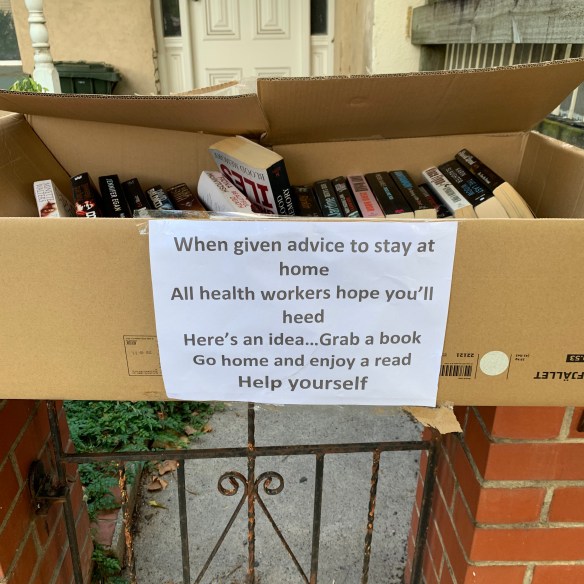
Just what the doctor ordered: “Stay home and read a book!”

In the intervening years since the GFC (and don’t those days seem positively nostalgic from our current vantage point?), we have already seen ever lower interest rates, even faster disruption in business models and services, and a gradual dismantling of the trend towards a global economy. The pre-existing geopolitical landscape has either exacerbated this situation, or has been a prime beneficiary of the dismantling of the established structures of pluralistic, secular, non-sectarian, social-democratic and liberal societies.

First, relations between the Superpowers (USA, Russia and China) have not been this bad since the Cold War. Second, nationalism has not been as rife since the 1930s. Third, political leadership has tended toward the lowest common denominator of populist sloganeering. Not to mention the rise of fundamental religious sects, doomsday cults and tribal separatist movements. Let’s agree that even before the current pandemic, our resistance was already low….

Whatever your favourite conspiracy theory on causes and cures for Covid-19, it’s increasingly apparent that populist leaders of both the left and the right will use the pandemic as vindication of their policies – increased xenophobia and tighter border controls, increased centralisation of power and resources, greater surveillance of their citizens, a heightened intolerance of political dissent, a continued distrust of globalisation, and a growing disregard for subject matter experts and data-driven analysis.
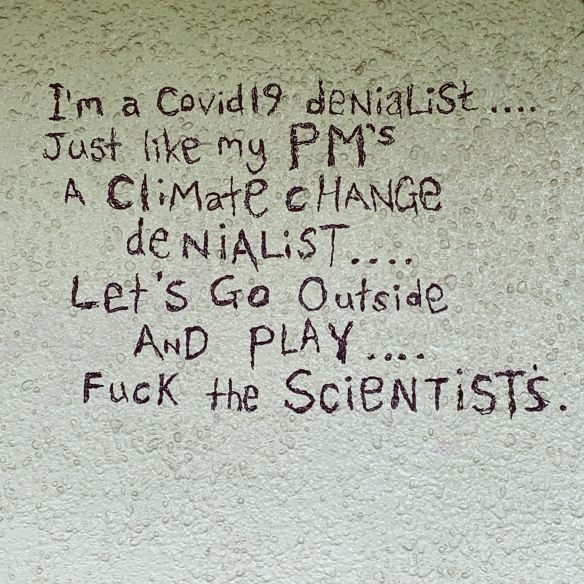
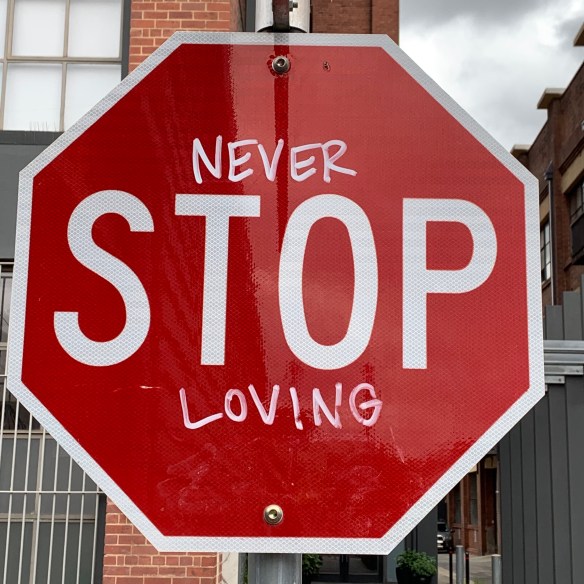
The writing’s on the wall? Message seen in East Melbourne

There are obviously some serious topics up for discussion when we get through this pandemic. Quite apart from making the right economic call (“printing money” in the form of Quantitative Easing seems the main option at the moment…), governments and central banks are going to have to come to grips with:

  • Universal Basic Income – even before Covid-19, the UBI was seen as a way to deal with reduced employment due to automation, robotics and AI – the pandemic has accelerated that debate.
  • Nationalisation – bringing essential services and infrastructure back into public ownership would suggest governments would have the resources they need at their disposal in times of crisis – but at the likely cost of economic waste and productivity inefficiencies that were the hallmark of the 1970s.
  • Inflation – as business productivity and industrial output comes back on-line, the costs of goods and services will likely increase sharply, to overcome the pandemic-induced inertia.
  • Credit Squeeze – banks were already raising lending standards under tighter prudential standards, and post-pandemic defaults will make it even harder for businesses to borrow – so whatever the central cash rates, commercial lenders will have to charge higher lending rates to maintain their minimum risk-adjusted regulatory capital and to cover possible bad debts.
  • Retooling Industry – a lot of legacy systems might not come out of the pandemic in good shape. If we have managed to survive for weeks/months on end without using certain services, or by reducing our consumption of some goods, or by finding workarounds to incumbent solutions, then unless those legacy systems and their capacity can be retooled or redeployed, we may get used to living without their products all together.
  • Communications Technology – government policy and commercial settings on internet access, mobile network capacity and general telco infrastructure will need to be reviewed in light of the work from home and remote-working experience.
  • The Surveillance State – I’m not going to buy into the whole “China-virus” narrative, but you can see how China’s deployment of facial recognition and related technology, along with their social credit system, is a tailor-made solution for enforcing individual and collective quarantine orders.

Another policy concern relates to the rate at which governments decide to relax social-distancing and other measures, ahead of either a reliable cure or a vaccine for Covid-19. Go too early, and risk a surge or second wave of infections and deaths; go too late, and economic recovery will be even further away. Plus, as soon as the lock-downs start to end, what’s the likelihood of people over-compensating after weeks and months of self-isolation, and end up going overboard with post-quarantine celebrations and social gatherings?

Next week: The lighter side of #Rona19
 

#Rona19 – beyond the memes

More commentary on Covid-19 – at the time of writing, Victoria is at Stage 3 restrictions, with Stage 4 possible very soon. Generally, people seem to adapting to if not actually coping with this daily reality (although people are still flouting their quarantine obligations). But there is still some confusion on how to interpret, observe and enforce the social distancing measures, and of course, huge economic uncertainty remains for many people who have seen their working hours evaporate, especially if they are in vulnerable industries, and/or they can’t work from home.

Sign of hope? (Seen on my daily walk)

Meanwhile, the shutdown has prompted a fair number of less serious responses, from toilet paper memes, to “viral” GIFS, from parodies of “My Sharona” and “Bohemian Rhapsody”, to unfortunate examples of the downside of company video conferences while working from home.

But beyond the hashtags, what might we expect once we get through the current pandemic? Here is a somewhat random list of possible outcomes:

  • A renewed appreciation of personal space in public places – will we continue to observe such protocols where and whenever practical, as it becomes a community norm?
  • Greater respect for introverts – possibly better able to handle self-isolation, they are comfortable with their own company and don’t feel the need to seek out crowds  – social distancing does not represent an existential crisis, and they don’t rely on social situations for their personal validation.
  • Passenger airlines and cruise companies are toast – the tourism and travel industries will be hard hit, and may struggle to rebuild in their current form.
  • The online economy will get a boost  – restaurants and providores are already retooling to offer D2C food and meal deliveries (even cutting out the likes of Uber Eats, Deliveroo and Menu Log). Some brick and mortar retail is adapting fast, but will face a reduced share of available discretionary spending.
  • Naturally, digital services will thrive – from communication solutions to virtual classes, from remote working support services to telehealth. But bandwidth capacity and internet down/upload speeds remain a challenge in Australia.
  • The end of physical cash – if retailers prefer contactless payments (less contamination), what use are those notes and coins in your wallet?
  • A higher community standard for the individual duty of care we owe to each other – Covid-19 will certainly test the “duty of care” we owe to neighbours, colleagues, members of the public… if I knowingly infect someone, or act recklessly or negligently, can the victim sue me?
  • Likewise, the corporate social license to operate will be tested and re-cast – in light of monopolistic practices, price gouging, market abuse and disregard for the “new normal”, companies will need to re-assess many of their standard policies.
  • Increased use of facial recognition and other technology for surveillance purposes – if people cannot be trusted to observe their quarantine, self-isolation and social distancing obligations, the authorities will not shy away from further incursions into civil liberties that we currently take for granted.
  • A hybrid of on-site and working from home employment structures – not everyone will want to continue working remotely, nor will everyone be in a rush to head back to the office (or the daily commute), which will likely cause headaches for employers….

More on these themes next week….

Next week: The “new, new normal”


Signing off for Saturnalia

According to a Gallup Report, in 2018 the world was “sadder and angrier than ever. If recent global events are anything to go by, 2019 will easily top that. And as I write, much of south east Australia is on fire (the bushfire season having started back in early August), only adding to the sense of rage. I can’t recall an angrier year, maybe not since the 1970s.

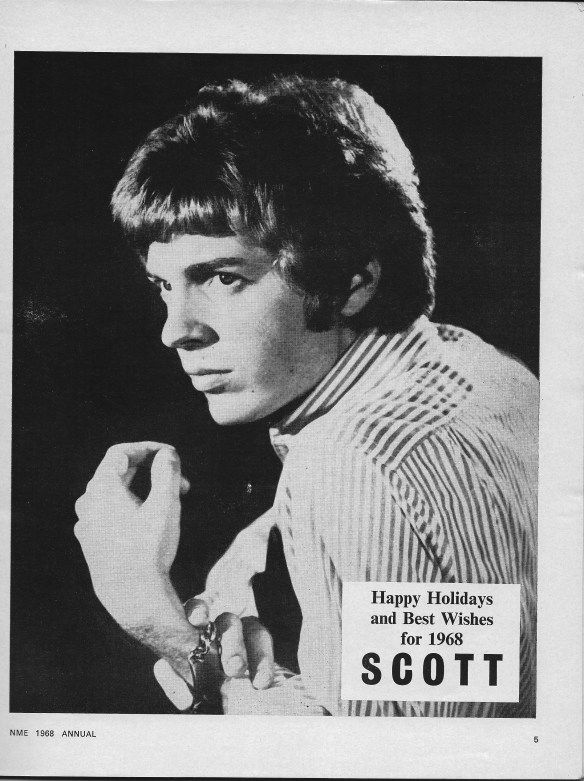
Image of Scott Walker scanned from the NME Annual for 1968

Reasons to be angry? World politics, climate change, fake news, growing nationalism, economic stagnation, and sectarian intolerance. Evidence of anger? Brexit, Impeachment, Hong Kong, France, Chile, Iran, India, Iraq, Adani, Extinction Rebellion, #MeToo, etc.

Meanwhile, considered academic debate has been reduced to very public slanging matches. Even popular music seems shoutier than ever, and no action movie is considered complete without gratuitous violence, hyperbolic pyrotechnics and pounding soundtracks.

So much noise, so much hot air (verbal and atmospheric) and so much sheer rage, not always easy to articulate or understand – and not easy to predict how that will translate at the ballot box, given the election results in Australia and the UK. Politicians of all persuasions are increasingly seen as being a key cause for voter anger, but in both cases, continuity was deemed preferable to change.

As we wind down for the holidays, it’s frustrating to think that the “season of goodwill” is limited to just a few weeks of the year. I’m not suggesting 12-month-long Black Friday Sales. Rather, can we find it in ourselves to be more civil to each other throughout the year, even if we disagree on certain things? In particular, I’m thinking of the growing evidence of sectarian strife. Established religions may condemn to hell (or even death) anyone who disagrees with their belief systems, but in a democratic, secular and pluralist society, the right to “freedom of religion” also means everyone is entitled to “freedom from religion”.

In light of that, I’d like to wish all my readers a safe and peaceful Saturnalia. Normal service will be resumed in the New Year.


Recent Notes from Hong Kong

Earlier this month I spent a few days in Hong Kong, on my way back from Europe. Hong Kong was my home for 6 years – before, during and after the 1997 Handover – and I have continued to visit on a regular basis ever since. While I didn’t directly witness any of the latest clashes between pro-democracy campaigners and the police, I did see (and hear) the knock-on effects of the past 6 months. I also spoke to a range of people living and working in the city – from local residents to long-term expats; from small business owners to entrepreneurs; from corporate employees to public servants; from teenagers to senior citizens. Whatever their particular views on recent events, their one common hope is that the situation can be resolved peacefully, and soon.

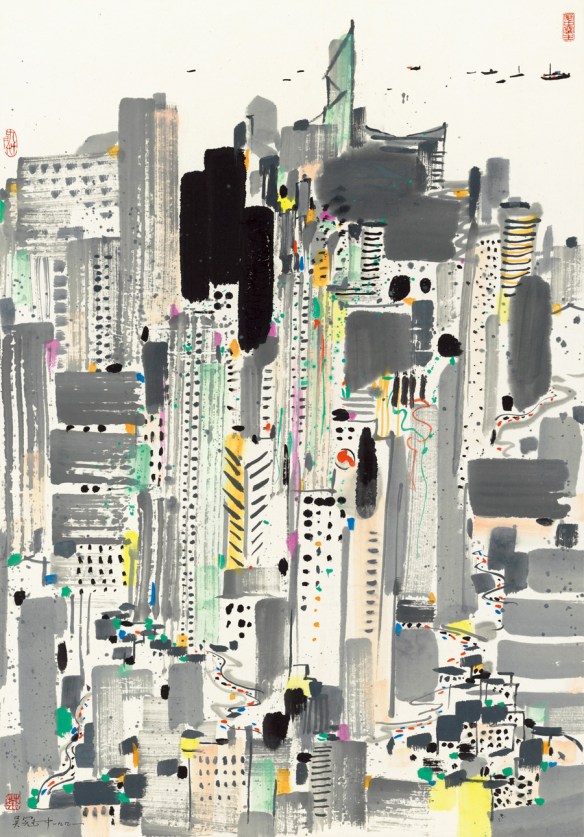
“Maze of Today” by Wu Guanzhong (2007) – Image sourced from China Online Museum website*

The trigger for the current protests was a proposed extradition law between the Hong Kong SAR and the rest of the PRC (as well as Taiwan and Macau). The bill was highly contentious, given the very different legal systems between Hong Kong and the Mainland. Serious concerns were expressed by the business sector, the legal profession and the general public. These concerns were given wider voice by the hundreds of thousands of ordinary people who joined the first of the peaceful mass marches at the start of the summer. Since then, nearly every weekend (and at times during the week) there has been direct action in the form of marches, strikes and occupations – sometimes leading to street battles between police and protestors, images of which have been seen around the world. These events have been accompanied by allegations of police brutality, the alleged use of agents provocateurs, and suggestions that the protestors are either terrorists, traitors or a threat to society.

On one level, Hong Kong continues to operate normally (although getting into the international airport is a little trickier since it was the target of so-called “stress testing” of the public roads and transport system). On the other hand, it certainly feels quieter than normal, and visitor numbers are down – as much as 40% overall on one measure, with a 90% decline in visitors from the Mainland. (My flight from Europe was barely half full.)

With the increased protest activity at weekends, public transport can be tricky. Some subway stations are suddenly closed without much warning from Friday evenings onward, and the express train from Central to the airport bi-passes the usual intermediate stops. On the Sunday I was there, there had been a mass gathering in Central, and access to the nearest subway station (for the local train service back to Kowloon) was closed, so there was an orderly queue of several hundred metres as people waited for the Star Ferry – many of the passengers dressed in black t-shirts, the unofficial uniform of the protest movement.

Given the recent bans on marches and gatherings in public places (notwithstanding Hong Kong’s right to peaceful assembly) a strange phenomenon has emerged. Each night, at around 10.30pm, local residents open their apartment windows and start chanting slogans associated with the pro-democracy movement. It is both eerie and extremely moving.

This nightly display certainly evokes the sense that no-one wants to see complete chaos or a violent end to the protests, so they chant in hope that a peaceful solution can be found. Otherwise, hope will give rise to despair, and with it the slow, painful decline of Hong Kong as a global city – a multi-cultural, international hub for trade, commerce, finance, ideas and innovation that combines notions of east and west, new and old, pragmatism and spiritualism.

The protestors have issued a set of five key demands. One relates to scrapping the extradition bill, which has now been withdrawn by the Hong Kong Chief Executive. Three relate to the protests themselves – removal of the term “rioters” to label the protestors; an independent investigation into the police response and alleged brutality (and even into police in-action when protestors were attacked by counter-demonstrators with seeming impunity); and an amnesty for all protestors who have been arrested to date.

The fifth demand, Universal Suffrage in direct elections for both the Legislative Council (Hong Kong’s Parliament) and the Chief Executive, is a lingering issue from the Umbrella campaign of 2014 (when large parts of the city were occupied in protest at Beijing’s decision to “defer” one person one vote). It’s probably even more contentious than the withdrawal of the extradition bill. To summarise: the Basic Law is Hong Kong’s Constitution. It is supposed to enshrine the city’s pre-existing common law systems for a minimum of 50 years after the Handover. Under the “One Country, Two Systems” regime, designed to govern Hong Kong’s legal, political and economic relationships with the Mainland, the people of Hong Kong were assured that their way of life would continue as before after 1997.

Article 45 of the Basic Law, states that:

“The ultimate aim is the selection of the Chief Executive by universal suffrage upon nomination by a broadly representative nominating committee in accordance with democratic procedures.”

The above has to be read in conjunction with Article 15 (Beijing directly appoints the Chief Executive), and Annex 1 (defines the candidate selection and election process – which has been revised in recent years).

The challenge is that the Central government believes it has to keep control over both the candidate nomination process, and the membership of the Election Committee (election college). On current evidence, the people of Hong Kong are unlikely to get to directly elect their own Chief Executive, nor nominate the candidates of their own choosing. (And the Legislative Council will continue to comprise members who represent “functional constituencies” – elected representatives voted in by their peer groups from various vested interests.) Even if they did directly vote for the Chief Executive of their choosing, Beijing would reserve the right not to confirm them in office, and would appoint their own candidate instead.

Of course, it’s not that Hong Kong was particularly democratic under colonial rule – the Governor was technically appointed by the British Monarch (on the advice and recommendation of the British Foreign Secretary), and acted as the Crown’s direct representative.

On another level, the model for the Election Committee is something like the US Electoral College that formally elects the President, based on the delegates elected by each State. This process was seen as “a compromise between election of the President by a vote in Congress and election of the President by a popular vote of qualified citizens”.

Finally, I was given an interesting interpretation of “One Country, Two Systems” by an elderly gentleman I spoke to on the MTR one day. “Where are you from?” he asked. “Australia” I replied. “Ah, near New Zealand. Same country.”

* My reason for choosing the above picture of Hong Kong by Wu Guanzhong to illustrate this blog is two-fold:

First, the painting is called “Maze of Today”, rather an apt title for the current state of affairs. Second, while I was working as a publisher in Hong Kong in the 1990s, my company licensed another Hong Kong picture by Wu for the cover of an introductory book on the law of the Hong Kong SAR. The first edition was issued in 1996, with a second edition in 2001 – and it still appears to be on the Hong Kong University reading list for law students, and cited in other law books as recently as this year.

Next week: Startup Vic’s Impact Pitch Night