Has web-traffic analysis just got better or worse thanks to Google search encryption?

Last month, WordPress informed its customers that Google has expanded search encryption to cover any search except for clicks on ads. The impact will mean less detail about which keyword searches are driving traffic to your website. Debate among industry observers suggested that this was done either in response to security-related issues, or simply to maximise ad revenue.

I’ll leave you to decide what the real motive is, and to determine what your own response should be around SEO strategies. My sense is that content owners and social marketers will sharpen their use of keywords, and devise new tactics to maximise the value of web traffic analytics. As one commentator has observed, Google has a near monopoly on search – but in the end, it’s their platform and they’ll do what they want with it.

From my own analysis here at Content in Context, the number of “unknown search terms” far outweighs precise keyword or search strings, but thanks to the WordPress stats, I am still able to get a reasonably informed sense of what drives traffic to this blog:

  • Social networks (Twitter, LinkedIn, Facebook, etc.) account for about half of all referrals to Content in Context (including 10% from Reddit, even though I do not actively participate on that platform)
  • Search engines comprise about one-third of referrals (with Google Search accounting for over 90%)
  • Meetup is an increasingly important source of referrals
  • Embedded links (used selectively) can also be a useful source of referrals

I have found some interesting citations to my blog (including undergraduate study forums), and I figure I must be doing something right when third parties approach me to write about their products or to include advertorial content in my blog – and of course, I would declare any such interest when it arises!

Even though I do not pay for Google ad words, or undertake any paid-for SEO, this blog comes up 2nd (after paid results) when using Google search for “Content in Context”.

One outcome from Google search encryption will undoubtedly be a renewed focus on providers offering contextual search solutions, because keyword search relies primarily on frequency, proximity and assumed relevance of search terms, rather than actual contextual meaning.

So, in some ways Google’s decision to encrypt all search will make everyone else lift their game, which can only be positive.

Whose content is it anyway?

Faust 2.0

Every social media and digital publishing platform is engaged in a continuous battle to acquire content, in order to attract audiences and bolster advertising revenues.

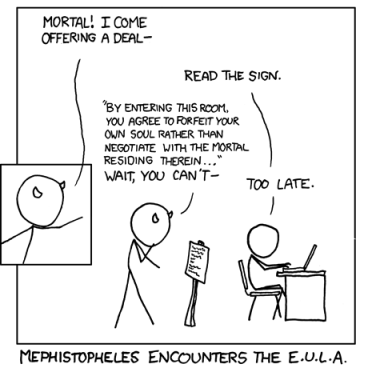
Content ownership is becoming increasingly contentious, and I wonder if we truly appreciate the near-Faustian pact we have entered into as we willingly contribute original material and our personal data in return for continued “free” access to Facebook, YouTube, Google, Flickr, LinkedIn, Pinterest, Twitter, MySpace, etc.

Even if we knowingly surrender legal rights over our own content because this is the acceptable price to pay for using social media, are we actually getting a fair deal in return? The fact is that more users and more content means more advertisers – but are we being adequately compensated for the privilege of posting our stuff on-line? Even if we are prepared to go along with the deal, are our rights being adequately protected and respected?

In late 2012, Instagram faced intense public backlash against suggestions it would embark upon the commercial exploitation of users’ photographs. While appearing to backtrack, and conceding that users retain copyright in their photographs, there is nothing to say that Instagram and others won’t seek to amend their end-user license agreements in future to claim certain rights over contributed content. For example, while users might retain copyright in their individual content, social media platforms may assert other intellectual property rights over derived content (e.g., compiling directories of aggregated data, licensing the metadata associated with user content, or controlling the embedded design features associated with the way content is rendered and arranged).

Even if a social media site is “free” to use (and as we all know, we “pay” for it by allowing ourselves to be used as advertising and marketing bait), I would still expect to retain full ownership, control and use of my own content – otherwise, in some ways it’s rather like a typesetter or printer trying to claim ownership of an author’s work….

The Instagram issue has resurfaced in recent months, with the UK’s Enterprise and Regulatory Reform Act. The Act amends UK copyright law in a number of ways, most contentiously around the treatment of “orphan” works (i.e., copyright content – photos, recordings, text – where the original author or owner cannot be identified). The stated intent of the Act is to bring orphan works into a formal copyright administration system, and similar reforms are under consideration in Australia.

Under the new UK legislation, a licensing and collection regime will be established to enable the commercial exploitation of orphan works, provided that the publisher has made a “diligent” effort to locate the copyright holder, and agrees to pay an appropriate license fee once permission to publish has been granted by the scheme’s administrator.

Such has been the outcry (especially among photographers), that the legislation has been referred to as “the Instagram Act”, and the UK government’s own Intellectual Property Office was moved to issue a clarification factsheet to mollify public concerns. However, those concerns continue to surface: in particular, the definition of “diligent” in this context; and the practice of some social media platforms to remove metadata from photos, making it harder to identify the owner or the original source.

Meanwhile, the long-running Google book scanning copyright lawsuit has taken another unexpected twist in the US courts. From the outset, Google tried to suggest it was providing some sort of public service in making long-out-of-print books available in the digital age. Others claim that it was part of a strategy to challenge Amazon.

Despite an earlier unfavourable ruling, a recent appeal has helped Google’s case in two ways: first, the previous decision to establish a class action comprising disgruntled authors and publishers has been set aside (on what looks like a technicality); second, the courts must now consider whether Google can claim its scanning activities (involving an estimated 20 million titles) constitute “fair use”, one of the few defences to allegations of breach of copyright.

Personally, I don’t think the “fair use” provisions were designed to cater for mass commercialization on the scale of Google, despite the latter saying it will restrict the amount of free content from each book that will be displayed in search results – ultimately, Google wants to generate a new revenue stream from 3rd party content that it neither owns nor originated, so let’s call it for what it is and if authors and publishers wish to grant Google permission to digitize their content, let them negotiate equitable licensing terms and royalties.

Finally, the upcoming release of Apple’s iOS7 has created consternation of its own. Certain developers with access to the beta version are concerned that Apple will force mobile device users to install app upgrades automatically. If this is true, then basically Apple is telling its customers they now have even less control over the devices and content that they pay for.

Outside of a small circle of friends, there’s only connections…

"A Dance to the Music of Time" is an epic tale of friendships and relationships

How many true friends can a person really have? Friends you would go to the cinema with, and who would walk out with you if you didn’t like the film? Friends whom you would invite to stay at your home for the holidays? Friends who would tell you when you had made a fool of yourself, but not hold it against you? Friends from whom you would borrow money or to whom you would lend money?

Social networking makes it all too easy to connect with people we’ve barely or never met. Instead of investing our time and effort in cultivating meaningful and lasting friendships, social media encourages us to “collect” as many virtual friends as possible, and we spend increasing amounts of time in vicarious “sharing” – but how many of these “connections” can we actually count on as our friends?

The question occurred to me as I read the First Movement of Anthony Powell’s “A Dance to the Music of Time”, a literary tour de force situated somewhere between Marcel Proust’s “À la recherche du temps perdu” and Evelyn Waugh’s sequence of novels from “Decline and Fall” to the “Sword of Honour” trilogy.

At the heart of Powell’s 12-novel saga is a group of four friends – Jenkins, the narrator, and his three contemporaries from school – Templer, Stringham and Widmerpool. As we follow their adventures over a 50-year period, we discover the interweaving relationships and often tangential connections that run through their lives. We also witness the subtle change in relationships between the main characters – especially the ebb and flow of their individual circumstances as they fall out of favour and lose contact with one another for years at a time. The reflective and considered format of the novel allows us to see that as in real life, there are periods when the friends positively dislike each other and are frequently disappointed by their personal shortcomings and irritated by their annoying habits.

Powell’s epic work of fiction reminds us that even among our strongest and most enduring friendships, there can be episodes of absolute dislike, as well as times of empathy, loyalty and support; and of course, being only human, our opinions and views of our friends can change over time. Powell’s perspective also confirms that most of the people we encounter in social and professional situations are mere acquaintances. We must surely recognize that our personal friendships are each valued on their own merits, and we enjoy different friendships for different reasons – we do not simply have a homogenous group of “connections” that are all exactly the same. There is nothing wrong with being part of well-connected and inter-related networks, but we must guard against reducing all these relationships to a single dimension.

Unfortunately, most social networking platforms operate on a binary structure where we are forced to make simplistic choices of either “friend” or “unfriend”, “like” or “unlike”, “follow” or “unfollow”. And there is something rather materialistic and incredibly narcissistic in the way that the number of “likes”, “follows” and “shares” we collect on-line is not only representative of our popularity, but it is somehow an indication of how fabulous a friend we really are.

Unlike the real world, these on-line platforms do not recognize the subtle dynamics of our true friendships, nor do they acknowledge that we value each of our friendships for the different experiences that we draw from them. We also have different friends with whom we enjoy doing different things, and we probably don’t introduce all our friends to one another (and certainly not at the same time).

Of course, younger generations who have grown up with social media may have no qualms about the reductionist nature of social networking, and the inherent opportunity it affords them to “connect” with as many different people as they can. But for someone like myself who is quite happy to count fewer than a score of people as my true friends, I relish the quality of my friendships, not the quantity.

Apologies to Phil Ochs for (mis-)appropriating his song title.

Social Networks – All the News You Can Eat

The New York Times‘ motto, “All the News That’s Fit to Print” was modified to “All the News That’s Fit to Click” when the newspaper went on-line. But based on the heated competition for on-line readership, as we move from dedicated news platforms to internet  megastores, and as news content pricing and business models are savaged by social media, the rallying cry is more like “All the News You Can Eat”.

It’s clear that social network sites are stepping up their efforts to attract more readers for on-line news content, if recent events are anything to go by:

1. Google rethinks its strategy for the Reader application, which will no doubt resurface in a new form within Google+.

2. Facebook announces changes to its news feed as it aims to create a highly personalized newspaper experience.

3. Twitter plans to introduce better contextual analysis around trending stories.

4. Yahoo! makes a splash with its purchase of Summly – a news aggregation app which has now been shut down prior to integration within the Yahoo! platform.

5. Even LinkedIn has been getting in on the act with its LinkedIn Today content aggregation tool.

Defining what constitutes news is no longer determined by the traditional business models for print and broadcast media. “Old-school” factual reporting (the “who, what, where, when and how”) combined with informed opinion and analysis (the “why”) is now something of a dying format. In its voracious appetite for content, social media is willing to slap the label “news” on anything that moves. So, one person’s news is another person’s gossip, trivia, PR, party political spin, advertorial or propaganda. All very post-modern and structuralist – the news is whatever you make it.

In response, established newspaper media are building pay walls around their on-line product, to offset the decline in print sales and classified advertising, even though most social media sites are offering “news” for free. This point is significant, because not only does this make it harder for newspapers to charge for content, the proliferation of free metro newspapers in many cities means that paying for a newspaper is something of an anathema to most people. Why on earth would they pay for on-line news content?

While it is understandable that newspapers want to charge for their content, they would be seriously misguided if they continue to see the content alone as the product. Of course, a reliable news service is expensive to produce, but the cost to the consumer should also be about quality, access and convenience. What we are paying for is the newspaper’s role as author, editor, curator, archivist, publisher, aggregator and distributor. In some cases, newspapers are recognized as a document of record – but we are probably some way off granting social media sites the same status.

What are the likely outcomes from this competition for news readership?

Initially, the traditional news media will continue to suffer declining print circulation, and will be challenged to make pay walls work. Stronger news brands with even deeper pockets will probably survive, but  they will need to think about upgrading their content syndication business models to remain relevant within an on-line and social media environment. There will be more apps and tools for personalized news aggregation, but only if these platforms can access or license enough content to be viable, and only if they can monetize the offering to be financially sustainable.

The great irony is that few of us want to rely on a single news source, but we want the convenience of getting all our news in one place.

My guess is that the we’ll see social media sites emerge as “news supermarkets”. They will source content from various suppliers, with whom they will engage in trading terms akin to practices commonly seen in the grocery industry: charging for shelf space and product placement, seeking bulk discounts, and adopting strict supply chain agreements. There will even be “own brand” and “house brand” content, plus a range of specialist and localized products to cater for individual tastes.

Alternatively, “news department stores” might emerge, hosted by a few of the major news brands, where they provide a marketplace for third-party content they have carefully selected and curated, along with a core range of content produced by their talented pool of in-house writers and journalists. Or, like IKEA and some up-scale department stores, the products will be store-branded, but designed by and commissioned from their business partners.

In both cases, these news department stores and news supermarkets could be the anchor tenants in large online news malls, where specialist and independent content providers (including bloggers) can set up shop to attract passing readers.

On a final note, the recent media legislation in the United Kingdom, and the attempted media reforms in Australia, have renewed debate around news regulation: who is to be regulated, what is to be regulated (especially on-line), and by whom will they be regulated? While much of this debate is concerned with news media standards and supervision, as well as issues of ownership and control, there is also a need to consider the impact that internet technology and on-line business models are having on the development, dissemination and consumption of news.