#FinTech – using data to disintermediate banks?

At a recent #FinTechMelb meetup event, Aris Allegos, co-founder and CEO of Moula, talked about how the on-line SME lender had raised $30m in investor funding from Liberty Financial within 9 months of launch, as evidence that their concept worked. In addition, Moula has access to warehouse financing facilities to underwrite unsecured loans of up to $100k, and has strategic partnerships with Xero (cloud accounting software) and Tyro (payments platform).

Screen Shot 2015-09-07 at 10.52.16 amMoula is yet one more example of how #FinTech startups are using a combination of “big data” (and proprietary algorithms) to disrupt and disintermediate traditional bank lending, both personal and business. Initially, Moula is drawing on e-commerce and social media data (sales volumes, account transactions, customer feedback, etc.). Combined with the borrower’s cashflow and accounting data, plus its own “secret sauce” credit analysis, Moula is able to process on-line loan applications within minutes, rather than the usual days or weeks that banks can take to approve SME loans – and the latter often require some form of security, such as property or other assets.

So far, in the peer-to-peer (P2P) market there are about half-a-dozen providers, across personal and business loans, offering secured and unsecured products, to either retail or sophisticated investors, via direct matching or pooled lending solutions. Along with Moula, the likes of SocietyOne, RateSetter, DirectMoney, Spotcap, ThinCats and the forthcoming MoneyPlace are all vying for a share of the roughly $90bn personal loan and $400bn commercial loan market, the bulk of which is serviced by Australia’s traditional banks. (Although no doubt the latter are waking up to this threat, with Westpac, for example, investing in SocietyOne.)

We should be careful to distinguish between the P2P market and the raft of so-called “payday” lenders, who lend direct to consumers, often at much higher interest rates than either bank loans or standard credit cards, and who have recently leveraged web and mobile technology to bring new brands and products to market. Amid broad allegations of predatory lending practices, exorbitant interest rates and specific cases of unconscionable conduct, payday lenders are facing something of a backlash as some banks decide to withdraw their funding support from such providers.

However, opportunities to disintermediate banks from their traditional areas of business is not confined to personal and business loans: point-to-point payment services, stored-value apps, point of sale platforms and foreign currency tools are just some of the disruptive and data-driven startup solutions to emerge. That’s not to say that the banks themselves are not joining in, either through strategic partnerships, direct investments or in-house innovation – as well as launching on-line brands, expanded mobile banking apps and new product distribution models.

But what about the data? In Australia, a recent report from Roy Morgan Research reveals that we are increasingly using solely our mobile devices to access banking services (albeit at a low overall engagement level). But expect this usage to really take off when ApplePay comes to the market. Various public bodies are also embracing the hackathon spirit to open up (limited) access to their data to see what new and innovative client solutions developers and designers can come up with. Added to this is the positive consumer credit reporting regime which means more data sources can be used for personal credit scoring, and to provide even more detailed profiles about customers.

As one seasoned banker told me recently as he outlined his vision for a new startup bank, one of the “five C’s of credit” is Character (the others being Capacity – ability to pay based on cashflow and interest coverage; Capital – how much the borrower is willing to contribute/risk; Collateral – what assets can be secured against the loan; and Conditions – the purpose of the loan, the market environment, and loan terms). “Character” is not simply “my word is my bond”, but takes into account reputation, integrity and relationships – and increasingly this data is easily discoverable via social media monitoring and search tools. It stills needs to be validated, but using cross-referencing and triangulation techniques, it’s not that difficult to build up a risk profile that is not wholly reliant on bank account data or payment records.

Imagine a scenario where your academic records, club memberships, professional qualifications, social media profiles and LinkedIn account could say more about you and your potential creditworthiness than how much money you have in your bank account, or how much you spend on your credit card.

Declaration of interest: The author currently consults to Roy Morgan Research. These comments are made in a personal capacity.

Next week: Rapid-fire pitching competitions hot up…..
It’s not enough to be #disruptive – you also have to #collaborate

For most tech #startups, especially in #fintech, it’s no longer just about being #disruptive – there’s a growing realization that entrepreneurs also have to be #collaborative.

One year on from his last visit to Melbourne, Stripe co-founder John Collison was back in conversation with Paul Bassat from Square Peg Capital, courtesy of Startup Victoria and sponsors Envato, LIFX, BlueChilli, Bank of Melbourne and PwC. Previously, John spoke about the need to be “disruptive rather than incumbent”, yet it seems that Stripe’s growing success can be attributed to relationships with other providers in the payments industry, such as AliPay and VISA, plus deals with retail sites such as Catch Of The Day and RedBalloon. Oh, and it probably helps that most U.S. presidential candidates are using Stripe for campaign donations….

Stripe has already launched an SDK platform for developers, and is planning to launch StripeConnect, a market place platform. The point being, the more users (upstream and downstream) you can plug into your platform, the greater the traction, but also the deeper the collaboration. Why would you want to annoy your potential partners, vendors and suppliers?

Meanwhile, Australia is now Stripe’s 4th largest market, and close to being its 3rd largest.

Going forward, despite some criticism (e.g., it’s still not rolled out in Australia), ApplePay has huge potential. It has an estimated 800m credit cards registered with iTunes (making it 5x bigger than PayPal), and with people currently paying as little as $1.69 per song download, ApplePay could crack the market for broader micropayments (e.g., the $2 on-line daily newspaper?).

However, Stripe stills sees that there are disconnects between traditional credit card application processes, account registration forms, payment solutions, merchant set-up and downstream payments for low-value (but high volume) transactions.

Looking ahead, Collison is talking up opportunities in same-day delivery for e-commerce (hard to see this happening outside of Australia’s main metro areas – unless the infrastructure is there…), and better video-conferencing services (again, in Australia this is hampered by poor broadband services).

A few days later, and Adrian Stone from AngelCube was in conversation with StartUpGrind‘s Melbourne convener, Chris Joannou. Adrian restated the sentiment that angel investors tend to back founders rather than ideas, which can seen by some of the ventures AngelCube has backed so far, including Tablo, LIFX and CoinJar. Each venture has been successful in raising early-stage funding (despite some teething problems and much pivoting), although AngelCube itself has not yet completed an exit.

Rather like his associate Dave McClure from 500 Startups, Adrian recognizes that for various reasons, VCs are having to make smaller, multiple bets, rather than betting the farm on single or a few ideas.

Perhaps this gives further credibility to the proposition that every portfolio (including individual members in retail and industry superannuation funds?) should have a discretionary 1-2% allocation to startups, but you still need an investment vehicle or platform to screen and manage opportunities. Sadly, we see that there is still a disconnect between institutional investors and startup founders. The former are having to get bigger to reduce operating costs, yet this means they have what one friend of mine has defined as the “Allocation Gap”. And of course, founders far outnumber the available sources of VC funding. Time for a rethink on how investors can collaborate to access startup opportunities?

Next week: Cultural Overload


The future of #FinTech is in Enterprise Solutions

Talk to anyone involved in FinTech, and apart from telling you the sector is “hot”, there’s little consensus on what happens next. Despite positioning itself as a disruptive force within financial services, much of what goes on in the sector is either driven by regulatory reform, or by technological developments in allied fields. Most of the disruption so far is in retail and B2C services, yet the more significant opportunities are likely to be found in enterprise and B2B solutions. But as The Economist commented recently, “The fintech firms are not about to kill off traditional banks.”

The Current State

In broad terms, FinTech is working in four main areas:

  • Cryptocurrencies
  • Payments
  • P2P lending
  • Financial Advice and Planning

The first two are responding to dual technological advances – namely, the use of block chains and cryptography; and increased sophistication around mobile and GPS. Patrick Maes, CTO of ANZ Bank, has stated that “Bitcoin and block chain are the first payments innovations in 2,000 years.” He also has a FinTech “wish list”.

The second two (at least, within Australia) are benefitting from regulatory changes, such as the new positive consumer credit reporting regime, and the Future of Financial Advice reforms. And when the National Payments Platform scheduled for 2017 mandates real-time settlements, everyone will have access to immediate inter-bank payment services.

Of course, there is some overlap among these categories, which in turn are also benefitting from developments in big data analytics, mobile solutions, social media platforms, and consumer trends like crowdsourcing and the shared economy.

CCE2z9TVIAENCcE

It may be interesting – but it’s not whole picture

Disintermediation May Not Be Enough?

Most of the FinTech disruption has been in the nature of disintermediation – displacing the role of traditional banks and merchant services in providing payment solutions, point-of-sale facilities and personal loan products. But given the relatively small margins on these services, you either need to have a totally different cost structure, or a significantly large market position to achieve scale and volume.

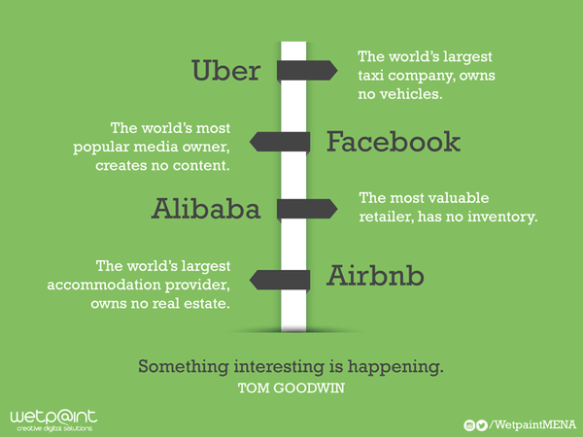
You will have seen the above infographic, often quoted with a sense of wonder at how these companies have built huge businesses seemingly without having to own any physical assets. Well, yes, but dig deeper, and what do we find? The banks have always worked on the same principle – they take customer deposits (which they don’t own), and then lend them to borrowers (whose secured assets they don’t own unless there is a default).

The main difference is that banks are highly regulated (unlike most of these digital market disruptors), and as such they have to hold sufficient capital assets to cover their exposures. Meanwhile, the banks finance the car loans taken out by Uber drivers, they provide credit facilities and export guarantees to Alibaba traders, they underwrite the mortgages on properties used for Airbnb, and will likely provide e-commerce services to advertisers who use Facebook.

For me, probably the last major FinTech disruptor was Bloomberg (founded back in 1981), because it changed the way banks and brokers accessed news and information to support their trading activities, by introducing proprietary analytics and data tools via dedicated terminals, screens and datafeeds. So successful has Bloomberg been that it now owns about one-third of the global market for financial data, and is the single-largest player (albeit by a very small margin over main rival Thomson Reuters – itself, a merger of two key data vendors). Plus Bloomberg is still privately held.

The Future State

I don’t believe FinTech can truly come of age until a major enterprise solution appears. For different reasons, Stripe and BlueDot could be on their way, but both are primarily operating in the consumer payments sector.

I have written previously on the areas where FinTech could impact institutional banking and securities trading, including loan origination, data analytics and risk management. I’ve also reported on the opportunity to disrupt traditional market data vendors by changing the pricing and consumption models. And elsewhere, I have hypothesized on how banks’ trade finance services could be disrupted.

The areas where “Big FinTech” could truly make a difference are:

  • Counterparty Risk Management
  • Predictive Credit Risk Analytics
  • Loan Pricing Models
  • Unit Pricing Calculations
  • Collateral Management
  • Portfolio Performance Attribution
  • Sentiment-based Trading and Risk Pricing

However, the final word should go to Patrick Maes, who suggested that a huge opportunity exists in deposit products linked to customer loyalty programs and frequent flyer points – what if your credit card points could be used to finance a car lease or as part of the deposit on your first home?

Next week: Change Management for Successful Product Development

How to Survive a #Startup Weekend

A rite of passage for any startup founder or budding entrepreneur is a weekend hackathon, and a Startup Weekend is probably the best way to throw yourself in at the deep end. As part of Startup Week, the York Butter Factory hosted Melbourne’s first fintech event. Here’s how I managed to survive the ordeal….

IMG_0210

Your correspondent in full flow at the Final Pitch…

Rather than provide an hour-by-hour account of my experience (the schedule is on the website and you can read the Twitter feed), here’s my thoughts on what it takes to participate and get the most out of the experience:

Courage

Take a leap of faith, step up and pitch an idea at the open mike session on the first night. Not only does this force you to craft your message, it also helps overcome any nervousness or awkwardness in joining a room full of total strangers with whom you will be working for the next 54 hours. My idea didn’t get enough votes, but it did spark several interesting conversations with other participants, such that I will probably take it further.

Stamina

Pace yourself. Yes, you could spend every available hour on finishing that customer validation, or refining the pitch, or making sure your demo site is up and running – all of which are important – but you also need to make time for rest, sleep, eating (all catering is laid on) and exercise. Again, 54 hours is a long time to spend on a single activity.

Open Mindedness

I had some idea from the program notes what to expect, but I still didn’t really know what it would it be like. So it was great to just go with the flow, to see what would happen. The format, structure and schedule (as well as the rules and requirements for the Final Pitch competition), pretty much define what goes on. But your attitude and willingness to be open to new ideas determine how much you get out of the experience.

I should also mention the value in having direct access to so many experienced mentors throughout the weekend – although I know from the experience, it’s hard not to get too defensive when mentors find fault with your project, and difficult to remain true to the idea when some of the feedback is contradictory.

Teamwork

Building teams to collaborate on a startup idea forms the basis of the hackathon model. As my own idea did not get enough votes at the open pitch, I looked to join a team that was a good fit in terms of the idea, the mix of skills to complement my own, and the ability to execute. As a “non technical” participant, I was extremely fortunate to be part of team that had a great balance of back-end and front developers, design skills and mobile deployment. Plus, given the theme was fintech, it was fantastic working with people from a banking IT background. (It also helped that several team members were veterans of Startup Weekend.)

Defining Roles

Although we didn’t spend a great deal of time creating or defining roles within the team, each of us played to our strengths, by self-determining what we would work on, and what our contribution would be. The only tricky decision was choosing who would present the Final Pitch to the panel of judges – but a process of elimination, preference and negotiation resulted in yours truly taking on the role.

Tools

In addition to the various software, hosting and domain name resources provided to each team, I was impressed by how many other tools the team plugged into – such as Trello, GoogleForms, Hangouts, ThemeForest, CanvasModel Design and Launchrock – most of which were free. We also spent some time reviewing competing and complementary products as part our MVP validation.

Less Is More

We could have spent a lot of time on customer validation – but we chose instead to talk to 3 or 4 key target customers for the MVP (qualitative), and run an on-line survey (quantitative) which generated around 100 responses overnight (not bad considering it was a weekend…). We also had more content than we actually used: the lean canvas business model was used sparingly, as was a competitor heat map; but it also meant that when we came to developing our pitch presentation, we had the luxury of being able to take stuff out and only focus on the important and most relevant points. Thanks, also, to a presentation template that one of the team had just used at a recent management course!

Practise

Having been chosen to make the Final Pitch on behalf of the team, and despite quite a lot of experience in making business presentations and in public speaking, I was extremely grateful for the coaching, feedback and rehearsals the team put me through. Getting to know the material, understanding the anchor points and how to navigate from topic to topic, helped me to give a presentation that flowed logically and hopefully demonstrated that the team had met the competition brief.

The Result?

Unfortunately our team did not win, nor did it place in the top 3. The judges pinged our presentation for being “too confident”, and for not demoing our prototype (we did briefly put up our beta website) – but given the working prototype mostly comprised some backend coding, it wouldn’t have been that interesting from a visual perspective.

Notwithstanding our disappointment on the night, the team is planning to get together to see how far we can take the idea, and separately I’ve been asked to join a new team at an upcoming hackathon.

(If anyone is interested, we designed a P2P payments tool called PayMee)

Next week: 3 Ways to Fund Your #Startup