#AngelCube favours B2B #startups…

The latest intake to AngelCube‘s accelerator program presented at the recent Startup Victoria meetup event. It was interesting to see that all 6 pitches were aimed at B2B audiences, since I have heard several angel investors and startup advisers express a strong preference for end-consumer products (or those with 2-sided markets). Perhaps there is more appetite for enterprise solutions, despite the longer lead times for sales, and the challenge of strategies required to displace incumbant products.

Screen Shot 2015-08-31 at 5.18.46 pmWhether there is a new interest in B2B startups, or whether more founders are identifying B2B opportunities, there’s probably some further analysis to be done. Meanwhile, here are the 6 fledgling startups in the order they pitched on the night:

Screen Shot 2015-08-31 at 5.45.53 pm1. Peer Academy

Peer Academy aims to “change the way professionals learn”. It does this by offering students access to open enrollment classes via an online market place. The classes are conducted by facilitators and experts (“hosts”) who have been “screened” for quality by Peer Academy, with a focus on “soft” management and leadership skills.

Peer Academy hopes that students will act as “warm leads” for corporate sales, by taking their classroom experience back into their organisations, and acting as champions or brand advocates. With follow-up introductions to training and HR managers, Peer Academy then curates programs for corporate clients, by matching training needs to individual users.

I like the notion of “peer-to-peer” learning (although I presume that the hosts are expected to have more advanced and developed skills than their students), and there is certainly a trend for alternative learning platforms. At least one major bank has expressed interest in sourcing corporate training via Peer Academy, who take a 30% commission on course sales.

A huge challenge will be to engage corporate clients who already have established relationships with trusted training providers, or who have existing panels of approved organisations, or who outsource training procurement to third parties.

Screen Shot 2015-08-31 at 6.04.05 pm2. Jack

Workplace wellbeing is becoming big business ($5bn and counting?), and in the process, sedentary workers are in the firing line. According to Apple CEO TIM Cook, “Sitting is the new cancer”, and hence the recent fad/trend/fashion for sit-stand desks which is driving market interest in ergonomic solutions. The team at Jack have built a device that can monitor how much time people are sitting or standing, and even provide some feedback on user posture.

As you would expect, Jack uses cloud connectivity to monitor user activity, and to relay data via cross-platform apps and dashboards. It also uses elements of social media engagement and gamification, and has already launched a pilot scheme with several desk suppliers, as well as a paid beta at a well-known payments provider.

Customers will buy the device plus pay for a monthly subscription service. There is a direct competitor, but Jack claim their device can be retrofitted to any sit-stand desk. The unit price is much higher than, say a Fitbit, but since this is not a consumer product, Jack is confident it can sustain current pricing.

Finally, with the data it aims to collect, Jack reckons it may even be able to help reduce insurance premiums, although this will no doubt be subject to actuarial scrutiny, Work Cover and OH&S requirements, as well as data privacy issues.

Screen Shot 2015-08-31 at 6.24.11 pm3. Coin-Craft

In the professional services and consulting sectors, tracking project costs and resourcing have become highly demanding activities – witness the plethora of project management, costing, billing, ERP and time-tracking solutions on the market. Based on personal experience, the founders of Coin-Craft have identified a specific need among architects, and have built an all-in-one tool for Project Management, Cashflow Analysis and Resource Planning. Built “for architects by architects”, Coin-Craft is designed to help clients stay optimal, by managing staff over/under utilisation, and tracking cashflow projections.

The system also claims to integrate with third-party accounting software, and has around a dozen firms using the service, with another 30 in the pipeline. Although Coin-Craft have chosen a niche client base to protect their market entry, they claim the solution can also be adopted by engineering practices, graphic art studios and project management firms.

However, feedback from the audience suggested there are already similar, mature products that are tracking individual billable hours against specific projects, so Coin-Craft may need to work on their value proposition and differentiation.

Screen Shot 2015-08-31 at 6.38.22 pm4. CurveUp!

As social media and content marketing become more ubiquitous (if not more sophisticated), companies need to understand the value of their direct marketing spend. Mostly, they can do this via web analytics, e-commerce tracking, campaign conversions, and cost of customer acquisition. According to CurveUp! however, measuring the ROI of your PR activity is not so easy using “conventional” social media monitoring tools. For example, CurveUp! claim they can deliver tailored reports to show which blog post or article converted to a ticket sale for a concert or event.

Currently using web and online sources only, CurveUp! track mentions and link this to customer data. Some platforms, such as Instagram, are harder to track, and even via a possible API solution, it will only be possible to monitor the number of views and shares, but otherwise little or no data will be available.

However, at least one online market place has expressed interest, and CurveUp! has the potential to integrate with Facebook and Google, so that clients could possibly use campaign codes to track referral activity from mention to firm sale. Overall, the service will need to align itself with the ROI outcomes linked to PR campaign goals – which will vary between clients and markets, depending on organisational KPIs around brand advocacy, share of wallet, products per customer and customer satisfaction.

Screen Shot 2015-08-31 at 6.56.07 pm5. TribeGrowth

In a similar vein, the team at TribeGrowth claim to have built “artificial intelligence for social media marketing“. Their goal is to help clients build an audience and get customers, via the use of “intelligent engagement” to generate conversions.

Initially targeting startups, professional service providers and the hospitality sector, TribeGrowth offers a tiered monthly subscription service, and claims to be a (cheaper) alternative to agencies or even Twitter ads.

Currently in private beta (and so far, only designed for Twitter and Instagram), TribeGrowth focuses on audience growth by careful selection of connections and influencers. According to the founders, this is not “pay & spray”, but uses machine learning to refine audience outreach and engagement.

Screen Shot 2015-08-31 at 6.59.11 pm6. SweetHawk

Finally, and in what was probably the most technical presentation of the evening, came SweetHawk, which is building “voice for e-commerce”. I have to confess that, although I had previously heard about this product, I’m still not totally clear how it works.

In essence, it’s an outbound platform that enables companies to have more focused/targeted real-time conversations with warm sales prospects, namely people who are visiting their websites. Personally, I would find that a bit spooky, if I was browsing a site and suddenly a widget popped up asking me if I wanted to receive a call right there and then. Isn’t it a bit like stalking?

The business model is designed to offer tiered services in return for monthly subscription fees – depending on call volumes and functionality, such as workflow tools. I would see it as sitting somewhere between an outbound sales call centre and a SaaS-style inbound helpdesk solution.

On the plus side, I do see the opportunity to deliver superior and more responsive customer service, except that SweetHawk appears to be a sales and prospecting platform, not an after-sales or support solution. I’m also used to live chat tools that pop up on various software and other service sites I use, so I would probably engage with a similar offering if I was browsing to purchase.

Final Thoughts

While none of these pitches has so far demonstrated anything truly disruptive (but let’s not criticise them for that), they all seem reasonably sensible and logical solutions using a mix of digitally-driven technologies (cloud, mobile, social, peer-to-peer, data analytics) that we are all increasingly familiar with. So, rather than major game changers, I see each of them building on established platforms. By refining the potential that new technologies and business models are creating, they are tapping into better-defined client needs rather than taking a “build it and they will come” approach.

In conclusion, I was generally impressed by the 6 pitches on offer, although some of the presentations will no doubt be reworked in light of the audience feedback and Q&A, and before the plucky founders hit the investor road show organised by AngelCube.

The event was hosted by inspire9, and sponsored by BlueChilli and PwC.

Next week: More on FinTech – another look at data and disintermediation



Tourism: Time to Get #Digital

In the latest State of the Nation report, Roy Morgan Research shone a spotlight on Australian tourism, an industry which has the potential to make a larger contribution to national GDP following the commodities boom. But the industry needs to get smarter at leveraging digital technology and embracing disruptive business models to ensure sustainable growth.

Melbourne's White Night Festival (Photo: Paul Jeffers for The Guardian)

Melbourne’s White Night Festival (Photo: Paul Jeffers for The Guardian)

As the report highlights, digital is disrupting traditional operators through “automation and variable pricing of everything from hotel rooms to airline seats”, which combined with huge changes in media consumption “is impacting the very essence of the industry”.

What does this mean for the industry, and how should it respond? Here is a quick overview:

1. Tourism is a major contributor to exports and to GDP

According to data from the Department of Foreign Affairs and Trade, tourism generated over $14bn in exports in 2014, and is #5 after iron ore, coal, natural gas and education.

In particular, revenue from Chinese tourists, especially “Free and Independent Travellers” (FIT), grew 19% in 2014, and now accounts for around one-third of in-bound tourism revenue.

With an increasing proportion of Australia’s population born overseas (in large part driven by people coming here to study or to work from China, India and South East Asia), it’s only natural that their friends and family will come to visit them for holidays. And since they are likely to be more affluent visitors, they can afford to curate their own itineraries, rather than be locked into package tours.

2. Great attractions need even better infrastructure and UX

It’s no longer enough that Australia can boast many of the best natural, cultural and lifestyle tourism attractions in the world. Increasingly, catering for the “visitor experience” means that travel operators, hotels, resorts, attractions and destinations need to consider things like:

  • Multilingual and multicultural capabilities
  • Internet & WiFi access
  • Smartphone compatibility
  • Signage and navigation aids
  • Integrated services (e.g., transportation and visitor attractions)
  • Content and interpretive tools

3. Market and digital disruption means more choice for travellers

Disruptive market forces mean that tourists have more choice, and can access the sharing/informal economy, such as Uber and AirBnB.

Digital disruption also means a myriad of ways to discover, book and pay for transport, accommodation and services, aided by numerous apps that can bypass official travel and tourism services.

Visitors not only have more choice, they are more likely to be well-informed, having done their research before they arrive, aided by social platforms that offer personal reviews and recommendations.

4. What are the reasons tourists come to Australia (and what do we do with them once they are here)?

I don’t have any official data, but anecdotally, tourists come to Australia because in general they believe it’s safe (notwithstanding shark attacks and venomous insects), it’s clean, it’s unique, it has variety, and for some the language is also a convenience.

Whether it’s natural scenery, food and wine, cultural events, sport, historical sites, gambling, surfing, trekking, arts festivals, fashion weeks, galleries, museums, beaches, or just hanging out in coffee shops, Australia has a lot to offer.

I’m obviously biased, but Melbourne alone hosts a full calendar of cultural, sporting, culinary and commercial events – there’s something significant happening every month of the year:

  • Major Festivals – Jazz, Comedy, Film, Arts, Fringe and Cabaret (plus the Laneways Festival)
  • Special Events – White Night, SuperSense, Winter Masterpieces, Gertrude Street Projection Festival
  • Sport – Tennis, Spring Racing Carnival, AFL Grand Final, F1 Grand Prix, Boxing Day Test
  • Commercial – Food & Wine Festival, Design Week, Fashion Week, Art Fair, Trade Expos, Professional and Industry Conferences

And did I mention the coffee shops???

5. Some further opportunities?

Digital won’t displace these attractions; in fact it should make it much easier for tourists to discover, connect to and interact with them before, during and after their visit.

Digital can also help curate the whole end-to-end experience, from suggesting thematic itineraries, managing personalised bookings and organising customised events, to providing travel information and advice in advance, updating information throughout their stay, and keeping in contact with visitors once they leave.

And a personal plea – can Melbourne’s trendy restaurateurs that don’t accept bookings offer an app to let customers know when their table comes up on the waitlist?

Declaration of interest: The author currently consults to Roy Morgan Research. These comments are made in a personal capacity.

Next week: Update on AngelCube


Cultural Overload: Oblique Strategies vs Major Tom

This week, Content in Context took a break from start-ups, fintech and the information superhighway to immerse itself in some cultural overload, with hardly a digital device in sight. However, I didn’t need to wander very far to realise that digital technology is both enhancing and restricting our ability to engage with art, music, culture and live performance – while analogue still wins out in terms of creating tangible experiences.

What technology would Thomas Jerome Newton have used to interpret “David Bowie Is”? (Image found here.)

To start with, I went to the “David Bowie Is” exhibition currently showing at Melbourne’s ACMI. As a retrospective on Bowie’s music career, including his dalliances with mime, theatre, fashion, videos, cut-ups, painting and film, it’s pretty comprehensive. What makes it particularly engaging is the lack of digital trickery among the exhibits: no touch screens, no VR or AR spectacular, not even a smart phone app to accompany your visit. It’s all very museum-like sedateness, well-presented artefacts, and extensively annotated displays – not surprising given the V&A provenance.

The absence of complex digital displays or an interactive/interpretive visitor experience is somewhat surprising, given that Bowie has always been an early adopter of new technologies (after all, this is the man who launched his own ISP, BowieNet, and was one of the first musicians to securitise his songwriting royalties via the so-called Bowie Bonds). Not forgetting that  Bowie was using multiple characters, personas and alter-egos long before we got around to internet avatars.

Bowie’s remarkable run of studio albums in the 1970s (unparalleled in popular music) stretched the limits of contemporary recording standards, because each LP has a distinct sonic palette, based on the careful selection of locations, musicians and studio technology. There’s even a section dedicated to some lyric-writing software that Bowie used to automate his cut-up process (which emulated the Dadaists and writers like Burroughs and Gysin). And videos for some of his early 80s songs (“Ashes to Ashes”, “Fashion”, “Let’s Dance” and “China Girl”) were MTV staples when the medium was still in its infancy. (But as the exhibition reminds us, Bowie was using the short film format as early as the late 60s.)

The only real concession to digital technology is the audio guide, which uses a personal playback device. These devices are linked to either NFC tags or wireless beacons to trigger specific music, commentary or soundtracks when the visitor is in a relevant location. Mostly it works well, and provides a collage of sounds to accompany the more significant exhibits. However, the cut-over between some “trigger zones” is a bit abrupt, even clunky, and there is nothing interactive for the visitor to explore or experience.

At the end, each visitor was given a postcard with a promotional code to download a free Bowie album. All very nice, and a great idea, but poorly executed:

  • The choice of albums is limited to his more recent studio albums, and a fairly average live album (by Bowie’s standards) – so none of those classic 70s recordings
  • The promotion is linked to Google Play and the process of setting up and downloading my account was not very intuitive, and compared to iTunes was very clunky (at least on my iMac)
  • It was not possible to curate my own personal Bowie album, which could have been fun – now, I understand the reluctance to deconstruct complete albums into individual songs, but perhaps some specially selected and Bowie-approved thematic compilations (e.g., based on his many stage and studio personas) could have provided a neat compromise?

While I liked the fact that the exhibition mainly used analogue technology, I think there was a missed opportunity to create an additional layer of interactivity, either via the audio guide, or via a separate smart phone app or website (I’m thinking of MONA’s “O Device”, the NGV’s “Melbourne Now” app, or some of the marvelous exhibition apps developed by London’s Tate Modern, the Réunion des Musées Nationaux in France, and both the MCA and Gallery of NSW in Sydney). Something for the V&A and ACMI to think about?

Then, it was a short walk across Federation Square to the Arts Centre, for a 3-day extravaganza of live events (music, dance, theatre, mixed media) collectively known as “Supersense”. OK, so I appreciate that this curated festival was all about experiencing live performance up close and in the moment – without being (dis)intermediated by any layer of technology between performer and audience (apart from some 3D glasses I wore for one mixed media show). But a festival app would have been very useful to help navigate the warren of corridors and backstage areas where the festival was held, to let visitors know when events were due to start, and to notify them when there no more seats in the smaller performance spaces.  Also, the festival website’s complicated schedule of events was impossible to read on a smart phone, so an app would have been great!

Anyway, the festival format, range of styles and mixed quality inevitably meant it was a veritable curate’s egg – the broad theme made it difficult to establish a cohesive context, and yet there were some connections and overlaps (both direct links between performers, and indirect conceptual links among the cross-cultural references and influences). Again, an app would have helped to make those connections. But the organisers (and performers) are to be congratulated for pulling off this inaugural event, and I look forward to next year’s programme.

Finally, for the culturally aware (or just plain old trainspotters) there were a number of connections to be made between “Bowie Is” and “Supersense”:

  • The performance of Brian Eno‘s ground-breaking ambient composition “Discreet Music” by The Necks and friends reminded us of Eno’s crucial role in recording Bowie’s trio of Berlin albums, “Low”, “Heroes” and “Lodger”
  • More specifically, the incorporation of Eno’s “Oblique Strategies” into the “Discreet Music” concert was very pertinent; not only did Eno use this system of random instructions when working on “Lodger”, he gave Bowie his own deck of “Oblique Strategies” cards, which are on display at ACMI
  • The festival finale by John Cale (also a sometime collaborator with Eno) included versions of “I’m Waiting for My Man” and “Venus in Furs” which he first recorded with The Velvet Underground in the 60s – and Bowie was one of the earliest artists to cover songs by The Velvet Underground in the early 70s.
  • Bowie’s early career incorporated mime, poetry and performance art, reflecting his influences and interests. In turn, thanks to the influence of cultural polymaths like him, a festival as diverse as Supersense seems perfectly natural to contemporary audiences.

Next week: Tourism – time to get digital


Deconstructing #Digital Obsolescence

Remember the video format wars of the 1980s? At one point, VHS and Betamax were running neck and neck in the consumer market, but VHS eventually won out (although the also-ran V2000 was technically superior to both). Since then, we’ve had similar format battles for games consoles, video discs, computer storage, CD’s and e-books. It’s the inevitable consequence of operating platforms trying to dominate content – a continuing trend which has probably reached its apotheosis with the launch of Apple’s Beats 1 streaming service. This convergence of hardware and software is prompting some contrary trends and, if nothing else, proves our suspicion of hermetically sealed systems…

about-format2

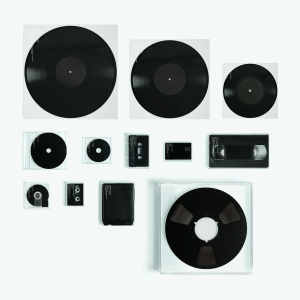
Trevor Jackson embarks on a format frenzy….

1. Digital Divergence

Earlier this year, UK music producer Trevor Jackson released a collection of 12 songs, each one pressed on a different media format: 12″, 10″ and 7″ vinyl; CD and mini-CD; cassette; USB; VHS; minidisc; DAT; 8-track cartridge; and reel-to-reel tape. Of course, he could have also used 78 rpm shellac records, digital compact cassettes, Digital8 tapes, 3.5 and 5.25 inch floppy disks (still available, I kid you not) or any of the multitude of memory cards that proliferate even today.

While Jackson’s “Format” project might seem gimmicky, it does demonstrate that many digital formats are already obsolete compared to their analogue counterparts (and until very recently, I could have played 8 of the 12 formats myself – but I’ve just donated my VHS player to our local DVD store).

As I have blogged previously, there is an established body of digital/analogue hybrids, especially in data storage, and I can only see this continuing as part of the creative tension between operating systems and content formats.

2. Digital Archeology

Each new hardware/software upgrade brings a trail of digital obsolescence (and a corresponding amount of e-waste). It’s also giving rise to a new discipline of digital archeology, combining forensics, anthropology and hacking.

Back in 2002, it was discovered that a 15-year old multimedia version of the Domesday book was unreadable* – yet the hand-written version is still legible, and available to anyone who can read (provided they can decipher 1,000-year old Norman English). Apparently, it has taken longer to decrypt the 1986 video disc than it took to create it in the first place.

More digital archeologists will be needed to mine the volumes of data that reside in archival formats, if we are to avoid losing much of the knowledge we have created since the advent of the personal computer and the public internet.

3. Digital Provenance

We’re used to managing our data privacy and computer security via password protection, network protocols and user authentication. If we think about it, we also question the veracity of certain e-mails and websites (phishing, scamming, malware, trojans etc.).

A while ago I blogged about the topic of digital forgeries, and the associated phenomenon of digital decay. Just as in the art world, there is a need to establish a method of digital provenance to verify the attributes and authenticity of content we consume.

We are already seeing this happen in the use of block chains for managing cryptocurrencies, but I believe there is a need to extend these concepts to a broader set of transactions, while also facilitating the future proofing and retrofitting of content and operating systems.

4. Digital Diversity

In response to closed operating systems, sealed hardware units and redundant formats, there are several interesting and divergent threads emerging. These are both an extension of the open source culture, and a realisation that we need to have transferable and flexible programming abilities, rather than hardwired coding skills for specific operating systems or software platforms.

First, the Raspberry Pi movement is enabling richer interaction between programming and hardware. This is especially so with the Internet of Things. (For a related example, witness the Bigshot camera).

Second, Circuit Bending is finding ways to repurpose otherwise antiquated hardware that still contain reusable components, processors and circuit boards.

Third, some inventive musicians and programmers are resuscitating recent and premature digital antiques, such as Rex The Dog‘s re-use of the Casio CZ-230S synthesizer and its Memory Tapes to remix their first single, and humbleTUNE‘s creation of an app that can be retrofitted to the original Nintendo Gameboy.

These trends remind me of those Radio Shack and Tandy electronics kits I had as a child, which taught me how to assemble simple circuits and connect them to hardware. (And let’s not forget that toys like LEGO and Meccano started incorporating motors, electronics, processors and robotics into their kits many years ago.)

 5. Salvaging the Future

Finally, as mentioned above, built-in digital obsolescence creates e-waste of the future. A few recycling schemes do exist, but we need to do a better job of reclaiming not just the data archives contained in those old disks, drives and displays, but also the materials from which they are made.

* My thanks to Donald Farmer of Qlik for including this in his recent presentation in Melbourne.

Next week: #FinTech – what’s next?