Haring vs Basquiat

Following last week’s “compare & contrast” entry, another similar exercise this week, between artists Keith Haring and Jean-Michel Basquiat, the subject of the NGV’s summer blockbuster exhibition.
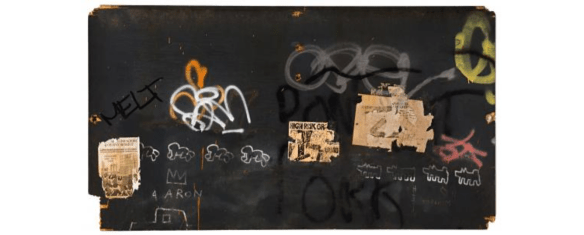
Keith Haring, Jean-Michel Basquiat, Other artists: “Untitled (Symphony No. 1)” c. 1980-83 [image sourced from NGV website]

Given their friendship, collaborations and mutual connections to the New York scene of the 1980s, it was only natural that the NGV went for this double-header retrospective. Since they both gained early recognition for their street art and graffiti-based work, and their images crossed over into the worlds of music, fashion and clubbing, they had a lot in common. They were as likely to be featured in style magazines such as The Face as they were to be found in the arts section (or society pages) of the New York Times.

Both died relatively young, and it’s as if they somehow knew they each had limited time, such is the intense pace at which they worked, as evidenced by their prolific output. If there is one element that really links them is their inner drive – they had to produce art, there was no choice for them, and they threw everything into it.

They each developed their own distinctive visual styles, much imitated and appropriated throughout popular culture, graphic design, video and advertising. Haring is known for his dog motif and cartoon-like figures, Basquiat for his iconic crown and text-based work. They also placed great emphasis on issues of identity, gender, sexuality and broader sociopolitical themes.

Where they perhaps differ is that Haring relied on more simplistic imagery (albeit loaded with meaning and context), using mainly primary colours, flat perspective (no shading or depth), and strong repetition. On the other hand, Basquiat’s paintings reveal confident mark-making, bold colour choices (not always successful), and an implied love of semiotics (even more so than Haring’s almost ubiquitous iconography).

Of course, we’ll never know how their respective work would have developed over the past 30 years – maybe what we now see is all there was ever going to be? As a consequence, there is perhaps a sense that they plowed a relatively narrow field, that they did not develop artistically once they became gallery artists. I’m not suggesting their work is shallow or one-dimensional (even though it can simply be viewed and appreciated “on the surface”), but it would have been interesting to see where their work took them.

Finally, we are still very close to the era in which they were active, and in that regard their true legacy will be in the influence they cast on late 20th century art and beyond.

Next week: Hicks vs Papapetrou
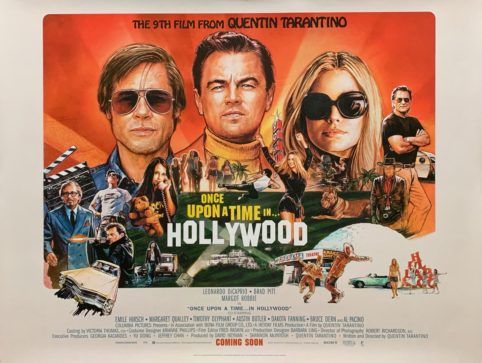
 

Tarantino vs Ritchie

Rather like an English Literature exam where students are invited to “compare and contrast” the work of two contemporary authors, over the holidays I had the opportunity to consider recent films by Quentin Tarantino and Guy Ritchie – cinema is a great way to stay out of the summer heat.

Both directors have something of the auteur about them – they like working with ensemble casts, adopting non-linear story lines, and showing off their taste in music via the soundtrack selections. In Tarantino’s case, he also writes, produces and occasionally acts; whereas for Ritchie, his trademark directorial style is defined by his London crime comedies.

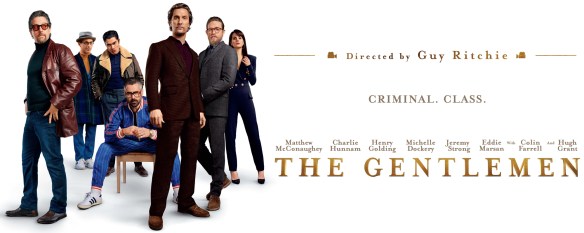
The latter’s forays into more traditional stories, adaptations and film franchises have not always been successful – but “The Gentlemen” is a return to the form of his early London gangster movies, which helped make his name. In the character portrayed by Hugh Grant, there is a certain pleasure at seeing the actor take cinematic revenge on the British tabloid press, enhancing (even refining) the satirical edge that these films sometimes reveal.

For Tarantino, “Once Upon a Time in Hollywood” is another oblique take on a familiar theme or storyline – in this case, the end of Hollywood’s Golden Age, amplified by the Manson murders and the death of the hippy dream. Once again, the director demonstrates a keen ability to create enormous cinematic tension prior to a cathartic denouement, a technique used to great effect in most of his films.

Both directors place great emphasis on dialogue and the interaction between characters, even if there is not a great deal of character development. Often, if feels like the leading roles are either pure ciphers (metaphors for interpreting events around them), or mere signifiers (the characters themselves are the meaning).

If there is one central theme connecting their core work, it is the concept of “honour among thieves” – that however far outside the law their characters reside, there is an internal logic and moral compass that guides them (however warped those values may appear to be to outsiders).

Overall, I think Tarantino’s films have more substance, and his nine feature films as director (and will the 10th also be his last?) represent a concentrated body of work that will stand the test of time. While I prefer Ritchie’s crime comedies (“Revolver” aside) to his more mainstream work, in the future those gangster capers will seem as quaint as Ealing comedies of the 1950s.

Next week: Haring vs Basquiat


Signing off for Saturnalia

According to a Gallup Report, in 2018 the world was “sadder and angrier than ever. If recent global events are anything to go by, 2019 will easily top that. And as I write, much of south east Australia is on fire (the bushfire season having started back in early August), only adding to the sense of rage. I can’t recall an angrier year, maybe not since the 1970s.

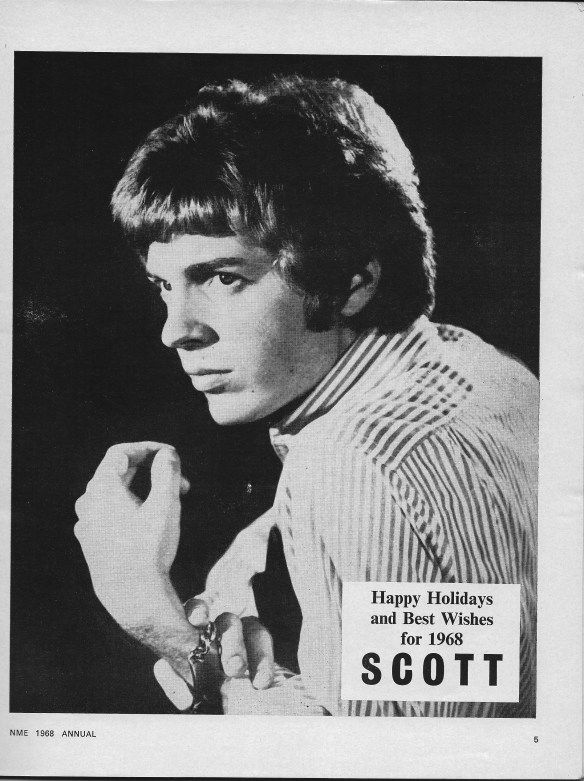
Image of Scott Walker scanned from the NME Annual for 1968

Reasons to be angry? World politics, climate change, fake news, growing nationalism, economic stagnation, and sectarian intolerance. Evidence of anger? Brexit, Impeachment, Hong Kong, France, Chile, Iran, India, Iraq, Adani, Extinction Rebellion, #MeToo, etc.

Meanwhile, considered academic debate has been reduced to very public slanging matches. Even popular music seems shoutier than ever, and no action movie is considered complete without gratuitous violence, hyperbolic pyrotechnics and pounding soundtracks.

So much noise, so much hot air (verbal and atmospheric) and so much sheer rage, not always easy to articulate or understand – and not easy to predict how that will translate at the ballot box, given the election results in Australia and the UK. Politicians of all persuasions are increasingly seen as being a key cause for voter anger, but in both cases, continuity was deemed preferable to change.

As we wind down for the holidays, it’s frustrating to think that the “season of goodwill” is limited to just a few weeks of the year. I’m not suggesting 12-month-long Black Friday Sales. Rather, can we find it in ourselves to be more civil to each other throughout the year, even if we disagree on certain things? In particular, I’m thinking of the growing evidence of sectarian strife. Established religions may condemn to hell (or even death) anyone who disagrees with their belief systems, but in a democratic, secular and pluralist society, the right to “freedom of religion” also means everyone is entitled to “freedom from religion”.

In light of that, I’d like to wish all my readers a safe and peaceful Saturnalia. Normal service will be resumed in the New Year.


Notes from Auckland

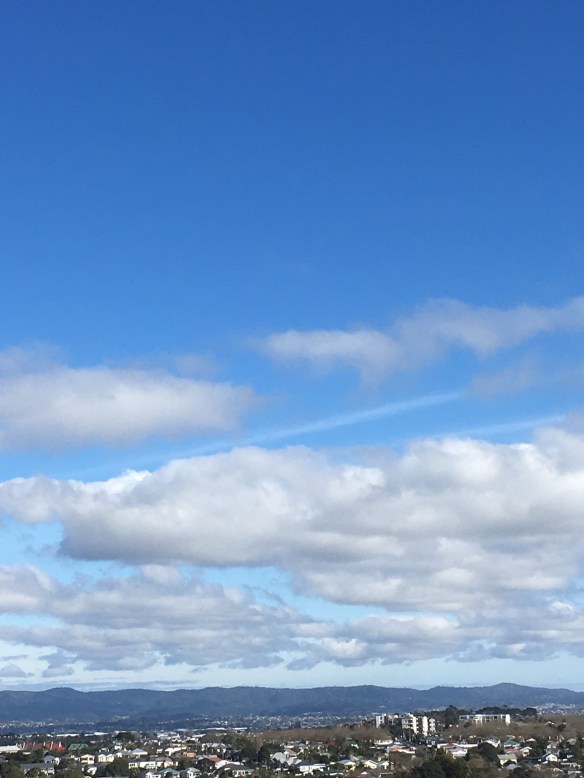
Over the past couple of years, I’ve been fortunate to make several trips to Auckland, as part of the work I do with Techemy and Brave New Coin. Although I had been to New Zealand a few times before these latest visits, it was only recently that I understood why Maori call it Aotearoa – “Land of the Long White Cloud” – as you can see from this photo I took from the office window.

To anyone from Australia who has spent time in New Zealand, it is quickly apparent that Maori culture and language are far more respected and recognised than idigenous identity is across the Tasman. From the bilingual signage and national anthem to the Haka performed prior to every All Blacks game, Maori identity is more visible and celebrated.

On my most recent visit a couple of weeks ago, this was reinforced during a guided tour of the University of Auckland’s art collection, as part of Artweek. First, the guide used Maori words for local place names. Second, he drew attention to some of the challenges that he and the other curators face when dealing with Taonga objects – which also opens up the debate about art vs craft. Third, he acknowledged that in his own early studies, he was influenced and even encouraged by his tutors to incorporate elements of Moari art into his own work – even though as someone of European (Pakeha) descent he did not really understand what these images represented. Finally, this form of appropriation can lead to questions about whether an artist’s identity (cultural or otherwise) should define their work and whether that work should only be interpreted through their identity. For example, can “maori art” only be produced by artists who are ethnically Moari? The artist Gordon Walters deployed images of Koru in his most famous work, which can divide critics and academics.

In many ways, Auckland is very similar to Sydney – both are their country’s largest city, but neither is the capital. Both are formed and defined by their respective harbours – and this in turn very much influences how people engage with their city: based on where they live, and their commute to work. Likewise, both Auckland (Albert Street) and Sydney (George Street) are trying to play catch-up with their public transport systems, which have not kept pace with the rate of urban and population growth. And, no doubt connected, both cities have very expensive property markets.

One of the things that I always notice in Auckland is how many buildings in the CBD are polyhedron in shape. Some of them even display an element of “Pacific Brutalism” which seems to be very popular in public and municipal architecture, from Hawaii to Singapore and beyond. It could be that polyhedral structures are more earthquake prone – or because Auckland is very hilly, giving rise to “creative” building designs.

To overcome the topography (and the limitations of the public transport system), a number of hire companies offer electric scooters for getting around the city. While it seems a great (and environmentally friendly) idea, the fact that there are no fixed pick-up and drop-off points, users can leave them anywhere – and many are even to be found lying across the pavement, causing something of an obstruction.

Finally, no visit to Auckland is complete without a ferry ride to Waihiki Island, for lunch and/or wine-tasting at one of the many cellar doors.

Next week: Startup Vic’s Pitch Night for Migrant and First Generation Founders