More on #FinTech, #Bitcoin and #Blockchain in Melbourne

The Melbourne FinTech community brought together a bunch of interested parties recently to find out what’s happening locally in Bitcoin and Blockchain. Organised by the Melbourne Bitcoin, FinTech and Silicon Beach Meetups, and hosted by the Melbourne Bitcoin Technology Centre (MBTC), the evening was part open house, part info sharing, and part pitch night.

BitcoinThe MBTC is now a recognised hub for Bitcoin and Blockchain activities, and currently hosts around a dozen startups within its co-working space. Offering a “full service” facility (it even has a Bitcoin miner on site), complete with staffed reception, meeting rooms, event space, a pod cast studio and an outdoor barbecue area, it’s something of a hidden gem in Melbourne’s Southbank. Regulars also get to attend Bitcoin “swap meets”…..

Last week’s event also featured a number of micro-pitches from Bitcoin and Blockchain startups, a few of the MBTC staff and tenants, and a couple of student projects from RMIT.

Given this was almost “speed pitching“, it’s probably not appropriate to go into too much detail:

  • Toodles – a dating app on a decentralized network, using a Blockchain solution for additional security and privacy
  • Blockfreight – the Blockchain for global freight, enabling cargo containers to be shipped around the world with minimal legacy documentation, based on smart contracts, RFID and Blockfreight tokens
  • blockTRAIN – a training provider and consultancy on Blockchain, smart contracts and digital currencies
  • Bitcoin Buskers v2 – sort of MySpace/Bandcamp/SoundCloud for Buskers, to promote their merchandise and to secure international festival bookings, all powered by Bitcoin
  • ACX – Australian Crypto Exchange, offering the largest single Bitcoin order book in Australia
  • Bitcoin Group – explaining that most Bitcoin mining is currently done in China due to cheaper electricity
  • Antstand – portable laptop stand (which you can buy with Bitcoin!)
  • Think Bitcoin – providing consulting and education services, particularly in schools
  • Lyra – an app to track and reduce your personal environmental impact, sort of Fitbit and Smart Meter combined
  • ImagineNation – innovation consultancy, backed by training and coaching, and featuring a 2-day startup game to help organisations transform cultural mindsets around agile, lean, design thinking, UX and incubator/accelerator concepts
  • Brave New Coin – the “Bloomberg for Bitcoin”, providing market data (prices, rates, indices, news) for Bitcoin and other digital currencies*

With the next Bitcoin halving due soon, and a significant uptick in FinTech, Blockchain and Digital Asset investments announced during Q2, this sector is going to look very interesting for some time to come, and it’s good to know that Melbourne, whose fortunes were founded on gold, is staking a claim in these new asset classes.

* Declaration of Interest: I have recently joined the team at Brave New Coin as Head of Business Development – more news to follow….

Next week: University Challenge – Startup Victoria’s Student Pitch Night

The future of #FinTech is in Enterprise Solutions

Talk to anyone involved in FinTech, and apart from telling you the sector is “hot”, there’s little consensus on what happens next. Despite positioning itself as a disruptive force within financial services, much of what goes on in the sector is either driven by regulatory reform, or by technological developments in allied fields. Most of the disruption so far is in retail and B2C services, yet the more significant opportunities are likely to be found in enterprise and B2B solutions. But as The Economist commented recently, “The fintech firms are not about to kill off traditional banks.”

The Current State

In broad terms, FinTech is working in four main areas:

  • Cryptocurrencies
  • Payments
  • P2P lending
  • Financial Advice and Planning

The first two are responding to dual technological advances – namely, the use of block chains and cryptography; and increased sophistication around mobile and GPS. Patrick Maes, CTO of ANZ Bank, has stated that “Bitcoin and block chain are the first payments innovations in 2,000 years.” He also has a FinTech “wish list”.

The second two (at least, within Australia) are benefitting from regulatory changes, such as the new positive consumer credit reporting regime, and the Future of Financial Advice reforms. And when the National Payments Platform scheduled for 2017 mandates real-time settlements, everyone will have access to immediate inter-bank payment services.

Of course, there is some overlap among these categories, which in turn are also benefitting from developments in big data analytics, mobile solutions, social media platforms, and consumer trends like crowdsourcing and the shared economy.

CCE2z9TVIAENCcE

It may be interesting – but it’s not whole picture

Disintermediation May Not Be Enough?

Most of the FinTech disruption has been in the nature of disintermediation – displacing the role of traditional banks and merchant services in providing payment solutions, point-of-sale facilities and personal loan products. But given the relatively small margins on these services, you either need to have a totally different cost structure, or a significantly large market position to achieve scale and volume.

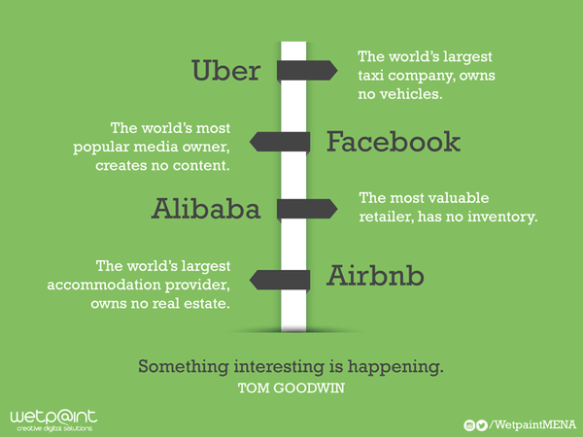
You will have seen the above infographic, often quoted with a sense of wonder at how these companies have built huge businesses seemingly without having to own any physical assets. Well, yes, but dig deeper, and what do we find? The banks have always worked on the same principle – they take customer deposits (which they don’t own), and then lend them to borrowers (whose secured assets they don’t own unless there is a default).

The main difference is that banks are highly regulated (unlike most of these digital market disruptors), and as such they have to hold sufficient capital assets to cover their exposures. Meanwhile, the banks finance the car loans taken out by Uber drivers, they provide credit facilities and export guarantees to Alibaba traders, they underwrite the mortgages on properties used for Airbnb, and will likely provide e-commerce services to advertisers who use Facebook.

For me, probably the last major FinTech disruptor was Bloomberg (founded back in 1981), because it changed the way banks and brokers accessed news and information to support their trading activities, by introducing proprietary analytics and data tools via dedicated terminals, screens and datafeeds. So successful has Bloomberg been that it now owns about one-third of the global market for financial data, and is the single-largest player (albeit by a very small margin over main rival Thomson Reuters – itself, a merger of two key data vendors). Plus Bloomberg is still privately held.

The Future State

I don’t believe FinTech can truly come of age until a major enterprise solution appears. For different reasons, Stripe and BlueDot could be on their way, but both are primarily operating in the consumer payments sector.

I have written previously on the areas where FinTech could impact institutional banking and securities trading, including loan origination, data analytics and risk management. I’ve also reported on the opportunity to disrupt traditional market data vendors by changing the pricing and consumption models. And elsewhere, I have hypothesized on how banks’ trade finance services could be disrupted.

The areas where “Big FinTech” could truly make a difference are:

  • Counterparty Risk Management
  • Predictive Credit Risk Analytics
  • Loan Pricing Models
  • Unit Pricing Calculations
  • Collateral Management
  • Portfolio Performance Attribution
  • Sentiment-based Trading and Risk Pricing

However, the final word should go to Patrick Maes, who suggested that a huge opportunity exists in deposit products linked to customer loyalty programs and frequent flyer points – what if your credit card points could be used to finance a car lease or as part of the deposit on your first home?

Next week: Change Management for Successful Product Development