Jump-cut videos vs Slow TV

In last week’s blog on the attention economy, I alluded to the trade-off that exists between our desire for more stimulus, and the need to consume more (sponsored) content to feed that hunger. Given the increasing demands on our available attention span, and the rate at which we are having to consume just to keep up, it feels like we are all developing a form of ADD – too much to choose from, too little time to focus on anything.
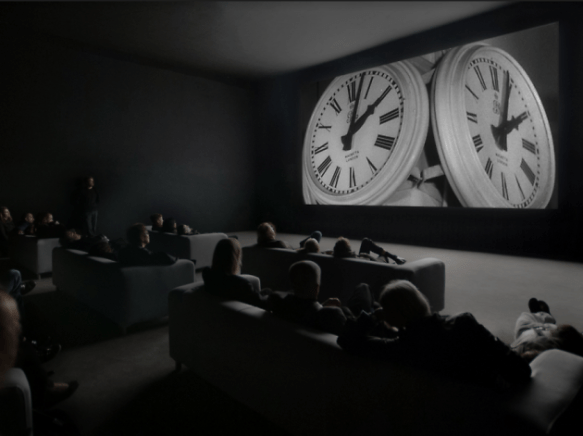
Christian Marclay – “The Clock” – image sourced from Time Out

Personally, I place a lot of the blame on music videos. Initially, this format merely reduced our attention span to the length of a 3-minute pop song. (Paradoxically, there was also a style known as the “long form music video”, which stretched those 3 minutes into a 10-20 minute extended narrative). Then, in recent years, the video format has been distilled to a series of jump cuts – no single shot lasts more than a few frames, and the back-n-forth between shots often has no narrative cohesion other than serving the technique of the jump-cut itself. I sometimes wonder if the reason for so many jump-cuts is because too few of today’s pop stars can really dance, forcing the director to distract our (minimal) attention from the poor moves. (Note: pop stars who can’t dance should take a leaf out of The Fall’s playbook, and call in the professionals, like Michael Clark…)

I have previously made a brief mention of Slow TV, which made a return to Australian channel SBS this summer in the form of trans-continental railway journeys, a UK barge trip (can it get any slower?) and a length-ways tour of New Zealand. These individual programs can screen for up to 18 hours, a perfect antidote to the ADD-inducing experience of jump-cut music videos and social media notifications.

Concurrently in Melbourne, two installation works are on display that, in their very separate ways also challenge the apparent obsession with rapid sensory overload in many of today’s video content.

The first is “The Clock”, by Christian Marclay – a sequence of finely edited clips sourced from a multitude of films and TV programmes that together act as a real-time 24 hour clock. The work also manages to reveal a beguiling (dare I say seamless?) narrative from such disparate and unrelated scenes that you really do begin to wonder how the story will end…. The fact that some of the scenes are quite mundane (and whose main function is to indicate the passage of time), while others are iconic cinematic moments, only adds to our real-time/real-life experience of the ebb and flow of the seconds, minutes and hours.

The second is almost the complete opposite. “Cataract”, by Daniel Von Sturmer comprises 81 screens, each showing looped sequences of somewhat banal events. Although each video event is no more than a few seconds, and none of the loops are synchronised with each other, it does not feel like a series of jump-cut edits. This is partly because the events, despite their brevity, are all engaging in their own way; and partly because even though we know it is a loop, we somehow expect something different to happen each time (maybe because our brain is wired to find a narrative even when none exists?).

According to the gallery’s description of “Cataract”, “the world is full of happenings, but it is only through selective attention that meaning is found”. Quite appropriate for the attention economy and jump-cut culture – meaning is where we choose to see it, but if we are not paying the appropriate amount of attention or if we are not viewing through a critical lens, we risk missing it altogether.

Next week: The Future of Fintech


Blipverts vs the Attention Economy

There’s a scene in Nicolas Roeg’s 1976 film, “The Man Who Fell To Earth”, where David Bowie’s character sits watching a bank of TV screens, each tuned to a different station. At the same time he is channel surfing – either because his alien powers allow him to absorb multiple, simultaneous inputs, or because his experience of ennui on Earth leads him to seek more and more stimulus. Obviously a metaphor for the attention economy, long before such a term existed.

Watching the alien watching us… Image sourced from Flicker

At the time in the UK, we only had three TV channels to choose from, so the notion of 12 or more seemed exotic, even other worldly. And of those three channels, only one carried advertising. Much the same situation existed in British radio, with only one or two commercial networks, alongside the dominant BBC. So we had relatively little exposure to adverts, brand sponsorship or paid content in our broadcast media. (Mind you, this was still the era when tobacco companies could plaster their logos all over sporting events…)

For all its limitations, there were several virtues to this model. First, advertising airtime was at a premium (thanks to the broadcast content ratios), and ad spend was concentrated – so adverts really had to grab your attention. (Is it any wonder that so many successful film directors cut their teeth on commercials?) Second, this built-in monopoly often meant bigger TV production budgets, more variety of content and better quality programming on free-to-air networks than we typically see today with the over-reliance on so-called reality TV. Third, with less viewing choice, there was a greater shared experience among audiences – and more communal connection because we could talk about similar things.

Then along came cable and satellite networks, bringing more choice (and more advertising), but not necessarily better quality content. In fact, with TV advertising budgets spread more thinly, it’s not surprising that programming suffered. Networks had to compete for our attention, and they funded this by bombarding us with more ads and more paid content. (And this is before we even get to the internet age and time-shift, streaming and multicast platforms…)

Despite the increased viewing choices, broadcasting became narrow-casting – smaller and more fractured viewership, with programming appealing to niche audiences. Meanwhile, in the mid-80s (and soon after the launch of MTV), “Max Headroom” is credited with coining the term “blipvert”, meaning a very, very short (almost subliminal) television commercial. Although designed as a narrative device in the Max Headroom story, the blipvert can be seen as either a test of creativity (how to get your message across in minimal time); or a subversive propaganda technique (nefarious elements trying to sabotage your thinking through subtle suggestion and infiltration).

Which is essentially where we are in the attention economy. Audiences are increasingly disparate, and the battle for eyeballs (and minds) is being fought out across multiple devices, multiple screens, and multiple formats. In our search for more stimulation, and unless we are willing to pay for premium services and/or an ad-free experience, we are having to endure more ads that pop-up during our YouTube viewing, Spotify streaming or internet browsing. As a result, brands are trying to grab our attention, at increasing frequency, and for shorter, yet more rapid and intensive periods. (Even Words With Friends is offering in-game tokens in return for watching sponsored content.)

Some consumers are responding with ad-blockers, or by dropping their use of social media altogether; or they want payment for their valuable time. I think we are generally over the notion of giving away our personal data in return for some “free” services – the price in terms of intrusions upon our privacy is no longer worth paying. So, brands are having to try harder to capture our attention, and they need to personalize their message to make it seem relevant and worthy of our time – provided we are willing to let them know enough about our preferences, location, demographics, etc. so that they can serve up relevant and engaging content to each and every “audience of one”. And brands also want proof that the ads they have paid for have been seen by the people they intended to reach.

This delicate trade-off (between privacy, personalisation and payment) is one reason why the attention economy is seen as a prime use case for Blockchain and cryptocurrency: consumers can retain anonymity, while still sharing selected personal information (which they own and control) with whom they wish, when they wish, for as long as they wish, and they can even get paid to access relevant content; brands can receive confirmation that the personalised content they have paid for has been consumed by the people they intended to see it; and distributed ledgers can maintain a record of account and send/receive payments via smart contracts and digital wallets when and where the relevant transactions have taken place.

Next week: Jump-cut videos vs Slow TV


Startup Victoria: supporting successful founders

I’ve been attending Startup Victoria’s meetups for more than 5 years, and have been a paid-up member for most of that time. The event formats and the key personalities have changed over the years, but the mission has always been to help create more founders and better founders, and to support the broader startup ecosystem. At last month’s AGM and panel discussion, the Board announced that the focus has now shifted to “helping founders to succeed”. A subtle change, but an indication that the local startup scene is finally maturing.

As part of this renewed focus, Startup Vic wants more corporates to engage with local startups – as suppliers, strategic partners and potential target acquisitions. Given the challenges startups face in meeting enterprise procurement processes (especially in the public sector…), this will not be easy. The path to engagement with startups has to be considerably de-risked before purchasing managers will get the sign-off to onboard new vendors.

That challenge aside, another observation from the panel discussion of founders and advisors was that Startup Vic needs to connect newer founders with more experienced founders, those who have already taken a startup to scale up to exit. Plus, as a leadership organisation, Startup Vic recognises that more needs to be done to highlight local success stories. That doesn’t just mean the startup community celebrating itself – it means spreading the word publicly and getting more media airtime for businesses that are building sustainable growth in the new economy.

One of the panelists asserted that “some of our politicians would rather have their photo taken with the winner of the Melbourne Cup, than be seen with the founders of Atlassian”. A bit harsh, perhaps – but I know that they mean. Aligning themselves with sporting heroes probably does more for their public profile, compared to hanging out with our key tech entrepreneurs in order to learn what government could do to foster more startup success.

To be fair to the Victorian Government, it has been trying to implement an innovation strategy that brings participants together – founders, investors, incubators, accelerators, etc. This has resulted in: the Victorian Innovation Hub (plus a number of sector-specific tech centres); LaunchVic (to provide grants to projects designed to foster the startup community); and engagement with overseas VC funds and offshore tech companies (to position Victoria as an investment destination, and as a national, regional or even global HQ).

Meanwhile, the panel also debated whether too many local founders are more interested in building a “lifestyle business” for themselves, rather than creating say, a $250m company. This apparent lack of ambition was seen as something of a local phenomena, partly linked to Melbourne’s status as one of the world’s most livable cities, partly linked to a generally benign Australian economy (but with a growing number of stress points), and the usual cultural factors such as the tall poppy syndrome. There are also some structural challenges in the economy (restrictive trade practices, a lack of competition in highly concentrated markets, continued economic uncertainty post-mining boom, delays in rolling out the NBN, a potential credit squeeze…), plus a growing distrust of public institutions and major corporations. This disenchantment and disengagement is not helped by a lack of strong leadership in government and in business – so why would anyone with any sense want to get involved, and hence the desire to take care of one’s own needs first.

Finally, emphasizing the need to re-think the founder mindset and to provide a better foundation for building the businesses of the future, Startup Vic is also committed to both the professional and personal development of founders.

Next week: Blipverts vs the Attention Economy


Manchester, so much to answer for….

I spent most of the festive season in and around Manchester, once a focal point of the industrial revolution (and the home to dark satanic mills), now a city that is as much about technology and culture (and the location for MediaCityUK). Plus, it’s a city that takes its hedonism very seriously, a place where a table is simply something to dance on…

Manchester Town Hall – photo by Mark Andrew – image sourced from Wikimedia under Creative Commons

I have had a direct connection with Manchester going back nearly 40 years. Prior to that, Manchester for me was probably defined by its famous football club (and that other one), Coronation Street (the world’s longest-running television soap opera), and the Manchester Guardian newspaper (now one of the few remaining sources of objective news coverage).

Then, in the late 1970s, Manchester started producing some of the most innovative music in the wake of punk. Manchester was the home to cutting-edge bands, labels, producers, designers, writers and fanzines – many of which outshone the best of what even London had to offer at that time. Record labels such as Factory, New Hormones, Object and Rabid helped launch the careers of Joy Division, Durutti Column, A Certain Ratio, Buzzcocks, John Cooper Clarke, Martin Hannett, Peter Saville, Ludus, Malcolm Garrett, The Passage, James and even Jilted John; while bands like The Fall, Magazine, The Frantic Elevators and The Distractions (plus fanzine City Fun) all added to the colourful mix. Then came New Order and The Smiths, followed by the Hacienda, Happy Mondays, Stone Roses and the rest of the Madchester era (as brilliantly told in the film “24 Hour Party People”).

So Manchester’s cultural output from that period has definitely shaped and informed a lot of my musical (and reading) choices. Just before Christmas, it was announced that musician and lyricist Pete Shelley had died. Along with Howard Devoto, he formed Buzzcocks, who inspired many other bands and independent labels with their debut 1977 release, the Spiral Scratch EP (also one of the first UK punk records). Their appreciation of visual artists like Marcel Duchamp and Odilon Redon, and writers like Franz Kafka, Jean-Paul Sartre, Aldous Huxley, Albert Camus, Dostoyevsky and Gogol meant that (along with many of their contemporaries) they made music that was not just about 3 minute pop songs. Plus, these literary influences prompted me to seek out those Penguin Modern Classics – much more interesting than my high-school set texts….

Every time I visit Manchester, I’m also reminded of the wry sense of humour, and the general tendency towards gritty resignation (along the lines of, “If you can’t laugh about it, you may as well give up now”).

One example – while checking my luggage in at the airport, I had the following exchange with the staff member behind the counter:

ME: “How are you today?” (it being a very early morning during the festive season, and goodwill to all people etc.)

THEM: “I’m full of it”

ME: “Full of the joys of Christmas?”

THEM: “No, the flu”

Another example (see opening reference to tables) – a quotation from Mark Twain, appearing in a public art gallery, had been modified to read:

“Explore, Dream, Disco…”

And as if by way of reinforcement, for Christmas I was given two books, essential reading for anyone wanting to further their appreciation of Mancunian (and Salfordian) pop culture – “The Luckiest Guy Alive” by John Cooper Clarke, and “Messing Up the Paintwork – The Wit and Wisdom of Mark E. Smith”.

The late Mark E. Smith, founder of The Fall (and no relation to the band The Smiths…) led  a group famous for its longevity, its voluminous discography, and its revolving door of musicians. In reference to the latter, he once said:

“If it’s me and yer granny on bongos, it’s the Fall.”

Next week: Startup Victoria – supporting successful founders