A Music Buyer’s Guide to Japan (or Crate Digging in Kobe, Kyoto & Tokyo…)

For serious music collectors, Japan is like an oasis in a desert of digital downloads and streaming services. Not only does Japan still have bricks and mortar record shops, it also boasts a couple of well-known chain stores, in the guise of Tower Records and HMV, although both brands operate under local licenses totally unconnected with their original US and UK parent companies.

A Crate Diggers Paradise....

A Crate Diggers’ Paradise…. (Picture sourced from Facebook post)

On my recent tour of Japan, I spent several hours visiting some of the crate-digging hubs of Kobe, Kyoto and Tokyo. I barely scratched the surface, but still managed to come across some interesting finds.

“Big In Japan”

Whether it’s the country’s aging population, the love of tactile objects combined with a strong design aesthetic, or just that national obsession with detail and authenticity when it comes to pursuing hobbies and interests; whatever the reason, Japan has established a reputation for being a paradise for lovers of vinyl records, CDs and cassettes.

For collectors like myself, it seems like all the unwanted and discarded records from around the world have ended up in Japan’s second hand music shops to be (re)discovered and appreciated by audiophiles, hipsters and analogue enthusiasts.

Here is just a small glimpse of what dedicated music lovers and crate-diggers can experience in Japan.

Kobe

The Motoko market (a series of cramped arcades underneath the railway lines) has at least a dozen second-hand music stores stuffed with vinyl. A few of these shops specialise in particular genres, and some also sell new independent releases. What they all have in common are over-stacked racks and heaving shelf units shoved close together, forcing shoppers to crab-walk very carefully between piles of records, at considerable risk of triggering a vinyl avalanche.

Some of the stores arrange their stock meticulously by type and artist, but not much help if you don’t read Japanese; others seemed to have given up cataloguing the stock, so if you are searching for a specific record, it’s like looking for a needle in a haystack.

At times, it felt like this was the end of the line for many of the items on display – if they can’t find a buyer here, there probably isn’t much hope for them anywhere. No doubt there is a lot of on-line trading behind the scenes, and prices were generally reasonable, so maybe the shops are more like warehouses open to the public?

Poring through some of the 70s vinyl was something of an education, as I came across albums I had never seen before, even though I worked in a second-hand record store in London in the late 80s. I resisted the temptation to buy some of the older Japanese pressings (especially at Wild Honey Pie), even though they have a reputation for superior sound quality, but I did pick up a Japanese edition of the first Y.M.O. album on CD at Freak Out Records.

Kyoto

Armed with a handy crate-digging map of Kyoto, I checked out several shops located near City Hall. Unlike their Kobe counterparts, these were neat and orderly boutiques, and were easy to browse. None of the stores are at street level, so navigation can be challenging. The map lists stores by genre and other specialisations, although some of the music categories can seem bewildering.

I spent most time at 100000t alonetoco (I think it means something like “100,000 tonnes of records”?), which has a good range of vinyl and CD, from classic rock to contemporary sounds, from soundtracks to electronica, plus books and other memorabilia. The owner stocks numerous Japan-only releases by independent US and UK artists, many of which are highly collectible. Speaking of which, I found an absolute bargain – a 1987 compilation CD of the 2nd and 3rd albums by The Pop Group, which was only released in Japan. Copies of this particular pressing are currently listed for sale online from A$145 – mine cost a mere 600 yen….

Also worth checking out is Prototype, which leans toward reggae, soul and funk.

Tokyo

Around the hip Tokyo suburb of Shimokitazawa are a cluster of hi-quality specialist stores, including Jet Set, which is also a label and distributor for local and international releases, mainly indie, techno, beats, ambient and electronica. There are a couple of branches of Dorama, a chain of second-hand CD stores (plus comics, magazines, graphic novels, games and DVDs). Well worth checking out, especially for promotional releases, box sets, jazz, classical, Japanese pop and electronica, and alternative international rock. I managed to find very cheap (less than 300 yen each) and long-deleted Japanese releases by United Future Organization and the late Susumu Yokota. For the latest independent Japanese releases, the Village Vanguard book store has an intriguing music section.

Further towards the city, in Shinjuku, is the institution known as Disk Union (and not Disc Union as my Australian guide-book spells it…). With 10 branches in the Shinjuku area alone (plus more than 20 others across Tokyo and in Osaka), it would probably take several days to check them all out. While they do stock selected new releases, the real attraction of browsing in Disk Union is the sheer breadth of second-hand, deleted and promotional items on sale. A case in point being the special Japanese edition of the recent David Bowie “Five Years” box set – looks wonderful but too rich for my wallet.

Finally, no trip to Tokyo is complete without a visit to Tower Records in Shibuya. This landmark, multi-storey superstore is constantly being upgraded, even though sales of physical albums are generally on the decline. It caters for most tastes, and many new releases are discounted, making it popular with locals and tourists alike. It’s great for finding the Japanese pressings of international CDs, as they usually feature additional music or limited editions not included in the European or US releases. There’s now even a section just for cassettes, both new releases and re-issues. On this occasion, I found a couple of very limited edition albums by Japan’s Silent Poets, both on sale at regular price, but which I’ve since found listed online for upwards of A$50 each…

Next week: Another weekend, another hacakathon


A big year in #FinTech

Looking back over the past year, it’s easy to see that 2015 has seen a giant leap forward for #FinTech in the Melbourne #startup scene. Much of this progress can be attributed to the efforts of the FinTech Melbourne Meetup Group, which, in little over a year, has established itself as one of the leading local startup groups, culminating in its first pitch night last month.
logo

Backdrop

There have been some significant business developments this year, including the launch and expansion of new P2P lending providers, payment platforms, digital currency solutions and robo-advice services. And while Melbourne does not yet have an equivalent to Sydney’s Stone & Chalk (a dedicated FinTech hub), there is enough momentum across the network of co-working spaces and the startup ecosystem of founders, advisors, incubators and accelerator programs to ensure that the city is building on its status as a financial centre.

For myself, the year in FinTech really got going with the inaugural FinTech Startup Weekend, which for me was a steep learning curve. I not only learned how to survive a hackathon, but I also gained a much deeper understanding of FinTech itself. I had become increasingly aware of the topic, via other meetup events, business networking and through reading (and writing for) specialist trade publications.* But until you actually see some of the innovative and practical ideas on new technical solutions for financial services, FinTech can seem like a lot of vaporware.

Emerging Winners

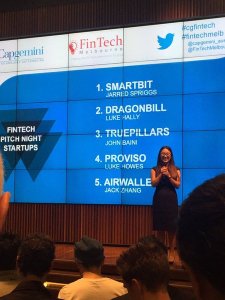
At the recent FinTech Melbourne Pitch Night, five local startups presented to a panel of distinguished judges in front of a packed audience at Melbourne Town Hall. Representing core fintech sectors (and the key messages from their pitches) were:

  • Fuzo – mobile payments platform: “2.5bn people don’t have a bank account”
  • CoinJar – a Bitcoin exchange: “targeting digital nomads”
  • StockLight – investment research: “24% of investors want help with analysis”
  • Moula – SME lending: “not a lender of last resort”
  • Timelio – cashflow finance: “factoring has missed the internet generation”

In what is traditionally a bank-dominated area of trade finance, Timelio is challenging the usual models for invoice discounting, while offering a new asset class for selected investors. I’ve featured Moula in this blog before, but this time around, I felt the presentation was quite low-key, and rather coy about the business model and the financials – maybe that’s because things are moving very quickly, and Moula is in the process of building significant traction via key commercial partnerships. The Fuzo pitch was quite complex (and probably too much technical information to present given the format), but the SIM card-based technology looks very interesting. StockLight‘s proposition is quite simple, and with access to quality content and a range of commercial models, could be one to watch as every financial institution is having to rethink wealth management and personal advice. However, on the night, CoinJar took out the first prize, and not for the first time, demonstrated how a simple concept can actually make the complex more straightforward: if nothing else, it proves that “Bitcoin can be done”.

Backlash

Some comments in the specialist trade publications have been quite scathing about FinTech, in particular those few startups that have embarked on public listings and IPOs. Much of this backlash relates to governance, disclosure and transparency; fair enough, they are important issues. But these criticisms should not be used to undermine the innovative technology, new business models and strategic partnerships that FinTech startups are bringing to the market.

Going mainstream

When otherwise conservative institutions such as industry superannuation funds start to embrace FinTech (e.g., Equip’s tie-up with Clover), or if the ASX decides to deploy blockchain technology to replace the CHESS clearing and settlement platform, it means that FinTech is definitely on the map, and can’t be written off or even ignored as some sort of irritating, disruptive upstart.

Next Steps?

In the wake of announcing the Victorian Government’s $60m LaunchVic startup initiative, the minister for small business, innovation and trade, Philip Dalidakis has been on a flurry of highly visible public speaking engagements, networking events and social media posts. Keen to get the message out there that his government intends to make Victoria a startup success, the minister is certainly generating considerable goodwill in the community.

I’m yet to understand fully the actual remit and stated goals of this new Quango. For example, what does “investing in core infrastructure” mean? Do we really need another bureaucratic body? Couldn’t the initiative have been better structured as a peak body to represent and support the private sector activities already underway?

If the minister is going to be true to his introductory remarks at the recent #hscodefest hackathon, the government needs to create the right environment for startups to flourish, not try to pick winners – leave that to the investors, entrepreneurs and industry experts. As an example, run a FinTech-themed hackathon to improve the Myki system…..

The Last Word…

Finally, for anyone needing an overview on crypto-currency and the future of money, I highly recommend Torsten Hoffmann‘s award-winning 2015 documentary, “Bitcoin: The End of Money as We Know It”, which received its Melbourne premiere last week at Collective Campus.

FOOTNOTE:

* I can’t claim any credit, but a few months after my Trade Finance blog, ICICI and Alibaba announced a new partnership – in part proving my theory that collaboration soon follows in the wake of disruption

Next week: Crate-digging in Japan

There’s an awful lot of coffee in Japan (but not much espresso…)

Living in Melbourne all these years, I have become spoilt when it comes to the choice and quality of coffee on offer in the numerous cafes and bars around the city. So when I go overseas, I can get withdrawal symptoms if I don’t get my morning doppio. And I don’t mean an over-priced and over-rated big brand product from a certain you-know-who-you-are multinational chain store. My recent experiences in Japan, which has the third largest coffee consumption by nation, revealed that espresso-style coffee is on the increase, but is competing with some entrenched coffee tastes.

Walter de Maria "Seen/Unseen Known/Unknown" (Photo: © Rory Manchee - all rights reserved)

Walter de Maria “Seen/Unseen Known/Unknown” (Photo: © Rory Manchee – all rights reserved)

On my recent trip to Japan, I not only found some excellent new espresso outlets, I also acquired a renewed respect for siphon and filter coffee, which are both great when they are done well. As anyone who has been to Japan will know, coffee (both hot and cold) frequently comes in a can, either from a vending machine or a convenience store. In cafes, the coffee is usually brewed, and however good the coffee beans, this style just doesn’t do it for me. Rarely have I seen a cafetière (“plunger”) or percolator in use, although iced drip coffee is something of a delicacy.

From three weeks of travel, here are some of the highlights:

In Tokyo’s Ginza district, there is the Renoir Coffee Room which has a certain appeal, if you like authentic retro (i.e., it’s probably the same decor since the 1970’s, without a hint of irony or post modernism). Certainly a favourite with an older clientele, presenting a genteel atmosphere (somewhat undermined by the popular smoking section) and a reminder of a slower, gentler time. In the absence of espresso, I had a standard filter or pour over coffee, and despite being a little on the weak side, it had just enough of a roasted flavour to compensate. Rating: 6/10

Over in hipsterish Ebisu, I was expecting to find loads of local coffee shops, packed with neo-beatniks, retro-hippies and proto-punks, and the constant hiss of espresso machines. Not to be – maybe it was too early in the afternoon, but there were few options. Marugo Deli is more of a juice bar and organic cafe, that also happens to serve espresso. It was a friendly place, nice atmosphere, but the coffee was nothing special. Rating: 6/10

Down in Himeji, after a challenging climb to the top of the castle on a hot day teeming with hundreds of other visitors, it was a welcome relief to escape into the cool, calm comfort of Hamamoto Coffee. Again, they don’t serve espresso, but they specialise in siphon coffee (something I probably haven’t had since I used to visit the former Martinos Coffee Lounge in Hong Kong’s Causeway Bay in the 1990s). Sitting at the counter meant that I got to see the whole process close up, as the bar tender kept several siphons going at the same time. It’s as much an art as working a good espresso machine, and makes for interesting entertainment. The coffee itself was bold, yet mellow at the same time – full-bodied but smooth with an almost zesty edge. HIghly recommended. Rating: 8.5/10

Wandering around Kyoto‘s hipster quarter close to Nijo Castle, I came across Cafe Bibliotic Hello! (quirky name, quirky building!!!) where it’s easy to while away the time browsing through the library of art books and sampling the excellent baked goods from the adjoining store. The espresso was a welcome bonus, and was the best I’d had up until then on this trip. Rating: 8.5/10

Outside Kyoto, in Saga-Arashiyama (near the bamboo forest), % Arabica has recently opened its second Kyoto coffee shop. Overlooking the river, this tiny cafe is really only a takeaway stand, but everything has been designed for maximum aesthetic effect. There’s clearly a personal statement being made here, almost verging on the pretentious/precious, but not surprisingly it is very popular with the passing visitors. And the coffee is also pretty good – full-roasted, robust, just enough acidity, and an excellent crema. Rating: 9.5/10

Back in Tokyo, nearing the end of my trip, I spent a day walking around the district of Kiyosumi-Shirakawa, visiting the numerous galleries, second-hand bookshops and the Kiyosumi Gardens. In 2014, the New Zealand-based Allpress Espresso roastery and cafe group opened a branch here, in a former timber warehouse. It’s an interesting space, and is bringing some serious competition to a rival coffee roaster nearby (which only serves filter coffee to its customers). However, not all the locals seem to have taken to espresso – after having the coffee menu explained to them, a number walked out without trying, looking somewhat confused. But for me, having an Antipodean barista was obviously a plus. Rating: 9/10

Finally, I tried a couple of other espresso bars on my stay in Shimo-Kitazawa, one of which was not much more than an espresso stand, offering good coffee (Rating: 7.5/10), but the service was very slow. I can’t remember the name, and I can’t find a website for it, but it was close to the west entrance to the railway station. This trendy neighbourhood has a number of well-regarded coffee shops, but sadly, I did not have enough time to visit many of them. Next trip, perhaps.

Next week: More #FinTech stuff

The convergence of #MedTech – monitoring, diagnostics, remediation

Earlier this year, I participated in MedTech’s Got Talent, a competition for medical technology and biotech startups, organised by STC. Now, HCF in partnership with Slingshot have announced a similar accelerator program, called Catalyst. Launched at a recent meetup event hosted by Startup Victoria*, Catalyst is the latest industry initiative to lend support to the growing #MedTech sector. It’s fair to say that the sector is not without its challenges (regulatory compliance and IP protection being foremost), but there is substantial investor interest given the potential for growth and widespread application of the resulting technologies. I also see that there is increasing convergence in respect to some of the digital products being brought to the market – through the use of wearables, mobile apps and analytics to deliver monitoring, diagnostic and remedial solutions.

Screen Shot 2015-11-22 at 8.10.47 PMAt the Catalyst launch, three #MedTech founders discussed their startup experiences and offered some insights to budding applicants. Jarrel Seah (Eyenemia), Phil Goebel (Quanticare) and Leonore Ryan (Cardihab – Cardiac Rehab Solutions) covered the product development process, being part of an accelerator program, and the specific challenges of medical technology.

There was  broad agreement that Australia (and Victoria in particular) has a strong and successful history of #MedTech development and innovation. There was also a sense that the future funding of telehealth services will be key to the sector’s development, especially the shift from “fee for service/solution” to “fee for value” models.

Aside from the regulatory and IP challenges, two of the biggest hurdles for #MedTech are the customer complexity, and procurement models, which can be summarised as follows:

Who Pays? Is it the clinician, patient or carer? Who, in effect, is the customer?

How Do They Pay? Each State has its own procurement and hospital funding models, plus there is the interplay of private health insurance and providers.

During the product development process, the founders stressed the need to manage expectations for an MVP, the use of customer discovery interviews, and the importance of making clinicians part of the solution. There is also a problem with data gaps (e.g., hospital re-admissions), and the requirement to establish patient trust: while the software, data and apps can support more meaningful consultation, there still has to be some human component to foster behaviour change. There was also a comment about marketing for tomorrow’s market, not the current state.

Having each been through some form of accelerator program, there was common agreement on the benefits:

  • Access to networks of mentors and strategic advisers
  • Help with navigating the regulatory landscape
  • Options for one-off funding to help convert trials to customers
  • Ability to focus on the project, along with peer stimulation, and a sense of urgency

Each of the three startups mentioned here deploy some combination of smart phone technology, sensors and analytics – just as Dr.Brand does, which featured at the recent Future Assembly. The notion was reinforced most recently at Swinburne University’s Design Factory Gala NIght which showcased, among others, innovative #MedTech student projects that utilise a mix of digital display/visualisation, wearable devices, mobile apps and analytics to address three key cognitive-related issues: patient falls in hospitals, dementia, and Asperger syndrome.

Previously, I have described health as one of the three pillars of the digital economy. Furthermore, the future of #MedTech (as distinct to biotech) is going to be built on the combined deployment and integration of smart sensors, personal devices, artificial intelligence and machine learning to monitor, diagnose and remediate behaviour – not necessarily to cure the patient, but to overcome physiological challenges and age-related conditions.


*Apologies – normally I acknowledge the Startup Victoria event sponsors – but since the team have been doing such a great job in securing new supporters, there are so many to mention!

Next week: There’s an awful lot of coffee in Japan (but not much espresso….)